
30 virtual team building activities for remote teams
30 virtual team building activities for enterprise remote and hybrid teams — organized by format, time commitment, and whether they work across time zones.

TL;DR
- Remote employees are 55% more likely to feel disconnected from their team than in-office employees — and disconnected employees are 4.5x more likely to leave within 12 months. (Gallup, 2023)
- Most virtual team building fails for one reason: it is scheduled as an event, not built into how the team works. One-off Zoom quizzes do not build the psychological safety that drives retention and collaboration.
- Enterprise teams need a mix of quick-connection formats (under 15 minutes, zero prep), structured social activities (45-60 minutes, monthly), and async-friendly options that work across time zones — not a single type repeated indefinitely.
- 74% of remote workers say they miss out on team camaraderie more than any other aspect of office culture. (Buffer State of Remote Work, 2023)
- The activities that work best at enterprise scale are low-friction, inclusive (no specialized equipment or skills required), and optional-in-name-but-culturally-expected — coerced participation produces worse outcomes than genuine voluntary engagement.
- For teams spanning multiple time zones, async-first activities (shared playlists, photo challenges, collaborative documents) consistently outperform synchronous events in participation rate and sustained engagement.
- This guide covers 30 virtual team building activities organized by format and time commitment, a cadence framework for enterprise teams, and a measurement approach for people ops leaders who need to justify the investment.
Your remote team is in 11 countries, spread across 6 time zones, and the last three “team building” sessions had 40% attendance, two complaints about mandatory fun, and a Slack message from a senior engineer asking if they could skip future ones. This is the enterprise virtual team building problem — not a lack of options, but a lack of structure that actually fits how distributed teams work.
This guide covers 30 activities organized by what they cost, how long they take, and whether they work across time zones — plus a cadence and measurement framework for people ops teams that need to make a case for the investment.
 ChatGPT
 Gemini
 Claude
 Grok
Grok Perplexity
Why most virtual team building fails
The most common failure mode is treating team building as an event rather than a system. A company schedules a virtual happy hour, attendance is uneven, senior leaders drop off early, and the conversation never moves past surface-level small talk. The team comes away having spent an hour but built nothing. The next quarter, someone suggests a virtual escape room and the cycle repeats.
Three structural problems drive this:
Forced synchronicity
Scheduling one-hour Zoom events for a team spread across London, Chicago, and Singapore means someone is always joining at 6am or 11pm. Mandatory events at inconvenient hours signal to employees that their time is not respected — the opposite of what team building is supposed to achieve.
No variety in format
Teams that rotate through the same three activity types (quiz, happy hour, game session) see participation drop 30-40% by the third cycle. (HBR, 2021) The format matters as much as the activity.
Participation is coerced, not earned
Making activities mandatory without making them worth attending produces attendance without engagement. The goal is activities that people want to join — which requires both good design and genuine optionality.
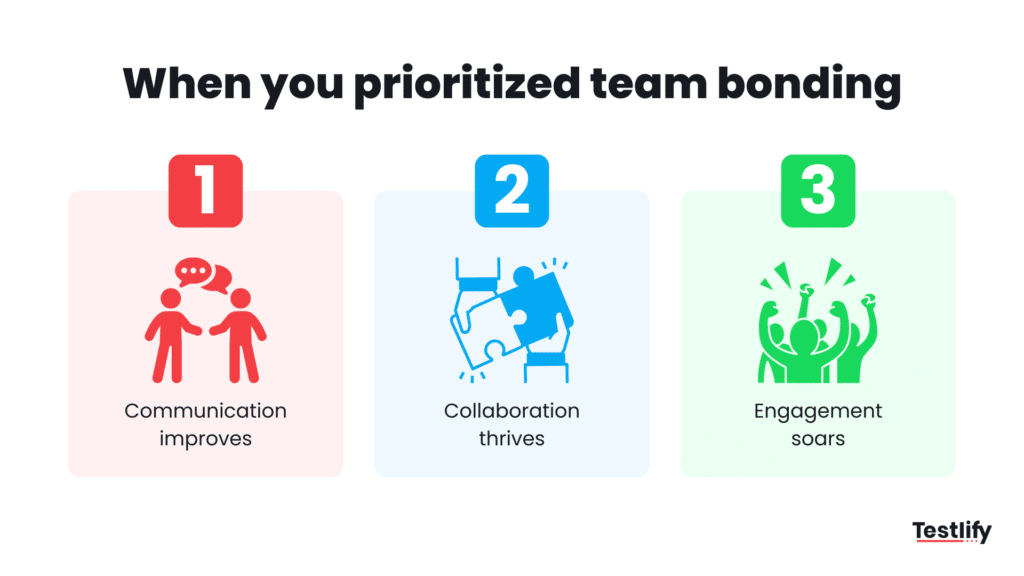
The fix is not finding a better activity — it is building a system with the right mix of formats, frequencies, and optionality levels. The 30 activities below are organized to make that system easy to build.

30 virtual team building activities for enterprise remote teams
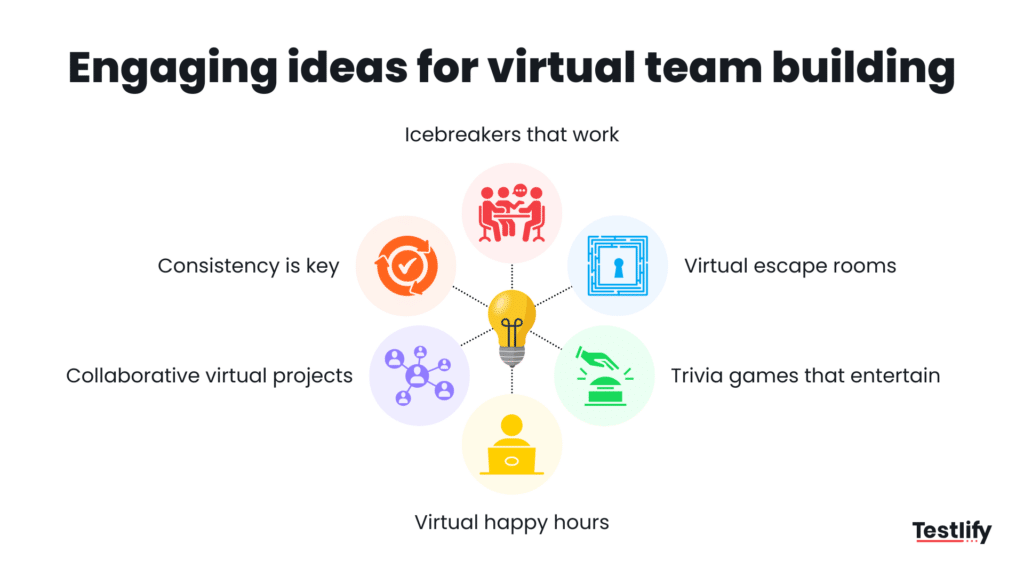
Quick connections (under 15 minutes, zero prep)
These activities require no calendar block, no facilitator, and no planning. They work inside existing meetings or as standalone micro-moments. Use them at high frequency — daily or weekly — to build the ambient connection that longer events cannot replicate.
1. Coffee roulette
A Slack bot (Donut, CoffeePals) randomly pairs two team members for a 15-minute informal chat each week. No agenda, no notes required. Works across time zones because pairs schedule their own time. Participation rates are consistently higher than facilitated events because the commitment is small and the conversation is genuinely unscripted.
2. Daily async check-in prompt
Post one non-work question in a team Slack channel each morning: “What’s one thing you’re looking forward to this week?” or “What’s on your desk right now?” Async format means everyone participates on their own schedule. Builds team personality over weeks, not hours.
3. End-of-week wins thread
A recurring Friday post where team members share one professional win from the week — however small. Normalizes recognition across hierarchy, surfaces contributions that managers often miss, and ends the week on a positive note without requiring synchronous attendance.
4. Meeting warm-up question
The first two minutes of every team meeting go to one lightweight question: “What’s one word that describes your energy right now?” or “What did you eat for breakfast?” Low stakes, fast, and signals that the meeting values the people in it, not just the agenda items.
5. Virtual background challenge
Weekly theme for meeting backgrounds (your favorite vacation spot, a movie scene, your childhood bedroom). Zero prep, no cost, surfaces personality in a format that already exists. Works particularly well for larger teams where individuals otherwise blend into the grid.
6. Team playlist
A shared Spotify playlist where everyone adds songs. No theme, no rules. Review it together once a month — the playlist tells you more about your team’s collective personality than most icebreakers. For distributed teams, this is one of the few genuinely async activities that generates conversation naturally.
7. Emoji status check-in
At the start of a meeting, everyone drops one emoji in chat to represent their current state. No explanation required unless they want to share. Gives the meeting facilitator real-time read on room energy without forcing disclosure.
Structured social (45-60 minutes, monthly)
These activities require scheduling and light facilitation. Run them monthly or quarterly. The key is keeping them genuinely optional — culturally expected, not mandatory. When the activity is good, people show up without being told to.
8. Online trivia
Kahoot or Mentimeter, 20-25 questions, 45 minutes. Include a mix of general knowledge, pop culture, and team-specific questions (“What city did [colleague] grow up in?”). Team-specific questions are the highest-engagement format — they create genuine curiosity about coworkers. Cap at 20 participants per session for quality of interaction; run multiple sessions for larger teams.
9. Virtual escape room
Third-party platforms (Escape Team, TeamOut, Wildly Different) provide pre-built scenarios. 60 minutes, teams of 4-8. Effective for cross-functional groups because it surfaces problem-solving styles in a low-stakes environment. High production-value sessions cost $20-40 per person; self-facilitated versions are free. The format works well for engineering and ops teams who find purely social events low-value.
10. Remote cooking or coffee session
Everyone makes the same recipe together on video. A facilitator walks through the steps; participants follow along from their own kitchens. Works well across cultures when the recipe is chosen for accessibility (no specialized equipment or unusual ingredients). Cooking together is one of the highest-rated team building formats in post-event surveys — the physical activity gives people something to do with their hands, which reduces the awkwardness of Zoom social events.
11. Show and tell
Each participant brings one object from their home — something meaningful, something they made, something they are working on. 2 minutes per person, no slides. Creates genuine curiosity about coworkers without requiring performance. Scales to 30 participants comfortably if each segment is strictly timed.
12. Virtual happy hour with a structured agenda
Unstructured Zoom social events fail. Structured ones work. A 45-minute happy hour with a clear agenda: 10 minutes trivia, 15 minutes small-group breakout conversations with a prompt, 10 minutes full-group share-out, 10 minutes open. The structure gives introverts something to engage with and prevents the event from stalling into silence.
13. Team book club
One business-adjacent book per quarter. 60-minute discussion, optional attendance. The goal is not to finish the book — it is to create a shared language and frame of reference. Works well for leadership teams and cross-functional groups. Async prep (shared notes document) means the discussion is higher quality even if not everyone read the whole book.
14. Skill swap session
One team member teaches a non-work skill for 20 minutes: sourdough baking, origami, basic photography composition, home brewing. No professional context, no career relevance required. These sessions consistently produce the highest post-event sentiment scores because they reveal dimensions of coworkers that professional interactions never surface.
15. Lunch-and-learn (rotating presenter)
A team member presents something they are an expert in — work or non-work — for 20-30 minutes. Rotating presenter keeps the format fresh. Works well for large teams because it surfaces internal expertise and creates informal mentorship opportunities. Low cost, high engagement when the topic selection is genuinely diverse.
Collaborative challenges (skills-based, high engagement)
These activities produce the highest engagement among high-performers and engineers because they involve real problem-solving. Schedule quarterly or semi-annually. They require more planning but produce stronger team memory than social events.
16. Internal hackathon
Cross-functional teams of 4-6 tackle a real company problem in 4 hours. No requirement to ship — the goal is to surface ideas and create cross-department relationships. The best implementations use real problem statements from leadership (“How would you reduce our onboarding drop-off rate?”) rather than hypothetical prompts. Post-hackathon, winning ideas get presented to leadership — closing the loop signals that the event was substantive, not performative.
17. Photo challenge
Weekly theme posted in Slack: “something green,” “your commute,” “a texture you find interesting.” Members post photos asynchronously throughout the week. Friday, the team votes on a favorite. Async format means global participation is natural; the creative constraint produces surprising conversations about context and perspective.
18. Virtual scavenger hunt
Participants find and photograph household items matching clues. Can be run synchronously (live, 30 minutes) or asynchronously over 48 hours. The async format works better for distributed teams — time pressure in a synchronous format disadvantages people with family or household constraints.
19. Data storytelling challenge
Teams are given the same dataset and 45 minutes to produce a two-slide story about what it means. Works especially well for analytics, product, and marketing teams. The debrief — where teams share their stories — reliably produces both laughs and genuine insight about how different people interpret the same information.
20. “Teach me something in 5 minutes” format
Each session, two volunteers each have exactly 5 minutes to teach the group something — any topic. Timer is enforced. The time constraint forces clarity and creates entertainment when presenters realize 5 minutes is much shorter than expected. Runs inside existing meeting time (10 minutes total) or as a standalone event.
Async-friendly activities (time-zone-safe)
For enterprise teams spanning more than two time zones, synchronous events will always exclude someone. These activities are designed to run without a live meeting — participation happens on each person’s own schedule and outputs are shared in a central channel.
21. 36 Questions thread
Based on the psychological research on accelerating closeness (Aron et al., 1997), post one question from the set in the team channel each week. Members answer asynchronously — or don’t. No pressure, no tracking. The questions are structured to move from light to meaningful over time, which mirrors the natural arc of relationship-building.
22. Collaborative team map
A shared Figma or Miro board where each team member adds their location, one fact about where they live, and one local recommendation. Updated asynchronously over one week. The finished map gives the team a visual sense of where everyone actually is — something that gets lost in distributed work. Pin it in Slack or Confluence as a persistent artifact.
23. “Currently reading / watching / listening” thread
Monthly thread where everyone shares one thing they are into right now — no work requirement. The thread generates more organic cross-team conversation than most facilitated events. Cultural taste is a genuine entry point for human connection, and the async format removes the performance pressure of real-time sharing.
24. Peer recognition wall
A dedicated Slack channel or tool (Bonusly, HeyTaco) where anyone can publicly recognize a colleague. No formal process — just a social norm that recognition should be public and specific (“Zara stayed on a call until midnight to unblock our Singapore launch — that mattered”). Recognition walls are the highest-ROI team building investment at enterprise scale because they distribute the work of culture-building across the team rather than concentrating it in HR.
25. Team “year in review” document
At year end, a shared document where each team member adds: one project they are proud of, one thing they learned, one thing they want to do differently. Compiled and shared with the full team. The document becomes an artifact of the team’s collective year — something that formal performance reviews rarely capture. Reference it in new hire onboarding to accelerate belonging.
Pro Tip: Start with coffee roulette before scheduling any structured event. The free Donut Slack integration runs automatically after a 10-minute setup — no ongoing HR time required. Teams that run coffee roulette for 6-8 weeks before their first structured event consistently report higher attendance at that event, because baseline familiarity is already in place.
Recognition and milestone activities
26. Virtual anniversary celebration
On each team member’s work anniversary, the team lead records a 60-second video with three specific things that person has contributed. Shared in Slack before the person’s usual start time. The specificity is what makes it land — generic “thanks for all you do” messages read as performative. Specific contributions signal genuine attention.
27. Quarterly virtual awards
Team-nominated, peer-voted awards with categories that reflect actual team values (“Most likely to have the answer,” “Best async communicator,” “Bravest feedback-giver”). Keep it light, skip trophies, announce in a 15-minute all-hands segment. The categories you choose signal what the team actually values — use that intentionally.
28. New hire welcome ritual
On each new hire’s first week, the team posts one question in Slack that the new hire answers publicly: “What is one thing people would be surprised to know about you?” The team responds with their own answers to the same question. Immediately breaks the isolation of remote onboarding and creates a two-way introduction rather than a one-way presentation.
29. Team retrospective with wins section
Monthly retros that start with a dedicated “wins” section — 10 minutes where the team surfaces things that went well before moving to improvements. Most retros skip wins entirely and go straight to problems. The wins section calibrates the team’s attention and prevents the meeting from feeling purely corrective.
30. Culture survey with public results share
A quarterly 5-question pulse survey on connection, inclusion, and collaboration. Share the results with the full team, not just leadership. Teams that see their own data are significantly more likely to take action and more likely to trust that the survey actually influences decisions. Transparency about the results is the activity — the survey alone is not team building.
How often should remote teams do virtual team building?
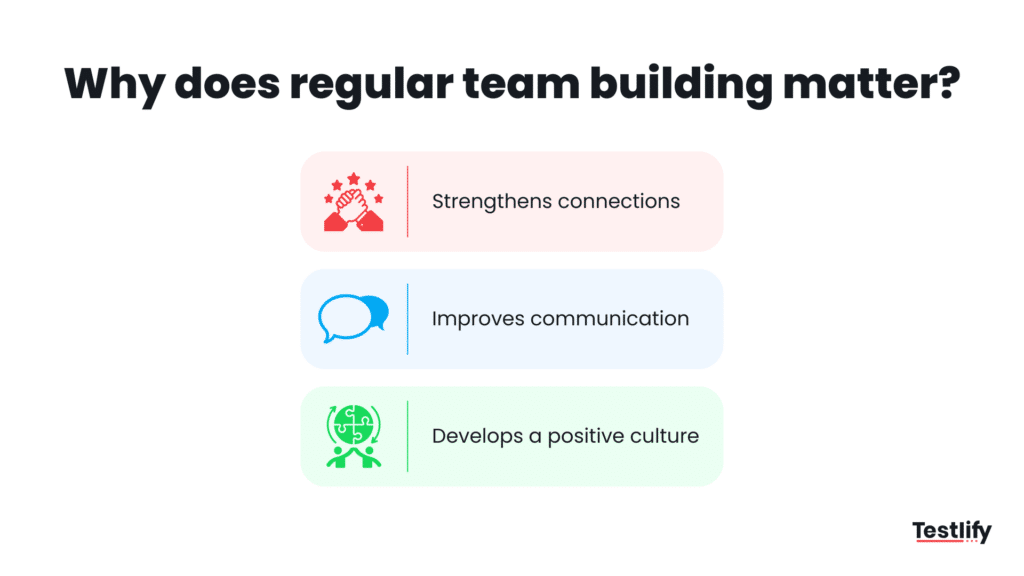
The answer depends on team size, time zone distribution, and the mix of formats you are using. A common mistake is treating frequency as a single dial — one team building event per month — when the real framework has three layers running simultaneously.
Format | Frequency | Time commitment | Primary purpose |
|---|---|---|---|
Quick connections (coffee roulette, async prompts, warm-ups) | Daily or weekly | 5-15 minutes | Ambient connection — builds baseline familiarity over time |
Structured social (trivia, happy hour, skill swap) | Monthly | 45-60 minutes | Shared experience — creates team memory and reference points |
Collaborative challenges (hackathon, scavenger hunt) | Quarterly | 2-4 hours | Deep connection — surfaces skills and problem-solving styles |
Teams that run only monthly structured events without the daily/weekly ambient layer report significantly lower connection scores than teams that run a mix. The monthly event gets 60% of the budget and attention; the daily layer gets most of the relationship-building work done. (Gallup, 2022)
For global teams: run quick-connection formats asynchronously at high frequency, structured social events at the overlap hours that work for your largest time zone clusters, and async-friendly activities year-round as a parallel track. No single event format will ever fully work for a team with 12 hours of time zone spread — the system has to compensate.
Once the cadence is in place, the question becomes how to tell whether any of it is actually working — which is where people ops leaders often get stuck.
How to measure whether virtual team building is working
Most team building goes unmeasured because the connection between a trivia event and a business outcome is hard to draw directly. But three metrics are reliably correlated with effective team building programs at enterprise scale and can be tracked without a major research investment.
eNPS (employee net promoter score) trend
Run a quarterly pulse survey with one question: “On a scale of 0-10, how likely are you to recommend this team as a great place to work?” Track the trend over 4-6 quarters, not the absolute score. A rising trend over two consecutive quarters after implementing a new team building cadence is a defensible correlation. It is not proof of causation, but it is the kind of directional signal that justifies continued investment.
Participation rate by format
Track attendance at structured events and engagement rate on async activities (reactions, replies, posts). Low participation on a specific format is signal — it means the format does not fit this team’s work style or time zone distribution, not that team building itself is failing. Replace underperforming formats before cutting the program.
Manager-reported collaboration quality
A quarterly 3-question survey to team managers: “How effectively did your team resolve ambiguous situations this quarter?”, “How often did team members proactively share information across functions?”, “How would you rate psychological safety in your team?” These are leading indicators of quality of hire and retention — and they move faster than turnover metrics.
For enterprise teams, the business case for virtual team building runs through job satisfaction and retention. Replacing a mid-level remote employee costs 50-200% of annual salary when recruiting, onboarding, and productivity loss are counted. A team building program that improves 12-month retention by even 5% produces a return that is straightforward to quantify. Build that ROI model before presenting to leadership — it converts “team building” from a cost line to a retention investment.
Key Takeaway: The activities that produce the highest sustained engagement are not the most elaborate — they are the most consistent. A daily async prompt and weekly coffee roulette running for six months will do more for team connection than four annual virtual events, because connection compounds through repetition, not intensity.
What is virtual team building?
Virtual team building refers to structured activities and practices designed to build connection, trust, and collaboration among remote or hybrid team members who do not share a physical workspace. It covers a range from quick async activities (shared playlists, daily prompts) to structured synchronous events (escape rooms, trivia, hackathons) to ongoing recognition systems (peer kudos walls, milestone celebrations).
Run quick-connection activities (coffee roulette, async prompts, meeting warm-ups) daily or weekly. Run structured social events (trivia, happy hour, skill swap) monthly. Run collaborative challenges (hackathon, scavenger hunt) quarterly. Teams that rely on monthly structured events alone — without the ambient daily layer — report significantly lower connection scores than teams running a mixed cadence.
What are the best free virtual team building activities?
The highest-ROI free activities are: coffee roulette (using the free Donut Slack integration), async daily prompts (no tool required), peer recognition Slack channels, photo challenges, collaborative team maps in Miro or Figma’s free tier, and the 36 Questions thread format. None of these require budget — they require consistency and a team lead willing to model participation.
How do you make virtual team building not feel forced?
Three rules: keep it optional (cultural expectation, not mandatory), keep the commitment low (15 minutes is better than 60 for recurring formats), and rotate formats so the same people are not always disadvantaged by time zone or introversion. The activities that feel most natural are ones that map to something the team already does — sharing recommendations, recognizing each other, discussing what they are working on — just with more structure and visibility.
What virtual team building activities work for large teams (100+ employees)?
For teams over 100, async-first activities scale better than synchronous events. Coffee roulette, peer recognition walls, async prompts, photo challenges, and collaborative maps all work at any size. For synchronous events, run multiple smaller sessions (15-20 people) rather than one large all-hands — connection quality drops sharply above 25 participants in a video call. Hackathons work well at enterprise scale when organized into cross-functional pods of 5-7.
How do you measure the impact of virtual team building?
Track three metrics: eNPS trend (quarterly pulse survey, watch the direction not the absolute score), participation rate by format (low participation signals a format problem, not a team building problem), and manager-reported collaboration quality (quarterly 3-question survey on psychological safety, cross-functional information sharing, and ambiguity resolution). Connect retention improvement to replacement cost to build the ROI case for leadership.
What are good virtual team building activities for hybrid teams?
The biggest risk in hybrid team building is designing events that favor the in-office group and leave remote participants as observers. Choose activities where remote participation is not a downgrade: async formats (recognition walls, photo challenges, collaborative docs) are inherently hybrid-safe. For synchronous events, require everyone to join from their own device even if some are in the same office — it equalizes the experience and prevents remote participants from being an afterthought in the room.

B2B SaaS Content Writer
Rishav Kumar is a B2B SaaS content writer with 4 years of experience. He loves crafting engaging content. Always exploring fresh ideas, he's passionate about helping businesses grow through impactful writing.
LinkedInRelated resources
View all
HR & recruitment
What is a job requisition & position: A guide for hiring managers
HR & recruitment
Top HR programs every organization should have
HR & recruitment
Gamified assessments: types, examples and benefits
HR & recruitment
HR KPIs: What are they? Examples & formulas
HR & recruitment
A complete guide to human proctoring vs AI proctoring

HR & recruitment
14 HR industry trends to look at in 2026
Get started.
Hire on proof, not resumes.
Run your first skills-based assessment free — no credit card required.