
5 best team assessment tools for performance management and continuous improvement
Discover the best team assessment tools for performance management and continuous improvement to boost productivity, engagement, and results.
Poor communication quietly drains performance. A 2023 Axios HQ study found the average employee loses thirty-five workdays each year, clarifying muddled messages—more than $10,000 in salary value per person. That lost month is why many leaders now trade annual reviews for data-driven, always-on feedback, and why team-assessment tools have become essential. In the pages ahead, we’ll break down five platforms that deliver clearer insights, faster wins, and a stronger foundation for continuous improvement—so you can start reclaiming those lost days.
 ChatGPT
 Gemini
 Claude
 Grok
Grok Perplexity
How we chose the five stand-outs
We began with a long list of more than twenty popular assessments, pulse platforms, and personality frameworks. Then we asked a single question: which ones help a busy manager improve teamwork this quarter, not next year? That filter alone cut the field in half.
From there, each candidate had to clear five hurdles:
- Proven science
- Immediately actionable reports
- Support for repeat use and visible progress
- Fast set-up and results inside one sprint
- Transparent, reasonable pricing
If a tool stumbled on even one, it left the list.
Finally, we scored the survivors on a 100-point rubric weighted toward research validity and speed to value. Only five earned a spot. In the next sections, we’ll explain what makes each pick special and when to reach for it.

A quick glance at the contenders
Before we explore the nuances, a single view helps. The table below shows what each tool does best, where you need to tread carefully, and how pricing works. Keep it handy; you’ll refer back as we explain each platform in detail.
Tool | Primary focus | Stand-out benefit | Caution | Pricing model |
|---|---|---|---|---|
TeamDynamics | Team habits & culture | Real-time dashboard with AI coaching nudges | Newer brand, needs team buy-in to use weekly | Per-user SaaS, custom quote |
High 5 | Team strengths | Strengths-based team collaboration and | Focuses on strengths rather than personality type | Free basic test, paid team, and coaching features |
CliftonStrengths | Individual talent mapping | Decades of Gallup research; boosts engagement scores | Skips weaknesses, one-time test only | $19.99–$59.99 per person |
Everything DiSC | Communication style | Simple four-type language that defuses conflict quickly | Can feel reductive for complex personalities | about $64 per person |
Culture Amp | Engagement & 360 feedback | Deep benchmarks and pulse analytics | Premium price, needs an admin owner | Annual subscription by employee count |
Working Genius | Workflow energy & roles | A ten-minute quiz immediately improves task alignment | Newer model, limited validation studies | about $25 per person |
TeamDynamics – your live team coach
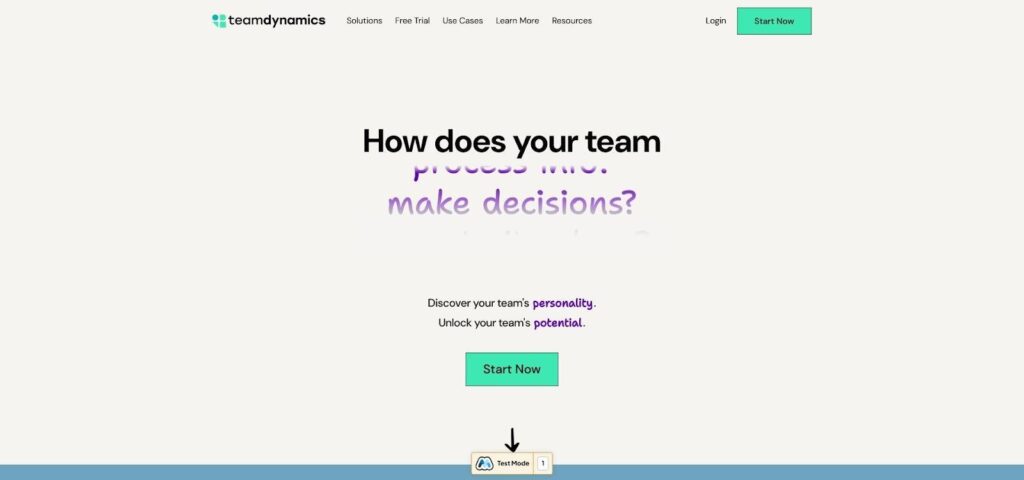
Think of TeamDynamics as an X-ray for collaboration. The platform combines a 10-minute survey with Slack and email metadata to map how information flows, where decisions stall, and who’s sidelined in the conversation.
Results arrive quickly, usually within forty-eight hours, inside a clear dashboard. Green zones flag healthy habits. Red zones highlight bottlenecks such as uneven airtime or slow response loops. You don’t just get a score; you see the specific moments that slow the team.
The software lives in the tools you already use. An AI “nudge bot” posts gentle prompts in Slack, suggesting actions such as rotating meeting roles or running a quick round-robin before decisions. Early adopters cut unresolved Slack threads by twenty-two percent in eight weeks, according to a 2024 DataDab review.
When to reach for it.
Choose TeamDynamics if your team works remotely or hybrid, relies on chat, and wants visible progress within a single sprint. It fits product squads aiming for tighter ship cycles or agencies balancing several clients.
Money talks.
Licensing follows a per-user SaaS model quoted to match team size. A starter pilot covers one squad without locking you into a long contract, so the risk stays low while insight lands high.
Continuous-improvement angle.
Because the integration keeps listening, you can rerun the pulse each quarter and watch red zones turn yellow, then green. Over time, the dashboard becomes a living record of how your culture matures, with no extra spreadsheets.
HIGH5 Test for Team
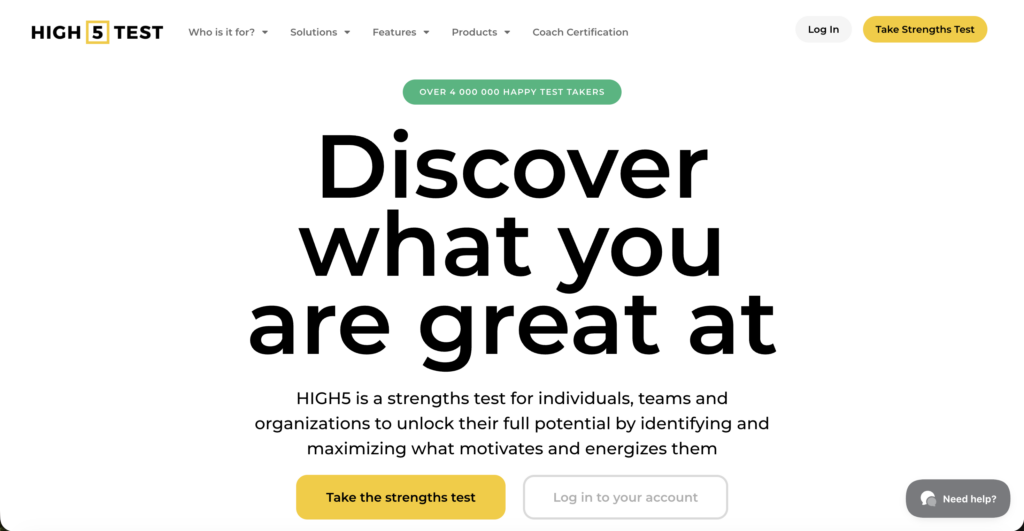
Think of HIGH5 test for team as a practical way to uncover what people naturally do best at work and turn those strengths into a coordinated team advantage. The assessment identifies each person’s top five strengths from a research-backed list of 20, highlighting how individuals contribute energy, problem-solving, and collaboration to the group.
The test takes about fifteen minutes, and results appear immediately in an easy-to-read report. Instead of abstract personality labels, the language focuses on real workplace behaviors such as Strategist, Catalyst, Coach, or Deliverer. That clarity makes it easy for teammates to recognize where they thrive and how they complement one another.
For managers, the real value comes when strengths are mapped across the team. Patterns quickly emerge. You might discover a cluster of creative ideators but fewer execution-oriented strengths, or a team rich in relationship builders but short on strategic thinkers. With that insight, leaders can adjust roles, pair complementary teammates, and build project groups that naturally perform better together.
HIGH5 also works well as a repeatable development tool. Teams often revisit their strengths during retrospectives, onboarding, or leadership development sessions. When people consistently work in areas that align with their natural talents, engagement rises and collaboration becomes easier because everyone understands how each teammate contributes to the bigger picture. When to reach for it.
HIGH5 fits teams that want a strengths-based approach to development without overwhelming complexity. It works particularly well for organizations focused on engagement, leadership growth, and building a positive team culture. Money talks.
The core HIGH5 test is free for individuals, which lowers the barrier for teams getting started. Organizations can unlock deeper team analytics, reports, and coaching tools through paid features designed for managers and HR teams. Because strong language becomes part of everyday conversations, the impact compounds over time. Teams can revisit their strengths when new members join, during project kickoffs, or in development reviews—turning the assessment into a long-term foundation for continuous improvement.
CliftonStrengths – lean into what lights people up
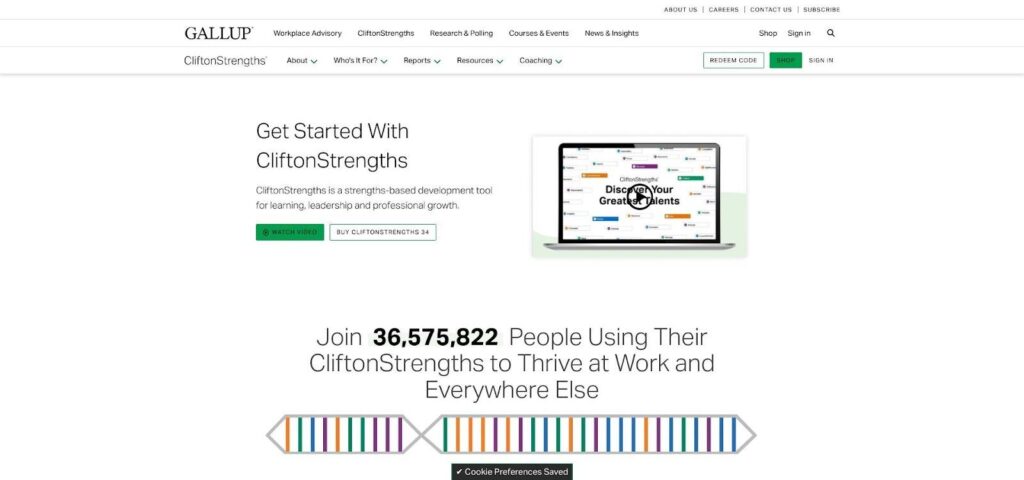
When teammates spend most of the day using their natural talents, work feels easier, and results climb. CliftonStrengths pinpoints those talents with a 30-minute assessment that ranks each person’s top themes from a library of 34. The language is upbeat and practical: think Achiever, Ideation, or Relator, so people instantly recognize themselves.
Gallup analyzed more than 1.2 million employees and found that teams discussing strengths every day record 12.5 percent higher productivity and nearly 9 percent better profitability (Gallup strengths-based culture research). That’s a serious lift for an assessment that costs less than a team lunch.
Implementation is simple. Send the code, block an hour for everyone to debrief their reports, then map strengths across the team. Gaps and overlaps jump off the page: maybe you’re rich in Strategic talent but light on Arranger skills. With that insight, you can shuffle responsibilities without adding headcount.
CliftonStrengths is a one-time test, yet it fuels continuous improvement when you keep the vocabulary alive. Add each person’s top five to Slack profiles, reference them during sprint retros, or pair mentors with complementary themes. Every mention reinforces the idea that great performance starts with playing to your edge.
Note: strengths don’t expose weaknesses, and the tool won’t show how the group interacts. For a full picture, pair it with a team-level diagnostic like TeamDynamics or a pulse survey. If engagement is sagging and morale needs a quick win, few interventions deliver such a strong boost for so little effort.
Everything DiSC – a common language for smoother conversations
Personality clashes rarely stem from malice. Most boil down to style: one teammate prefers blunt bullet points, another wants context and detail. Everything DiSC shines a bright light on those differences.
The assessment takes about ten minutes. Each person lands on a primary style (Dominance, Influence, Steadiness, or Conscientiousness) and receives a nuanced dot that shows intensity. The report converts the result into plain-English tips: how you prefer to give feedback, what stresses you out, and the email tone that grabs your attention.
Run a short workshop and watch tension drop. Suddenly, the terse project manager isn’t “rude”; she’s a high-D who values efficiency. The meticulous analyst isn’t “nit-picky”; he’s a high-C who finds comfort in data. Labels turn judgment into understanding.
DiSC keeps paying off when you weave it into daily routines. Add styles to video-call nameplates, open meetings with a quick nod to who needs a one-pager versus a headline, or pair high-I brainstormers with high-C editors so ideas get polished instead of parked. Over time, misfires fall and decision speed climbs.
Be aware that the four-type model simplifies complex people. Some teammates may feel boxed in, and a free quiz online won’t match the accuracy of the licensed version. Make it clear that the goal is empathy, not categorization, and the framework stays healthy.
If communication friction is your biggest blocker, DiSC offers a quick, low-cost fix. Because styles don’t change overnight, a single session can pay dividends for years with no recurring subscription required.
Culture Amp – pulse the mood, prove the impact
Good intentions stall without data. Culture Amp prevents that by translating fuzzy feelings into clear, quarter-over-quarter metrics.
You choose a template (engagement, team effectiveness, inclusion), adjust a few questions, and hit send. By lunch, heat maps reveal exactly where morale dips, where clarity slips, and which levers will drive progress fastest.
The real power lives in the benchmarks. Your team’s score on “I understand how my work drives company goals” isn’t just 74 percent; it sits eight points below peers of similar size. That context sharpens priorities and arms you with evidence when you ask leadership for resources.
Act, survey again, and watch the line chart climb. One client trimmed attrition by six points within a year after tackling low “growth” scores, easily covering the subscription fee.
Note the admin lift. Someone must own rollouts, reminders, and follow-up plans. Skip that stewardship, and Culture Amp becomes an elegant dashboard of ignored truths.
Working Genius – fuel projects with the right kind of energy
Every project runs through six phases: wonder, invention, discernment, galvanizing, enablement, and tenacity. Working Genius pinpoints which two phases each teammate loves and which two drain them. The quiz takes ten minutes; the insights last much longer.
Picture a launch that keeps stalling near the finish line. The team debrief shows no one has Tenacity genius, so closing tasks feel like a slog. Solution? Recruit a finisher from another squad or schedule focused “T-time” blocks so the work ships. One simple reallocation and the bottleneck disappears.
Because results connect directly to work stages, you can apply them the next day. Start brainstorming with your Wonder and Invention crew, ask Discernment voices to test the concept, let Galvanizers spark momentum, and hand the baton to the E-and-T duo to execute. The framework turns vague project roles into a reality everyone understands.
Costs stay friendly: about the price of a pizza per person, and there’s no subscription. Run the assessment whenever the lineup changes or a new initiative spins up. Over time you’ll build a roster that shows, at a glance, whether a project is starved for ideation, feedback, or finish-line grit.
Working Genius is younger than our other picks, so academic studies are still catching up. If your team wears multiple hats and deadlines slip because nobody enjoys the last stretch, this tool offers a quick course correction.
How to choose the right fit
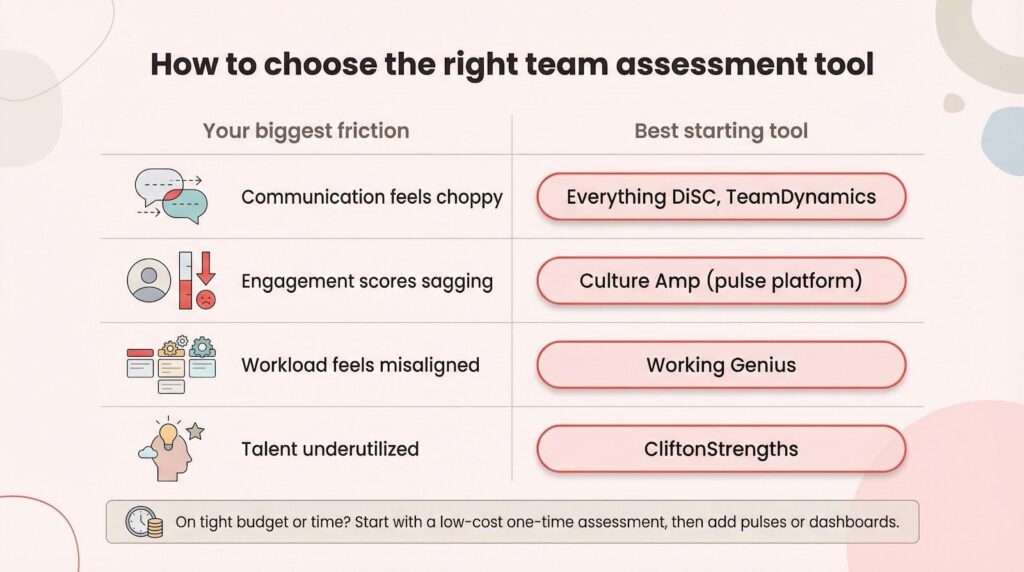
All five tools add value, but each addresses a different pain point. Start by identifying your team’s biggest friction, then match it to the remedy below.
- Communication feels choppy? Everything DiSC or TeamDynamics can highlight style clashes and channel overload.
- Engagement scores sagging? A pulse platform, such as Culture Amp, pinpoints where motivation leaks and tracks recovery.
- Workload feels misaligned? Working Genius reveals who loves ideation and who thrives on finishing work.
- Talent underutilized? CliftonStrengths surfaces hidden skills you can redeploy right away.
Budget and admin capacity matter too. If headcount is tight, begin with a low-cost one-time assessment, prove a fast result, then layer in pulses or dashboards as appetite grows. Whatever you choose, schedule the debrief before launch; the conversation, not the survey, sparks the progress.
Conclusion
Performance doesn’t stall because teams lack talent. It stalls when good intentions get lost in unclear signals, misaligned roles, or feedback that arrives too late to matter. The right team assessment tool fixes that, not by adding more process, but by making the invisible visible.
Whether you need sharper communication, higher engagement, better workflow balance, or faster course correction, the five tools in this guide all share one advantage: they translate data into action quickly. Some shine at diagnosing real-time habits, others at unlocking strengths or restoring energy to stuck projects. None are silver bullet, but each can move the needle when paired with an honest conversation and consistent follow-through.
The key is to start small. Pick the friction that hurts most right now, run a focused assessment, and act on one or two insights within the same sprint. Improvement compounds when teams see progress, not just reports. Reclaim a few lost days this quarter, and the bigger gains will follow.
Frequently asked questions (FAQs)

Wordpress Developer
Yash Patel is a Wordpress and SEO Specialist at Testlify with 3+ years of experience in technical SEO, on-page optimization, and content strategy. He works on improving Testlify's organic presence and produces content focused on hiring, talent assessment, and HR technology.
LinkedInRelated resources
View all
Skill assessment
What skills-based hiring data shows beyond the US and UK

HR & recruitment
AI across all stages of the hiring process in 2026

AI in recruitment
Best practices for hiring data analysts using assessments?
Candidate assessment
What tools support voice responses for language proficiency testing?
Candidate assessment
How do ATS-integrated assessments streamline hiring workflows?
Candidate assessment
How to assess financial modeling and accounting skills pre-hire?
Get started.
Hire on proof, not resumes.
Run your first skills-based assessment free — no credit card required.