
Enneagram type 4: The Individualist at work and in life
What drives an Enneagram type 4, how 4w3 and 4w5 differ, where Fours go under stress, and what they need from work to do their best.

Enneagram type 4, known as the Individualist, is the personality type driven by a need to find and express a true, personal identity. Fours feel things deeply, notice what is missing, and want their work and life to mean something. At their best they are honest, original and emotionally brave. Under pressure they can turn moody, envious or withdrawn.
The Enneagram maps nine personality types. If you are new to it, start with how to read an Enneagram chart and what the Enneagram test is and how to use it. This page stays on Type 4 only, with a close look at how Fours experience meaning, creativity and belonging at work.
TL;DR:
- Enneagram type 4 is the Individualist: a person whose core desire is to find a true identity and whose core fear is having no identity or significance.
- Envy is the Type 4 trap. Fours compare their inner life with other people's outer success and focus on what they lack.
- A 4w3 is more ambitious, visible and polished. A 4w5 is more private, analytical and absorbed in ideas.
- Under stress a Four moves toward Type 2 and clings or over-gives. In growth a Four moves toward Type 1 and becomes steady and disciplined.
- At work, a Four needs a clear "why", real creative ownership and feedback that judges the work, not the person.
- Fours often do their best work in design, writing, brand, research and people-facing roles where originality is the job.
- Never use Enneagram type as a pass or fail hiring screen. Pair it with job-relevant skills tests.
 ChatGPT
 Gemini
 Claude
 Grok
 Perplexity
What is an Enneagram type 4?
Enneagram type 4 is the Individualist, one of the three types in the feeling-based heart group of the Enneagram. A Four builds their sense of self around being different, authentic and emotionally true. Fours are self-aware, sensitive and creative, and they tend to feel that something essential is missing in them that other people seem to have.
The other common names for Type 4 are the Romantic and the Artist. All three point to the same pattern: a person who looks inward first and judges experiences by how real they feel.
Type 4 at a glance | What it means |
|---|---|
Name | The Individualist (also the Romantic) |
Core desire | To find themselves and their significance |
Core fear | Having no identity or personal significance |
Core emotion and trap | Longing, which can turn into envy and melancholy |
Wings | 4w3 (Type 3 wing) and 4w5 (Type 5 wing) |
Stress line | Toward Type 2 |
Growth line | Toward Type 1 |
At work, they bring | Originality, emotional honesty, taste, depth |
At work, watch for | Mood-driven output, withdrawal after criticism |

What does an Enneagram 4 want and fear most?
An Enneagram 4 wants a stable, authentic identity and fears being ordinary, empty or without significance. Most Type 4 behavior comes back to that pair. Fours ask "Who am I, really?" more often than most people, and they distrust any answer that feels borrowed from someone else.
That search shapes small daily choices. A Four may rewrite a standard team bio three times because the template "doesn't sound like me". The same Four may turn down a promotion into a role that feels generic, even when the pay is better.
Identity also explains why Fours notice gaps. When they look at a room, a product or their own career, the eye goes to what is missing. That focus is painful in private, and useful at work. The person who spots that a brand voice feels flat, or that a customer journey has no emotional peak, is often a Four.
Key takeaway: When a Four pushes back, ask what part of the work feels fake to them. The answer is usually specific and worth hearing.
Why are envy and emotional depth central to a Type 4?
Envy and emotional depth sit at the center of Type 4 because Fours measure themselves by what they feel and by what they lack. In Enneagram terms, envy is the Four's core passion: a sense that other people have an ease, a belonging or a gift that the Four is missing.
At work, envy rarely looks like jealousy in the open. A more common scene: a designer's concept loses to a colleague's in a review. The designer says "fine" in the meeting, then spends the evening replaying it, sure the other person "just gets it" in a way they never will. The next day the designer's work is either sharper or noticeably flat.
Emotional depth is the other side of the same coin. Fours can sit with grief, conflict and awkward truths that many people avoid. They are often the ones who say what everyone in a retro is thinking but nobody will name. The skill to develop is turning that depth into action, not getting lost in it.
How do a 4w3 and a 4w5 differ at work?
A 4w3 and a 4w5 share the Type 4 core, but the wing changes how a Four shows up. A 4w3, sometimes called the Aristocrat, borrows energy and image focus from Type 3. A 4w5, sometimes called the Bohemian, borrows privacy and analysis from Type 5. Both remain Fours first; the wing adds flavor, not a new type.
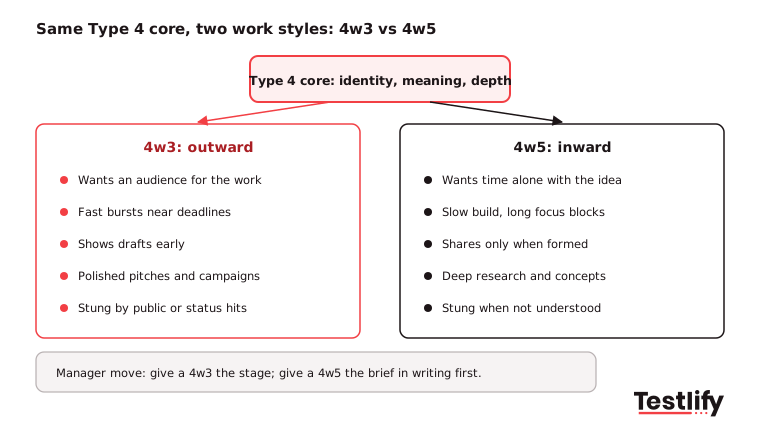
Pro tip: If you manage a 4w5, send the brief in writing a day before the kickoff meeting. If you manage a 4w3, give them the room to present their own work to senior people.
Where does an Enneagram type 4 go in stress and growth?
An Enneagram type 4 moves toward the average traits of Type 2 under stress and toward the healthy traits of Type 1 in growth. For a Four, stress means trading self-expression for approval. Growth means trading mood for steady, principled action. Each line is described here only for Type 4; the general theory of arrows sits in the chart guide linked above.
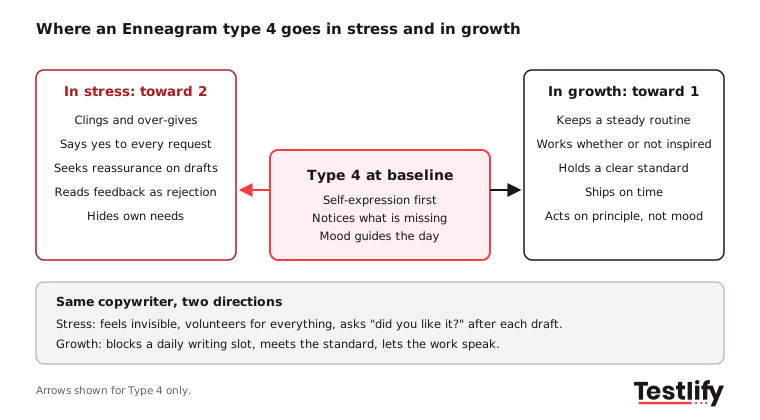
In stress (toward 2): A withdrawn Four suddenly becomes over-involved. Picture a copywriter who has felt invisible for weeks. Instead of saying so, they start volunteering for every request, checking whether people liked their drafts and taking feedback as a verdict on whether they are wanted.
In growth (toward 1): The same copywriter, when healthy, sets a daily writing slot and keeps it whether or not they feel inspired. They hold their work to a clear standard, ship on time and let the quality speak. Feeling stops being the gatekeeper for doing.
What makes work feel meaningful to an Enneagram Type 4?
Work feels meaningful to an Enneagram Type 4 when it lets them express something true, when they can see who the work helps, and when their part in it is recognizably theirs. A Four can work hard on almost anything once those three are in place. Without them, even a dream job can feel empty.
Meaning is a wider problem than one type. Gallup's State of the Global Workplace 2026 report found that global employee engagement fell to 20% in 2025, down from a peak of 23% in 2022. Fours tend to feel that gap sooner and say it louder, often in strong words like "soul-destroying" or "pointless".
What meaning looks like in practice for a Four:
- A visible why: "This onboarding email is the first thing a nervous new customer reads" lands better than "we need four emails by Friday".
- A signature: Their name on a concept, a byline, or a credit in the release notes.
- Values fit: A Four will tolerate a hard project for a cause they believe in, and quietly disengage from an easy one they find hollow.
- Room for craft: Time to make one piece excellent instead of ten pieces passable, at least some of the time.
How does a Type 4 bring original ideas and cope with routine work?
A Type 4 brings original ideas by starting from a personal angle: "What would make this feel real?" rather than "What did we do last time?" Fours spot what is missing, connect unlikely references and push past the safe first draft. Routine work is harder, because repetition can feel like the ordinary self they fear becoming.
In a brand team, a Four might be the one who asks why every campaign uses the same stock-photo smile, then proposes a series built on real customer voice notes. In product, the Four questions an error message that sounds like a legal disclaimer and rewrites it in a human voice.
Routine still has to get done. What helps:
- Bundle it: Batch admin into one fixed block, so the rest of the week stays open for deep work.
- Give it a reason: Explain why the tedious task matters to a real person downstream.
- Let them shape the process: Many Fours handle routine better when they designed the template themselves. That is a form of job crafting.
- Rotate: Pair routine stretches with one creative project at a time, so the week never feels fully gray.
What happens when a Type 4 feels misunderstood at work?
When a Type 4 feels misunderstood at work, they usually withdraw before they complain. Fours treat being seen accurately as a basic need, so a team that flattens everyone into the same mold, or a manager who reads their intensity as drama, triggers the old fear of being invisible.
The cookie-cutter team is the classic trigger. Same deck template, same tone of voice, same "move fast" pace for every task, and a culture where the loudest opinion wins. A Four in that setting often goes quiet in meetings, keeps their best ideas for personal side projects and starts updating their portfolio.
Belonging for a Four does not mean being like everyone else. It means being valued for the difference they bring. Signs a Four feels it:
- They share rough, unfinished ideas without being asked.
- They name problems early instead of venting after the fact.
- They mentor others in their craft.
Signs they do not: shorter messages, cameras off, perfect compliance and no opinions. Across the teams we have spoken with, that silent compliance is the warning sign managers miss most often, because on paper nothing is wrong.
How do a Type 4's emotions shape the quality of their work?
A Type 4's emotions shape their work in both directions: strong feeling can produce their most original output, and low moods can stall them completely. Fours often wait to feel ready before starting, which turns a two-hour task into a three-day one. Once engaged, they can work with unusual intensity and care.
A typical pattern, and one we have seen often in creative teams, looks like this. On Monday the Four is energized by a new brief and sketches five directions. On Wednesday a stakeholder dismisses the favorite direction in one line. By Thursday the Four is stuck, rereading the comment and doubting the whole idea. On Friday, after a short conversation that separates the comment from the person, the work is back on track and better.
What helps a Four manage the swing:
- Start before the mood arrives: A 25-minute first pass, even a bad one, breaks the wait-for-inspiration loop.
- Name the feeling, then park it: "I'm annoyed about that review; I'll come back to it at 4 pm" keeps one comment from eating the day.
- Watch for drift into burnout: Long stretches of meaningless work, combined with intense feeling, can tip a Four into burnout faster than the people around them expect.
How can a manager give an Enneagram 4 creative ownership and honest feedback?
A manager gives an Enneagram 4 creative ownership by handing over a real problem with clear limits, then letting them own the solution and the credit. Honest feedback for a Four is specific, tied to the goal and delivered privately first. Both matter more to a Four than perks, because both tell them they are seen.
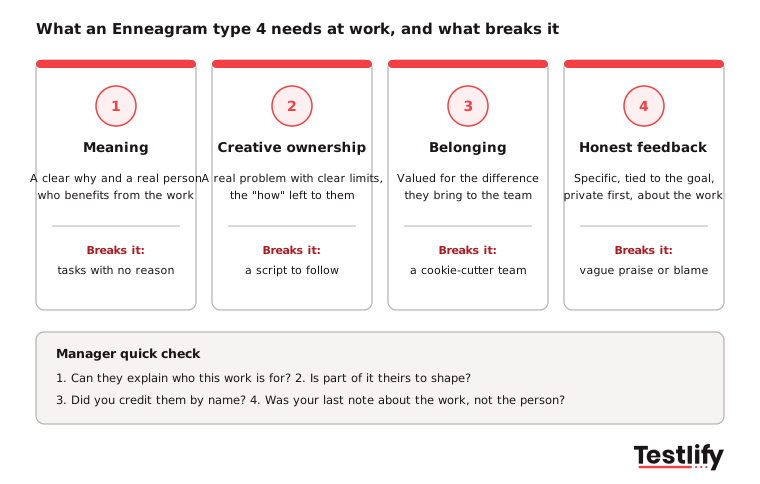
Creative ownership, in practice:
- Share the problem, the audience and the hard constraints (budget, deadline, brand rules). Leave the "how" open.
- Agree on one checkpoint where you will react to direction, not detail.
- Credit them by name in the room where the work is shown.
Feedback that a Four can use:
- Lead with what the work is trying to do, then whether it does it: "The goal is trust for first-time buyers. The headline is bold, but the tone feels distant for that reader."
- Separate taste from requirements. "I would do it differently" and "this breaks the brand rules" are not the same note.
- Avoid vague praise. "Love it!" lands as hollow; "The second paragraph is the first copy that sounds like our customers" lands as real.
Recognition is part of this. A 2024 study by Gallup and Workhuman found that only 22% of employees get the right amount of recognition, and that well-recognized employees were 45% less likely to have left after two years. Gallup's research on recognition and retention stresses recognition that is personal and authentic, which is exactly the kind a Four believes. For more ways to build it, see the guide to rewards and recognition.
Which roles reward an Enneagram 4's originality?
Roles that reward an Enneagram 4's originality are those where a distinct point of view is the deliverable, not a side effect. Design, writing, brand, research and some people-facing roles fit well. The US government's O*NET career database groups much of this under its Artistic interest type: work that involves creating original visual or written work, or applying artistic principles to design.
Role family | Why a Four often thrives | What to watch |
|---|---|---|
Brand and graphic design | Taste, emotional read of an audience, original concepts | Endless rounds of revisions without a clear owner |
Copywriting and content | Voice, empathy, storytelling | Templated, high-volume output with no room for craft |
UX writing and UX research | Notices friction and feelings others miss | Pressure to ship without user input |
Brand strategy and creative direction | Spots what makes a company distinct | Politics that reward the safest idea |
Coaching, counseling, people development | Comfort with hard emotions | Absorbing other people's moods |
Product marketing for a cause they believe in | Meaning plus craft | Messaging that feels exaggerated |
Type does not decide fit on its own. Plenty of Fours are excellent engineers, analysts and operators. The point is to give them a part of the role that is theirs to shape. For the wider team picture, see how to build a successful marketing team.
What do people get wrong about Enneagram type 4?
People most often misread Enneagram type 4 as dramatic, self-absorbed or only suited to the arts. These labels come from watching the surface of a Four's behavior without the motive underneath. Here are the four common misreadings and what is usually going on.
- "Fours are narcissistic": Fours focus on themselves, but usually through doubt, not grandiosity. The question underneath is "Am I enough?", not "Admire me."
- "Fours are always sad": Fours are comfortable with sadness, which is different from being stuck in it. Healthy Fours have a dry humor and real joy, often in small, specific things.
- "Fours are difficult to manage": Fours are difficult to manage generically. Give a clear why, ownership and honest feedback, and many become a team's most committed people.
- "Every creative person is a Four": Creativity shows up in every type. Type 4 is defined by the search for identity and the pull of envy, not by a job title or a style.
Should hiring teams use Enneagram type 4 results?
Hiring teams should never use Enneagram type 4 results, or any Enneagram type, as a pass or fail screen. Type describes motivation, not skill, and a person's type says nothing about whether they can do the job. Used that way, a type label can also create legal risk.
The EEOC's guidance on employment tests notes that personality tests can break federal anti-discrimination law if they screen out a protected group without a job-related reason. Read the Enneagram test and how to use it in hiring for safe uses, such as team conversations and onboarding.
The fair way to hire for a creative role is to test the work itself. Testlify's library of 3,500+ tests includes a graphic designer test, a copywriter test, a creativity test and a brand management test.
Add file upload or practical task questions to see real work samples, and keep the Enneagram personality test for development conversations after the hire. This is how skills-based hiring works in practice.
Hiring for a creative role?
Judge designers, writers and brand people on the work they can do, then use personality insight to manage them well. Browse the Testlify test library for creative and role-specific tests, or start a 7-day free trial, no credit card required, and build your first assessment from your own job description.
Frequently asked questions

Content Writer
Yashika Khandelwal is a Content Writer with 3+ years of experience creating research-backed content on hiring, talent assessment, and HR technology. She is a registered Organizational Psychologist and subject matter expert who combines behavioral science with practical recruitment insights to produce accurate, evidence-based content.
LinkedInRelated resources
View all
Workplace culture
Enneagram type 1: The perfectionist at work, wings and growth

Workplace culture
40 stay interview questions to ask your employees

Workplace culture
How to read an Enneagram chart: wings, arrows and the triangle explained

Workplace culture
12 employee motivation strategies that actually work

Workplace culture
How to boost employee morale: 9 ways that work

Workplace culture
How to reduce employee absenteeism: 10 steps that work
Get started.
Hire on proof, not resumes.
Run your first skills-based assessment free — no credit card required.