
Enneagram type 6: the Loyalist at work and in life
What drives an Enneagram type 6, how 6w5 and 6w7 differ, where Sixes go under stress, and what they need from work to do their best.
Every team has someone who asks "what if this fails?" just as everyone else is ready to ship. Often that person is an Enneagram type 6, known as the Loyalist.
Sixes are driven by a need for security and support. At their best they are prepared and committed, and under pressure they can turn suspicious or indecisive.
This guide stays on Type 6 and shows how Sixes handle risk, trust and change at work. For the nine types in general, see how to read an Enneagram chart and what the Enneagram test is and how to use it.
TL;DR:
- Enneagram type 6 is the Loyalist: a person whose core desire is security and support and whose core fear is being without support or guidance.
- Anxiety is the Type 6 trap. Sixes run worst-case scenarios on a loop and look for the catch in a plan that sounds too easy.
- A 6w5 is more private, skeptical and expert-focused. A 6w7 is warmer, more social and quicker to act on a decision once it is made.
- Under stress a Six moves toward Type 3 and turns competitive or image-focused. In growth a Six moves toward Type 9 and becomes calmer and more trusting.
- At work, a Six needs clear expectations, a manager who keeps their word and a real channel to raise risks without being called negative.
- Sixes often do their best work in compliance, quality assurance, risk, security, project coordination and operations, where catching problems early is the job.
- Never use Enneagram type as a pass or fail hiring screen. Pair it with job-relevant skills tests.
 ChatGPT
 Gemini
 Claude
 Grok
 Perplexity
What is an Enneagram type 6?
Enneagram type 6 is the Loyalist, one of the three types in the fear-based head group of the Enneagram. A Six builds their sense of safety around having reliable people, systems and plans around them.
Sixes are responsible, hardworking and alert to risk. They tend to feel that something could go wrong even when nothing has yet.
The other common names for Type 6 are the Guardian and the Skeptic. All three point to the same pattern: a person who tests trust before giving it and who plans for the version of events that does not go smoothly.
Type 6 at a glance | What it means |
|---|---|
Name | The Loyalist (also the Guardian) |
Core desire | To have security and support |
Core fear | Being without support or guidance |
Core emotion and trap | Anxiety, which can turn into worry and suspicion |
Wings | 6w5 (Type 5 wing) and 6w7 (Type 7 wing) |
Stress line | Toward Type 3 |
Growth line | Toward Type 9 |
At work, they bring | Preparation, loyalty, early warning on risk |
At work, watch for | Worst-case thinking, slow decisions, testing trust |

What does an Enneagram 6 want and fear most?
An Enneagram 6 wants dependable support and fears being left without guidance when something goes wrong. Most Type 6 behavior comes back to that pair.
Sixes ask "What happens if this fails?" before most people have finished describing the plan. They look twice at anyone who promises something will definitely work.
That search for security shapes small daily choices. A Six may re-read a contract clause three times, keep a backup plan for a backup plan, or ask a new manager pointed questions in the first week to see if their word holds.
The same Six may turn down a flashy opportunity that feels unstable in favor of a steadier one that pays less.
Security also explains why Sixes notice risk. When they look at a launch plan, a vendor contract or a hiring decision, the eye goes straight to what could break it.
That focus is uncomfortable in the room, and valuable afterward. The person who asks "what is our plan if the vendor misses the deadline" is often a Six.
Key takeaway: When a Six raises a concern, treat it as information about the plan, not a comment on morale. The concern is usually specific and worth checking.
Why are anxiety and loyalty central to a Type 6?
Anxiety and loyalty sit at the center of Type 6 because Sixes manage uncertainty by preparing for it and by sticking with people and systems that have proven reliable. In Enneagram terms, anxiety is the Six's core passion: a low hum of "what if" that never fully switches off, even when things are going well.
At work, anxiety rarely looks like panic in the open. A Six told a deadline is "basically fine" may spend the evening building a contingency timeline nobody asked for.
The next day they arrive with three questions nobody else thought to ask. The plan gets better, but the Six still feels uneasy until the work is done.
Loyalty is the other side of the same coin. Once a Six decides a team has earned their trust, they commit hard and stay through rough periods.
The skill to develop is telling a real red flag from an anxious mind generating one. That way loyalty goes to the right people.
How do a 6w5 and a 6w7 differ at work?
A 6w5 and a 6w7 share the Type 6 core, but the wing changes how a Six shows up. A 6w5, sometimes called the Defender, borrows detachment and expertise from Type 5.
A 6w7, sometimes called the Buddy, borrows warmth and spontaneity from Type 7. Both remain Sixes first, and the wing adds flavor, not a new type.
At work | 6w5 | 6w7 |
|---|---|---|
Energy | Inward, reserved, wants to study the problem first | Outward, upbeat, wants to talk it through with people |
Best output | Deep technical review, security and policy work | Rallying a team, keeping morale up under pressure |
Pace | Slow to commit, then thorough and consistent | Faster to decide, keeps several options moving at once |
Collaboration | Prefers written questions and clear documentation | Prefers a quick conversation over a long document |
Feedback sensitivity | Stings most when the reviewer has not done the homework | Stings most when it comes with no warmth or context |
Stress signal | Withdraws further and stockpiles information | Gets scattered, takes on too many commitments at once |
What helps | Time to research before being asked to commit | A clear priority list, so energy goes to one thing first |
Pro tip: If you manage a 6w5, send the agenda and the supporting documents well before the meeting. If you manage a 6w7, help them pick the one thing that matters most this week.
Where does an Enneagram type 6 go in stress and growth?
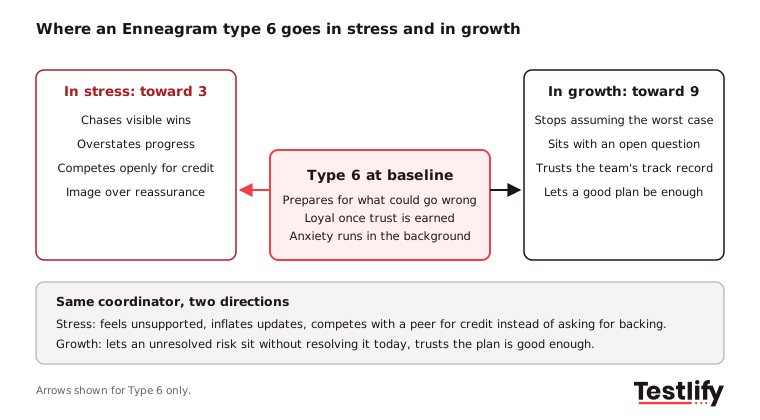
An Enneagram type 6 moves toward the average traits of Type 3 under stress and toward the healthy traits of Type 9 in growth. For a Six, stress means trading preparation for performance.
Growth means trading anxiety for trust. Each line is described here only for Type 6, and the general theory of arrows sits in the chart guide linked above.
In stress (toward 3)
A cautious Six suddenly starts chasing visible wins. Picture a project coordinator who has felt unsupported by leadership for weeks. Instead of raising it directly, they overstate progress in status updates and compete openly for credit. They hope a strong image will buy the security that reassurance has not.
In growth (toward 9)
The same coordinator, when healthy, stops assuming the worst case is the likely one. They can sit with an unresolved question without needing to solve it immediately, trust the team's track record, and let a reasonable plan be good enough without triple-checking it.
What makes work feel safe for an Enneagram type 6?
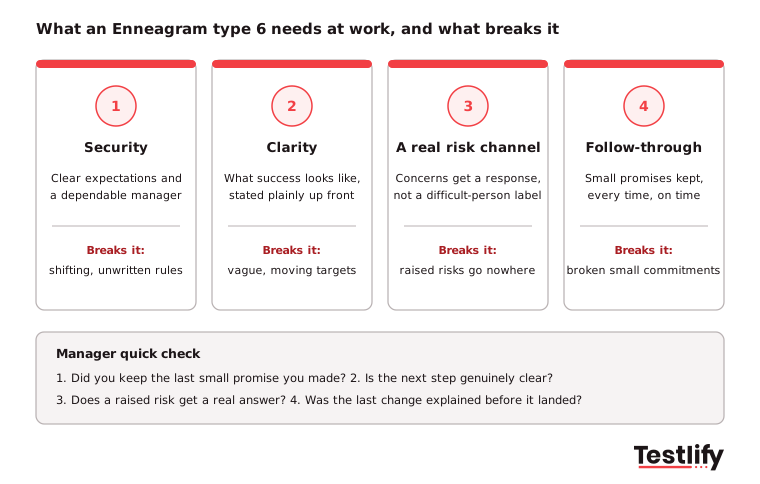
Work feels safe for an Enneagram type 6 when expectations are clear, promises are kept, and there is a real way to raise a concern before it becomes a crisis. A Six can handle a demanding job once those three are in place.
Without them, even a well-paid role can feel like standing on shifting ground. Sixes tend to notice drift in trust early, because consistency is what they track.
What safety looks like in practice for a Six:
- Consistency: A manager who follows through on what they say, even on small things.
- Clear rules: Knowing what is actually expected, rather than guessing at an unwritten standard.
- A real channel for concerns: A process for flagging risk that leads to a response, not a label of being difficult.
- Advance notice: Enough warning before a change, so the Six has time to prepare rather than react.
How does a Type 6 handle risk, planning and change?
A Type 6 handles risk by assuming a plan has a weak point until proven otherwise, then working to find and close it. Planning is where a Six adds the most value: they build in the buffer, the backup supplier and the rollback step that an optimistic plan skips.
Change is harder, because a new system or a new boss resets the trust a Six has spent months building.
In an operations team, a Six might be the one who insists on a dry run before a system migration, or who keeps a written incident log that nobody else wanted to maintain until it saved a client relationship. In hiring, the Six on the panel is often the one who checks a reference that everyone else assumed was fine.
Change still has to happen. What helps:
- Explain the why early: A Six accepts change faster when they understand the reasoning, not just the decision.
- Give a real timeline: Vague "coming soon" changes raise anxiety more than a firm date, even a less convenient one.
- Ask them to pressure-test it: Many Sixes support a change they helped stress-test, because they found the risks instead of being told there were none.
- Keep the channel open after launch: A short follow-up check reduces the urge to keep worrying about edge cases that never happened.
What happens when a Type 6 feels unsupported at work?
When a Type 6 feels unsupported at work, they usually test the relationship before they complain. Sixes treat reliable backing as a basic need, so a manager who overpromises, a reorg with no real explanation, or a culture where raising a risk gets read as disloyalty triggers the old fear of being left without guidance.
The classic trigger is a broken small promise. A manager who says "I'll get you an answer by Friday" and does not, even on something minor, costs more trust with a Six than the manager realizes.
A Six in that setting often starts double-checking everything that manager says, builds a private paper trail, and quietly updates their resume just in case.
Belonging for a Six does not mean never raising concerns. It means being heard when they do.
Signs a Six feels supported:
- They flag a risk early, in plain language, without hedging it to death.
- They commit fully once a decision is made, instead of relitigating it.
- They defend the team or the plan to outsiders.
Signs they do not: constant hedging, repeating the same question to several people, and a sudden drop in the questions they used to ask. That silence is easy for managers to miss, because on paper the Six is still doing the work.
How does a Type 6's anxiety shape the quality of their work?
A Type 6's anxiety shapes their work in two ways: it drives thorough preparation and can stall decisions. Sixes often want one more data point, which turns a same-day call into a three-day review.
Once a decision is made, the follow-through is typically strong and well-documented.
A typical pattern looks like this: on Monday a Six is handed a vendor choice due Friday. By Wednesday they have built a comparison sheet nobody asked for and flagged a risky contract clause.
On Thursday they are still weighing a fourth option that barely differs from the other three. Naming a decision deadline, not just a work deadline, gets the choice made on time with the useful research kept.
What helps a Six manage the loop:
- Set a decision deadline, separate from the work deadline: "Research by Wednesday, decision by Thursday noon" works better than one combined date.
- Name the anxious thought, then test it: "I'm worried the vendor will miss the deadline" can be checked against their actual track record instead of assumed.
- Watch for drift into burnout: Constant vigilance with no reassurance can tip a Six into burnout faster than the people around them expect.
How can a manager give an Enneagram 6 clarity and trust?
A manager gives an Enneagram 6 clarity through specific expectations and consistent follow-through, then earns trust by keeping small commitments over time. Both matter more to a Six than charisma or big promises, because both show the ground underneath them is solid.
Clarity, in practice:
- Write down what success looks like for the task, not just the deadline.
- Say what you do not yet know, instead of papering over a gap with false confidence.
- Give advance notice of changes whenever you can, even a rough heads-up.
Trust that a Six can use:
- Do the small things you said you would do, on the timeline you said you would do them.
- When a Six raises a risk, respond to the risk, not to the tone it was raised in.
- Separate "I disagree with this concern" from "stop bringing me concerns." Only the first is a fair response.
Recognition plays a role here too. A Gallup and Workhuman study on recognition found only 22% of employees get the right amount of recognition, and well-recognized employees were 45% less likely to have left two years later.
For a Six, being thanked specifically for catching a risk early does more than general praise. For more ways to build it, see the guide to rewards and recognition.
Which roles reward an Enneagram 6's vigilance?
Roles that reward an Enneagram 6's vigilance are those where catching a problem before it happens is the actual job, not a distraction from it. Compliance, quality assurance, risk, security and operations roles fit well.
The US government's O*NET career database groups much of this under its Conventional interest type: structured, rule-based work that organizes records, data and process.
Role family | Why a Six often thrives | What to watch |
|---|---|---|
Compliance and governance | Comfortable with rules, catches gaps before an audit does | A culture that treats every raised risk as an obstacle |
Quality assurance | Methodical, finds the edge case others miss | Burnout from being the last line of defense with no backup |
Risk and security | Natural at running worst-case scenarios | Chronic high alert with no clear end state |
Operations and project coordination | Builds the buffer and the backup plan into any schedule | Over-planning a task that needed a quick decision |
Finance and accounting | Careful, consistent, follows the process | A role with no clear process to follow |
Customer support and account management | Loyal to the people they serve, remembers history | Taking on a customer's anxiety as their own |
Type does not decide fit on its own. Plenty of Sixes are excellent in sales, design and leadership roles.
The point is to give them real information and a working process to lean on. For hiring-side examples, see compliance officer interview questions or quality assurance manager interview questions.
What do people get wrong about Enneagram type 6?
People most often misread Enneagram type 6 as paranoid, negative or indecisive. Those labels come from watching the surface of a Six's behavior without the motive underneath.
Here are four common misreadings and what is usually going on.
- "Sixes are paranoid": Sixes scan for risk, but usually because they have learned that unprepared is unsafe, not because they distrust people for no reason. The question underneath is "What am I missing?", not "Who is out to get me?"
- "Sixes are always negative": Sixes raise what could go wrong because naming it is how they neutralize it. Healthy Sixes are often warm, funny and fiercely loyal once trust is established.
- "Sixes can't make decisions": Sixes are slow with decisions that feel unsafe or reversible-feeling-permanent. Give a clear deadline and the key facts, and many decide faster than their reputation suggests.
- "Every careful person is a Six": Carefulness shows up in several types. Type 6 is defined by the search for security and the anxious scan for risk, not by a job title or a habit.
Should hiring teams use Enneagram type 6 results?
Hiring teams should never use Enneagram type 6 results, or any Enneagram type, as a pass or fail screen. Type describes motivation, not skill, and used as a screen it can create legal risk.
The EEOC's guidance on employment tests warns personality tests can break anti-discrimination law if they screen out a protected group without a job-related reason. Safe uses of the Enneagram include team conversations and onboarding.
The fair way to hire for a risk-aware role is to test the work itself. Testlify's library of 3,500+ tests includes a risk assessment test, a compliance and governance test, an attention to detail test and a decision-making test.
Add scenario-based questions to see how a candidate actually reasons through risk, and keep the Enneagram personality test for development conversations after the hire. This is how skills-based hiring works in practice.
Hiring for a role that needs reliability?
Judge compliance, QA and risk candidates on the judgment they can show, then use personality insight to manage them well once hired. Book a demo to see Testlify in action, or start a 7-day free trial, no credit card required.
Frequently asked questions (FAQs)
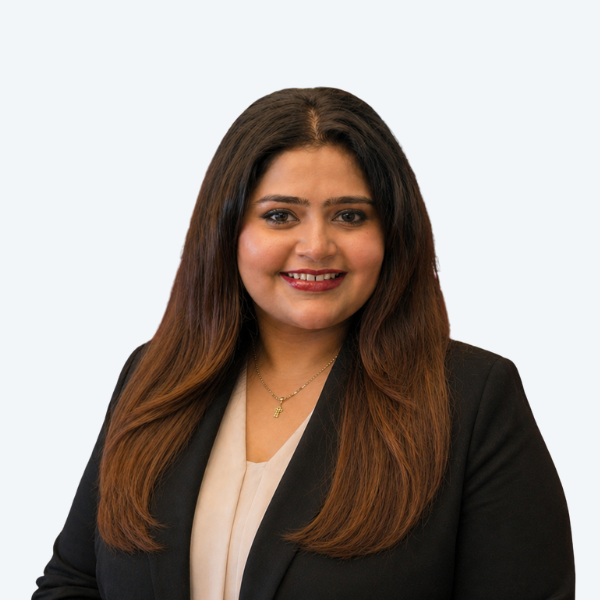
People and Talent Partner
Arushi Shah runs day-to-day talent acquisition and candidate experience at Testlify. She writes on interviewing, structured hiring, and giving candidates a fair, fast process.
LinkedInRelated resources
View all
Workplace culture
Enneagram type 9: how the Peacemaker handles conflict, decisions and work

Workplace culture
Enneagram type 2: the Helper at work, wings and stress lines

Workplace culture
Change management training: what it covers and how to measure it

Workplace culture
Enneagram type 4: The Individualist at work and in life
Workplace culture
Enneagram type 1: The perfectionist at work, wings and growth

Workplace culture
40 stay interview questions to ask your employees
Get started.
Hire on proof, not resumes.
Run your first skills-based assessment free — no credit card required.