
Enneagram type 2: the Helper at work, wings and stress lines
What drives an Enneagram Type 2, how 2w1 and 2w3 differ, and how managers can support Helpers at work without letting them burn out.
Picture the colleague who stays late to fix a teammate's deck and never mentions it. That colleague is often an Enneagram Type 2, quietly hoping someone notices.
Read on for how 2w1 and 2w3 differ, what stress and growth look like, and how to prevent burnout. New to the nine types? Start with how to read an Enneagram chart.
Enneagram Type 2, known as the Helper or the Giver, is driven by a need to be loved, which Twos usually pursue by being needed. Their core fear is being unwanted, so saying no and asking for help are hard.
TL;DR:
- An Enneagram Type 2 is the Helper: a person whose sense of worth rests on being loved and needed, and who earns that by anticipating and meeting other people's needs.
- The core fear is being unwanted or unworthy of love. The core desire is to feel loved for who they are, not for what they give.
- A 2w1 helps through duty and doing things right. A 2w3 helps through charm, visibility and getting results for people.
- Under stress a Two moves toward Type 8 and turns blunt and controlling. In growth a Two moves toward Type 4 and starts to name its own feelings and needs.
- At work, Twos are the colleagues who onboard new hires, calm upset customers and hold teams together. They also overcommit quietly and burn out late.
- Managers get the best from a Two with specific, personal recognition and by making workload visible, so helping becomes a choice, not a reflex.
- Enneagram type is never a pass or fail hiring screen. Pair it with job-relevant skills tests and use it for onboarding and coaching.
 ChatGPT
 Gemini
 Claude
 Grok
 Perplexity
What is an Enneagram Type 2?
An Enneagram Type 2 is the Helper: a warm, people-focused personality type motivated by the wish to be loved and appreciated, and by the belief that being needed is the way to get there. Twos read emotional cues fast, give generously, and measure their own value by how much they matter to the people around them.
The Enneagram Institute names the Type 2 core fear as being unwanted or unworthy of being loved, and the core desire as feeling loved. Other Enneagram schools call the type the Giver, and they describe the same pattern: attention flows out to other people's needs, and the Two's own needs drop out of view.
Type 2 is one of the more common types. According to Truity's study of more than 54,000 people, about 11% of respondents type as Twos, including about 15% of women and 7% of men. Cloverleaf reports that Twos make up 14% of the 883,560-plus Enneagram assessments taken on its platform.

What drives an Enneagram Type 2 and the need to be needed?
The need to be needed drives an Enneagram Type 2 because, deep down, a Two believes love has to be earned through giving. Helping is how a Two proves they belong.
Being needed feels safe. Being unneeded feels like being replaceable.
Three ideas explain most Type 2 behavior:
- The core belief: "I am worth something when I am useful to people I care about." Enneagram teacher David Daniels describes the Two's deepest fear as becoming useless or dispensable to others.
- The passion, pride: Pride here is not arrogance. Pride is the quiet belief that others depend on you, and that you know what they need better than they do. A Two who says "I'll handle it, you're swamped" is often acting from this.
- The virtue, humility: At their best, Twos give without keeping score and accept help without feeling smaller for it.
Here is what that looks like on a Tuesday. A Two notices a new analyst struggling with a client deck at 6 pm, stays an hour to fix the formatting, and says nothing about it.
That gap between giving freely and quietly hoping for a return is the central tension of the type. The help was real. So was the unspoken hope that someone would notice.
The next morning the manager thanks the analyst for a great deck. The two smiles, and then feels a sting that lasts all day.
What is the difference between a 2w1 and a 2w3?
The difference between a 2w1 and a 2w3 is where the helping energy goes. A 2w1 (Type 2 with a Type 1 wing) helps out of duty and principle, quietly and by the rules.
A 2w3 (Type 2 with a Type 3 wing) helps through charm and visible action, and is more comfortable in the spotlight. The Enneagram Institute calls the 2w1 the Servant and the 2w3 the Host.
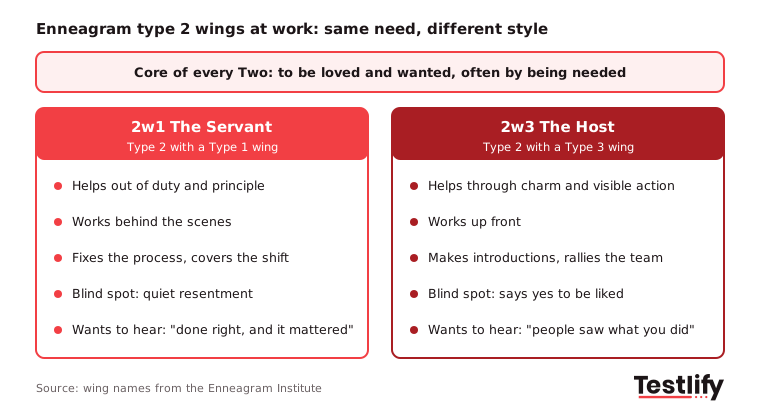
Read the wing as a flavor, not a second type. Each wing changes how a Two helps, but the core motive stays the same.
Where does an Enneagram 2 go in stress and growth?
An Enneagram 2 goes toward Type 8 under stress and toward Type 4 in growth. Under stress, a Two who has given too much for too long turns blunt, controlling and resentful. In growth, a Two turns inward, notices their own feelings and needs, and starts to give from choice instead of fear.
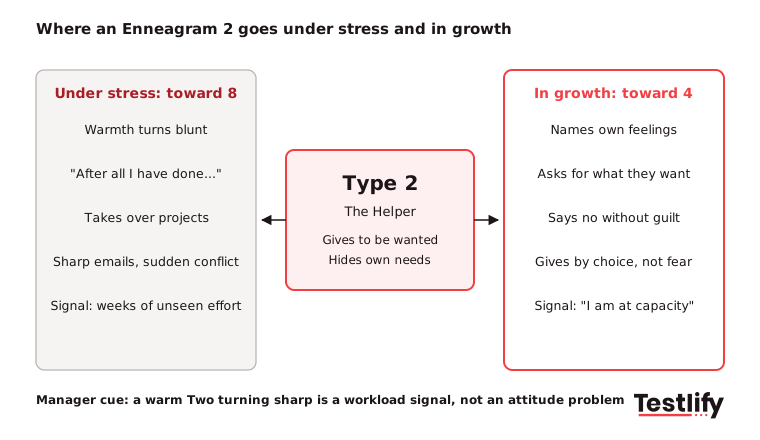
Stress, toward 8
The warmth flips. The Two who usually asks "How can I help?" starts saying "After everything I have done for this team."It rarely comes out of nowhere. It is weeks of unacknowledged effort arriving all at once.
You may see sharp emails, a takeover of a project they were only supporting, or a confrontation that seems to come out of nowhere.
Growth, toward 4
The Two starts to ask "What do I want?" and answer it honestly. At work this looks like a Two who tells a manager "I am at capacity, and I would like to be considered for the team lead role," instead of hinting and waiting to be noticed.
The arrows are a map, not a forecast. A healthy Two can borrow the directness of 8 in a good way, for example by finally pushing back on a client who keeps expanding scope.
How does an Enneagram Type 2 build relationships at work?
An Enneagram Type 2 builds relationships at work by noticing people. Twos remember the new hire's first name and their kid's football match, check in after a hard meeting, and spot the customer who is about to churn because their tone changed in a support ticket.
Relationships are their main currency, and they invest early.
According to Truity's survey of more than 64,000 employees, Twos rank meaningful work, collaboration and connection above other workplace motivators. In practice that shows up in a few repeatable ways:
- With new colleagues: A Two volunteers as onboarding buddy, sends the "Who to ask for what" list nobody wrote down, and sits with the new person at the first all-hands.
- With teammates: Twos act as the team's informal support desk and its emotional glue. They notice when someone goes quiet and ask about it privately.
- With customers: A Two in customer success hears the frustration behind a polite renewal call, flags the risk early, and follows up with a personal note. Accounts often stay because the customer trusts the person, not the product.
- With managers: Twos keep leaders informed about how the team is feeling, often before a pulse survey would show it.
The pattern is common in HR and customer success teams: the Two is the person everyone goes to, and the person whose own workload nobody tracks.
Why do Enneagram Type 2s find it hard to say no or ask for help?
Enneagram Type 2s find it hard to say no because every no feels like a small risk to the relationship, and their sense of worth rests on relationships. Asking for help is harder still: for a Two, needing something feels like becoming a burden, the exact opposite of the role they have built.
You can hear the pattern in their language:
- "Sure, send it over." (said while already at capacity)
- "No worries at all, I can stay late."
- "I'm fine, honestly. How are you doing?"
Twos also tend to express needs indirectly. Instead of saying "I need help with the quarterly report," a Two may mention how busy the week is and hope someone offers.
When nobody offers, the Two concludes, again, that they have to do it alone. The fix is not telling a Two to "set boundaries." The fix is making a no feel safe.
When a Two declines a request and the relationship survives, that experience does more than any coaching tip. Managers can speed this up by thanking a Two the first few times they push back.
What do overcommitment and hidden burnout look like in a Type 2?
Overcommitment in a Type 2 looks like generosity until it suddenly looks like exhaustion. Twos keep saying yes, hide the cost, and show burnout late, often as illness, resentment or a sharp change in tone rather than a request for help.
The risk is higher when managers are stretched. Gallup's State of the Global Workplace found manager engagement fell from 31% to 22% between 2022 and 2025.
A stretched manager is more likely to lean on the colleague who never says no, and that colleague is often a Two.
Early signal | What it often means | What to do |
|---|---|---|
Covers for two or more colleagues in the same week | Helping has become the default, not a choice | Ask which of those tasks were theirs to take |
Works late but reports "all good" in 1:1s | Hiding cost to avoid seeming needy | Look at hours and output, not just the answer |
Sudden sharp tone or "after all I've done" comments | Resentment from unnoticed effort (the stress line to 8) | Name the effort specifically and redistribute work |
Takes no leave, or falls ill on the first day off | Running on adrenaline and duty | Book time off with them and protect it |
Stops offering ideas in meetings | Feels used or invisible | Ask for their view directly, then act on it |
One coach who works with Type 2 leaders, CoCreate, notes a common "boom and bust" pattern: Twos push through for months and then get ill the moment they finally take a break.
How do Enneagram Type 2s want to be recognized?
Enneagram Type 2s want to be recognized for who they are and for the specific difference they made to someone, not with a generic "thanks, team." Personal, specific recognition tells a Two they are valued as a person, which is the need behind all the helping.
Most workplaces miss this. Gallup's 2024 research on recognition found only 22% of employees get the right amount of recognition, and well-recognized employees were 45% less likely to have left two years later.
For a Two, the gap hurts more than for most, because unnoticed effort feeds the resentment cycle.
Compare these two messages:
- Weak: "Thanks everyone for pulling together this quarter."
- Strong: "Priya, when you sat with the two new support agents during their first week, both closed their tickets faster than any new starters this year. That was you."
A few rules that work well for Twos:
- Name the person before the task: Start with them, then the outcome.
- Show the impact on people: Twos care most about who was helped.
- Mix private and public: A one-to-one note often lands harder than a shout-out on Slack.
- Recognize the boundary, too: Praise a Two the first time they say "I can't take that on." That reward reshapes the habit.
Key takeaway: Twos keep giving when they feel seen. When effort goes unnoticed, they keep giving anyway, but resentment builds underneath.
How can a manager stop a Type 2 from taking on everyone else's work?
A manager can stop a Type 2 from taking on everyone else's work with four simple moves: make workload visible, route requests to a clear owner, scope the helping role and give the Two a safe way to say no. The aim is not to stop a Two helping. The aim is to make sure the helping is chosen. The image below shows the four moves at a glance.
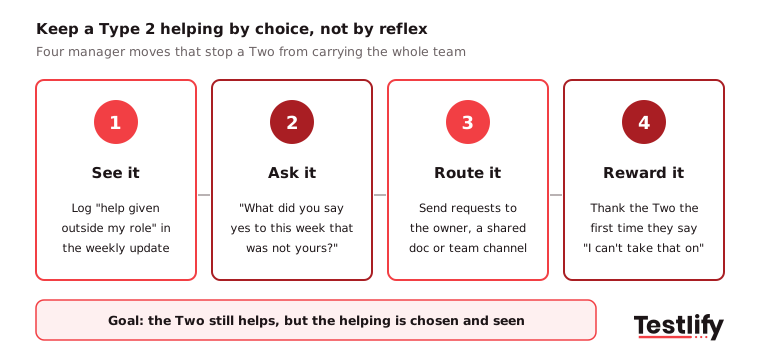
Here are seven steps managers can start using this week:
- Make the invisible work visible: Add a line to the weekly update for "help given outside my role." Twos rarely log it. Once it is on paper, you can see who is carrying the team.
- Ask a better 1:1 question: Swap "How's your workload?" (always answered "fine") for "What did you say yes to this week that was not yours?"
- Route requests, do not let them leak: If colleagues go straight to the Two for every question, point them to the owner, a shared doc or a team channel.
- Give a script for no: "I can't take that on this week, but here is who can help" is easier to say when the manager has said it is fine.
- Scope the helping role: If a Two loves onboarding or mentoring, make it official with time set aside, and take something else off their plate.
- Check the glue work: Twos often end up organizing farewells, taking notes and onboarding. Rotate it, or count it when you review performance.
- Watch the stress line: If a usually warm Two turns sharp, treat it as a workload signal, not an attitude problem.
Pro tip: In the first month with a new Two on your team, ask them directly: "How will I know when you are overloaded?" Twos will not volunteer the answer, but most will give an honest one when asked.
The managers who keep Twos the longest tend to do one simple thing: they notice the help out loud, and then they protect the Two from being asked for more.
Which roles suit an Enneagram Type 2?
Roles that suit an Enneagram Type 2 put relationships and service at the center. Twos tend to do less well in roles that are purely transactional, highly competitive or isolated from people. The table below shows six common fits, why each works and what to watch for.
Role | Why a Two often fits | Watch-out |
|---|---|---|
Customer success manager | Builds trust, spots churn risk early, follows through | Over-servicing one account at the expense of the book |
HR generalist or HR business partner | Reads people, mediates, supports employees through change | Absorbs everyone's problems, struggles with hard calls |
People operations or onboarding specialist | Makes new hires feel welcome from day one | Becomes the default answer to every question |
Learning and development | Enjoys watching others grow | Neglects own development |
Support team lead | Coaches agents, calms escalations | Takes on the hardest tickets personally instead of delegating |
Account manager | Long relationships, renewals, expansion | Avoids raising prices or saying no to scope creep |
Type does not decide whether someone can do any of these jobs. Skills, experience and judgment decide that. Type helps explain how a person will approach the work and where they may need support.
What do people get wrong about Enneagram Type 2s?
People get Enneagram Type 2s wrong in five common ways, mostly by mistaking the behavior (helping) for the motive (being wanted). The misreadings matter at work because they lead managers to under-support Twos or to miss the moment a Two is struggling.
- "Twos are selfless": Twos have needs like everyone else. They just tend to meet them indirectly, through being needed.
- "Twos are pushovers": A Two under pressure can be very direct, even forceful, especially on behalf of someone else. Twos will fight hard for a customer or a colleague.
- "Every helpful person is a Two": Plenty of people help for other reasons, such as duty, competence or keeping the peace. Type is about why someone helps, not whether they help.
- "Type 2 is a women's type": Truity's figures show more women than men type as Twos, but about 7% of men do too, and male Twos are often mistyped because the stereotype does not fit them.
- "Twos are not leadership material": Many Twos lead well, especially when they pair care with clear decisions. The growth edge is holding people accountable without fear of losing the relationship.
Should you use Enneagram Type 2 results in hiring?
Enneagram Type 2 results should never be a pass or fail screen in hiring. Personality type describes motivation, not ability, and the EEOC expects selection tests to be job-related and consistent with business necessity. For more on where the test fits, read how to use the Enneagram test in hiring.
The better approach is to pair any personality insight with job-relevant skills tests, then use the type after the hire, in onboarding and coaching conversations. For a relationship-heavy role, that could mean:
- A customer success manager test for a CSM role
- An HR generalist test for a people role
- An emotional intelligence test or a conflict management test for skills a Two might claim but still needs to show
That way, a candidate who types as a Two and a candidate who does not are judged on the same evidence.
How can Testlify help you hire for relationship-heavy roles?
Testlify helps hiring teams assess the skills behind relationship-heavy roles with a library of 3,500+ tests, including role tests for customer success, HR and support, and the Enneagram personality test for team and coaching conversations. Tests run in 15+ languages with 20+ proctoring checks.
Browse the Testlify test library to find role tests for your next hire. Book a demo to see how Testlify works for your team. Want to try it yourself? Start a 7-day free trial, no credit card needed.
Frequently asked questions (FAQs)
People and Talent Partner
Arushi Shah runs day-to-day talent acquisition and candidate experience at Testlify. She writes on interviewing, structured hiring, and giving candidates a fair, fast process.
LinkedInRelated resources
View all
Workplace culture
40 stay interview questions to ask your employees
Workplace culture
How to read an Enneagram chart: wings, arrows and the triangle explained
Workplace culture
12 employee motivation strategies that actually work
Workplace culture
How to boost employee morale: 9 ways that work
Workplace culture
Organizational change management in 2026: why change stalls and what HR should do
Workplace culture
How to reduce employee absenteeism: 10 steps that work
Get started.
Hire on proof, not resumes.
Run your first skills-based assessment free — no credit card required.