
Enneagram type 9: how the Peacemaker handles conflict, decisions and work
What drives an Enneagram Type 9, how 9w8 and 9w1 differ, and how to draw out a Peacemaker's real view on conflict, decisions and goals.

Enneagram type 9, often called the Peacemaker, is the personality type driven by the need for inner and outer peace. Nines see every side of an issue, calm tense rooms and keep teams together. At work that means steady, easygoing colleagues and natural mediators, with a real risk of avoiding conflict, delaying decisions and losing track of their own priorities.
 ChatGPT
 Gemini
 Claude
 Grok
 Perplexity
TL;DR
- An Enneagram type 9 is the Peacemaker: an easygoing, accepting type whose core desire is peace of mind and whose core fear is loss and separation.
- 9w8 Nines are steadier and more direct. 9w1 Nines are more principled, orderly and reserved.
- Under stress a Nine moves toward 6 and turns anxious and worried. In growth a Nine moves toward 3 and becomes energized and goal-focused.
- Nines often say yes when they mean maybe. Ask for their view in writing or before the loudest person speaks.
- Nines decide faster with a short, ranked priority list and a clear deadline. Gallup found only 46% of US employees clearly know what is expected of them.
- A calm Nine is not always a content Nine. Quiet stubbornness and slow replies are early signs of disengagement.
- A Type 9 result should never decide a hire. Pair it with job-relevant skills tests.

What is an Enneagram type 9?
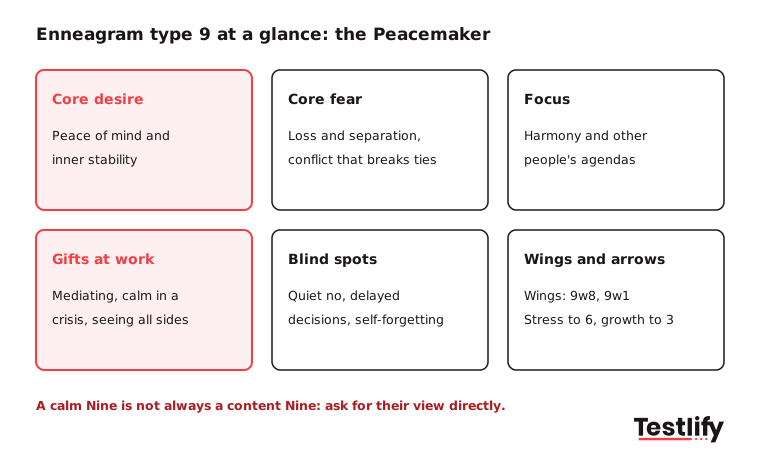
Enneagram type 9 is one of nine personality types in the Enneagram, known as the Peacemaker or the Mediator. Nines sit in the gut center, focus on harmony and stability, and tend to merge with other people's plans to avoid friction. Truity reports that about 13% of its 54,000+ respondents type as Nines, around 14% of women and 12% of men.
If you need the basics first, the guide to reading the Enneagram chart covers the nine points, the centers, and how wings and arrows work. This page stays on Type 9.
Signs you are looking at a Nine at work:
- Calm in a crisis: A Nine keeps their voice level when a launch slips, and the room calms down with them.
- Sees every side: A Nine can explain why both teams in a dispute have a point, often better than either team can.
- Easy yes: A Nine agrees to a plan in the meeting, then moves slowly on the parts they never liked.
- Quiet stubbornness: A Nine rarely argues, but pushing a Nine hard usually makes them dig in, not speed up.
What drives an Enneagram type 9: peace or avoiding conflict?
Enneagram type 9s are driven by the need for peace, and avoiding conflict is the habit they built to protect it. According to The Enneagram Institute, the Nine's basic desire is inner stability or peace of mind, and the basic fear is loss and separation. Smoothing over tension feels safer than risking a break.
That link between peace and connection explains most Type 9 behavior at work:
- Others' agendas come first: Nines tune in to what the team, the manager or the client wants, and lose sight of what they want themselves.
- Anger goes underground: Nines rarely show anger openly. It comes out as delay, silence or a task that never quite gets done.
- Comfort beats change: A Nine will often keep a familiar process running long after it stopped working, because changing it means friction.
- Self-forgetting is the trap: Nines can downplay their own ideas until they half believe those ideas do not matter, which is why being asked directly matters so much.
How is a 9w8 different from a 9w1 at work?
A 9w8 is a Nine with an Eight wing, which adds strength and directness, so the calm comes with a firmer edge and more willingness to push back. A 9w1 is a Nine with a One wing, which adds principles and order, so the calm comes with high standards, careful work and a quieter, more idealistic style.
The Enneagram Institute calls the 9w8 "The Referee" and the 9w1 "The Dreamer". Both want harmony. They differ in how they protect it.
9w8: the Referee | 9w1: the Dreamer | |
|---|---|---|
How they keep the peace | Steady presence, will step in and settle a dispute | Fair process, clear rules, doing things the right way |
Typical strength | Grounded, practical, comfortable with people | Thoughtful, conscientious, principled |
Conflict style | Slow to anger, but blunt once pushed too far | Avoids open conflict, holds quiet judgments |
Watch out for | Stubborn refusal that looks like calm | Withdrawing into ideals, quiet self-criticism |
Best feedback style | Plain, direct, one point at a time | Calm, private, tied to standards and fairness |
Common roles | Operations, support, field roles, team lead | HR, counseling, nursing, editing, compliance |
Where does a Type 9 go under stress and in growth?
A Type 9 under stress moves toward Type 6 and becomes anxious: worry rises, the Nine second-guesses plans and becomes defensive or reactive. In growth, a Type 9 moves toward Type 3 and becomes more energized, focused on their own goals and willing to take visible action.
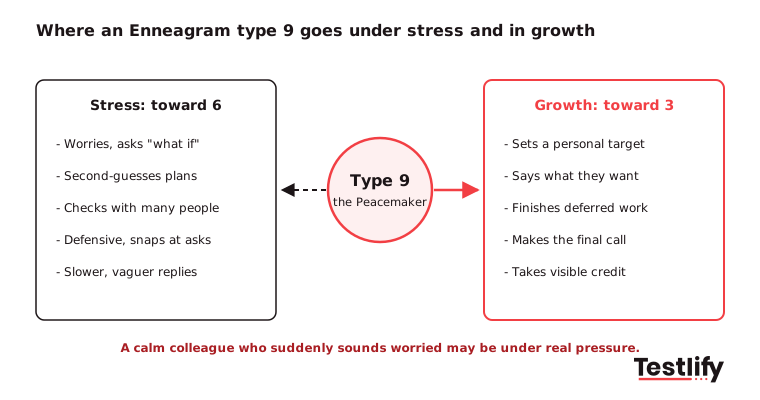
What each line looks like in a working week:
- Stress (toward 6): A Nine who normally shrugs off changes starts asking "what if" questions about every plan, checks with several colleagues before acting, and snaps at small requests. Truity notes that Nines under strain become less responsive and harder to engage in discussion.
- Growth (toward 3): A Nine sets a personal target, says what they want in a planning meeting, and finishes the project they kept deferring. The work gets more visible and the Nine gets more credit for it.
The general mechanics of arrows sit in the Enneagram chart guide. For a Nine, the practical point is this: a calm colleague who suddenly sounds worried and defensive is often under real pressure, not just having a bad day.
How does an Enneagram 9 handle conflict at work?
Enneagram 9s handle conflict by smoothing it over, stepping around it or waiting for it to pass. A Nine will often agree in the meeting to keep the room calm, then express disagreement through delay or quiet resistance. Nines are excellent at settling other people's disputes and much slower to name their own.
This creates what many managers call the "quiet no". Signs that a Nine's yes is not a real yes:
- Soft words: "Sure, I can look at that" or "That could work" instead of a clear commitment.
- Slow start: The agreed task sits untouched for days while easier tasks get done first.
- Side comments: The real objection surfaces later, to a peer, not to the person who made the decision.
- Sudden busyness: The Nine is "swamped" whenever the topic comes up again.
How to handle it:
- Name the pattern without blame: "I noticed this has not started. What part of the plan does not sit right with you?"
- Lower the cost of disagreeing: Thank the Nine for objections in public, so dissent feels safe, not disloyal.
- Use their mediator skill on purpose: Ask a Nine to summarize both sides of a dispute before the team decides. Nines do this well, and it often surfaces their own view too.
For a wider toolkit, the conflict management guide covers the main styles and when each one helps.
How do you get a Type 9's real opinion in meetings?
Getting a Type 9's real opinion in meetings works best when you ask before the group has settled, give time to think, and accept written input. Nines adapt to the room. Once the loudest voice has spoken, a Nine will often find reasons that view makes sense and drop their own.
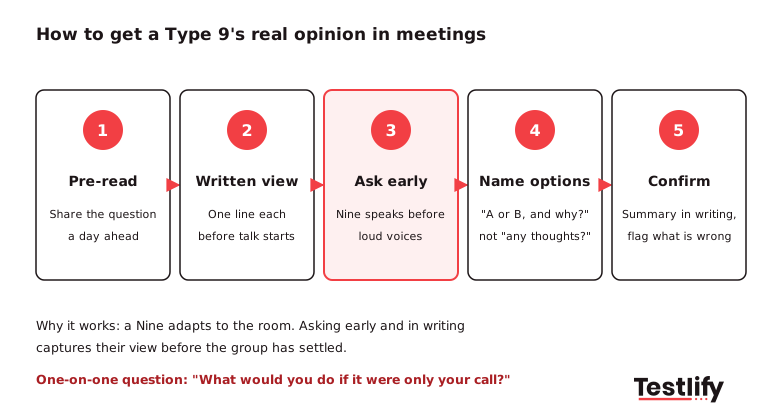
A simple routine that suits most Nines:
- Send a pre-read: Share the question and options a day ahead, so the Nine can form a view in peace.
- Collect written views first: Ask everyone to post one line in a doc or chat before discussion starts.
- Ask the Nine early: Invite their view before senior or forceful voices speak.
- Offer concrete options: "Do you prefer A or B, and why?" is easier to answer than "Any thoughts?"
- Confirm in writing: Send a short summary of what was decided and who owns what, and ask the Nine to flag anything that is wrong.
Pro tip: In one-on-ones, ask "What would you do if it were only your call?" The question removes the need to keep everyone happy, and Nines often give their clearest answer to it.
Why do Enneagram 9s delay decisions, and how do you help?
Enneagram 9s delay decisions because choosing means someone might be unhappy, and because every option can look reasonable to them. Nines also spread attention across many small, comfortable tasks, so the important decision keeps slipping. A clear priority list and a firm deadline usually unlock them.
What helps:
- Rank the priorities: Give the Nine a short list of their top three priorities for the month, in order. Without one, a Nine works on whatever someone asked for last.
- Set the decision date: "We decide on Thursday" works better than "when you are ready".
- Shrink the choice: Two or three options with clear trade-offs, not an open question.
- Make the default visible: Agree what happens if nobody decides, so delay is no longer the safe option.
Unclear expectations make this worse, and they are common. Gallup's October 2026 engagement update found only 46% of US employees strongly agreed they know what is expected of them at work in the third quarter of 2026, down from 49% in the first half of the year. For a Nine, that gap shows up as drift.
When does keeping the peace turn into disengagement or burnout?
Keeping the peace turns unhealthy when a Type 9 stops raising problems, stops saying what they want and slowly withdraws effort. Common signs are short, vague replies, missed deadlines on tasks the Nine never agreed with, more time on low-value busywork, and a colleague who seems fine but no longer contributes ideas.
Watch for these signals:
- Numbing out: Long stretches on email, admin or easy tickets while the hard project waits.
- Silent overload: The Nine says yes to every request, then quietly falls behind on all of them.
- Passive pushback: Plans the Nine disliked stall without anyone hearing an objection.
- Hidden fatigue: Nines rarely complain, so the first visible sign of burnout may be a sudden drop in replies or a sick day nobody expected.
The wider picture makes this easy to miss. Gallup's State of the Global Workplace found global employee engagement fell to 20% in 2025, and manager engagement dropped 9 points since 2022 to 22%. Stretched managers tend to notice the loud problems first. A Nine's quiet withdrawal is rarely loud.
How do you manage and coach an Enneagram 9?
Managing and coaching an Enneagram 9 works best with clear priorities, regular one-on-ones and a safe way to disagree. Nines respond to calm, specific feedback, to being asked what they want and to recognition for speaking up. Harsh pressure usually makes a Nine dig in, not move faster.
Practical steps for managers:
- Agree three priorities: Write down the top three for the quarter and revisit them monthly.
- Ask what they want: In every one-on-one, ask one question about the Nine's own goals, not only the team's.
- Give feedback one point at a time: A Nine can take hard news when it is calm, specific and not stacked with five other issues.
- Reward dissent: When a Nine pushes back, thank them and act on it where you can.
- Set a stretch goal: A visible, personal target pulls a Nine along the growth line toward 3.
- Check in after changes: Reorgs, new managers and team moves hit Nines harder than they show.
Feedback quality matters as much as tone. Gallup's 2024 feedback study found only one in four employees strongly agree they receive valuable feedback, and those who do are 5 times as likely to be engaged and 57% less likely to be burned out. The same habits carry into a formal performance review: one clear point, the evidence behind it, and an agreed next step.
Managers who get the best from Nines tend to say the same thing in different words: make it safe to disagree, make the priorities clear, and ask the quiet person first.
Which roles suit a Type 9's steady, mediating style?
Roles that suit a Type 9's steady, mediating style involve supporting people, calming tension or keeping stable systems running. Counseling, HR, nursing, customer support, operations, mediation and many back-office roles fit well. High-conflict roles with constant confrontation and few clear priorities tend to drain a Nine.
Role or track | Why a Nine tends to thrive | What to watch |
|---|---|---|
HR and employee relations | Sees every side, calms disputes | Avoiding hard calls on underperformance |
Counseling and social work | Patient listening, acceptance | Taking on others' problems as their own |
Nursing and patient care | Steady under pressure, caring | Quiet overload, skipped breaks |
Customer support and success | Calms upset customers, even tone | Saying yes to every request |
Operations and administration | Keeps systems stable and running | Resisting needed changes |
Team lead or project coordination | Builds consensus, keeps peace | Delaying decisions to avoid friction |
The data on people-focused work fits this pattern. O*NET, the US occupational database, rates the work style it calls Cooperation, a tendency to be pleasant, helpful and willing to assist others, at the top impact score of 100 for social workers, clergy and radiation therapists, among 882 rated occupations.
A Type 9 profile describes what energizes someone, not whether they can do the job. A Nine can still struggle in support without the product knowledge, while a blunt non-Nine can resolve conflicts well on skill alone.
What are the three Enneagram 9 subtypes?
The three Enneagram 9 subtypes are self-preservation, social and one-to-one, and each shows the Nine pattern in a different place. Self-preservation Nines find peace in comfort and routine. Social Nines find it by belonging to a group. One-to-one Nines find it by merging with one close person.
- Self-preservation Nine: Builds steady routines and enjoys simple comforts. At work, this Nine protects a predictable schedule and can turn stubborn when it is disrupted.
- Social Nine: Friendly, involved and often the team's informal mediator. Integrative9 calls this the countertype, because Social Nines can work very hard for the group while hiding their own stress.
- One-to-one Nine: Feels most secure in close partnership. At work, this Nine may adopt a manager's or partner's priorities as their own and struggle with boundaries.
What do people get wrong about Enneagram type 9s?
People most often get Enneagram type 9s wrong by reading their calm as having no opinions. A Nine who stays quiet in a debate usually has a view and is weighing whether sharing it is worth the friction. Other common misreadings are that Nines are lazy, always agreeable and never angry.
- "Nines have no opinions": Nines have firm views. They share them when asked directly and when it feels safe.
- "Nines are lazy": Nines often work hard on many small tasks. The problem is priority, not effort.
- "Nines always agree": A Nine's yes can be a polite way to end a tense moment. Check for a real commitment.
- "Nines never get angry": Nines feel anger. It tends to show up as stubbornness or delay rather than raised voices.
- "Nines cannot lead": Many Nines lead well through consensus and trust. They need to practice making the final call.
Should hiring teams use a Type 9 result when selecting candidates?
Hiring teams should not use a Type 9 result, or any Enneagram type, as a pass or fail screen. Personality type describes motivation and working style, not ability. Use it after hiring for onboarding, team conversations and coaching, and decide hires on job-relevant evidence such as skills tests, work samples and structured interviews.
The guide to the Enneagram test in hiring covers responsible use in detail. The EEOC's guidance on employment tests lists personality tests among selection procedures and expects any test used in selection to be job related and consistent with business necessity.
For roles where a Nine's strengths often matter, test the skill itself. A conflict management skills test, a teamwork test or a decision-making test shows how a candidate actually handles those moments, whatever their type. Testlify's library holds 3,500+ tests across technical and non-technical roles, so skill evidence and working-style insight can sit in one candidate report.
Key takeaway: A Type 9 profile tells you how someone keeps the peace, not how well they will do the job. Use it to run better meetings and coaching, and use skills evidence to hire.
Ready to pair personality insight with skills evidence?
Explore the Enneagram personality test alongside role-specific skills tests in the Testlify test library. Start a 7-day free trial, no credit card required, and build an assessment for your next HR, support or team lead hire.
Frequently asked questions (FAQs)

Related resources
View all
Workplace culture
Enneagram type 2: the Helper at work, wings and stress lines

Workplace culture
Change management training: what it covers and how to measure it

Workplace culture
Enneagram type 4: The Individualist at work and in life
Workplace culture
Enneagram type 1: The perfectionist at work, wings and growth

Workplace culture
40 stay interview questions to ask your employees

Workplace culture
How to read an Enneagram chart: wings, arrows and the triangle explained
Get started.
Hire on proof, not resumes.
Run your first skills-based assessment free — no credit card required.