
Why and how to choose the right recruitment CRM?
Learn how Recruitment CRM can streamline your hiring process, improve candidate engagement, and help HR teams build a strong talent pipeline.

Sometimes, recruitment is just one of those never-ending wheels for HR professionals. The tasks get overwhelming with the job postings, reviewing resumes, interviewing, and finally making offers.
Of course, the endgame still stands as finding the right talent for the organization. Still, in reality, the hard part is the different relationships to be managed with candidates. This is where a recruitment CRM system comes in.
A Recruitment CRM aids the HR team in its recruitment process by arranging and automating all core tasks involved in the hiring process. It aims to become a better source of communication, save time, and even improve the experience for recruiters and candidates alike.
Let’s walk you through a Recruitment CRM, how it works, and why it’s an invaluable asset for your recruitment strategy.
Let’s dive in!
 ChatGPT
 Gemini
 Claude
 Grok
Grok Perplexity
What exactly is a recruitment CRM?
A Recruitment CRM is an application made solely to help HR teams build relationships with the candidates and nurture relationships while recruiting. It is similar to traditional CRMs used by sales and marketing but targets more talent and the best hiring experience.
Consider it like an assistant in your hiring process; it centralizes candidate information; it tracks your interactions, not only with the probable hire but also with every interaction of the entire team. More than a database, it becomes the complete tool for consolidating all the pieces into one smooth recruitment process flow.
According to LinkedIn, 80% of recruiters are using some version of recruitment software in a recruitment effort, and more will do so as companies more widely understand the benefit of streamlined, efficient recruitment.

How does a recruitment CRM work?
A recruitment CRM is a tool that enables managing and nurturing relationships with candidates. But how exactly does it do this? Let’s break it down for you.
1. Candidate sourcing and data management
The Recruitment CRM will find you on job boards, social media, and career sites. Once they apply or express interest, you’ll have all their information automatically loaded into the CRM, including resumes, LinkedIn profiles, and contact information. No more searching for all those emails or files to track potential candidates.
2. Engagement and communication
After collecting the candidates’ profiles, CRM updates every candidate at every hiring process step.
Most communication is also automated, including an email with a personalized message or sending interview invitations so that every candidate feels important and involved.
According to Glassdoor, 86% of job seekers say they would change their mind about a role based on the interview.
3. Pipeline management
One of the major advantages of best crm for recruitment is that it helps you manage a candidate pipeline. You can track candidates and see where they are in the process with just a few clicks-through initial screening, interviews, final selection, and so on. It helps in that amount of organization, so you never lose sight of where any candidate is in the process.
4. Reporting and analytics
Most CRMs have deep analytics and reporting capabilities. It tracks everything from time to hire to source effectiveness, thus enabling you to make decisions based on facts.
According to research, top-tier candidates get hired 2.5 times more by data-driven companies because of that.
You know where the candidates are falling off and which sourcing channels work, and you can optimize those strategies for better results.
Key benefits of using a recruitment CRM
The major benefits of a recruitment CRM are:
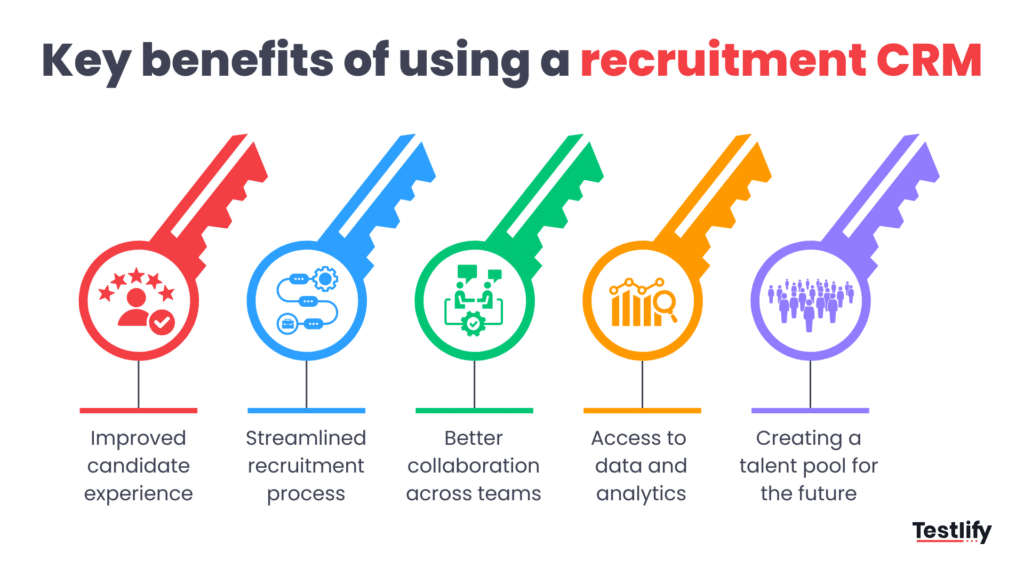
1. Improved candidate experience
In a tight job market, smooth and professional candidate experience becomes very important to attract the best talent. Indeed, positive candidate experience affects the candidate’s perception of a company, even if the latter is not selected for a position.
55% of job seekers state that how a company treats them during hiring determines whether they would be interested in working for the company again.
A Recruitment CRM ensures consistency and timely communication with candidates who feel valued and develop a transparent process.
This is further enhanced by sending personalized emails, reminders, and status updates using automation tools to reduce delays while keeping the candidate engaged.
2. Streamlined recruitment process
It may have many repetitive activities in recruitment, such as scheduling interviews, sending follow-up emails, and updating candidate records.
A recruitment CRM will help streamline much of this process and let you focus on the more important parts of the hiring process: interviewing and deciding.
Automating routine processes can help cut time-to-hire dramatically. For instance, the Aberdeen Group found that companies that implement automation in their recruitment process were able to cut their average time-to-hire by 30%.
The more you are free from administrative tasks, the more you’ll spend looking for the right candidate.
3. Better collaboration across teams
Hiring is rarely ever an activity that one does alone. It usually coordinates with HR, the hiring manager, and key stakeholders. Recruitment CRM helps keep everyone on the same page by centralizing information about candidates, feedback, and progress.
The hiring manager can access a candidate’s profile, leave comments, and track the status of a candidate without needing endless meetings or emails.
This collaborative approach increases transparency and helps the hiring process more coherent and efficient. A study by SHRM found organizations with collaborative hiring processes will improve their time-to-hire and candidate quality 2.5 times.
4. Access to data and analytics
The most important benefit of using a Recruitment CRM is its ability to analyze recruitment data. It offers in-built reporting that tracks your recruitment channels’ effectiveness and checks on the progress of an individual candidate. It provides you with KPIs such as time-to-hire, cost-per-hire, and quality of candidates.
Therefore, with all the above insights, you have more choices, refine and better strategies, and optimize your hiring procedures over time. Studies show that companies using recruitment analytics are 20% more likely to be self-assured in their hiring decisions.
5. Creating a talent pool for the future
Talents are not always available when you may need them. With a Recruitment CRM, you can maintain a talent pool or a pool of qualified candidates whom you may have rejected for a specific role but whom you can reach out to later when a similar role is available.
56% of candidates say they’d be open to considering a future job offer from a company they’ve previously interviewed with, even if they weren’t hired for the initial role. By nurturing these relationships through your CRM, you’ll have a ready-made pool of candidates to tap into when new roles arise.
Key features of a recruitment CRM
1. Centralized candidate database
This digital filing cabinet may hold everything from resumes to application forms, interview notes, and feedback. Centralization makes tracking down the candidate’s information much easier when needed and ensures that no candidate is ever missed.
2. Automated communication
The recruitment CRM also has other strong features, such as automated communication. It can also send personalized emails with scheduling and reminders for interviewing to follow through. All these help the HR team save time while ensuring proper communication on schedule rather than being sporadic.
3. Job posting integration
Most CRMs connect job boards and social media; hence, posting jobs on all the platforms can be as easy as a click. Integration ensures higher visibility, which calls in more candidates.
4. Interview and scheduling tools
The interviewing schedule may become a logistical nightmare, but you can smoothen this process using a Recruitment CRM. Interview scheduling tools are available with most CRMs wherein candidates may choose the times they prefer rather than playing back-and-forth email games.
5. Talent pool management
As has been said, a CRM helps you build a talent pool for future hiring. It categorizes the candidates by their qualifications and skills so that you never run out of candidates ready for the next hire.
6. Reporting and analytics
A good CRM does not just store the data but helps you understand it. With powerful analytics and reporting capabilities, Recruitment CRM gives you the insight to optimize hiring strategies, track KPIs, and measure recruitment success.
How to choose the right recruitment CRM for your organization?
There are far too many choices in Recruitment CRM; hence, the right choice depends on your business. Here are some points that come into the scene:
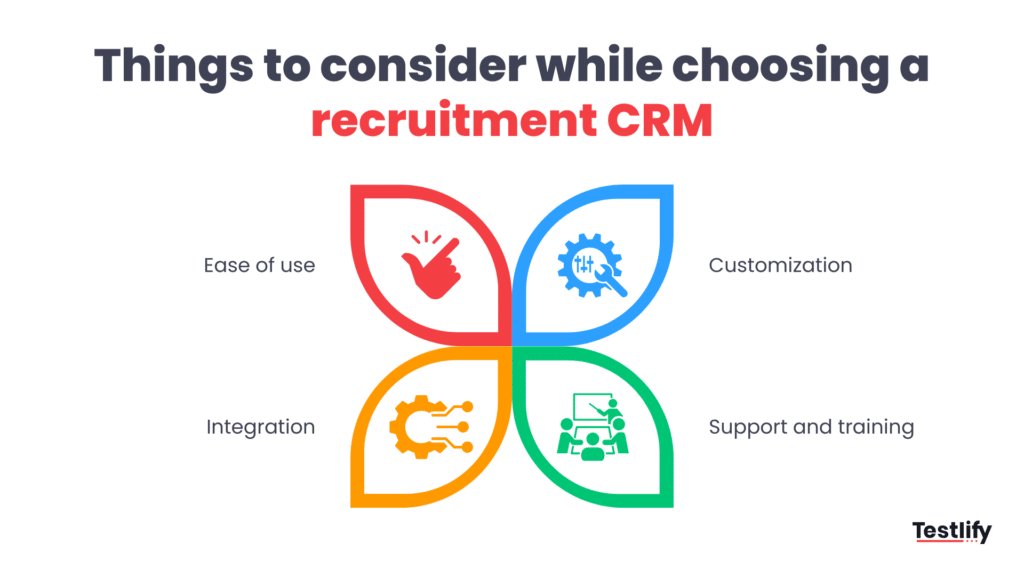
1. Ease of use
It has to be an intuitive, simple CRM that your team will adopt. The less time it takes to train your team, the better.
2. Customization
Your recruitment process may be unique, and therefore, a CRM must be able to adapt to its uniqueness. Hence, look for customization aspects related to workflows, candidate pipelines, and reporting.
3. Integration
A Recruitment CRM should marry with the tools you already use- ATS, HRIS, and job boards. Then, it will make sure there are no data silos in the hiring process running smoothly.
4. Support and training
You would find a CRM provider that offers great customer support and resources for training in getting the system to the fullest extent for your team.
Conclusion
A recruitment CRM is a tool that any HR team needs to streamline its hiring process, attract the best talent available, reduce inefficiency, and enhance candidate experience by centralizing candidate information, automating communications, and offering valuable insights.
The right tools in dealing with and engaging candidates are not just nice to have but a must in the competitive world of job recruitment. Recruitment CRM is slowly becoming the new front-runner for your team, which will make better and more informed hiring decisions.
Frequently asked questions (FAQs)

Content Writer
Yashika Khandelwal is a Content Writer with 3+ years of experience creating research-backed content on hiring, talent assessment, and HR technology. She is a registered Organizational Psychologist and subject matter expert who combines behavioral science with practical recruitment insights to produce accurate, evidence-based content.
LinkedInRelated resources
View all
HR & recruitment
Compassionate leave: A guide for HR and employees

HR & recruitment
What is E-Recruitment? Pros, cons, strategies for 2026

HR & recruitment
11 core HR functions every recruiter should know in 2026

HR & recruitment
Interview to hire ratio: A complete guide for hiring teams

HR & recruitment
Revenue per FTE: Formula, Benchmarks, and How to Improve It

HR & recruitment
What is job restructuring and how to do it?
Get started.
Hire on proof, not resumes.
Run your first skills-based assessment free — no credit card required.