
What is job restructuring and how to do it?
Learn what job restructuring is, its types, benefits, and challenges. Discover how to restructure roles effectively while ensuring legal compliance.

Job restructuring is changing what a job contains: which tasks sit inside it, which duties move out, who it reports to, and what a person needs to be good at to do it well. The role survives. The work inside it changes.
That distinction is where most of the confusion starts. People hear "restructuring" and think job cuts. Sometimes it ends there. Often it doesn't.
 ChatGPT
 Gemini
 Claude
 Grok
Grok Perplexity
TL;DR
- Job restructuring changes the contents of a role, not the headcount. Downsizing and redundancy remove people; restructuring moves work around.
- In the US the term also carries a legal meaning. Redistributing the marginal parts of a job is one of the named reasonable accommodations under the Americans with Disabilities Act.
- Run it in five steps: map the work that really happens, design the target role, consult the people in it, match people to the new role on evidence, then review after 90 days.
- The step teams skip is the last one that matters: re-checking who actually fits. A restructured job is a new job, so yesterday's read on who can do it is stale.
- Employers expect 39% of workers' core skills to change by 2030, so the roles you write today are already drifting. Restructuring is maintenance, not an emergency.

What is job restructuring?
Job restructuring is the deliberate redesign of an existing role: adding tasks, removing them, shifting reporting lines, or changing how and when the work gets done. It targets the job, not the person. Done well, the role comes out clearer and better matched to what the business now needs.
Think of a job as a container. Over time people drop things into it. A support lead picks up billing questions because they sat near finance. A designer inherits the website because nobody else would. Two years on, the container holds a job nobody designed and nobody would hire for.
Restructuring empties the container, sorts what is in it, and decides what belongs. Some tasks go back to the team that owns them. Some get automated away. Some get promoted into the core of the role. What is left is a job you could write a real job description for.
Horizontal and vertical job restructuring: types of job restructuring
Job restructuring does not always mean creating a new position. In many cases, it means changing the scope of an existing role to match new business needs. The two common approaches are horizontal and vertical restructuring, and the distinction matters because each affects skills, accountability, compensation, and career progression differently.
Aspect | Horizontal restructuring | Vertical restructuring |
|---|---|---|
What changes | Adds duties of similar scope and difficulty | Adds authority, judgment, ownership, or people responsibility |
Skill effect | Broadens the range of tasks the employee can handle | Increases the level of decision-making and leadership required |
Example | An accounts clerk takes on supplier reconciliation and invoice tracking | A support agent becomes responsible for a shift, team, or escalation process |
Pay implication | May not require a pay change if the role remains within the same level | May require a new salary band or promotion |
Main HR risk | Workload increases without a corresponding change in title, pay, or development | Employee is given managerial responsibility without the skills or authority to perform it |
What recruiters should assess | Whether the employee has the additional technical skills needed | Whether the employee can handle greater ownership, judgment, and leadership |
For recruiters and HR teams, the important question is not simply “what new tasks are we adding?” it is “has the level of the job changed?” adding related responsibilities may broaden a role without changing its level. Adding decision-making authority, budget ownership, team management, or accountability for business outcomes can move the role into a different job level and should trigger a review of the job description, competency requirements, and compensation band.
Horizontal restructuring can also create scope creep when additional responsibilities are added gradually without formally updating the role. If an employee is consistently performing work that sits above the original job level, recruiters and HR should review whether the role has effectively become a different position rather than treating the extra work as an informal addition.
Job restructuring vs downsizing and redundancy
Job restructuring, downsizing, redundancy, reassignment, and demotion can all appear during workforce changes, but they describe different actions. Recruiters need to distinguish them because each has different implications for headcount, employee communication, job descriptions, and workforce planning.
Term | What it does | Does headcount fall? | What recruiters should consider |
|---|---|---|---|
Job restructuring | Changes the duties, scope, skills, or reporting structure of a role | Not by itself | Update the role profile and reassess the skills required |
Downsizing | Reduces the overall workforce, usually to reduce costs or align capacity with demand | Yes | Identify affected roles, required capabilities, and future workforce needs |
Redundancy | Removes a position because the business no longer needs that work in its current form | Yes, for the affected role | Determine whether the work has disappeared or can be redistributed or redesigned |
Reassignment | Moves an employee into another existing or newly structured role | No | Assess whether the employee's skills match the requirements of the new role |
Demotion | Moves an employee to a lower level of responsibility or authority | No | Review the reason, role level, compensation, and applicable employment requirements |
A restructure can happen without reducing headcount. For example, a company may combine overlapping responsibilities, create broader roles, move employees between teams, or introduce new skills without eliminating positions.
The key recruiting question is what happens to the work after the restructure. If the work still exists but the role has changed, the company may need reskilling, reassignment, or external hiring. If the work no longer exists, redundancy may be appropriate. If the business simply has fewer roles than it needs people to fill, that is a workforce reduction issue rather than job restructuring alone.
Why do companies restructure jobs?
Companies usually restructure jobs for one of three reasons: the work has changed, the current structure no longer fits the work, or an employee needs a role adjustment to meet a specific requirement.
The first two are business decisions. The third may involve legal or workplace obligations and needs to be handled differently.
5 Business reasons to restructure a job
1. Technology has changed the work
New tools can automate repetitive tasks while creating demand for new skills. A role may need less manual processing and more analysis, quality control, or oversight.
2. The team has outgrown the original structure
A generalist role that works well on a 12-person team may become inefficient when the team reaches 40. Restructuring can split responsibilities, create specialist roles, or add management layers.
3. Business priorities have changed
When a product, market, or service is scaled back, some roles may end up with responsibilities that no longer match the business. Restructuring can redistribute that work instead of leaving outdated responsibilities in job descriptions.
4. Work is overlapping across roles
Two employees or teams may gradually take ownership of similar tasks. Clarifying responsibilities can reduce duplication and make accountability easier to define.
5. The company needs a stronger career path
A role with no clear progression can make retention harder. Expanding responsibilities or creating a higher-level version of the role can give employees a clearer path to develop new skills and take on more ownership.
For recruiters, the important step is to reassess the job before hiring against the old version of it. If the responsibilities, tools, or level of ownership have changed, update the job description and competency requirements first. Otherwise, you may hire for a role that no longer exists in the same form.
What restructuring work looks like in practice
Skills are the clock everyone is watching. The World Economic Forum's Future of Jobs Report 2025 found that employers expect 39% of workers' core skills to change by 2030. That is down from 44% in the 2023 edition, and over the same period the share of workers completing training as part of a long-term plan rose from 41% to 50%.
Read that as a maintenance schedule rather than a warning. If roughly two fifths of what a role demands turns over within five years, a job description written once and filed is wrong long before anyone reopens it. The teams that handle this well treat role design as something they revisit on a cycle, the way they revisit budgets. The ones that don't end up with a skills mismatch they have to fix under pressure.
Is job restructuring a reasonable accommodation?
Yes. Under the Americans with Disabilities Act, job restructuring is one of the named forms of reasonable accommodation an employer may need to provide to a qualified employee with a disability. In that context it means redistributing duties or changing when and how the job is done, not redesigning the role for business reasons.
This is the half of the topic most articles drop, and it is the half with legal consequences. The business version of restructuring is discretionary. The accommodation version can be required.
Workplace restructuring guide: the 5 steps
Here is the sequence that holds up in practice. It works for a single role or for a whole team, and the order matters more than the paperwork.
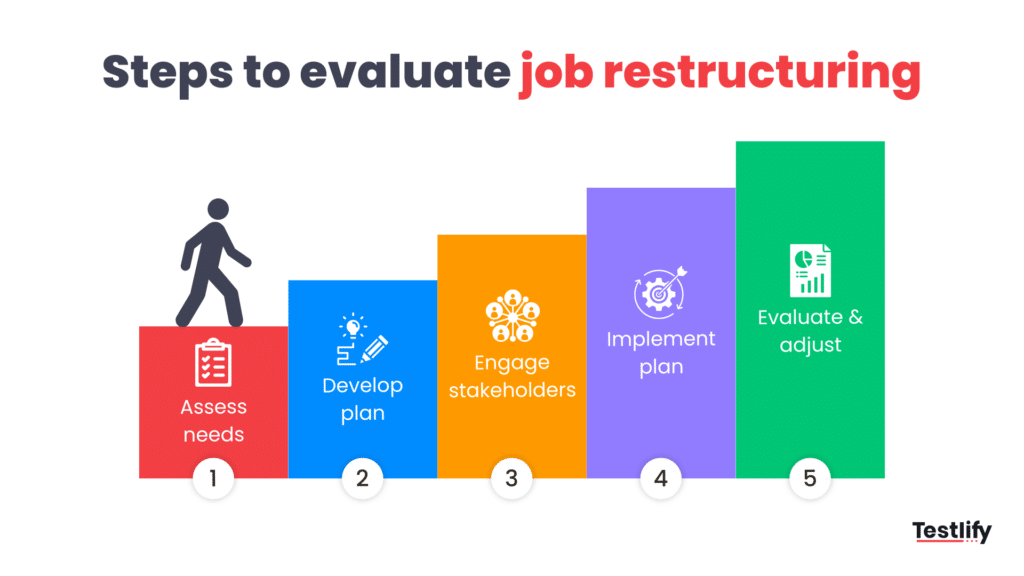
Step 1: Map the work that actually gets done
Not the job description. The work. Ask the people in the role to list what they did last month and how long each thing took. You will find duties nobody assigned, duties nobody needs, and one person quietly holding a process together.
This is unglamorous and it is the step that decides whether the rest is real. A restructure designed from out-of-date documents just moves fiction around.
Step 2: Design the target role on paper
Write the role you need, not the role you have. List the outcomes it owns, the duties that deliver them, and the competencies those duties demand. Mark each competency as required at hire or trainable within 90 days. That single mark is what later tells you whether to redeploy someone or recruit.
Step 3: Consult the people in the role
Talk to them before the design is locked, and mean it. Two reasons. They know which duties are load-bearing, and you will be wrong about at least one. And in many jurisdictions, consultation before a change to terms is a legal step, not a courtesy. In the UK, collective consultation rules require it to start at least 30 days before any dismissal when 20 to 99 roles are affected, and 45 days at 100 or more.
Tell people plainly whether jobs are at risk. Vagueness reads as bad news, so ambiguity costs you the people you were trying to keep.
Step 4: Match the new role to evidence, not tenure
Here is the part almost everyone gets wrong. The role changed, so the question of who fits it changed too, and the answer from before the redesign no longer applies. Teams still default to whoever held the old job longest.
The Testlify Competency-to-Evidence Matrix is built for this. It maps a role to the competencies that matter, then connects each competency to measurable evidence through assessments, simulations, interviews, references and structured reviewer feedback. Applied to a restructure, it turns a redesigned job description into a short list of things you can actually check, so redeployment decisions rest on what people can demonstrate rather than on who has been there longest.
Say a 200-person agency merges two coordinator roles into one that now owns client reporting. Three people want it. A structured assessment of the two new competencies (data handling and client communication) takes each of them under an hour, and the decision stops being a popularity contest. The two who miss get a named gap and a training plan instead of a shrug.
Step 5: Review after 90 days
Put the date in the calendar during step 2, before anyone is invested in the redesign being right. Check three things: is the new workload real, did the duties you moved out actually land somewhere, and are the people in the role still there.
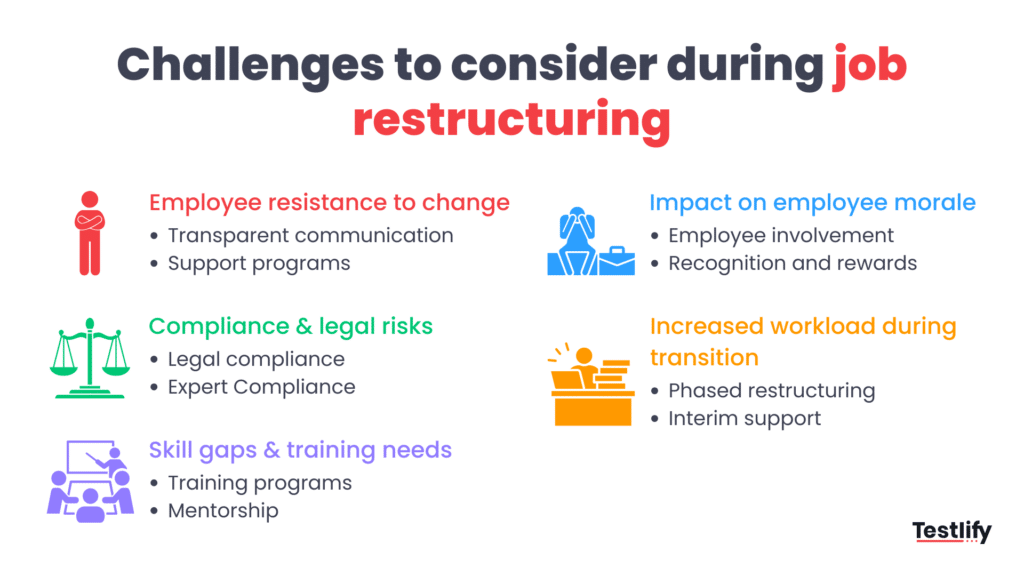
What goes wrong in a job restructure?
Most failures are not design failures. They are communication failures wearing a design costume.
How do you know the restructure worked?
Decide the measures before you start, because afterwards everyone grades on a curve. Four hold up well.
- Duty coverage. Every duty from step 1 sits in exactly one role. Orphaned tasks are the most common residue of a rushed redesign.
- Time to competence. How long until people in the new role hit the benchmark you set in step 2. If it runs past 90 days, the role was designed beyond what the training supports.
- Retention in the affected group. Track it against the rest of the company for two quarters, not two weeks. Restructure-driven exits show up late.
- Manager load. If spans of control moved, check whether managers now carry more reports than they can support. Restructures quietly create 12-report managers all the time.
None of these need a new system to track. A spreadsheet and a calendar reminder cover it, and a measure you actually check beats a dashboard you don't.
Hire for the restructured role with evidence
Once a role changes, the old shortlist logic stops working. Testlify helps you define what the new role demands and test for it directly, with role-based and custom assessments, work simulations, weighted scoring and structured reviewer feedback, so redeployment and hiring decisions rest on demonstrated skill. Book a demo and see how it maps to a role you are redesigning right now.
Frequently asked questions (FAQs)

B2B SaaS Content Writer
Rishav Kumar is a B2B SaaS content writer with 4 years of experience. He loves crafting engaging content. Always exploring fresh ideas, he's passionate about helping businesses grow through impactful writing.
LinkedInRelated resources
View all
HR & recruitment
Cost-effective employee training solutions: using SCORM-compliant authoring tools to create E-learning courses

HR & recruitment
7 tips on recruiting students for HR professionals

HR & recruitment
HR budget 101: A comprehensive guide for 2026

HR & recruitment
16 innovative recruitment strategies in 2026
![13 most common HR issues [and solutions]](/api/media/file/13-most-common-HR-issues-and-solutions-2.png?dpl=dpl_6Z8Gzi5dgny5ePrnCfPbRPCRYCA7)
HR & recruitment
13 most common HR issues [and solutions]

HR & recruitment
Global recruitment: benefits, models, and best practices
Get started.
Hire on proof, not resumes.
Run your first skills-based assessment free — no credit card required.