
In-app telephone screening for faster, better interviews
Discover how in-app telephone screening streamlines hiring, saves recruiter time, and improves candidate evaluation with voice AI.

When it comes to hiring, a telephone screening is important. But it’s also time-consuming, repetitive, and hard to scale. You’ve likely felt the crunch of scheduling dozens (or hundreds) of screening calls, only to find that many candidates aren’t even the right fit.
Wouldn’t it be better if you could automate that first call without losing the human touch?
Enter in-app telephone screening. It’s not just a new way to screen candidates, it’s a smarter, faster, and more scalable approach. In this blog, we’ll explore how in-app screening is transforming hiring for enterprise HR teams, why it matters now more than ever, and how tools like Testlify’s voice AI make it surprisingly simple to implement.
 ChatGPT
 Gemini
 Claude
 Grok
Grok Perplexity
Why the traditional phone screen is holding you back
For large organizations, the traditional screening approach slows down hiring, strains recruiter bandwidth, and makes it harder to deliver a fair and efficient candidate experience. It’s time-consuming, inconsistent, and provides limited insights making it a costly step in high-volume recruitment.
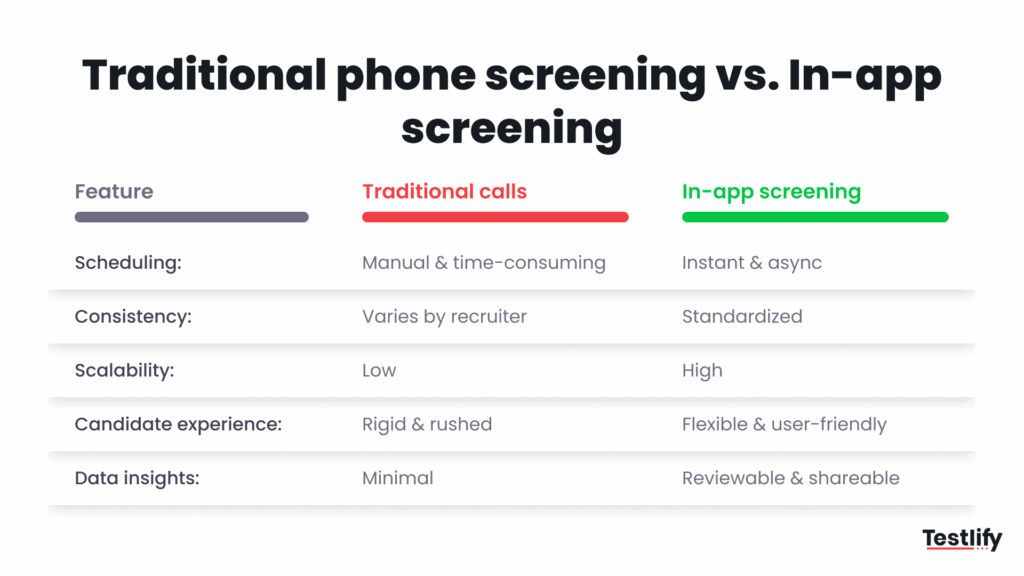
The scheduling struggle is real
Coordinating live phone calls with candidates is a logistical headache. Recruiters spend hours juggling calendars, sending reminders, and dealing with no-shows. Multiply that by dozens or hundreds of applicants, and it quickly becomes a major bottleneck in the hiring process. This not only wastes valuable recruiter time but also slows down the overall pipeline causing delays in identifying top talent and extending offers.
Consistency is hard
Even with a structured script, traditional phone screens vary from one recruiter to another. Differences in tone, delivery, and follow-up questions can unintentionally introduce bias and create unequal candidate experiences.
This lack of standardization makes it harder to compare candidates fairly and reliably. For enterprise teams, maintaining consistency across hundreds of interviews becomes nearly impossible without a more controlled and scalable approach.
Limited insights, high cost
Phone screens offer minimal data for decision-making. Recruiters may miss key verbal cues or struggle to document everything accurately. You can’t easily search, share, or review voice responses after the fact.
Plus, each call eats up 15–30 minutes adding significant cost at scale. For enterprise hiring, this translates into hundreds of hours and dollars spent on a process that yields limited actionable insights.

What is in-app telephone screening?
In-app telephone screening is a modern hiring practice where candidates respond to pre-recorded screening questions within an app or platform, using audio responses. Think of it like a voice-based interview but automated and asynchronous.
Instead of a recruiter making a live call, candidates record their answers at their convenience. Recruiters can then review, rate, and compare responses on their own time.
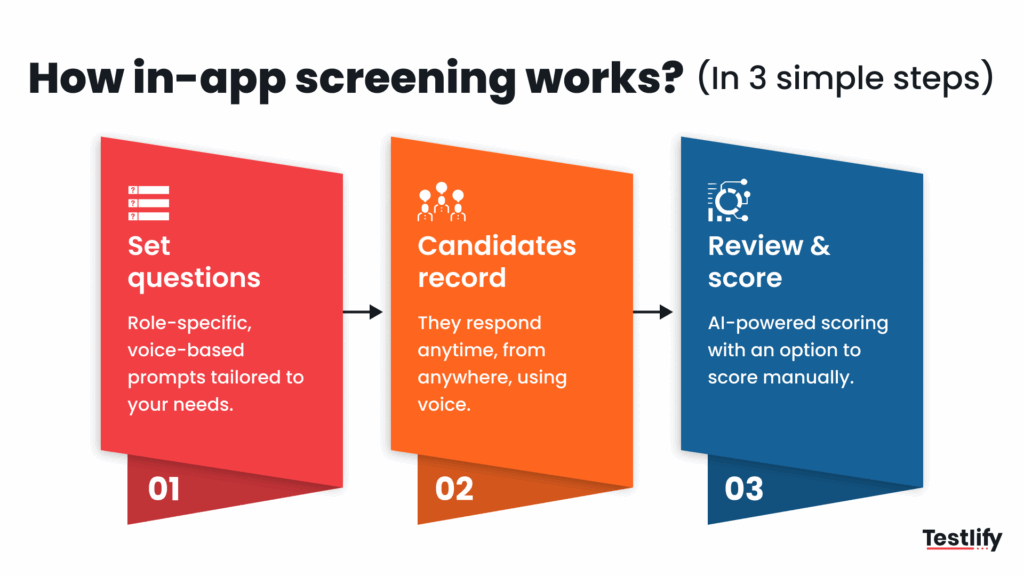
How it works?
- You set the questions– These could be role-specific or general screening questions.
- Candidates record their answers– They speak their responses directly into the app, usually from their phone or computer.
- You review and assess- Hiring teams get the results with an option to also assess and score manually.
Why in-app telephone screening is a game-changer for enterprise hiring?
Hiring teams require tools that can move quickly without compromising quality. In-app telephone screening offers a powerful way to streamline early-stage interviews, improve consistency, and save recruiter hours. It’s not just a time-saver, it’s a strategic upgrade to your hiring process.
1. Save recruiter hours every week
When you remove the need to call every candidate live, recruiters gain back hours each week. Those hours can be spent on sourcing, relationship-building, or moving top candidates faster through the pipeline.
With tools like Testlify’s voice AI screening, you can screen hundreds of candidates in the time it takes to do a handful of phone calls manually.
2. Increase consistency and reduce bias
Since every candidate hears the same questions recorded exactly the same way, you eliminate variability in how interviews are conducted. This creates a level playing field and promotes a fairer hiring process.
3. Evaluate communication skills more effectively
Whether you’re hiring for sales, customer service, or any client-facing role, communication skills are key. Hearing a candidate speak gives you immediate insights into tone, clarity, and confidence.
Using in-app screening, you can:
- Compare how different candidates respond to the same prompt
- Identify hesitation or fluency issues
- Share standout answers with hiring managers instantly
4. Speed up decision making
Instead of waiting days to schedule calls, you can start evaluating candidate responses within hours of their application. This speed is especially critical in high-volume or competitive hiring environments.
When does in-app telephone screening work best?
While in-app voice screening can benefit almost any hiring workflow, it shines especially bright in certain scenarios.
From high-volume roles to communication-heavy positions, this method gives recruiters the clarity they need to make better decisions fast. Here are a few key situations where it delivers the most value.
High-volume hiring
When you’re hiring at scale, hundreds or even thousands of candidates, manual phone screens aren’t sustainable. Industries like retail, hospitality, and customer support often face this challenge.
In-app telephone screening streamlines the process by automating initial calls, allowing recruiters to review responses efficiently. It saves time, reduces burnout, and ensures no qualified candidate gets overlooked due to scheduling delays or bandwidth issues.
Customer-facing roles
For roles like sales, account management, and customer support, strong verbal communication is non-negotiable. In-app voice screening lets you assess tone, clarity, and confidence early before committing time to interviews.
It helps identify candidates who can represent your brand effectively over the phone or in meetings, ensuring you prioritize applicants who already demonstrate the interpersonal skills vital to client-facing roles.
Screening for soft skills
Soft skills like empathy, professionalism, and confidence are tough to gauge from resumes or written responses. But with in-app telephone screening, you hear how candidates communicate giving you valuable insight into their personality and behavior.
The tone of voice, pace, and delivery reveal how they may handle real-life scenarios, especially in high-pressure or people-oriented roles. It’s a more human way to evaluate human qualities.
How does Testlify make in-app screening effortless?
Testlify’s in-app telephone screening feature is built for modern HR teams. It uses voice AI to create a seamless experience for both candidates and recruiters.
Here’s what sets it apart:
Customizable screening questions
With Testlify, you have full control over the screening questions. Whether you want to keep it light or dig into real-world scenarios, you can tailor prompts to match each role. From handling customer complaints to resolving team conflicts, you can assess exactly what matters making it easy to identify candidates with the right mindset and communication style from the very first interaction.
Review responses anytime, anywhere
Say goodbye to calendar chaos and back-to-back calls. With Testlify AI-powered scoring system, candidates’ responses are scored based on multiple factors. Testlify also lets you review candidate responses with an option to score manually.
This flexibility means recruiters and hiring managers can evaluate on their own time, reducing delays and helping you move top candidates forward quickly without the usual scheduling bottlenecks.
Shareable with stakeholders
Testlify makes collaboration easy. Instead of relaying notes or scheduling extra interviews, you can share actual results directly with hiring managers or team leads. It’s a faster, clearer way to align on candidates and ensures decision-makers hear the same unfiltered communication that recruiters do. Everyone stays on the same page without extra calls or back-and-forth.
Built into the candidate journey
In-app voice screening is part of the seamless experience Testlify offers. There’s no need to jump between platforms, send separate links, or manage calls manually. Candidates complete everything in one place keeping the process smooth, simple, and professional. For recruiters, it means full control and visibility without ever leaving the platform. No friction, no confusion just a smarter workflow.
What candidates think (Spoiler: They like it)
You might wonder won’t candidates find it awkward?
Surprisingly, most candidates prefer asynchronous voice interviews. Here’s why:
- They can respond when they’re ready, no pressure, no surprises.
- They don’t have to block time or coordinate schedules.
- It feels more modern and less intrusive than a cold call.
And because Testlify’s platform guides them through each step, even less tech-savvy candidates find it easy to use.
Best practices to get the most out of in-app screening
To maximize the impact of in-app telephone screening, it’s important to apply a few proven strategies. The right setup and structure can ensure a smooth experience for both candidates and your team. Follow these best practices to keep the process efficient, consistent, and effective.
Keep it short and focused
Limit your in-app screening to 3–5 well-crafted questions that align with the role’s key requirements. You’re not conducting a full interview; you’re gathering enough insight to determine who should move forward.
Focus on high-impact prompts that reveal communication skills, role understanding, and cultural fit. A short, focused approach keeps candidates engaged and makes your team’s review process faster and more effective.
Set time limits
Give candidates a fixed time like 60 to 90 seconds per question to keep responses concise and on-topic. Time limits help reduce rambling and ensure candidates get straight to the point. It also makes reviewing easier and more efficient for your team.
Testlify allows you to set time parameters for each question, helping standardize responses while keeping the candidate experience smooth and structured.
Standardize evaluation
Use a consistent scoring rubric to evaluate candidate responses fairly. Criteria like clarity, tone, and content should be rated using the same benchmarks across all candidates. Testlify enables you to rate, comment, and even collaborate with team members all within the platform. This not only ensures objectivity but also makes comparisons more accurate and easier to share with hiring stakeholders.
Combine with other assessments
While voice responses provide valuable soft skill insights, combining them with skill-based assessments offers a more complete picture. Pairing voice screening with role-specific tests, like cognitive ability or situational judgment, helps you assess both what a candidate knows and how they communicate. With Testlify, you can integrate voice and skill assessments into a single workflow, streamlining the hiring process without compromising depth.
Final thoughts: Hiring smarter, not harder
In today’s talent landscape, speed and quality can’t be at odds. You need to move fast and make smart decisions. In-app telephone screening helps you do both.
It frees up your recruiters, improves consistency, and gives you richer insights early in the process all while creating a better experience for candidates.
If you’re already using a talent assessment platform like Testlify, the good news is: you’re halfway there.
With built-in audio interview tools powered by voice AI, you can modernize your screening process in days not weeks. And your team (and candidates) will thank you for it.
Ready to try It? Testlify’s audio interview feature is ready when you are.
Whether you’re screening 50 candidates or 5,000, in-app voice screening can help you make faster, better hiring decisions, without burning out your recruiters.
Curious to see it in action?Book a demo or start your free trial today.
Frequently asked questions (FAQs)

Content Writer
Yashika Khandelwal is a Content Writer with 3+ years of experience creating research-backed content on hiring, talent assessment, and HR technology. She is a registered Organizational Psychologist and subject matter expert who combines behavioral science with practical recruitment insights to produce accurate, evidence-based content.
LinkedInRelated resources
View all
HR tools
25 Top interviewing platforms

HR tools
What is AI proctoring and why it matters in certification

HR tools
Prioritization matrix: What it is & how to use it effectively
HR tools
What is timesheet management? Benefits and best practices
![What are HR SOPs and how to create them? [+Free template]](/api/media/file/Blog_featured_image_37-2.png?dpl=dpl_9Ai1hrmD1YZ8yPSLhy5MhtJd5zy3)
HR tools
What are HR SOPs and how to create them? [+Free template]

HR tools
What is HR automation? Benefits, use cases, and how to get started
Get started.
Hire on proof, not resumes.
Run your first skills-based assessment free — no credit card required.