
What is AI proctoring and why it matters in certification
AI proctoring secures certification exams, meets AI Act rules, cuts fraud, and boosts candidate trust. See Testlify’s bias-audited, audit-ready solution.
Online testing gained momentum during the pandemic and has continued to grow, but misconduct has also ballooned with it.
Studies now indicate that trickery in unsupervised digital exams reaches as high as 70% of test-takers in some cohorts, triple the rates seen in traditional classrooms.
That erosion of trust carries a price tag: every invalidated credential forces retakes, candidate churn, and a loss of credibility for the issuing body. Enter AI proctoring.
 ChatGPT
 Gemini
 Claude
 Grok
Grok Perplexity
What is AI proctoring?
AI proctoring is software that monitors a candidate’s webcam, screen, keystrokes, and background audio in real-time, using computer vision and machine learning models to flag behavior that appears to be cheating.
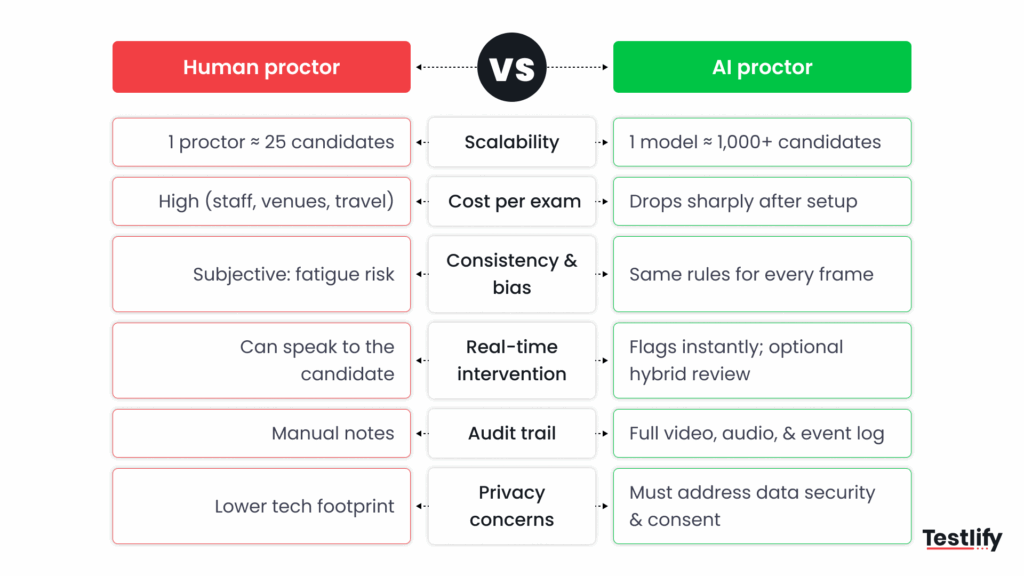
Unlike a human invigilator, the system scales to thousands of test-takers at once and logs every event for later audit.
How does a modern AI proctoring work?
The goal of AI proctoring is to maintain test fairness while protecting candidates’ privacy and avoiding overloading them. It combines computer vision and audio cues to assist hiring teams and recruiters in identifying warning signs.
Let’s examine how it functions in actual evaluations:
Step 1: Consent & tech check
Candidates complete a 30-second system check (camera, microphone, and internet) and accept a privacy notice before proceeding. If they choose not to participate, no data is collected.
Step 2: ID and face match
The candidate must upload a legitimate ID (such as a government-issued identification card) and take a live selfie before proceeding.
The AI determines whether the individual in the selfie is the same person who registered for the test and whether they match the ID. This puts an end to impersonation right away. For privacy-sensitive programs, it can help to keep biometric checks lightweight and data-minimizing. One option is a face recognition SDK that supports identity verification on mobile, web, and desktop, and is secure by design with no user data collected.
Step 3: Live face presence detection
The camera tracks whether the candidate is present and paying attention once the test starts. The system raises a gentle alert if the subject consistently looks away, vanishes, or someone else enters the frame, but it doesn’t track eye movement with laser precision.
Testlify generates a 360-degree view of the testing environment through dual-camera proctoring driven by AI. A second camera, usually from a phone behind the candidate, records the entire setup in real time while the candidate uses their laptop webcam as usual.
This panoramic perspective helps the AI:
- Look for any devices or side notes on the desk.
- Find out who else is in the room,
- Monitor head movements and body posture, providing additional context.
It’s subtle yet effective. Testlify’s model comprehends behavior rather than merely identifying misconduct. And that means better flagging and a fairer evaluation for everyone.
Step 4: Voice and sound monitoring
AI can listen for unexpected sounds, such as a phone call, a second voice, or loud noises in the room, if it is enabled.
Private conversations are not recorded, but they highlight any indications that outside assistance may be needed. Reviewers can assess the test setting’s integrity with the help of these alerts.
Step 5: Behavioral & screen activity analysis
Modern proctoring systems flag suspicious activity for later human review, rather than locking users out or assigning instant scores.
For example, when a candidate leaves their seat or there is too much background noise, a recruiter or test administrator can review the flagged moments and determine whether they are worth addressing.
Step 6: Human review & transparent reports
Every flag is time-stamped and clipped. Recruiters (never the algorithm alone) decide whether an event was innocent, e.g., a pet walking by, or genuine misconduct.

Why certification programs can’t ignore exam fraud
Remote testing unlocked global reach, but it also unlocked the door to industrial-scale trickery. Three trends make the threat impossible to shrug off:
- Misconduct is no longer fringe. Industry watchdogs report that question-theft (“pre-knowledge”) and impersonation schemes now surface in every major credentialing field.
- The financial penalties are brutal. Accounting giant KPMG was fined US$25 million after hundreds of staff shared certification-maintenance exam answers.
- Market dollars follow the risk. Analysts now peg the online exam-proctoring market at US$868.9 million in 2024, rising to US$2.35 billion by 2031 (15.5 % CAGR).
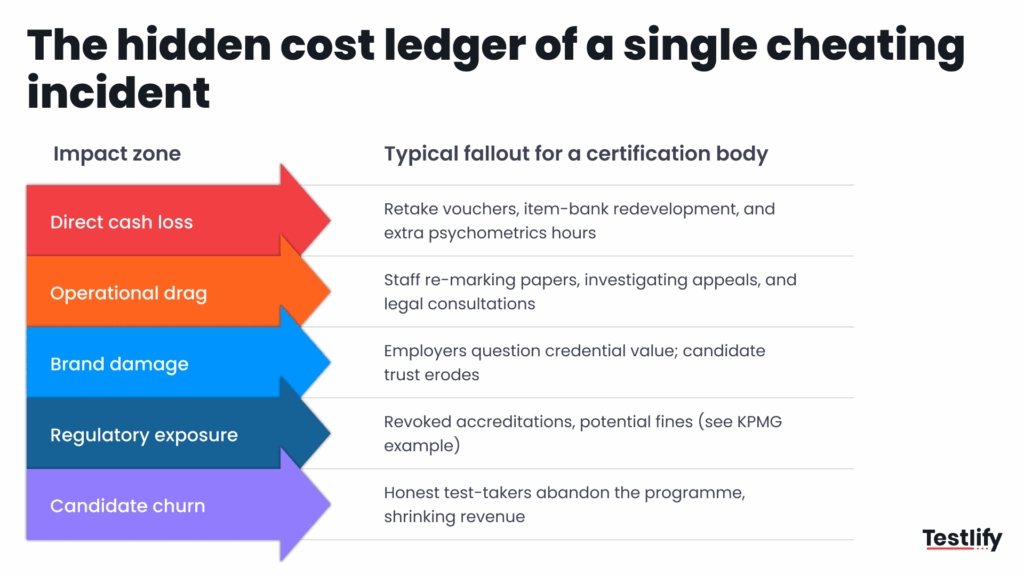
Even before reputational loss is tallied, internal audits estimate that invalidating and re-issuing a mid-sized professional exam can exceed US$150,000 in rewrite costs alone, and that figure balloons when thousands of candidates are involved.
Bottom line: guarding certification integrity is not optional compliance hygiene; it is a balance-sheet imperative. That is why AI proctoring has become the default first line of defence.
Benefits that go beyond “catching tricker”
Certification bodies that have rolled it out at scale report gains on three fronts: money saved, candidate experience lifted, and compliance challenges neutralised.
Hard-dollar ROI: Test-centre costs vs. cloud seats
Every physical test centre needs rent, utilities, hardware, and at least two invigilators. Kryterion estimates that shifting a 200-seat exam online reduces direct delivery costs by 40–60% per sitting.
Candidate convenience = Higher completion rates
Remote windows run 24/7 in every time zone, eliminating “exam-day churn” caused by travel delays or limited seating. Early adopters report that registration-to-completion rates climbed by 12–18% once remote slots became available.
Instant, audit-ready compliance
The EU AI Act, NYC Local Law 144, and ISO 27001 audits now require transparent logs and algorithmic fairness testing.
It matters because KPMG’s US$25 million fine for answer sharing demonstrated that regulators treat exam fraud as a governance breach. Clean audit trails are now a license-to-operate feature.
Scalable surge capacity
Certification cohorts often spike after changes to the syllabus or fiscal-year deadlines. Human proctors max out fast, but Testlify‘s cloud model autopools GPU resources; you can run 10,000 parallel sessions.
Higher brand trust
Academic studies have found that well-designed AI proctoring with clear privacy cues reduces test-taker stress compared to unfamiliar test-center environments.
Testlify’s onboarding flow clearly indicates what data is captured and when it is automatically deleted, turning a potential surveillance concern into a transparency win.
How Testlify’s AI proctoring truly stands apart
AI Proctoring Capability | Testlify | Other Platforms |
|---|---|---|
Dual‑Camera 360° Monitoring | Laptop + mobile (tablet/phone) cameras give a full-view environment continuously | Typically single-view only |
Real-Time Identity Match (Face + Voice) | Combining facial recognition with voiceprint verification during the test | Usually face-only or periodic liveness checks |
Attention Tracking with Heatmaps | Live analysis of head position and gaze patterns through video feed | Usually flagged after review |
Audio & Speech Monitoring | AI flags extra voices, background noises, and pings in real-time | Often requires manual review |
Screen & Behavior Tracking | Detects tab switches, copy-paste, full-screen enforcement, and mouse-outs | Some or paid add-ons |
Snapshot & Session Logging | Periodic snapshots + full HD video logs with timestamps | Incomplete or unavailable |
Human-in-the-Loop Review | Flags reviewed by administrators—not auto-blocked | Some auto-terminate sessions |
GDPR & Privacy Respect | Consent-driven, encrypted storage, controlled retention policies | Privacy varies by vendor |
Data Deletion | The candidate can revoke consent; data will be wiped in ≤ 30 days | Manual ticket |
What the table shows
- Complete Visibility: Dual-camera monitoring ensures nothing escapes detection.
- Deep identity assurance: Vision and voice biometrics ensure the test taker is the registered candidate.
- Live attention insights: AI-generated heatmaps display real-time attention, enabling proactive oversight.
- Smart integrity checks: Audio, behavior, and screen activity are tracked automatically, reducing manual workload.
- Human accountability: AI flags questionable moments—humans decide the outcome, minimizing false positives.
- Compliance you can trust: Transparent consent and storage practices align with GDPR.
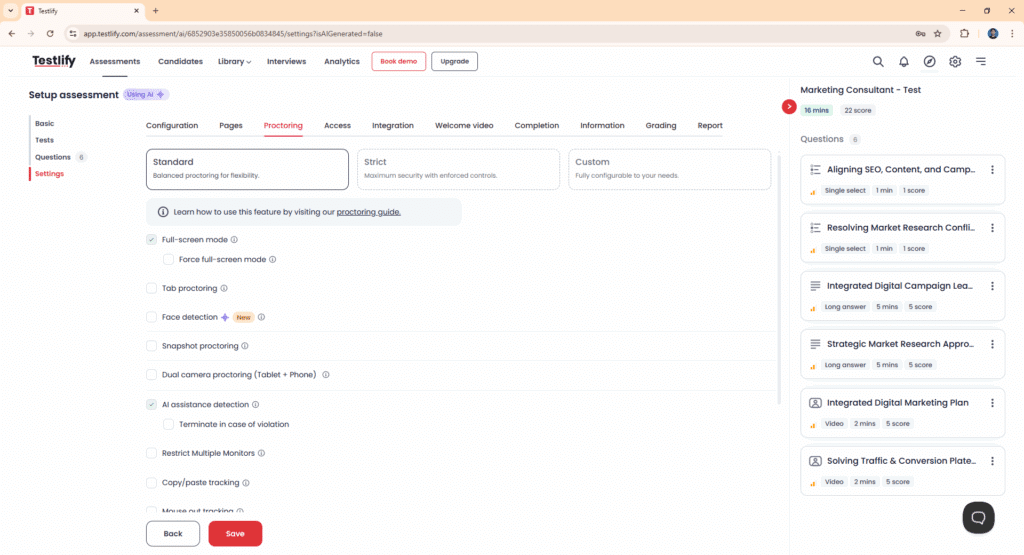
If your board requires a single contract that covers proof of skill and evidence of integrity, Testlify is currently the only platform that ships the complete stack out of the box.
Where Testlify fits in your certification pipeline
The market is racing, projected to jump from US$869M (2024) to US$2.35B by 2031, because boards need verifiable integrity on a global scale.
New “high-risk” rules in the EU AI Act and NYC LL 144 demand bias audits, liveness proof, and strict data-purge windows. Testlify bundles those safeguards.
One platform shows what a candidate knows and that they earned it fairly. Book a 10-minute sandbox demo to see it live.
Frequently asked questions (FAQs)

B2B SaaS Content Writer
Rishav Kumar is a B2B SaaS content writer with 4 years of experience. He loves crafting engaging content. Always exploring fresh ideas, he's passionate about helping businesses grow through impactful writing.
LinkedInRelated resources
View all
HR tools
Prioritization matrix: What it is & how to use it effectively
HR tools
What is timesheet management? Benefits and best practices
![What are HR SOPs and how to create them? [+Free template]](/api/media/file/Blog_featured_image_37-2.png?dpl=dpl_9Ai1hrmD1YZ8yPSLhy5MhtJd5zy3)
HR tools
What are HR SOPs and how to create them? [+Free template]

HR tools
What is HR automation? Benefits, use cases, and how to get started

HR tools
Are recruitment chatbots necessary for talent acquisition?
HR tools
Tech Tools for Enhancing HR Efficiency
Get started.
Hire on proof, not resumes.
Run your first skills-based assessment free — no credit card required.