
Prioritization matrix: What it is & how to use it effectively
Struggling with task management? Learn how a prioritization matrix helps you focus on high-impact work, reduce stress, and boost productivity efficiently.

 ChatGPT
 Gemini
 Claude
 Grok
Grok Perplexity
TL;DR
- Research by Asana found that the average knowledge worker spends 60% of their workday on low-value tasks, leaving little capacity for high-impact work.
- HBR research found managers spend 41% of their time on tasks that could be delegated or eliminated, costing organizations hundreds of productive hours per year.
- PMI research found that organizations waste an average of $97 million for every $1 billion invested due to poor project performance and inadequate prioritization.
- The Eisenhower matrix, priority matrix, weighted scoring model, and RICE framework each fit different workload types; choosing the wrong framework produces a prioritized list that still misses the highest-value work.
Research by Asana found that the average knowledge worker spends 60% of their workday on low-value tasks, which multiplies the cost of poor prioritization across every hour of the workday.
A prioritization matrix solves this problem by providing a structured decision-making framework that helps teams distinguish high-impact initiatives from low-value activity. This guide explains what a prioritization matrix is, how it works across different workload types, and how to apply it step by step.

What is a prioritization matrix?
A prioritization matrix, also called a priority matrix, is a decision-making tool that helps project managers and team leads categorize tasks based on defined variables like urgency, importance, and impact.
A prioritization matrix can be simple or complex depending on the number of variables involved. A simple matrix uses two axes; a complex matrix uses weighted scoring across five or more criteria to identify which tasks produce the highest return on time invested.
Both types share the same goal: a clear, defensible action plan that ensures high-priority work gets done first. Most prioritization matrices classify tasks into four quadrants:
- High-priority and high-impact
- High impact, low urgency
- Low impact, high urgency
- Low-priority and low-impact
HBR research found that managers spend 41% of their time on low-value work that could be delegated or eliminated. A prioritization matrix makes that delegation decision explicit rather than leaving it to individual judgment.
How does a prioritization matrix work?
A prioritization matrix works by sorting tasks based on urgency, importance, and impact. It helps managers make strategic decisions rather than just reacting to whatever appeared most recently in their inbox or task queue.
It follows a structured approach where tasks are placed into quadrants. This makes it immediately clear what needs immediate attention, what can be scheduled, what can be delegated, and what should be removed from the list entirely.
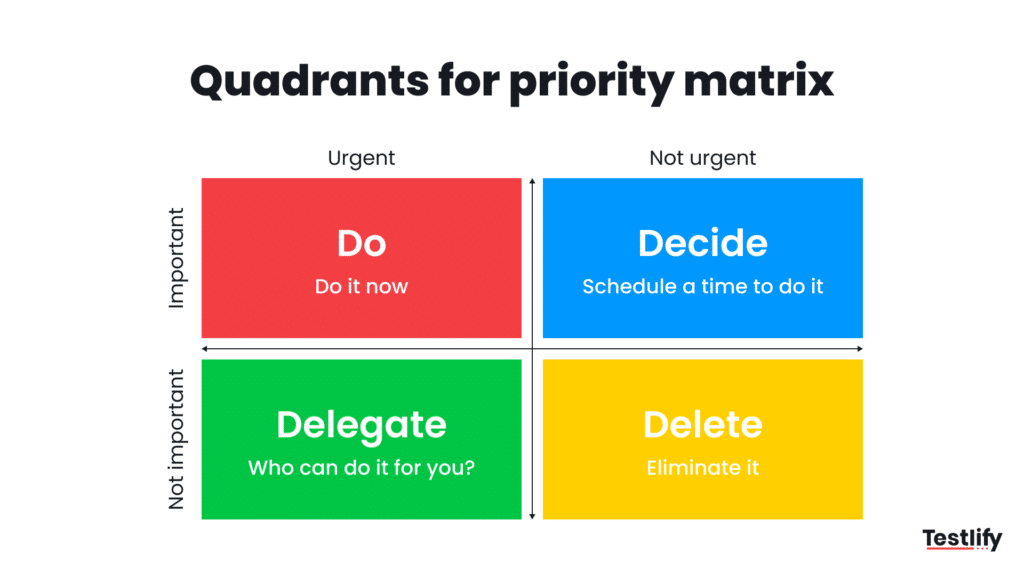
For instance, a project manager working on a product launch would categorize tasks using the Eisenhower prioritization matrix as follows:
- Do First (High Urgency, High Importance): Fixing a major software bug before release.
- Plan and Schedule (Low Urgency, High Importance): Developing a long-term marketing strategy.
- Delegate (High Urgency, Low Importance): Answering routine customer service emails.
- Delete or Delay (Low Urgency, Low Importance): Attending a non-essential meeting.
Several prioritization methods and frameworks build on the Eisenhower quadrant structure to address different workload types. Understanding which framework fits your context is what separates a well-organized task list from one that still misses the highest-value work.
The priority matrix and the Eisenhower matrix are frequently used interchangeably, but they are distinct frameworks. The priority matrix is a broader decision-making tool that accommodates different scoring variables beyond urgency and importance, making it more adaptable to project management and operational planning contexts.
Popular prioritization methods and frameworks
A prioritization matrix is not a one-size-fits-all tool. Different projects require different frameworks to produce the most accurate prioritization decisions.
Below are the most widely used methods. Each one addresses a different decision-making context and workload type.
The Eisenhower matrix (urgent vs. important framework)
The Eisenhower matrix organizes tasks by urgency and importance so that individuals and teams can prioritize high-impact work over reactive busy work. It is the most widely used framework for time management, personal productivity, and leadership decision-making.
Tasks are sorted into four quadrants: do first, schedule, delegate, and delete. A project deadline due tomorrow falls in “do first”; planning next quarter’s budget falls in “schedule” because it is important but not time-critical today.
The Eisenhower matrix works best for individual contributors, and team leads managing competing time-sensitive obligations. It is less suited to multi-variable project prioritization where effort, cost, and organizational impact must all be weighed simultaneously.
The priority matrix (general project use)
A priority matrix sorts tasks or projects by a defined set of variables, most commonly impact and effort. It is broadly used for project management, product roadmap planning, and operational decision-making where the goal is to maximize results with the least resource expenditure.
In an action-centered priority matrix, tasks are sorted into four zones: investigate, proceed, avoid, and consider. High-impact, low-effort tasks are prioritized first because they produce the strongest return on time invested, which is the key distinction between the priority matrix and the Eisenhower model.
A bug fix that affects thousands of users and takes 2 hours to resolve is high-impact and low-effort; it ranks highest regardless of when it was added to the backlog. This output-based logic makes the priority matrix particularly useful for engineering and product teams.
More methods and frameworks for prioritization
The Eisenhower matrix and priority matrix cover most use cases, but several advanced frameworks address specific organizational contexts where two-axis models are insufficient.
Weighted scoring model
The weighted scoring model assigns a numerical value to tasks or projects based on key factors like ROI, impact, urgency, cost, and effort. Each factor is given a weight, and the total score determines the priority order across multiple competing initiatives.
A marketing team might assign higher weights to customer acquisition efforts over social media engagement based on revenue attribution data. Tasks with the highest weighted score are executed first, making resource allocation decisions explicit and auditable.
RICE framework
The RICE framework prioritizes tasks based on four factors: reach, impact, confidence, and effort. Each factor is assigned a score, and the final formula produces a priority ranking that accounts for both upside and uncertainty.
Formula: (Reach x Impact x Confidence) / Effort = Priority score
A feature update for a mobile app that impacts millions of users (high reach), provides significant value (high impact), and requires minimal engineering effort will rank higher than a feature benefiting only a small user segment.
The RICE framework is widely used in product management because it produces a defensible priority score that accounts for confidence levels, not just estimated impact.
Key Takeaway: Choose the prioritization framework that matches your decision variables. Eisenhower fits time-bound personal productivity decisions. Priority matrix fits impact-vs-effort project triage. Weighted scoring and RICE fit multi-stakeholder, multi-initiative environments where decisions need to be documented and justified.
How and when to use a priority matrix?
A priority matrix is most useful when managing multiple projects, competing deadlines, or workloads where the volume of tasks makes informal prioritization unreliable.
PMI research found that organizations waste an average of $97 million for every $1 billion invested due to poor project performance, and inadequate prioritization is one of the primary contributing factors.
The following scenarios are where a priority matrix consistently produces the strongest return on the time invested in setting it up:
- You have too many tasks and limited time: If your task list is overwhelming, a priority matrix filters out low-value work and focuses effort on high-impact items.
- You need to align team efforts and improve collaboration: It helps teams identify top-priority work and eliminate low-value distractions that fragment focus across the group.
- You are struggling with decision-making: A structured prioritization framework replaces guesswork with a repeatable scoring process that improves both speed and confidence of decisions.
- You are managing multiple projects with competing deadlines: Prioritization matrices give project managers a consistent method for handling competing deadlines without defaulting to whichever stakeholder applied the most recent pressure.
A priority matrix produces the most value when it is used as an ongoing decision tool rather than a one-time exercise. Teams that review their matrix weekly maintain better alignment between daily work and strategic objectives than teams that reset priorities only when something goes wrong.
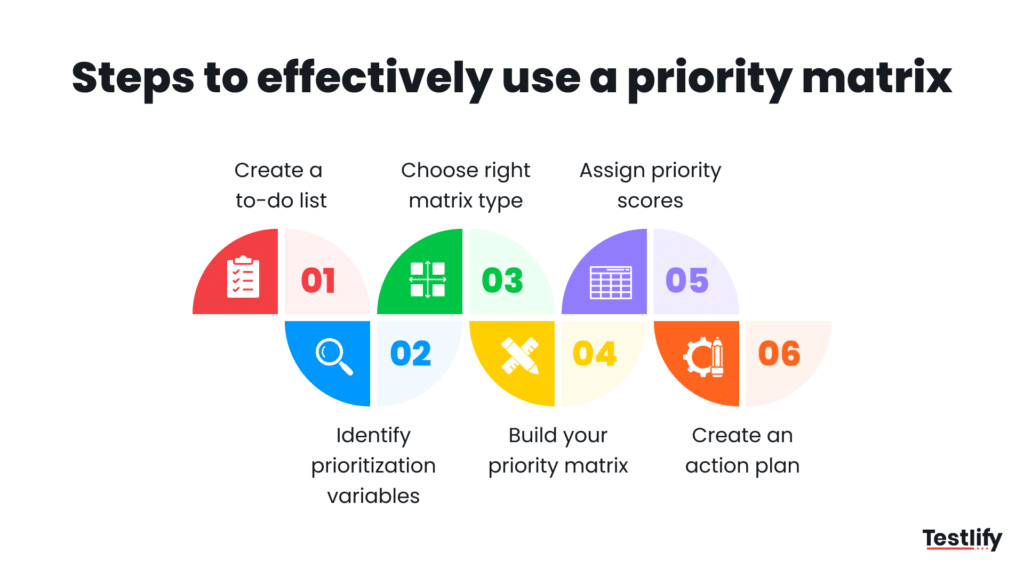
1. Create a to-do list
Before prioritizing, you need a complete inventory of what requires your attention. Start by listing every task, project deliverable, meeting commitment, and responsibility that is currently active or upcoming.
Organizing tasks into categories makes it easier to identify patterns and ensure nothing critical is missed during the prioritization step. Common category groupings include:
- Work-related tasks: Team meetings, reports, deadlines, follow-ups.
- Personal responsibilities: Scheduled appointments, recurring commitments.
- Long-term projects: Business goals, research initiatives, skill development.
Seeing everything in one place exposes the full workload context and prevents the common pattern of over-investing time in visible tasks while high-value but less visible work gets delayed. Whether you use a notebook or task management software, the inventory step is non-negotiable before placing any task into a matrix quadrant.
2. Identify your prioritization variables
Once you have a complete task list, the next step is choosing the two variables that will define the axes of your matrix. The right variables depend entirely on the decision context: a tight deadline environment calls for urgency and effort; a product roadmap calls for impact and confidence.
Ask these three questions before selecting your variables:
- Is this task urgent, or can it wait without significant consequence?
- How much impact will completing this task have on the primary goal?
- How much time and effort does it require relative to alternatives?
The most commonly used variable pairs are urgency and importance (Eisenhower matrix) for time-sensitive personal or team workflows, effort and impact (value vs. effort matrix) for maximizing productivity, and risk and reward for business strategy and investment decisions.
Choose the pair that aligns most directly with how your team measures success, not the one that produces the most satisfying visual matrix.
3. Build your priority matrix
Building the matrix requires choosing the right format for your workload type. A simple two-by-two matrix works for most team and individual use cases, whereas a complex five-by-five matrix with weighted scoring is better suited to large-scale project portfolios where granular prioritization is required.
For the complex matrix, assign levels for each variable from high to low on a 1 to 5 scale:
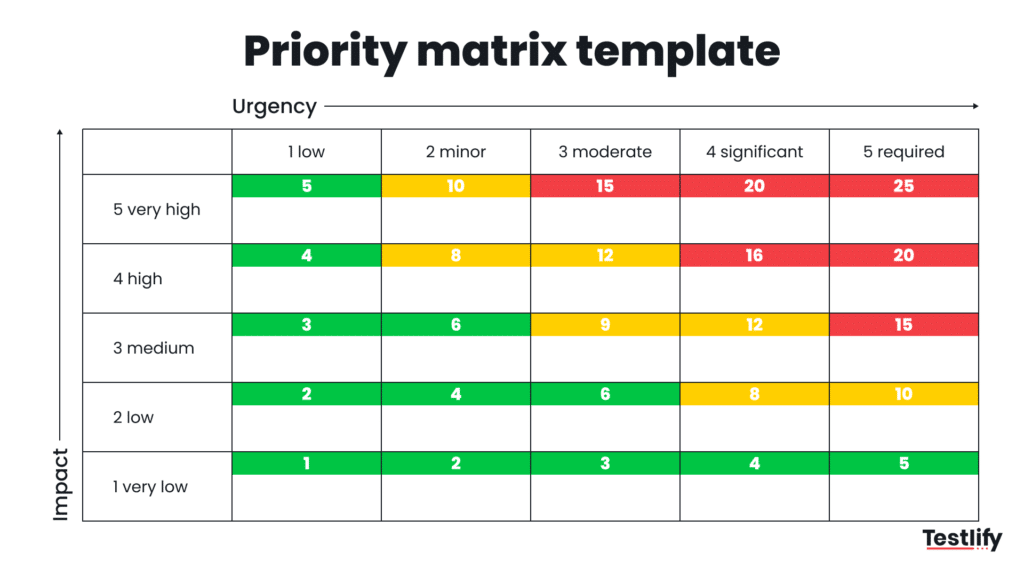
If a task has high urgency (5) and medium effort (3), its priority score is 15. This scoring approach helps teams manage large project portfolios where 20 or more tasks compete for limited bandwidth, because it produces an ordered list rather than a set of judgment calls made under pressure.
4. Create an action plan
Once the matrix is built and tasks are ranked, the final step is converting priorities into an executable plan with owners, deadlines, and defined outcomes. A matrix without an action plan is an analysis exercise; an action plan without a matrix is a task list with no defensible order.
The following steps translate matrix output into execution:
- Set SMART goals: Define specific, measurable, achievable, relevant, and time-bound objectives for each priority-one task so that completion criteria are unambiguous.
- Allocate resources: Assign a named owner to each task with the authority and capacity to execute it; unowned tasks default to delayed.
- Set deadlines and milestones: Define when each priority task should be completed and establish checkpoints for multi-week initiatives.
- Monitor and adjust: Revisit the matrix weekly or bi-weekly to account for shifting priorities, new information, and completed work.
Pro Tip: Task management tools like Trello, Asana, or Monday.com can make priority matrices visible and shared across teams. For individual use, a weekly review of a simple spreadsheet matrix takes under 15 minutes and consistently outperforms ad-hoc prioritization in both focus quality and on-time delivery rate.
A priority matrix is not a one-time setup. Reviewing and updating it weekly ensures priorities stay aligned with your current workload, which is what turns a prioritization framework into a productivity habit rather than a one-off planning exercise.
Final thoughts
A prioritization matrix gives professionals and teams a repeatable framework for directing time and effort toward work that produces the highest return.
McKinsey research shows that teams using structured prioritization strategies achieve a 25% increase in efficiency compared to teams operating without a defined prioritization method.
The same logic applies to hiring. HR teams that prioritize candidates with structured, scored assessment data rather than intuition-based screening consistently make faster, more defensible decisions.
Testlify’s 3,500+ role-specific assessments give hiring managers a scored, comparable candidate dataset at every stage of the process.
Book a demo to see how structured assessment improves hiring prioritization decisions.
For further reading on organizational decision frameworks, explore our guide to the 9 Box Matrix.
Frequently asked questions (FAQs)

B2B SaaS Content Writer
Rishav Kumar is a B2B SaaS content writer with 4 years of experience. He loves crafting engaging content. Always exploring fresh ideas, he's passionate about helping businesses grow through impactful writing.
LinkedInRelated resources
View all
HR tools
What is timesheet management? Benefits and best practices
![What are HR SOPs and how to create them? [+Free template]](/api/media/file/Blog_featured_image_37-2.png?dpl=dpl_9Ai1hrmD1YZ8yPSLhy5MhtJd5zy3)
HR tools
What are HR SOPs and how to create them? [+Free template]

HR tools
What is HR automation? Benefits, use cases, and how to get started

HR tools
Are recruitment chatbots necessary for talent acquisition?

HR tools
Tech Tools for Enhancing HR Efficiency

HR tools
How to find the right senior developer
Get started.
Hire on proof, not resumes.
Run your first skills-based assessment free — no credit card required.