
12 best online interview platforms for hiring teams in 2026
A side-by-side look at 12 online interview platforms for one-way video, live, AI and coding interviews, plus how to choose and the costs.
The best online interview platforms let hiring teams run screening and interview rounds over the internet in a consistent, scored and searchable way: one-way video, live video, AI-led interviews and live coding. The right pick depends on the stage you need to fix, your hiring volume, the roles you hire for and the ATS you already run.
TL;DR / Key takeaways
- Pick the platform by the stage you need to fix. Use AI or one-way video for first rounds, live video for finals and a coding tool for technical rounds.
- Testlify suits AI interviews plus skills tests, HireVue large-enterprise AI screening, and VidCruiter structured, regulated hiring.
- Spark Hire, Hireflix and Willo are simple one-way video tools. Jobma and Talview cover multiple formats, with Talview focused on identity checks.
- HackerEarth FaceCode fits coding rounds and Metaview takes notes on your existing calls. Zoom, Teams and Webex host calls but do not score or compare candidates.
- Compare tools on formats, explainable scoring, integrity checks, two-way ATS sync, candidate experience and compliance. Then run a 30-day pilot on one real role.
- Fraud is real: a 2025 Gartner survey found 6% of candidates admitted to interview fraud. Look for identity checks and AI-assistance detection.
- Under NYC Local Law 144, AI scoring tools need a yearly bias audit. Choose a platform where a person can see and override every score.
This list is for employers. If you are a candidate looking for mock interview practice, tools such as Big Interview or Pramp are built for that job instead.
 ChatGPT
 Gemini
 Claude
 Grok
 Perplexity
What is an online interview platform?
An online interview platform is software that hiring teams use to interview candidates remotely and score them against the same criteria. Most platforms support one or more of five formats, and the format decides which stage of hiring the tool can take over.
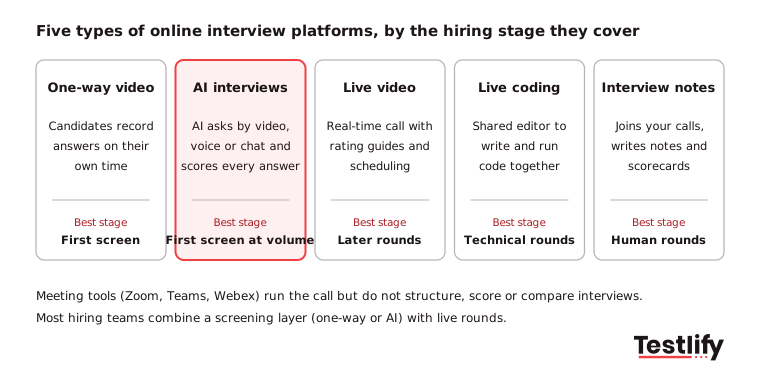
General video tools like Zoom, Microsoft Teams and Webex handle the call itself, but they do not structure, score or compare interviews.

What are the best online interview platforms in 2026?
The best online interview platforms in 2026 are Testlify for AI interviews plus skills tests, HireVue for large-enterprise AI screening, VidCruiter for structured and regulated hiring, Spark Hire, Hireflix and Willo for simple one-way video, Jobma and Talview for multi-format and secure interviews, interviewstream for public sector teams, HackerEarth FaceCode for coding, Metaview for interview notes, and Zoom, Teams or Webex for basic live calls.
Vendor details below were checked on each vendor's own site on October 24, 2026. Features change often, so confirm anything critical in a demo.
Platform | Main interview types | AI help | Best for |
|---|---|---|---|
Testlify | AI video, voice and chat interviews; one-way video and audio; live coding | Scores every answer, per-skill insights, follow-up questions | Skills-first screening at volume, tech and non-tech roles |
HireVue | AI screening interviews, video interviews, live co-pilot | AI interviewer, live interview co-pilot | Large enterprises with high-volume hourly and professional hiring |
VidCruiter | Pre-recorded and live video | Transcripts, summaries, highlights | Structured, auditable hiring in public sector and regulated industries |
Spark Hire | One-way video, interview scheduling | AI scoring of responses | Small and mid-size teams starting with video |
Hireflix | One-way video only | None advertised | Teams that want the simplest one-way screen |
Willo | One-way video, skill assessments | Transcripts, summaries, benchmarks | Global async screening with flexible buying |
Jobma | One-way, live and panel video, audio, coding | AI interviewer | Mid-size, enterprise and staffing teams that want many formats in one tool |
Talview | AI interviews, live rooms, phone screening | AI interviewer and AI proctor | Secure, identity-checked interviews and exams |
interviewstream | On-demand and live video, event scheduling | AI interview summary | Public sector, healthcare systems and school districts |
HackerEarth FaceCode | Live coding interviews | Coding environment with code playback | Developer hiring |
Metaview | Notes on your existing calls | AI notes, scorecards, follow-ups | Keeping human interviews consistent |
Zoom, Teams, Webex | Live video calls | Meeting summaries | Teams that only need a call link |
1. Testlify
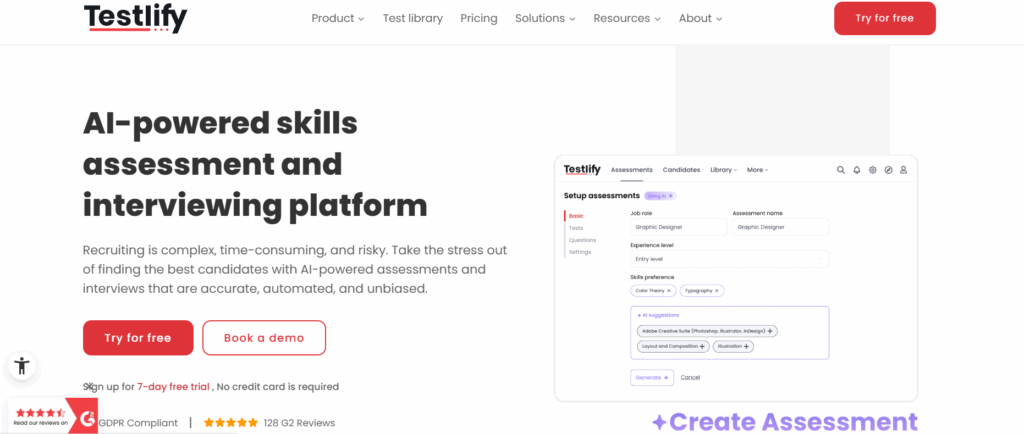
Testlify is an AI-native skills assessment and interviewing platform. Teams run structured AI interviews by video, voice or chat next to role-specific skills tests, so each candidate reaches the human round with scored evidence already attached.
- Interview formats: Video AI, Voice AI and Chat AI interviews, one-way video and audio questions, plus live coding and pair-programming interviews.
- Scoring: every answer scored against the same criteria, with a per-skill breakdown, AI-written strengths and gaps, and suggested follow-up questions. A Reviewers Portal gives interviewers one place to score and comment.
- Integrity: 20+ proctoring checks, AI-assistance detection and speech authenticity detection for voice and video answers.
- Fit with your stack: 100+ ATS and HRIS integrations including Workday, Greenhouse and SAP SuccessFactors, 3,500+ validated tests, 25+ question types and 15+ languages.
Best for: mid-size and enterprise teams that want AI interviews and skills tests in one shortlist, for tech and non-tech roles. See Testlify AI interviews.
Watch out for: live video panels for final rounds still run in your usual meeting tool.
2. HireVue
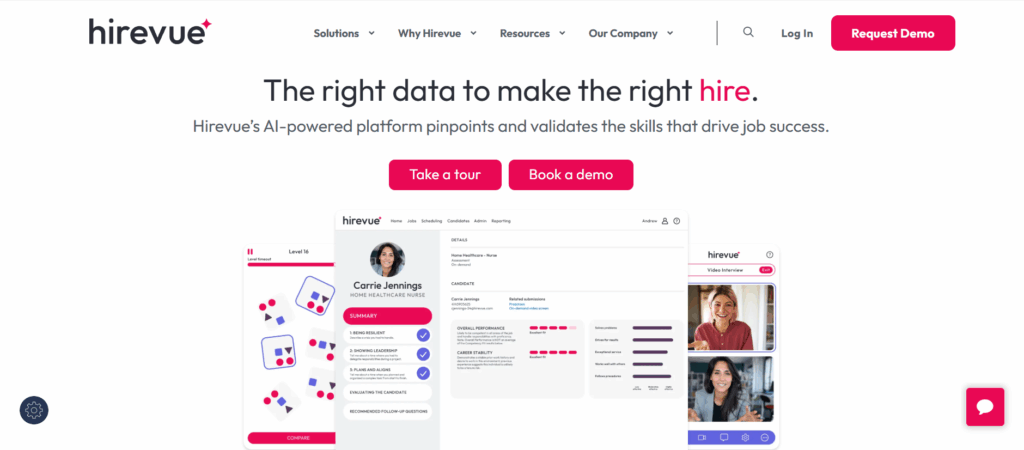
HireVue is an enterprise hiring platform that combines AI screening interviews, video interviewing, assessments and scheduling. It now offers 24/7 AI screening interviews and an interview co-pilot that joins live interviews on your own Zoom or Teams.
- Best for: large employers with high-volume hourly hiring or structured professional hiring.
- Strengths: game-based assessments and job-relevant skills tests next to interviews; its site lists healthcare, retail, manufacturing, financial services and government.
- Watch out for: buying starts with a demo; there is no public pricing or self-serve trial.
3. VidCruiter
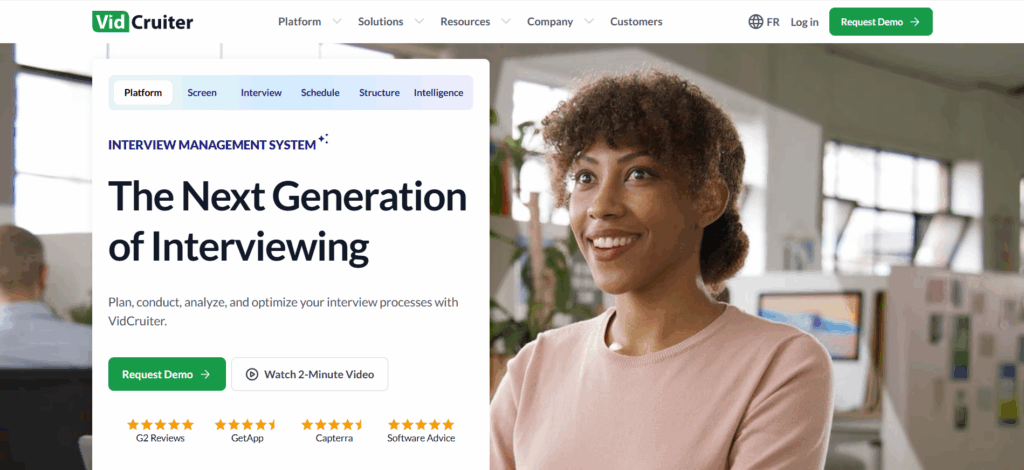
VidCruiter offers pre-recorded and live video interviews with rating guides that appear beside the candidate video, so evaluators score in real time. Automated scheduling and AI transcripts, summaries and highlights sit around the interview.
- Best for: government agencies, public-sector employers and regulated industries that need auditable hiring.
- Strengths: structured rating guides, accessibility standards and security certifications listed on its site.
- Watch out for: more setup than lightweight one-way tools. For a direct comparison, read Testlify vs VidCruiter.
4. Spark Hire
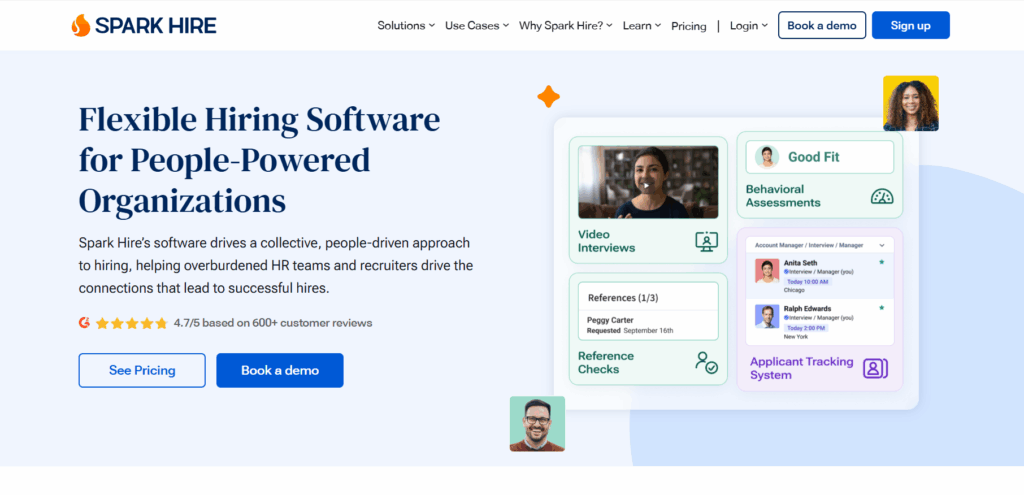
Spark Hire is a video interviewing and ATS product for small and medium organizations. Candidates answer one-way interviews on demand, and AI scoring helps surface strong applicants early.
- Best for: small and mid-size teams moving from phone screens to video for the first time.
- Strengths: simple candidate flow, live interview scheduling that syncs interviewer calendars.
- Watch out for: fewer assessment and integrity options than platforms that pair interviews with skills tests.
5. Hireflix
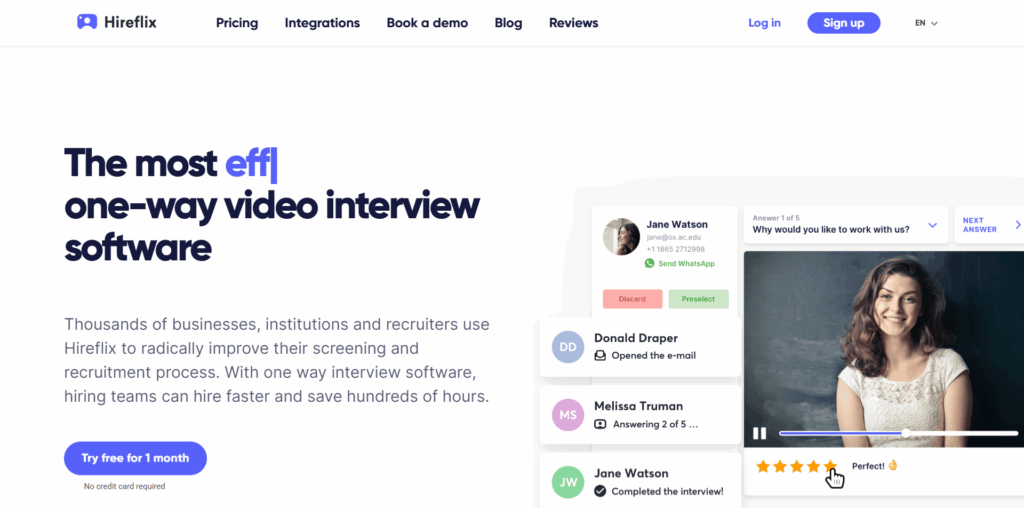
Hireflix does one-way video interviews and nothing else. Its own site says it focuses on "one thing and one thing only", which makes it quick to roll out.
- Best for: teams that want the simplest possible async screen.
- Strengths: a one-month free trial with no credit card; candidates can be invited from ATS tools such as Greenhouse.
- Watch out for: no live interviews, no scheduling and no AI scoring advertised.
6. Willo
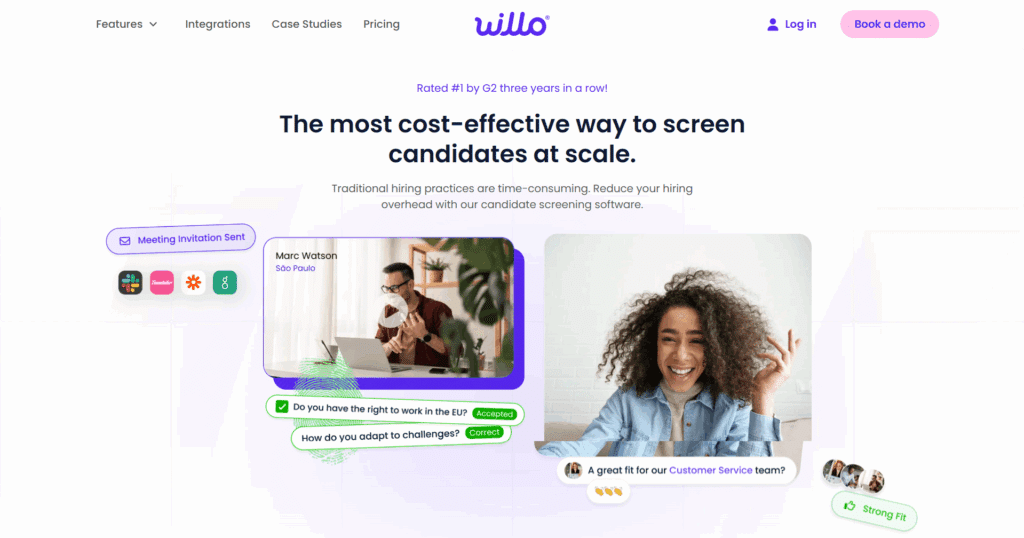
Willo is an asynchronous video interview platform with skill assessments and AI-assisted insights such as transcripts, summaries and benchmarks. Willo states that the AI supports shortlisting without making the decision.
- Best for: global teams screening across time zones, with 18+ candidate languages and WCAG accessibility.
- Strengths: 50+ native integrations including Greenhouse, Workday and Lever; pay-as-you-go buying.
- Watch out for: no live interview mode on its home page.
7. Jobma
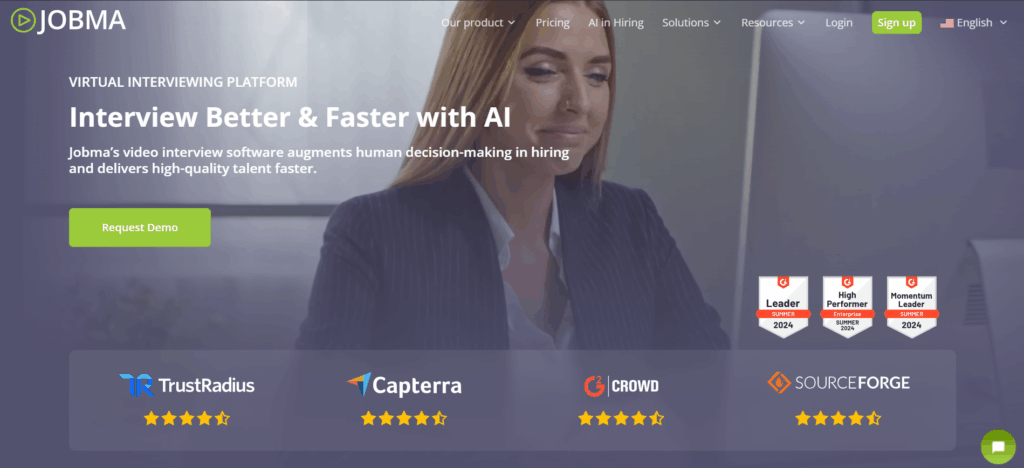
Jobma covers one of the widest mixes of formats in this list: one-way video, live and panel video, audio answers, an AI interviewer that asks role-specific questions and coding tasks in a live IDE. Pre-hire tests sit alongside.
- Best for: mid-size and enterprise teams and staffing firms that want many interview formats in one tool.
- Strengths: 16 interview languages; ATS, HRIS and calendar integrations.
- Watch out for: more choice means more configuration; agree a standard interview design per role first.
8. Talview
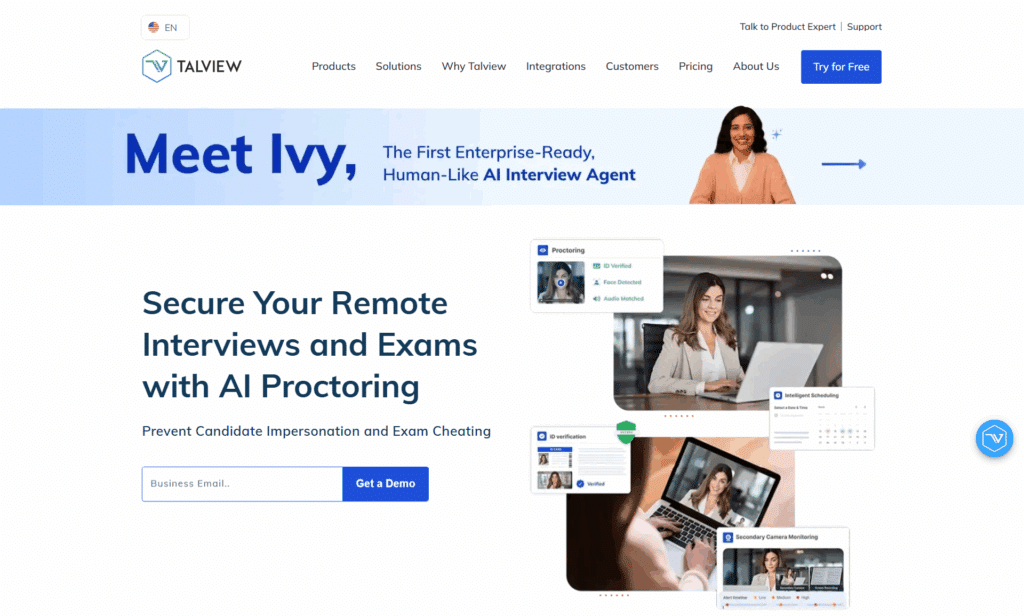
Talview pairs an AI interviewer, Ivy, with an AI proctor, Alvy, and live interview rooms that include coding tasks and whiteboarding. Identity checks include ID document checks, face match with liveness detection and re-checks during the session.
- Best for: employers and certification bodies where proving who took the interview matters most.
- Strengths: continuous identity checks and a scored, timestamped record for each interview.
- Watch out for: a strong exam and certification focus; check the hiring workflow fits your process.
9. interviewstream
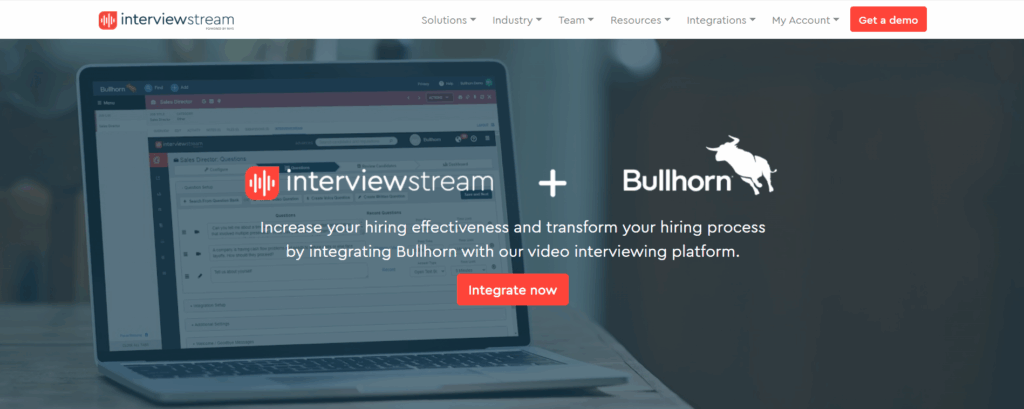
interviewstream offers on-demand and live video interviewing, interview scheduling, hiring event scheduling and an AI interview summary. Its customers include hospital systems, city governments and K-12 school districts.
- Best for: public sector, healthcare and education teams with seasonal or event-based hiring.
- Strengths: scheduling for hiring events next to video interviews.
- Watch out for: lighter on skills testing and AI scoring than assessment-led platforms.
10. HackerEarth FaceCode
HackerEarth FaceCode is a live coding interview tool where candidates solve programming problems with an interviewer, with 40+ programming languages and auto-complete in the editor.
- Best for: engineering and IT hiring that needs a real coding round.
- Strengths: built for technical interviews; HackerEarth states it is designed for regulated recruitment.
- Watch out for: made for developers only; non-technical roles need a second tool.
11. Metaview
Metaview is an interview notes tool. It joins the scheduling, phone and video tools you already use, writes notes and scorecards automatically, and syncs them to ATS platforms such as Greenhouse, Lever and Ashby.
- Best for: recruiters and hiring managers who run many live interviews and want consistent notes.
- Strengths: no change to how candidates join; less time on write-ups.
- Watch out for: a notes layer only; it does not screen or test candidates on its own.
12. Zoom, Microsoft Teams and Webex
General video meeting tools are where most live interviews still happen. Zoom's AI Companion can summarize a meeting and turn recordings into highlights and next steps, and Teams and Webex also record meetings.
- Best for: final rounds and panels once the shortlist exists.
- Strengths: candidates already know them; no new software to buy.
- Watch out for: no structured questions, no scoring, no comparison across candidates and no fraud checks built for hiring.
One-way, live or AI interviews: which format do you need?
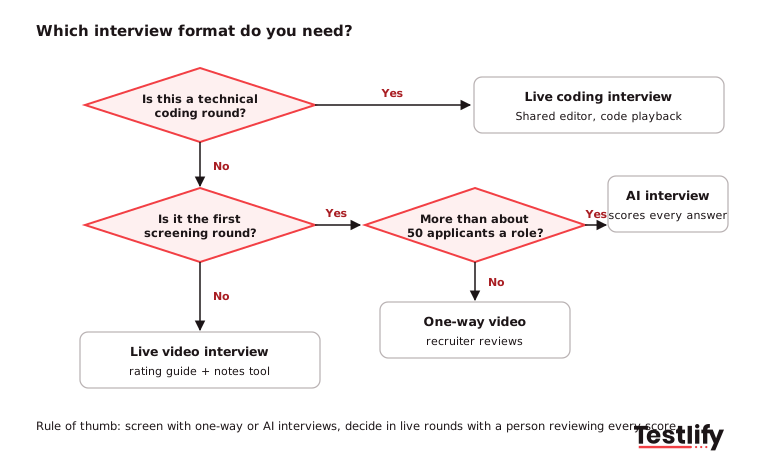
The right interview format follows the hiring stage. One-way video and AI interviews suit the first round, when volume is high and every candidate should face the same questions. Live video suits later rounds and senior roles. Coding interviews belong in technical rounds, and a notes tool keeps human rounds consistent.
One-way video | AI interview | Live video | |
|---|---|---|---|
Who asks | Recorded questions | AI interviewer, with follow-ups | A person |
Scheduling | None | None | Needed for every interview |
Scoring | Reviewer watches and rates | Every answer scored, a person reviews | Interviewer's notes and rating guide |
Best stage | First screen | First screen, high volume | Final rounds, senior roles |
Main risk | Reviewer time, candidate drop-off | Weak criteria, candidate trust | Interviewer drift, calendar delays |
Most enterprise teams end up with two layers: AI or one-way interviews to build a shortlist, then live interviews in a meeting tool for the final rounds. For volume roles, see how AI interviews improve high-volume hiring.
Pro tip: Write the scoring criteria before you pick a tool. A platform can only apply the structure you give it, and teams that start from a structured interview and an interview scorecard get far more out of any platform.
How do you compare the best online interview platforms?
Comparing the best online interview platforms works best on six points: the formats you need, how scoring works, integrity checks, ATS fit, candidate experience and compliance support. Shortlist two or three tools against these points, then run a short pilot on one real role before you sign.
- Formats: Match the tool to the stage you are fixing: first-round screening, live rounds, coding or all of them.
- Scoring you can explain: Can a reviewer see the exact answer behind each score, and can your team edit the criteria?
- Integrity: Check identity verification, AI-assistance detection and recording rules before you need them.
- ATS fit: Ask for two-way sync: invites sent from the ATS and scores, notes and status written back, not just a link. Testlify lists its ATS integrations.
- Candidate experience: Browser-based, mobile-friendly, no download, clear time limits and instructions in the candidate's language.
- Compliance: Bias audit results, data residency, consent and retention settings, and the security certificates your IT team will ask for. If you hire in Europe, the EU AI Act treats AI used in recruitment as high-risk, so ask how the vendor supports human oversight and record-keeping.
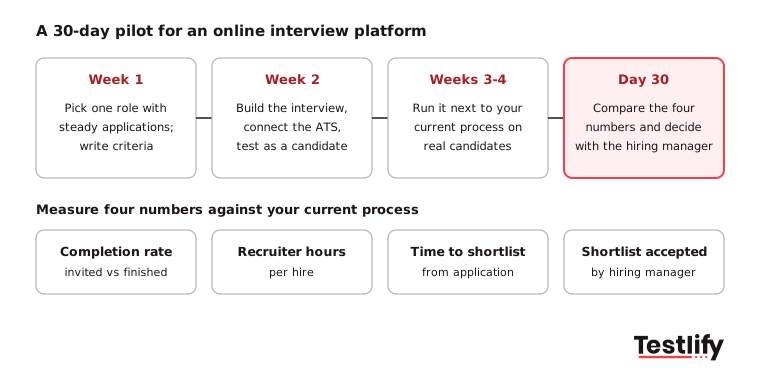
A 30-day pilot is long enough to decide. Pick one role with steady applications, run the platform alongside your current process, and measure four numbers: completion rate, recruiter hours per hire, time from application to shortlist and how many shortlisted candidates the hiring manager accepts.
How do online interview platforms stop cheating and candidate fraud?
Online interview platforms stop cheating with identity checks, proctoring and answer analysis. The common checks are photo ID and face match, webcam snapshots or recording, tab and screen monitoring, copy and paste blocking, AI-assistance detection and checks for synthetic or read-out voice answers.
Fraud is now a real hiring risk, not an edge case. A 2Q25 Gartner survey of 3,000 job candidates found that 6% admitted to interview fraud, either posing as someone else or having someone pose as them. Gartner predicts that by 2028 one in four candidate profiles worldwide will be fake. The same research found that 39% of candidates used AI during the application process.
Trust runs both ways. Gartner also found that only 26% of candidates trust AI to evaluate them fairly, so tell candidates what is checked, how AI is used and that a person reviews the result. For practical steps, read how to prevent impostors in video interviews and see Testlify's anti-cheating and proctoring checks.
What rules apply to AI interview platforms?
AI interview platforms that score or rank candidates fall under AI hiring rules in a growing number of places. Two set the bar for global employers in 2026: New York City's Local Law 144 and the EU AI Act. Both expect audits or risk controls, transparency to candidates and human oversight.
- New York City: Under Local Law 144, an employer cannot use an automated employment decision tool unless it has had a bias audit within one year of use, a summary of the results is public, and candidates get notice at least 10 business days before use. Enforcement started on July 5, 2023.
- European Union: According to the European Commission, AI used for employment and worker management, such as CV-sorting software, is high-risk under the AI Act. After the AI Omnibus agreement, the rules for these high-risk uses apply from December 2, 2027.
- Recording and consent: Recording interviews usually needs candidate notice and, in many places, consent under privacy law. Set retention periods before go-live.
Ask every vendor for its bias audit and data processing terms. Testlify's matching model completed a third-party NYC bias audit on June 16, 2023.
Key takeaway: Pick a platform where a person can see the evidence behind every score and override it. That protects candidates, satisfies the rules and makes the scores useful to hiring managers.
How much do online interview platforms cost?
Online interview platforms are priced in four common ways: per candidate or credit, per user seat, a flat monthly or annual subscription, or an enterprise contract. Simple one-way tools are the cheapest to start; AI interviews, proctoring, integrations and white label options usually add cost.
- Per candidate or credit: You pay when a candidate takes an interview or test. Good for uneven hiring volume.
- Per seat: You pay for each recruiter or interviewer. Watch this if many hiring managers need access.
- Flat subscription: A fixed fee for set usage. Easy to budget for steady volume.
- Enterprise contract: Custom terms for SSO, data residency, SLAs and dedicated support.
Ask what counts as usage, whether unused credits roll over, and which features are add-ons. Testlify uses credits: you pay only when a candidate starts, with a 7-day free trial and no credit card needed.
When does an interview service make more sense than a platform?
An interview service makes more sense than a platform when your team does not have enough trained interviewers, not when it lacks software. If engineers or domain experts are too busy to run first-round technical interviews, outside experts can run them for you to an agreed structure.
Platforms give your own team the tools. Services give you the interviewers as well. If that is the gap, an interview as a service platform such as Testlify's matches each role with a vetted domain expert from a pool of 1,500+ interviewers across 13+ domains, usually within the hour, and returns an AI-backed report after each interview.
Ready to try AI interviews on a real role?
Testlify lets you build an AI interview from your own job description, run it next to skills tests and get a ranked, scored shortlist. Start a 7-day free trial with no credit card, or book a demo to see how it fits your ATS and hiring volume. You can also explore the video interviewing tool and Chat AI interviews.
Frequently asked questions

Content Writer
Yashika Khandelwal is a Content Writer with 3+ years of experience creating research-backed content on hiring, talent assessment, and HR technology. She is a registered Organizational Psychologist and subject matter expert who combines behavioral science with practical recruitment insights to produce accurate, evidence-based content.
LinkedInRelated resources
View all
HR tools
What is AI proctoring and why it matters in certification

HR tools
Prioritization matrix: What it is & how to use it effectively
HR tools
What is timesheet management? Benefits and best practices

HR tools
What are HR SOPs and how to create them? [+Free template]

HR tools
What is HR automation? Benefits, use cases, and how to get started

HR tools
Are recruitment chatbots necessary for talent acquisition?
Get started.
Hire on proof, not resumes.
Run your first skills-based assessment free — no credit card required.