
Full cycle recruiting: what it is, the 6 stages and how to run it
One recruiter owning a hire from intake to onboarding. Learn the 6 stages of full cycle recruiting and when to split the work instead.

Every handoff in hiring is a chance to lose a candidate, and the hiring manager's brief gets thinner each time it moves. Full cycle recruiting answers this with one recruiter who owns the role from the first manager conversation to the new hire's first day.
That recruiter plans the role, screens candidates, runs interviews and makes the offer. The model suits specialist roles but strains under volume, so this post covers the six stages and when to split the work.
TL;DR:
- Full cycle recruiting means one recruiter owns a hire from intake to onboarding, instead of passing candidates between a sourcer, a recruiter and a coordinator.
- The six stages are preparation, sourcing, screening, selection, hiring and onboarding. Each one should end with a clear output, such as an approved role profile or a ranked shortlist.
- The model gives candidates a single contact, keeps the hiring manager's context in one head and makes one person accountable for time to hire and quality of hire.
- The weak point is volume: when one recruiter carries too many open roles, screening is the first stage to slip.
- Use full cycle recruiting for specialist, senior and low-volume roles. Use a split or hybrid model for high-volume hiring.
- Agree on skills and scoring criteria at intake, then screen with skills tests before interviews, so the recruiter spends time on the best candidates rather than on resumes.
 ChatGPT
 Gemini
 Claude
 Grok
 Perplexity
What is full cycle recruiting?
Full cycle recruiting is an approach where a single recruiter, or a small team acting as one owner, manages every step of hiring for a role, from the requisition to onboarding. It is also called full life cycle recruiting or 360 recruiting.
The opposite is a split model, where sourcing, screening, and coordination sit with different specialists.
The term comes from agency recruiting, where a "full desk" recruiter both wins the client and fills the role. In-house teams use it to describe a recruiter who owns the requisition from intake to start date.
The hiring manager and interviewers still assess candidates and make the hiring decision. The full cycle recruiter runs the process around them.
If you are new to the basics, start with our recruitment glossary entry, and for the 360 variant see what 360 recruitment means for recruiters.

What are the 6 stages of full cycle recruiting?
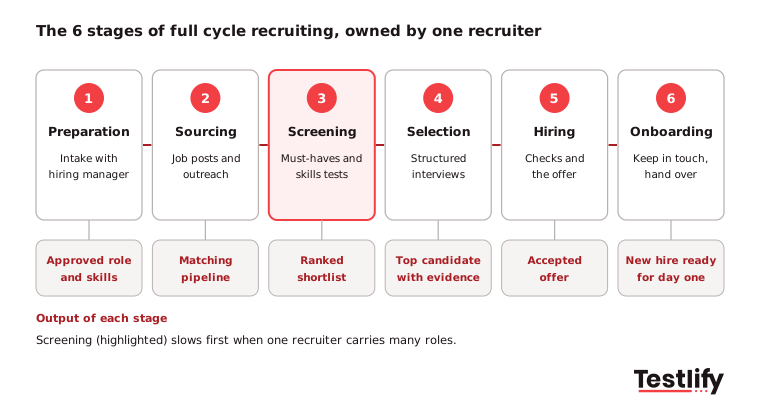
Full cycle recruiting runs through six stages: preparation, sourcing, screening, selection, hiring and onboarding. Each stage hands a clear output to the next one, from an approved role profile at the start to a new hire ready for day one at the end.
1. Preparation
The recruiter holds an intake meeting with the hiring manager to agree on the role, the must-have skills, the salary range, the interview plan and the timeline. The output is an approved requisition and a job description that lists skills, not just years of experience.
2. Sourcing
The recruiter posts the role, searches for passive candidates, asks for referrals, and checks past applicants. Good sourcing targets the profile agreed at intake rather than chasing application volume.
3. Screening
The recruiter checks every applicant against the must-haves: work authorization, location, key skills. Resume reviews, short phone screens and online skills tests turn a long applicant list into a shortlist the hiring manager trusts.
4. Selection
Shortlisted candidates go through interviews, work samples, or assessments. The recruiter schedules rounds, prepares interviewers, collects scorecards and runs the debrief.
A structured interview with the same questions for every candidate keeps the comparison fair.
5. Hiring
The recruiter checks references, runs any background checks, makes the verbal offer, negotiates, and sends the offer letter. Candidates who were not selected get a clear, timely answer.
6. Onboarding
The recruiter stays in touch between acceptance and the start date, then hands the new hire to the manager and HR for onboarding. Many recruiters check in again after 30 or 90 days to learn whether the hire is working out.
What does each stage of the recruiting cycle need to deliver?
Each stage of the recruiting cycle needs one owner, one output and one number to watch. When a stage has no clear output, problems show up two stages later, usually as a weak shortlist or a rejected offer.
Stage | Who is involved | Output | Metric to watch |
|---|---|---|---|
Preparation | Recruiter, hiring manager, finance | Approved requisition, skills list, interview plan | Days from request to approval |
Sourcing | Recruiter | Pipeline of candidates who match the profile | Qualified applicants per channel |
Screening | Recruiter | Ranked shortlist | Screen-to-interview pass rate |
Selection | Recruiter, hiring manager, interviewers | Preferred candidate with scored evidence | Interviews per hire, feedback turnaround |
Hiring | Recruiter, HR | Accepted offer | Offer acceptance rate |
Onboarding | Recruiter, manager, HR | New hire ready for day one | 90-day retention, manager satisfaction |
Watch the screening pass rate most closely. If most screened candidates fail the first interview, the problem is the screening criteria, not the interviewers.
What does a full cycle recruiter do?
A full cycle recruiter owns the requisition: they agree on the role with the hiring manager, fill the pipeline, screen and shortlist, coordinate interviews, make the offer and keep the candidate warm until the start date. They do not make the final hiring decision, which stays with the hiring manager, but they shape it with evidence.
The role asks for a wide set of skills:
- Intake and stakeholder management: Turning a vague request into clear must-haves, and pushing back when the wish list is unrealistic.
- Sourcing and outreach: Finding passive candidates and writing messages people answer.
- Assessment: Knowing which skills to test, how to read results, and how to run a fair screen.
- Coordination: Keeping interviews, feedback and candidate updates on schedule across several roles at once.
- Negotiation: Closing offers within budget and knowing when to escalate.
- Data: Tracking time to hire, pass rates, and offer acceptance to spot slow or leaky stages.
How is full cycle recruiting different from a split model?
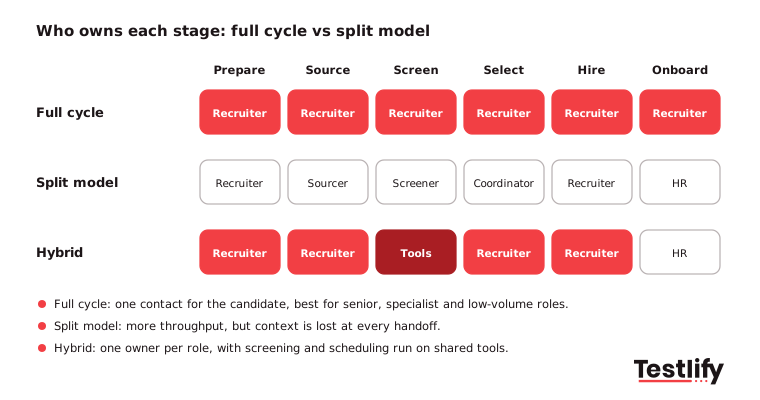
Full cycle recruiting gives one recruiter every stage of a hire, while a split model (sometimes called 180 recruiting) divides the work between sourcers, recruiters, coordinators and HR. A hybrid keeps one owner per role but hands the high-volume tasks, such as first-round screening and scheduling, to specialists or software.
Factor | Full cycle | Split model | Hybrid |
|---|---|---|---|
Who owns the hire | One recruiter | Several specialists | One recruiter, with specialists or tools for screening and scheduling |
Candidate contact | One person throughout | Changes at each handoff | One person, with automated updates |
Best for | Senior, specialist and low-volume roles | High-volume and seasonal hiring | Growing teams with a mix of both |
Main strength | Context and accountability | Throughput and specialist depth | Context with capacity |
Main risk | Overload when open roles pile up | Lost context between handoffs | Tools set up without clear criteria |
Most mid-market and enterprise teams end up with a hybrid. A recruiter owns each role, while screening and interview scheduling run on shared tools so that one person can carry more roles without cutting corners.
What are the benefits of full cycle recruiting?
Full cycle recruiting gives candidates one point of contact, keeps every detail of the role in one place and makes one person accountable for the outcome. Fewer handoffs also mean fewer delays and fewer candidates who drop out because nobody answered them.
- Better candidate experience: Candidates hear from the same person from first call to offer, so updates are faster and more personal.
- Context does not get lost: The recruiter who heard the hiring manager at intake is the one screening and closing, so the brief survives every stage.
- Clear accountability: One person owns time to hire, offer acceptance and early quality of hire for the role.
- Stronger hiring manager relationship: Managers work with one partner who knows their team and what "good" looks like.
- Better offers: A recruiter who has spoken to the candidate since the first call knows their motivations and can close with fewer surprises.
These gains matter because hiring is still hard. SHRM's 2025 Talent Trends report found that nearly 70% of organizations still struggle to recruit for full-time roles, and it names applicant ghosting as one of the causes.
A single, responsive contact is one of the simplest ways to keep candidates engaged.
What are the challenges of full cycle recruiting?
Full cycle recruiting is hard to scale, because every extra open role adds sourcing, screening, scheduling and closing to the same person's week. The usual result is that screening gets rushed, and good candidates sit unanswered while the recruiter chases interview feedback.
- Workload: A recruiter with too many open roles cannot give each one full attention, and the earliest stages suffer first.
- Screening overload: A popular role can draw hundreds of applicants. Reading every resume by hand is slow and inconsistent.
- Generalist depth: One person has to source, assess, negotiate and coordinate. Few people are equally strong at all of them, especially for technical roles.
- Single point of failure: If the recruiter leaves or goes on leave, the context goes with them unless it is written down.
- Inconsistent decisions: Without agreed criteria, each search follows the recruiter's own habits, which makes results hard to compare across the team.
Recruiters are already looking for time back. LinkedIn's Future of Recruiting 2025 found that recruiters using generative AI save about 20% of their work week, and 35% of them put that time back into candidate screening, with 26% putting it into skills assessments.
How do you run full cycle recruiting well?
Running full-cycle recruiting well comes down to fixing the criteria at intake, screening on evidence, keeping interviews structured and writing everything down. These habits let one recruiter carry more roles without lowering the bar.
- Run a real intake meeting: Agree on four to six must-have skills, the deal-breakers, the interview plan and how each skill will be tested. Write it down and share it.
- Screen on skills before interviews: Send a short, role-specific skills test to every applicant who meets the basic requirements. Interview the top scorers, not the best resumes.
- Use the same questions and scorecards: Give every interviewer an interview scorecard tied to the skills from intake, and ask for feedback within 24 hours.
- Set candidate update rules: Every candidate hears back within a fixed number of working days at every stage, including a clear no.
- Follow the rules on checks: In the US, background checks through a consumer reporting company fall under the Fair Credit Reporting Act. The FTC's guidance for employers requires a stand-alone disclosure, written permission and notices before and after any adverse decision.
- Keep notes in the ATS: Store intake notes, scores and feedback in your applicant tracking system, so anyone can pick up the role if the recruiter is away.
Pro tip: Review the screen-to-interview pass rate after the first ten interviews on a role. If fewer than half of the interviewed candidates are strong, go back to the intake notes and tighten the screening criteria before you source more.
How do you measure full cycle recruiting?
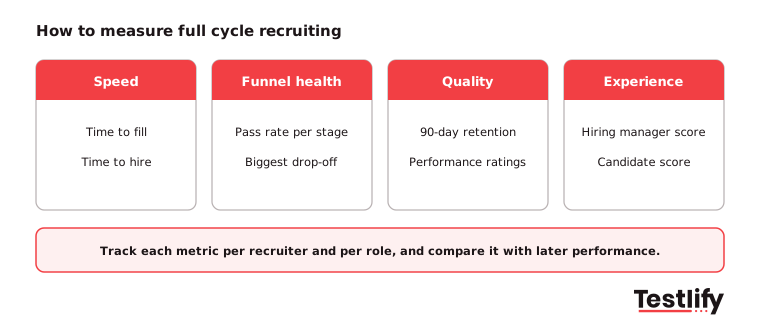
Full cycle recruiting is measured by speed, quality and experience across the whole cycle, tracked per recruiter and per role. The core set is time to fill, time to hire, screen-to-interview pass rate, offer acceptance rate, quality of hire, hiring manager satisfaction and candidate satisfaction.
Quality of hire is the hardest number to get right. LinkedIn's Future of Recruiting 2025 report found that 89% of talent acquisition professionals expect measuring quality of hire to become more important, but only 25% feel highly confident they can measure it.
Scored evidence from screening and interviews gives you a baseline to compare with later performance.
Where does Testlify fit in the full cycle recruiting process?
Testlify fits into the screening and selection stages of full-cycle recruiting, where recruiters lose the most time. Recruiters turn a job description into a role-specific assessment, invite every qualified applicant and get a ranked shortlist with scores they can explain to the hiring manager.
- Skills tests for screening: Choose from 3,500+ validated tests across technical, cognitive, language, role-specific and personality areas, and add your own questions with 25+ question types.
- AI interviews for the first round: Video, voice and chat AI interviews ask every candidate the same role-based questions and score each answer, so first rounds no longer wait on calendars.
- Fair, trusted results: 20+ proctoring checks help confirm that results reflect the candidate's own work.
- Fits the existing stack: Assessments run in 15+ languages and connect with 100+ ATS and HRIS integrations, so scores sit next to the rest of the candidate record.
The recruiter still owns the intake, the hiring manager relationship and the close. Testlify takes on the part of the cycle that grows with every new applicant.
Ready to take the busywork out of screening?
Book a demo to see how Testlify can help fill your open roles with top talent best suited to get the job done. You can also start a 7-day free trial, no credit card required.
Frequently asked questions (FAQs)

Human Resources Lead
Snehi Parmar leads People at Testlify, owning hiring, culture, performance, and retention for a 90-person team. She writes on practical HR strategy and building people processes that scale.
Related resources
View all
Talent Acquisition
What is a hiring manager? Role and duties explained

Talent Acquisition
Contingent workforce management: a guide for hiring teams

Talent Acquisition
Public sector recruitment: a practical guide for hiring teams

Talent Acquisition
Hiring military veterans: a practical guide for employers in 2026

Talent Acquisition
Should job ads still list the years of experience qualified candidates need?

Talent Acquisition
Campus Recruitment: A 2026 Guide to Skills-First Hiring
Get started.
Hire on proof, not resumes.
Run your first skills-based assessment free — no credit card required.