
Hiring military veterans: a practical guide for employers in 2026
How to hire military veterans in 2026: where to find them, how to read military skills, what to ask, the laws and the tax credit status.

Hiring military veterans means recruiting people who have served in the armed forces and building a hiring process that can read their experience fairly. Veterans bring leadership, discipline and hands-on technical skills, but military job titles rarely match civilian ones. Employers who hire veterans well translate that experience into skills, test those skills directly, and support the move into civilian work.
TL;DR / Key Takeaways
- They bring leadership, technical skills and reliability under pressure. Veteran unemployment was 3.5% in 2025, against 4.2% for nonveterans.
- Employers often cannot read military titles and acronyms, so qualified people get screened out.
- Use DOL programs, American Job Centers, DOD SkillBridge, Hiring Our Heroes and your own veteran employees.
- Follow seven steps, from leadership support and skills-based job descriptions to structured interviews and onboarding.
- Use the O*NET Military Crosswalk, then test the skills the role needs.
- Ask job-related questions. Never ask about disabilities, medical history, combat or future deployment.
- USERRA, VEVRAA, the ADA and state preference laws may apply. Confirm obligations with counsel.
- The WOTC lapsed for hires starting after December 31, 2025, unless Congress renews it.
- Offer mentors, clear career paths, veteran employee groups and Guard and Reserve support.
 ChatGPT
 Gemini
 Claude
 Grok
 Perplexity
What are the benefits of hiring military veterans?
Hiring military veterans gives employers people with proven leadership, training under pressure, security awareness and technical skills that many civilian candidates take years to build. Veterans are also a large, available talent pool: the US has 17.3 million of them, and many leave service with skills that match hard-to-fill roles in IT, logistics, maintenance and healthcare.
The numbers back this up. According to the BLS Employment Situation of Veterans 2025, released in April 2026, veterans had an unemployment rate of 3.5% in 2025, below the 4.2% rate for nonveterans. Veterans make up about 7% of the US adult civilian population.
The main benefits for a hiring team:
- Leadership early in a career: Many service members lead teams and look after costly equipment early in their careers.
- Training that sticks: The military trains people to follow a process, document their work and keep learning on the job.
- Technical and trade skills: Maintenance, logistics, cyber security, communications and medical roles all have direct civilian matches.
- Security clearances: Some veterans hold clearances that defense and government contractors need.
- Reliability under pressure: Veterans are used to deadlines, shift work and decisions with real consequences.

Why is it hard for military veterans to find jobs?
Military veterans find it hard to get hired mainly because civilian employers struggle to read military experience. A resume full of unit names, ranks and acronyms rarely matches the keywords an applicant tracking system or a recruiter looks for, so qualified people are screened out before anyone talks to them.
Other common barriers:
- Job descriptions that ask for years of civilian experience instead of the skills the role needs.
- Stereotypes: Some hiring managers assume veterans are rigid, or that every veteran has a combat-related condition.
- Timing: Service members often start looking for work only a few months before they separate, while hiring cycles can take longer.
- Underemployment: Many veterans take the first job offered, even when it sits below their skill level, which leads to early turnover.
The fix sits mostly on the employer side: describe the role in skills, and judge candidates on what they can do rather than on how their resume reads.
Where can you find veteran candidates?
Veteran candidates are easiest to find through government programs, veteran nonprofits, military job boards and transition programs that start before service ends. The US Department of Labor Hire a Veteran page lists free federal options, and most of them cost an employer nothing beyond time.
Source | What it offers employers | Best for |
|---|---|---|
DOL Regional Veterans' Employment Coordinators | Free one-to-one help building a veteran hiring plan | Starting a program |
American Job Centers (CareerOneStop) | Local recruiting help and hiring events | Local and hourly roles |
National Labor Exchange | Job posting that sends veterans to your careers site | Wide reach at no cost |
DOD SkillBridge | Service members train with you in their last 180 days of service | Building a pipeline before separation |
Hiring Our Heroes | Hiring events, fellowships and military spouse programs | Corporate and spouse hiring |
VA Vocational Rehabilitation and Employment | Help hiring veterans with service-connected disabilities | Inclusive hiring |
Registered Apprenticeships | Earn-while-you-learn programs that can use GI Bill benefits | Skilled trades and technical roles |
Your own veteran employees | Referrals and credibility with candidates | Every program |
Industry data shows where veterans are already landing. The Hire Heroes USA Top Jobs for Veterans 2025 report found that among hires of veterans and military spouses from January to September 2025, defense contracting led at 13.8%, followed by government at 10.5%, IT at 7.1%, healthcare at 6.6% and retail at 5.4%.
How do you hire military veterans step by step?
Hiring military veterans works best as a repeatable process: get leadership support, write skills-based job descriptions, source through veteran channels, screen on skills instead of titles, interview with a veteran on the panel, and plan onboarding before day one. The seven steps below cover the full cycle.

- Get leadership support: Set a goal, a budget and an owner. A veteran hiring program without a named owner fades after the first hiring event.
- Write skills-based job descriptions: List the skills and tasks, drop unneeded degree and "years of experience" rules, and avoid internal acronyms.
- Source through veteran channels: Use the free programs in the table above, plus referrals from veterans already on your team.
- Screen on skills, not titles: Use a short skills test or work sample so a military resume does not have to "match" to pass the first filter.
- Run structured interviews: Ask every candidate the same questions, scored against the same criteria, and include a veteran on the panel where you can.
- Make a clear offer: Explain pay, benefits, career path and leave for Guard or Reserve duty in plain terms.
- Onboard and retain: Assign a mentor, set 30, 60 and 90 day goals, and track how veteran hires progress.
Pro tip: Ask your current veteran employees to review your job descriptions before you post them. They will spot acronyms and requirements that put veterans off in minutes.
How do you translate military experience into civilian skills?
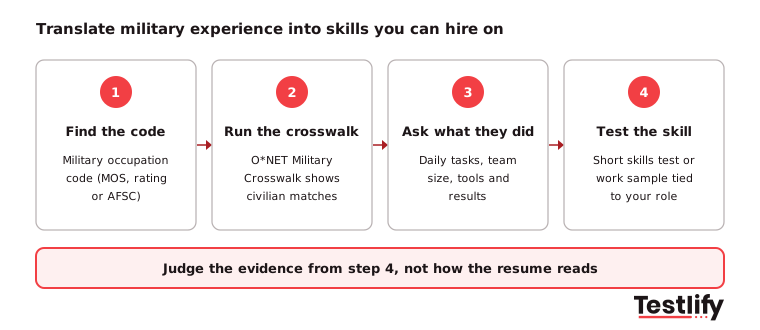
Translating military experience starts with the military occupation code, which tells you what the person was trained to do. Look the code up in the O*NET Military Crosswalk to see matching civilian occupations, then ask the candidate what they did day to day, and test the skills that matter for your role.
Military role (examples) | Civilian skills it often builds | Civilian roles it maps to | How to check the skill |
|---|---|---|---|
Logistics or supply specialist | Inventory control, planning, vendor coordination | Supply chain, warehouse, procurement | Logistics test, planning work sample |
Aircraft or vehicle mechanic | Diagnostics, preventive maintenance, safety rules | Maintenance technician, field service | Mechanical reasoning test, practical task |
Cyber or signals specialist | Network security, incident response, systems admin | Security analyst, IT support, network engineer | Cyber security or networking test, hands-on lab |
Combat medic or corpsman | Emergency care, triage, record keeping | EMT, medical assistant, care coordinator | Role knowledge test, scenario questions |
Squad or platoon leader | Team leadership, planning, risk decisions | Shift supervisor, operations manager | Leadership and situational judgment tests |
Administrative specialist | Records, scheduling, compliance paperwork | Office manager, HR coordinator | Office software and attention to detail tests |
A short skills test does two jobs here. Veterans get a fair chance to show what they can do, and the hiring team gets evidence that does not depend on reading a resume written in military language. For a broader view, see this guide to transferable skills and how skills-based hiring works.
What should you ask (and avoid) when interviewing veterans?
Interviewing veterans works best with structured, job-related questions that ask for specific examples, the same way you would interview any candidate. Avoid questions about disabilities, medical history or the chance of future deployment, which can break disability and military service laws.
Good questions to ask:
- "Tell me about a time you led a team through a task with a tight deadline. What did you do first?"
- "Which parts of your military role are closest to this job, and which would be new for you?"
- "Describe a process you improved or a mistake you caught. What changed afterwards?"
- "How did you train new people on your team?"
- "What kind of support would help you most in your first 90 days?"
Questions to avoid:
- "Do you have PTSD?" or any question about medical conditions or disabilities before an offer.
- "Will you be deployed again?" or "Are you still in the Reserve?" Employment decisions cannot be based on future service.
- "Did you see combat?" It is not job-related and can feel intrusive.
- "What type of discharge did you get?" Ask only if the role has a legal requirement, and check with counsel first.
A structured interview keeps questions consistent and scores tied to the role, which protects candidates and the company.
Which laws apply when hiring veterans?
Hiring veterans in the US is governed mainly by USERRA, VEVRAA for federal contractors, the ADA for veterans with disabilities, and state veteran preference laws. Most private employers have no duty to prefer veterans, but none can discriminate against someone for past, present or future military service.
- USERRA: Under USERRA, employers cannot treat people worse because of military service, and must promptly rehire service members returning from duty in the job they would have held, with the same seniority, status and pay.
- VEVRAA: Federal contractors and subcontractors must take affirmative action to recruit and promote protected veterans. The national hiring benchmark for 2025 is 5.1%, down from 5.2%, according to Proskauer's summary of the OFCCP update.
- Protected veteran status: Indeed's guide to protected veterans lists four groups: disabled veterans, recently separated veterans (within three years), Armed Forces Service Medal veterans, and active duty wartime or campaign badge veterans.
- ADA: A third of veterans live with a service-connected disability. BLS counts 5.8 million, or 34% of all veterans. Reasonable accommodation rules apply as they would for any employee.
- State laws: Many states allow private employers to adopt a voluntary veteran preference policy. Check your state's rules before you use one.
This section is general information, not legal advice. Confirm your obligations with employment counsel.
Is there a tax credit for hiring military veterans in 2026?
The federal tax credit for hiring veterans, the Work Opportunity Tax Credit (WOTC), lapsed for people who started work after December 31, 2025. Unless Congress renews it, hires made in 2026 do not earn the credit. Credits for veterans hired on or before that date can still be claimed.
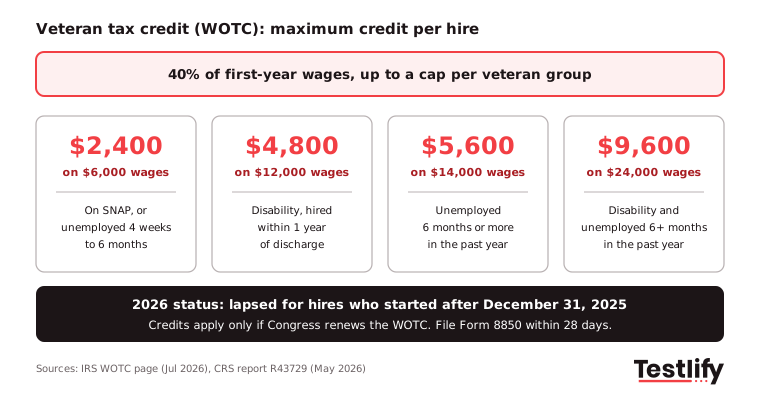
When the credit is active, the IRS WOTC page sets the veteran amounts at 40% of first-year wages up to a cap, and employers must file Form 8850 with their state within 28 days of the start date:
Veteran group | Wages counted | Maximum credit |
|---|---|---|
Receiving SNAP, or unemployed 4 weeks to 6 months | $6,000 | $2,400 |
Service-connected disability, hired within 1 year of discharge | $12,000 | $4,800 |
Unemployed 6 months or more in the past year | $14,000 | $5,600 |
Service-connected disability and unemployed 6 months or more | $24,000 | $9,600 |
The Congressional Research Service report on the WOTC, updated May 2026, confirms the lapse and notes that states can prepare certification requests but cannot issue them for now. Past lapses were renewed retroactively, so many employers keep screening new hires and filing on time. Treat the credit as a possible bonus, not a reason to hire.
How do you keep veteran hires?
Keeping veteran hires depends on what happens in the first year: a clear role, a mentor, visible career steps and a manager who understands military leave. Veterans who feel underused are the ones most likely to leave early, so match the role to their skill level from the start.
- Mentors: Pair each new hire with a colleague, ideally a veteran, for the first six months.
- Clear career paths: Veterans are used to defined promotion steps. Show what the next role looks like and what it takes to get there.
- Veteran employee groups: A group gives new hires a network and gives HR honest feedback on the program.
- Guard and Reserve support: Explain the paperwork for military leave on day one, and make sure managers know USERRA rules.
- Program metrics: Track veteran applicants, hires, 90 day and one year retention, and internal moves, and review them each quarter.
Key takeaway: The best veteran hiring programs fix the process, not the candidate. Describe roles in skills, test skills directly, interview in a structured way and plan the first year. That works for veterans and for every other candidate too.
How can skills assessments support veteran hiring?
Skills assessments support veteran hiring by letting candidates prove what they can do, so the hiring decision rests on evidence rather than on how well a military resume translates. Testlify helps hiring teams set this up without building tests from scratch.
- Tests for the roles veterans move into: The Testlify test library has 3,500+ tests, including leadership, logistics, mechanical reasoning, cyber security and IT support, and you can mix them with situational judgment tests.
- Built from your job description: The AI test builder turns a skills-based job description into a role-specific assessment, with 25+ question types for practical tasks, coding, video and more.
- Fair, consistent screening: Every candidate gets the same questions and automated scoring, with 20+ proctoring checks and a report that shows the evidence behind each score.
- Fits your stack: Assessments run in 15+ languages and connect with 100+ ATS and HRIS tools, so scores sit next to your veteran sourcing data.
Frequently asked questions
Ready to give veteran candidates a fair test?
Pick a role you hire for often, write it as a list of skills, and screen the next group of candidates with a short skills test instead of a resume filter. Start a 7-day free trial of Testlify, no credit card required, and build your first assessment from your own job description.

Content Writer
Yashika Khandelwal is a Content Writer with 3+ years of experience creating research-backed content on hiring, talent assessment, and HR technology. She is a registered Organizational Psychologist and subject matter expert who combines behavioral science with practical recruitment insights to produce accurate, evidence-based content.
LinkedInRelated resources
View all
Talent Acquisition
Should job ads still list the years of experience qualified candidates need?

Talent Acquisition
Campus Recruitment: A 2026 Guide to Skills-First Hiring

Talent Acquisition
What is experiential recruiting

Talent Acquisition
Realistic Job Preview: Examples, Template and How-To (2026)

Talent Acquisition
Top talent acquisition solutions in 2026, compared

Talent Acquisition
Data-Driven Recruitment: Metrics, Steps and Why Synced Data Matters
Get started.
Hire on proof, not resumes.
Run your first skills-based assessment free — no credit card required.