
Campus Recruitment: A 2026 Guide to Skills-First Hiring
Campus recruitment brings in thousands of graduates at once. The step-by-step process, what to test, and how to screen fairly at scale.

Campus recruitment is how employers hire students and recent graduates directly from universities and colleges, usually for internships, graduate programs and entry-level roles. The hard part is no longer finding applicants. A single campus drive can bring in thousands of them, and the team has to pick the right few fairly and fast.
TL;DR: what this guide covers, in five lines.
- Campus recruitment means hiring students straight from college, in batches, on a calendar set by the academic year.
- It runs in three shapes (on-campus, off-campus pool drives and virtual), and most employers now mix all three.
- Applications have grown far faster than graduate jobs, so the assessment stage, not sourcing, is where a drive is won or lost.
- Grades and resumes separate graduates poorly, so test the few skills the role needs in the first six months and score every student on the same scale.
- Track pass rate, offer-to-joining and first-year performance by campus, and pick next season's colleges from that data instead of from rankings.
 ChatGPT
 Gemini
 Claude
 Grok
Grok Perplexity
What is campus recruitment?
Campus recruitment is a hiring strategy in which an employer works with universities and colleges to attract, assess and hire students who are about to graduate or have just graduated. Employers use it to fill internships, graduate schemes and entry-level roles in batches, often on a fixed yearly calendar tied to the academic year.
Campus recruiting is also called campus hiring, university recruiting or early careers hiring. The goal is the same in each case: build a steady pipeline of junior talent the business can train and promote, instead of competing for experienced hires every time a team grows.
A campus recruitment program usually has four parts: employer branding on campus, a hiring event or drive, a selection process with tests and interviews, and an offer and onboarding plan for the graduates who accept.

What are the types of campus recruitment?
Campus recruitment comes in three main types: on-campus drives held at one college, off-campus or pool drives that bring students from several colleges to one venue, and virtual drives run fully online. Most large employers now mix all three, using virtual rounds for screening and in-person days for final selection.
Type | How it works | Best for | Main trade-off |
|---|---|---|---|
On-campus | The employer visits one college, gives a pre-placement talk, then tests and interviews students on site | Top-tier colleges with a proven track record | High travel cost per hire, limited reach |
Off-campus (pool) | Students from several colleges apply and attend one shared drive | Reaching smaller or tier-2 colleges in one go | Harder logistics, larger and more mixed pool |
Virtual | Applications, online tests and video interviews run on the internet | High volume, many regions, lower cost | Needs strong cheating controls and clear candidate communication |
Which mix is right depends on how many graduates you need, not on what large employers do. A team hiring 20 graduates from three colleges can run the whole thing in person. A team sorting 2,000 applications cannot, and should put its in-person time at the end of the process rather than the start. Choosing and keeping the colleges you visit is its own job, covered in building stronger university partnerships.
When does campus recruitment season start?
Campus recruitment season usually starts a full semester before the hires are needed, with most employers running one autumn cycle for the following year's graduates and a smaller spring cycle to fill what is left. Planning begins two to three months before the first campus visit, because colleges set their placement calendars early and the good slots go fast.
- Three to four months out. Agree headcount and roles with each team, and get budget signed off. This is also the moment to pick the colleges, using last season's results.
- Two months out. Book slots with placement cells, and lock the assessment: which tests, how long, what the pass mark is. A test still being argued over two weeks before a drive is a test nobody trusts.
- One month out. Run employer branding on campus and open applications. Brief interviewers so every panel asks comparable questions.
- Drive week. Pre-placement talk, assessments, interviews, and offers to the students you are sure about before you leave the campus.
- Offer to joining, often six to nine months. This is the stretch most teams underplan. Graduates accept in winter and start the next summer, and anything can happen in between.
The long gap between offer and start date is the structural feature of campus hiring that nothing else in recruiting has. Plan for it as a real stage with owners and check-ins, not as dead time.
Why does campus recruitment matter in 2026?
Campus recruitment matters in 2026 because employers are hiring more graduates again while each opening draws more applicants than ever. The result is a volume problem: recruiters have more candidates to judge, thinner signals to judge them on, and the same small team to do it.
The demand side is picking up. NACE's Job Outlook 2026 Spring Update found that US employers expect to hire 5.6% more graduates from the Class of 2026, and companies with more than 5,000 employees plan an 8.7% increase. Other data is less upbeat. The LinkedIn 2026 Grad's Guide reports entry-level hiring down 6% year over year, though that is still better than the 10% drop for mid-level roles.
Applications have grown much faster than jobs. The Institute of Student Employers reports 140 applications per graduate vacancy for the last two years, up from 86 in 2022/23 and 38 two decades ago. In retail, FMCG and tourism the figure reaches 290. Read that as a sorting problem, not a popularity contest: at 140 applications a vacancy, the quality of your screen decides the quality of your hire.
What does the campus recruitment process look like?
The campus recruitment process usually runs in eight stages: plan roles and headcount, choose campuses, build the employer brand, open applications, run online assessments, interview the shortlist, make offers, and onboard the graduates who join. The assessment stage carries the most weight, because it decides who out of thousands gets a human conversation.
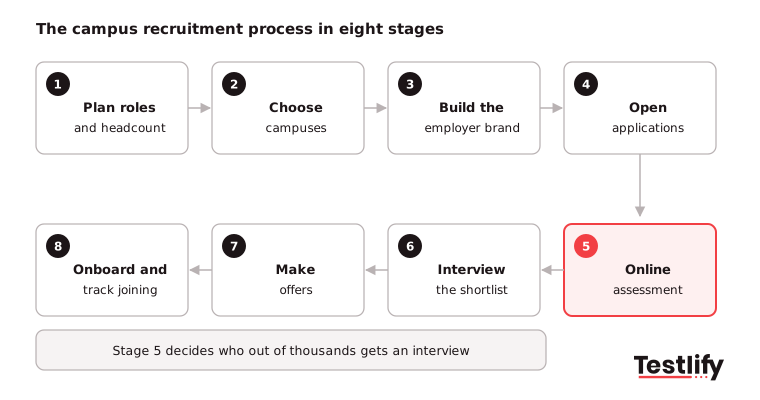
- Plan roles and headcount. Agree how many graduates each team needs, for which roles, and the skills each role needs on day one.
- Choose campuses. Pick colleges on past results: how many hires each one produced and how those hires performed, not only on rankings.
- Build the employer brand. Pre-placement talks, career fairs, student clubs and social media tell students why the role is worth applying for. Our campus hiring and job fair email templates help with the outreach.
- Open applications. Collect applications through the college placement cell, your careers page or your ATS.
- Run online assessments. Give every applicant the same short, role-based test so the shortlist rests on skills, not on the college name.
- Interview the shortlist. Use structured video or AI interviews for the first round, then panel interviews for the final round.
- Make offers. Offer quickly. Strong graduates often hold several offers at once.
- Onboard and track joining. Stay in touch between offer and start date. Offer-to-joining drop-off is common in campus hiring, especially when the start date is months away.
Pro tip: Set the assessment pass mark before the drive opens, not after you see the scores. A fixed bar keeps the shortlist fair across campuses and stops the team from lowering it at the last college to fill seats.
Why do resumes and GPA fall short for graduates?
Resumes and GPA fall short for graduates because most students have similar degrees, little work history and resumes that AI tools can now polish in seconds. Grades show how a student performed in exams. They say little about whether that student can analyze data, write clearly or handle a customer.
Employers are reacting. The ISE survey found that 85% of employers had seen some form of cheating in applications and assessments, and 79% are redesigning or reviewing their recruitment process because students use AI to apply. A year earlier, ISE found 205 applications per vacancy in digital and IT and 188 in financial and professional services, the two sectors that hire the most graduates.
Students are already working around the resume. LinkedIn's guide reports that 21% of Gen Z have started a business or side hustle to get going, and 22% are building apps, websites or other projects to show what they can do. The useful response is not a better resume filter. It is to collect evidence of the work itself.
That is what the Testlify Multi-Signal Talent Evaluation Model is for. It evaluates a candidate on several independent signals, such as a skills assessment, a coding or cognitive test, a structured interview and reviewer feedback, rather than on one resume, one test score or one interviewer's opinion. One signal is fragile. Several signals that agree are worth acting on. For graduates the model matters more than it does for experienced hires, because the resume signal is close to empty: a student with no job history can still show a scored piece of work, and that evidence does not depend on which college they attended. Not every role needs every signal, and the signals are not equally weighted; pick the two or three that predict the job.
What should a campus recruitment assessment test?
A campus recruitment assessment should test the few skills a graduate will use in the first six months, plus general learning ability. For most roles that means a cognitive or aptitude test, one or two role skills tests, and a communication or language check, kept to 30 to 45 minutes so students finish it.
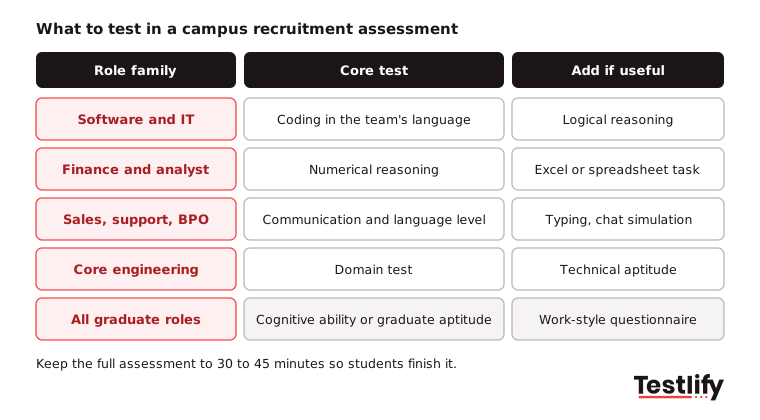
Graduate role family | Core tests | Useful extras | What to skip |
|---|---|---|---|
Software and IT | Coding in the language the team uses, logical reasoning | Live coding interview for finalists | Long theory quizzes on many languages |
Finance, analyst, consulting | Numerical reasoning, Excel or spreadsheet task | Situational judgment, business English | Trivia about financial products |
Sales, customer support, BPO | Communication, English or local language level, typing | Chat simulation, situational judgment | Advanced technical tests |
Core engineering | Domain test (mechanical, electrical, civil), technical aptitude | Safety or process knowledge | Generic personality-only screens |
All roles | Cognitive ability or graduate aptitude | Culture and work-style questionnaire | Anything you will not use in the decision |
Start from the job description, not the test catalog. If a skill does not affect who you hire, leave it out: every extra test lowers completion rates and adds nothing to the decision.
How do interns turn into graduate hires?
An internship is the cheapest graduate assessment there is, because it measures months of real work instead of 40 minutes of testing. The catch is that the offer rate has been falling. NACE's internship benchmarks show employers extended full-time offers to 62% of their 2024 intern class, down from two thirds of the 2023 group and the lowest offer rate in five years, while the average intern-to-full-time conversion rate sits at 63.1%.
The detail worth planning around is how the internship ran. NACE put the average offer rate at 72% for employers with in-person internships and about 56% for those mixing remote and in-person work, and roughly twice as many employers ran hybrid programs as in-person ones. That gap is not proof that remote interns are weaker. The simpler reading is that a manager who has sat near someone for ten weeks has enough evidence to make an offer, and a manager who has not, does not. If a program has to be hybrid, build the evidence deliberately: a scored project, a structured mid-point review, and a named manager who owns the hire-or-not call.
For a team that runs both, the sequence that works is to assess at the internship intake with the same test used for graduate roles, then treat the internship as the second signal and the conversion decision as the third. Students you do not convert are not wasted either; they are a pre-assessed pool for the next drive.
How do you keep campus assessments fair and hard to cheat?
Campus assessments stay fair when every student gets the same test, the same time limit and the same scoring, and they stay hard to cheat when proctoring runs on every attempt instead of at random. Clear instructions, a device check and a choice of language also cut drop-off among good candidates.
- Same rules for every campus. One test, one pass mark and one scoring method across all colleges, so a student from a smaller college is judged on the same scale.
- Proctoring that fits the stakes. Webcam snapshots, tab tracking, copy-paste blocking and question randomization deter most cheating without a live proctor.
- AI-assistance checks. With 85% of ISE employers reporting cheating, look for tools that flag answers pasted from AI tools.
- Job-related tests, validated for the role. The EEOC's guidance on employment tests says employers should make sure selection procedures are properly validated for the positions and purposes they are used for, and that a test which screens out a protected group has to be job-related and consistent with business necessity.
- Validated is not the same as safe. The same EEOC guidance describes a cognitive test validated in 1991 that still had a statistically significant disparate impact years later, in a case settled for $8.55 million. Re-check pass rates by group each season, on your own data, rather than relying on a vendor's validation study.
- Candidate experience. Tell students how long the test takes, what it measures and when they will hear back. Silence after a test damages your brand on campus fast.
- Local rules. In New York City, Local Law 144 bars automated employment decision tools unless they have had a bias audit within one year of use, the results are public and candidates get notice. Keep a person in the loop for every rejection.
Which campus recruiting metrics should you track?
Campus recruiting metrics should cover the whole funnel, from applications per campus to first-year retention, so the team can see which colleges, events and tests produce graduates who stay and perform. Cost per hire alone hides the most useful signal: which campuses send you people who pass the assessment and succeed in the role.
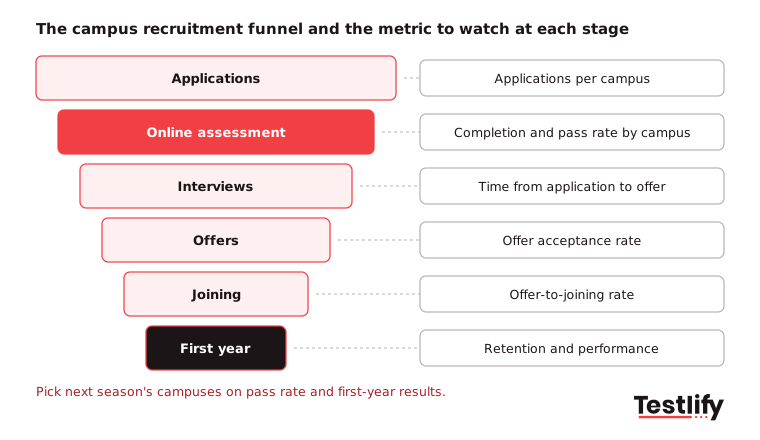
Metric | What it tells you | Warning sign |
|---|---|---|
Applications per campus | Reach of your employer brand at each college | High volume, very low pass rate |
Assessment completion rate | Whether the test length and instructions work | Many students start but do not finish |
Pass rate by campus | Which colleges send job-ready graduates | A top-ranked college with a low pass rate |
Time from application to offer | Speed against competing employers | Offers going out weeks after interviews |
Offer acceptance rate | Strength of the offer and the process | Students declining after the final round |
Offer-to-joining rate | Engagement between offer and start date | Accepted offers that never show up on day one |
First-year retention and performance | Real quality of hire | Early exits from one campus or one test band |
What should campus recruitment software do?
Campus recruitment software falls into two groups: event and relationship tools that manage colleges, career fairs and student communication, and screening tools that assess and rank applicants. Most teams running a real drive need both, connected to the ATS, so a student's details and scores move from event to offer without manual export.
Ask any campus recruiting platform these six questions before you buy:
- Can we build role-based tests from our job descriptions and set our own pass marks?
- Can thousands of students take the test in the same week without a drop in performance?
- Which cheating checks run on every attempt, and can we adjust them per drive?
- What exactly do students need to sit the test: which browsers, and does it work on a phone? Campus bandwidth and borrowed laptops decide completion rates, and most proctored assessments need a desktop browser.
- Do scores and reports sync back to our ATS without manual export, and is that integration included or priced separately?
- Is there an independent bias audit we can share with colleges and candidates?
How does Testlify support campus recruitment?
Testlify runs the assessment and first-interview stages of campus recruitment, so a pool of thousands becomes a ranked shortlist on one consistent scale before recruiters spend time on interviews. Teams build a test from the job description, invite every applicant, and get scored reports with the evidence behind each score.
- Build tests from the role. AI assessment creation takes a job description or an uploaded document and drafts the questions, up to 20 at a time. Teams can also pick from 3,500+ validated tests, including a graduate aptitude test, across 25+ question types such as coding, video, typing, spreadsheet tasks and simulations.
- Screen every student the same way. Multi-stage pipelines send the next assessment automatically, and score thresholds move students forward without manual sorting. Invitations and reminders can go by email, SMS or WhatsApp, which matters when students check one inbox and not another.
- Interview at volume. One-way video interviews plus Video AI and Voice AI interviews ask every shortlisted student the same questions, with selectable avatars and voices, attempt and recording-time limits, transcripts, and auto-scoring a human can override.
- Keep it fair and clean. 20+ proctoring measures, including photo ID verification with face match, periodic webcam snapshots, AI-tool detection and copy-paste tracking, plus dual-device proctoring that uses the student's phone as a second camera. Flags are evidence for a reviewer, not an automatic rejection. See anti-cheating and proctoring.
- Reach every campus. Tests and custom questions translate into the candidate's preferred language in real time, with the honest caveat that quality varies by language pair, so check the pairs you care about before a drive.
- Fit the stack. 100+ ATS and HRIS integrations, priced as an add-on on the self-serve plans and included on Custom, with AI resume screening free on the Greenhouse integration. See integrations.
Two constraints worth knowing before a drive, because they decide completion rates: assessments run on Chromium desktop browsers such as Chrome and Edge, with the mobile app as a fallback for recording audio and video rather than a way to sit a whole test, and plans are credit-based at one credit per started assessment, with credits that do not roll over. For a seasonal campus team, size the credit plan to the drive you are actually running. Compliance documentation covers SOC 2 Type II, ISO 27001, GDPR and NYC Local Law 144. See how teams set up a drive on the campus hiring software page.
Ready to run your next campus drive on skills?
Build your first graduate assessment from your own job description and see a ranked shortlist before the first interview. Start a 7-day free trial of Testlify, no card required, or book a walkthrough with our team to plan a drive.
Key takeaways
Four decisions carry most of the result in campus hiring.
- Pick campuses from pass rates and first-year performance, not rankings. Assessment scores give you that data for every college you visit, including the ones that produced no hires, so a tier-2 college that quietly sends you people who pass belongs on next year's list ahead of a famous one that does not.
- Fix the test before the drive, not after. Pass marks set after scores arrive stop being a standard and become a negotiation, and that is where fairness complaints and bad hires both come from. Lock the test two months out.
- Plan the offer-to-joining gap as a stage. Six to nine months of silence between acceptance and day one is where campus pipelines leak. Give it an owner, a check-in schedule and a measure (offer-to-joining rate) the same way you would any other funnel step.
- Treat internships as the assessment they already are. With conversion around 63%, an intern class is a pre-assessed hiring pool. Score it deliberately, in-person where you can, and keep the students you did not convert in a named pool for the next season.
Frequently asked questions

Related resources
View all
Talent Acquisition
How to scale talent acquisition without losing quality?
Talent Acquisition
Top 10 targeted training strategies to bridge the skills gap

Talent Acquisition
Diversity and inclusion in talent acquisition: Best practices for success

Talent Acquisition
Leveraging technology in talent acquisition: Trends and tools

Talent Acquisition
Building a winning talent acquisition strategy: A step-by-step guide

Talent Acquisition
The evolution of talent acquisition: From traditional to modern approaches
Get started.
Hire on proof, not resumes.
Run your first skills-based assessment free — no credit card required.