
Contingent workforce management: a guide for hiring teams
A practical guide to running contractor, freelancer and temp programs: worker types, program models, classification, skills checks, audits.

Contingent workforce management is the way a company plans, hires, classifies, onboards, pays, and offboards people who work for it without being on its payroll: independent contractors, freelancers, agency temps, gig workers, and consultants on a statement of work. Done well, it gives hiring teams the speed of flexible talent with the same control over quality, cost, and compliance they expect for employees.
 ChatGPT
 Gemini
 Claude
 Grok
 Perplexity
TL;DR
- Contingent workforce management is how a company plans, hires, classifies, pays, and offboards non-payroll workers: contractors, freelancers, agency temps, and SOW consultants.
- BLS found 6.9 million US workers held contingent jobs in July 2023, and 11.9 million worked as independent contractors.
- The main risks are misclassification, co-employment, shadow spend, uneven quality, security gaps, and lost knowledge.
- Classify each engagement at the request stage, before sourcing. The IRS weighs behavioral control, financial control, and the type of relationship.
- Give every contractor the same 20 to 40 minute role-based test before the contract, and track each agency's pass rate.
- Audit before picking a model or software. An in-house VMS fits smaller programs, and an MSP fits large, multi-country agency spend.
- Measure quality as closely as cost: track supplier pass rates and early terminations next to rates and invoices.

What is contingent workforce management?
Contingent workforce management is the set of policies, processes, and tools a company uses to source, engage, manage, and release non-employee workers. A complete program decides who may hire contingent talent, how each worker is classified, how skills are checked, how rates and invoices are approved, and how access is removed when the work ends.
A contingent worker is anyone engaged for a defined period or project instead of an open-ended employment contract. Most companies already use plenty of them. What separates a managed program from an unmanaged one is visibility: knowing how many contingent workers you have, what they cost, what they do, and whether they were vetted like everyone else.
How is contingent workforce management different from workforce management?
Contingent workforce management covers non-employee talent: who you bring in from outside, on what terms, and how you control the risk. General workforce management, or WFM, is mostly about scheduling, forecasting demand, and tracking time for the people you already have, which is why contact centers and retailers rely on it.
If you are looking for shift planning and labor forecasting, our glossary entry on workforce management (WFM) covers that ground. The two meet in workforce planning, where leaders decide which work should go to employees and which to contingent talent.
Who counts as a contingent worker?
Contingent workers fall into five common groups: independent contractors, freelancers, temporary agency workers, gig or on-call workers, and consultants engaged through a statement of work (SOW).
Each group is hired, paid, and controlled differently, so each carries a different mix of cost, speed, and legal risk.
Worker type | How they are engaged | Typical use | Main risk |
|---|---|---|---|
Independent contractor | Direct contract, invoices the company | Specialist skills, projects | Misclassification |
Freelancer | Direct or through a talent platform | Design, content, development tasks | Unchecked quality |
Temporary agency worker | Employed and paid by a staffing agency | Volume roles, cover, peaks | Co-employment, agency quality varies |
Gig or on-call worker | Platform or call-in arrangement | Short tasks, shifts | Classification, turnover |
SOW consultant | Contract for a defined deliverable | Projects, outsourced services | Hidden headcount inside the project |
The numbers are large even under strict definitions. The Bureau of Labor Statistics' contingent and alternative employment release found that in July 2023, 6.9 million US workers (4.3% of employment) held contingent jobs, while 11.9 million worked as independent contractors, 2.8 million as on-call workers, 945,000 through temp help agencies, and 862,000 through contract firms.
For definitions of each type, see our glossary terms for independent contractor, gig worker, and temporary employee.
Why do companies build a contingent workforce?
Companies build a contingent workforce to add skills fast, cover peaks without permanent headcount, and test new markets or projects with less long-term cost. A good contingent workforce strategy also lets hiring teams fill hard roles while a permanent search runs in the background.
- Speed: A contractor or agency temp can start in days, not after a two-month search.
- Specialist skills: Short projects in areas like data, security, or localization rarely justify a full-time hire.
- Flexible capacity: Seasonal peaks, product launches, and backfills for leave can be covered and then released.
- Lower fixed cost: You pay for the work, not for benefits and idle time, although hourly rates are often higher.
- A trial before a hire: Some contingent roles become permanent once both sides know the fit.
Pressure on permanent hiring keeps this demand high. SHRM's 2025 Talent Trends found that 69% of organizations still struggle to fill full-time roles, and 47% are updating existing roles to include new skills, which is exactly the gap contingent talent often fills.
What are the risks of managing contingent workers?
Managing contingent workers carries six main risks: misclassification, co-employment, shadow spend, uneven quality, security gaps, and lost knowledge. Most of them grow quietly when each manager hires contractors their own way, so a program is really a way to make these risks visible.
- Misclassification: Treating someone as a contractor when the law sees an employee can bring back taxes, penalties, and back pay.
- Co-employment: Directing agency workers like staff can make you a joint employer. Our guide to co-employment explains the line.
- Shadow spend: Contractors hired on a department card or a loose SOW never appear in headcount or budget reviews.
- Uneven quality: Agency submittals and marketplace profiles are rarely tested against the role, so quality depends on the supplier.
- Security and access: Contractors keep system access after the work ends unless someone removes it.
- Lost knowledge: Work done by contingent staff leaves with them unless it is documented.
Rules differ by country. In the UK, the GOV.UK off-payroll working (IR35) guidance puts the status decision on medium and large clients, who must give the worker a status determination statement explaining their reasons.
How does a contingent workforce program work?
A contingent workforce program works as a seven-step lifecycle: request, classify, source, check skills, onboard, manage, and offboard. Every contingent hire follows the same path, whatever the supplier, so the company can compare cost and quality across agencies, platforms, and direct contractors.
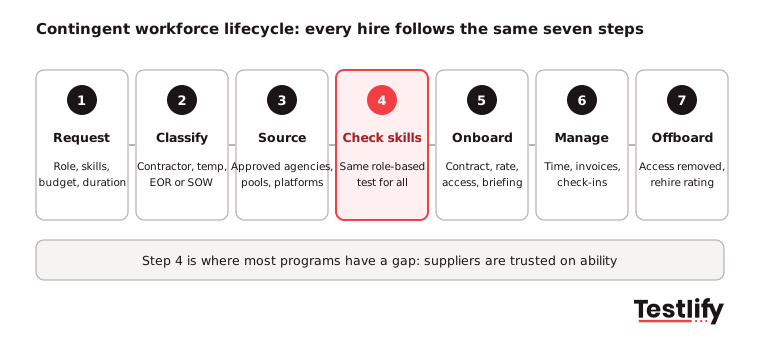
- Request: A manager raises a request with the role, skills, duration, budget, and reason for using contingent talent.
- Classify: HR or a compliance partner decides the right engagement type before anyone is sourced.
- Source: The request goes to approved agencies, a talent pool, or a freelance platform, not to whoever the manager knows.
- Check skills: Every shortlisted worker takes the same role-based assessment, whatever channel they came from.
- Onboard: Contract, rate, system access, equipment, and a short role briefing, logged in one system.
- Manage: Timesheets or milestones, invoice approval, performance check-ins, and extension decisions.
- Offboard: Access removed on the last day, knowledge handed over, and a rating recorded for rehire decisions. Our offboarding glossary entry covers the basics.
Pro tip: Put the skills check before the contract, not after the first missed deadline. Removing a weak contractor costs far more time than testing five candidates up front.
Which contingent workforce program model fits your company?
The right contingent workforce program model depends on how many workers you engage, which types, and how much in-house capacity you have. Small programs often run on a vendor management system (VMS) owned by HR or procurement, while large ones add a managed service provider (MSP), direct sourcing, or an employer of record (EOR).
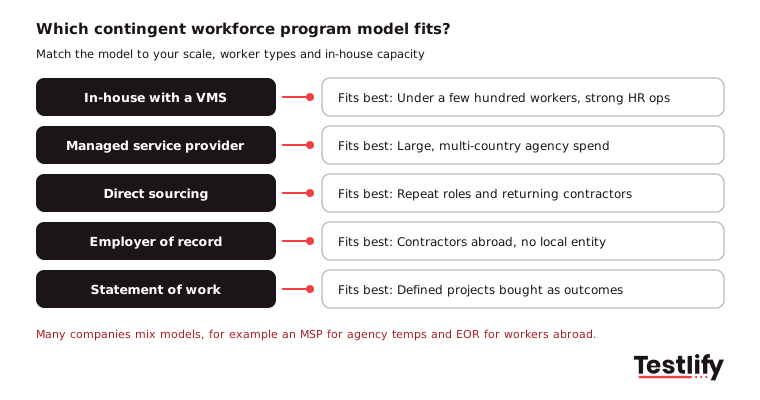
Model | What it does | Fits best when | Watch out for |
|---|---|---|---|
In-house with a VMS | Your team runs requests, suppliers and invoices in one system | Under a few hundred workers, strong HR ops | Team capacity |
Managed service provider (MSP) | An outside firm runs the program and agency suppliers for you | Large, multi-country agency spend | Less direct control over quality |
Direct sourcing | You build your own pool of vetted contractors and alumni | Repeat roles, strong employer brand | Needs talent pool upkeep |
Employer of record (EOR) | A third party employs the worker in their country for you | Hiring contractors abroad without a local entity | Cost per worker |
Statement of work (SOW) | A supplier delivers an outcome, not hours | Defined projects | Hidden headcount, weak oversight |
Many companies mix models: an MSP for agency temps, direct sourcing for repeat freelance roles and an employer of record for international contractors.
How do you classify contingent workers correctly?
Classifying contingent workers correctly means testing each engagement against the rules of the country where the work happens, before the worker starts. In the US, the IRS and the Department of Labor both look past the contract title to how the work is actually controlled and paid.
The IRS guidance on independent contractors and employees groups the evidence into three areas: behavioral control (who directs how the work is done), financial control (who supplies tools, sets payment and carries expenses) and the type of relationship (benefits, expected duration, and whether the work is central to the business). No single factor decides the outcome, so document the reasoning for each role.
Practical steps for hiring teams:
- Classify the role at the request stage, not after the contract is signed.
- Use a short, standard questionnaire for every engagement and keep the answers.
- Review long-running contractors every six to twelve months, since status can drift as the work changes.
- Check the current federal and state position before you rely on an old ruling, because US contractor guidance has changed more than once since 2024.
How do you check contingent workers' skills before they start?
Checking contingent workers' skills before they start means giving every contractor, freelancer and agency temp the same short, role-based assessment before a contract or assignment is confirmed. Most programs track rates, invoices and compliance in detail but accept a supplier's word on ability, which is where many failed engagements begin.
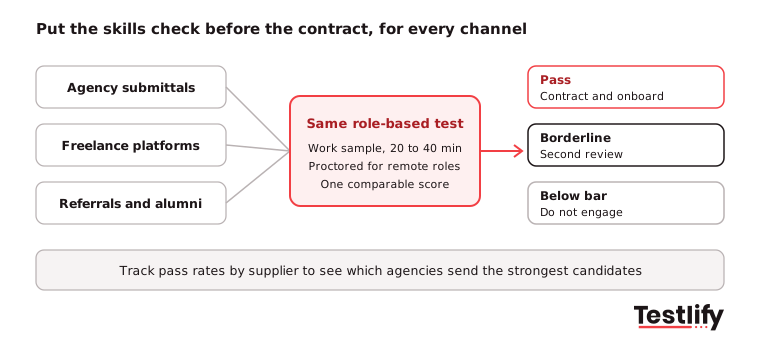
- Test the deliverable: Use a work sample or a role-specific test that mirrors the actual task, such as a coding exercise, a writing brief or an Excel model.
- Use one scale for every channel: Agency submittals, platform freelancers and referrals should land on the same score, so you compare people, not suppliers.
- Keep it short: Contractors juggle several clients. Twenty to forty minutes is enough for most roles.
- Protect integrity for remote work: Most contingent screening happens remotely, so add proctoring and identity checks on higher-risk roles.
- Score suppliers too: Track the pass rate of each agency's candidates. Low pass rates tell you which supplier to coach or drop.
- Reuse results: Store scores in the talent pool so a strong freelancer can be rehired without starting again.
This is the part of contingent workforce management hiring teams can fix fastest, because it needs no new contracts with suppliers, only a consistent check on your side.
How do you run a contingent workforce audit?
A contingent workforce audit is a structured review of every non-employee working for the company, what they cost, how they were engaged and whether the risk is controlled. Run one before you choose a program model or software, and repeat it every year.
- Build the list: Pull contractors, agency workers and SOW suppliers from accounts payable, IT access logs, the VMS and department budgets. Expect the list to be longer than anyone thinks.
- Map each worker: Record type, supplier, manager, start date, rate, role and system access.
- Check classification: Flag long tenures, employee-like control and missing contracts for review.
- Check access: Find active accounts for workers whose engagement has ended.
- Check quality: Note who was skill-checked before starting and who was not, and compare performance by supplier.
- Check spend: Compare rates for the same role across suppliers and spot off-contract purchases.
- Decide actions: Convert, re-paper, end or move each engagement, and set the rules that stop the same gaps returning.
The US Department of Labor states that employers are responsible for determining a worker's status, which is why classification sits at the center of every audit.
Which metrics show your contingent workforce program is working?
The metrics that show a contingent workforce program is working cover four areas: speed, cost, quality and compliance. Spend alone is a weak signal, because a cheap contractor who misses deadlines costs more than a skilled one at a higher rate.
Area | Metric | What good looks like |
|---|---|---|
Speed | Time from request to start | Falling, and similar across suppliers |
Cost | Rate variance for the same role | Narrow range across suppliers |
Cost | Share of spend under contract | Close to all of it |
Quality | Skills check pass rate by supplier | Known for every supplier |
Quality | Early termination rate | Low, and explained when it rises |
Quality | Manager rating at end of engagement | Recorded for every worker |
Compliance | Workers with a documented classification | Every one |
Compliance | Access removed on the last day | Every one |
Planning | Contingent roles converted to permanent | Tracked to spot lasting skill gaps |
Key takeaway: Contingent workforce management pays off when quality is measured as closely as cost. Track supplier pass rates and early terminations next to rates and invoices.
What should contingent workforce management software do?
Contingent workforce management software should give one record of every non-employee, from request to offboarding. The core categories are vendor management systems for agency spend, freelancer management platforms for direct contractors and EOR services for workers abroad, and most companies connect two of them.
Look for these features:
- Requests and approvals with budget and classification fields.
- Supplier management with rate cards and performance by supplier.
- Classification workflows with stored questionnaires and review dates.
- Onboarding and offboarding tied to IT access, so accounts close on time.
- Time, milestone and invoice tracking with approval rules.
- Skills assessment links so test scores sit next to each worker's record.
- Reporting across all contingent spend, not one supplier at a time.
- Integrations with your HRIS, ATS and finance systems.
Choose software after the audit. The audit tells you whether your bigger problem is agency spend, freelancer quality, international compliance or simple visibility.
How does Testlify help with contingent hiring?
Testlify helps hiring teams add a consistent skills check to contingent hiring, so every contractor, freelancer and agency temp is tested on the real work before a contract is signed. The same assessment can go to candidates from any channel, and the scores land on one comparable scale.
- Tests for almost any contingent role: 3,500+ tests cover coding, data, design, finance, language, customer support and blue-collar skills, with 25+ question types for work samples. Browse the test library.
- Built for freelancers: Send a role-specific test the moment a freelancer applies and compare everyone on the same score. See freelance hiring assessments.
- Integrity for remote screening: 20+ proctoring checks, including AI assistance detection and identity verification. Read more on anti-cheating and proctoring.
- Global and connected: Assessments run in 15+ languages, and 100+ ATS and HRIS integrations keep scores in your existing systems. See integrations.
For mixed teams of employees and contractors, our entry on the blended workforce explains how the two groups work together.
Ready to check contingent talent on skills?
Test your next contractor or freelancer on the real work before the contract is signed. Start a 7-day free trial of Testlify, no credit card required, and send your first role-based assessment today.
Frequently asked questions (FAQs)

Related resources
View all
Talent Acquisition
Public sector recruitment: a practical guide for hiring teams

Talent Acquisition
Hiring military veterans: a practical guide for employers in 2026

Talent Acquisition
Should job ads still list the years of experience qualified candidates need?

Talent Acquisition
Campus Recruitment: A 2026 Guide to Skills-First Hiring

Talent Acquisition
What is experiential recruiting

Talent Acquisition
Realistic Job Preview: Examples, Template and How-To (2026)
Get started.
Hire on proof, not resumes.
Run your first skills-based assessment free — no credit card required.