
Public sector recruitment: a practical guide for hiring teams
A practical guide to public sector recruitment: the process, the 2026 rules, the common challenges and how to hire faster and fairer.

Public sector recruitment is the process government bodies and other publicly funded organizations use to attract, assess and appoint people to public roles, under rules that require open competition, selection on merit and equal treatment for every applicant. It covers federal, state and local government, public health services, schools, police and other public bodies.
 ChatGPT
 Gemini
 Claude
 Grok
 Perplexity
TL;DR
- Public sector recruitment follows merit-based selection, open competition, equal opportunity rules, and documented hiring decisions.
- The recruitment process typically involves seven steps, from workforce planning and job posting to screening, assessment, interviews, checks, and onboarding.
- Common challenges include skill shortages, uncompetitive pay, lengthy hiring processes, upcoming retirements, and limited adoption of recruitment technology.
- Clear job competencies, shorter applications, structured interviews, and skills-based assessments can help agencies hire faster without compromising fairness.
- Skills assessments help evaluate candidates consistently across job-related competencies, while documented scores and pass-rate monitoring support accountability and fair hiring.
- Track time to hire, qualified applicant rates, offer acceptance, pass rates across groups, reposting rates, and first-year turnover to measure recruitment effectiveness.

What is public sector recruitment?
Public sector recruitment is hiring for organizations funded and run by government, where every appointment has to be made through a fair, open and documented competition. The goal is the same as in any company, the best person for the job, but the method is set by law and policy, not by the hiring manager's preference.
The public sector is large and varied. It includes:
- Central or federal government: departments, agencies and regulators.
- State, regional and local government: cities, counties, councils and their services.
- Public services: public hospitals and health systems, schools and universities, police, fire and emergency services.
- Public bodies and enterprises: transport authorities, utilities and other organizations owned by the state.
Roles range from caseworkers, clerks and inspectors to engineers, data analysts, nurses and senior executives. That range is why one hiring model rarely fits every role in an agency.
How is public sector recruitment different from private sector hiring?
Public sector recruitment differs from private sector hiring in four main ways: it is bound by merit and equal opportunity rules, it follows set job classifications and pay scales, it must leave a full record of every decision, and it usually takes longer. Private employers can move faster but face less scrutiny when a decision is challenged.
Public sector recruitment | Private sector hiring | |
|---|---|---|
Legal basis | Merit principle, civil service law, open competition | Company policy within employment law |
Job design | Fixed classifications and grades | Flexible titles and scope |
Pay | Published pay scales, limited room to negotiate | Negotiable, often market-led |
Posting | Public posting for a set period, often on official portals | Any channel, including referrals only |
Screening | Minimum qualifications, exams, scored assessments, panels | Resume review and interviews, varies by team |
Records | Every score and decision documented and open to challenge or audit | Records kept, less outside scrutiny |
Speed | Often months, with layers of approval | Often weeks |
Main appeal to candidates | Job security, benefits, public service mission | Pay, growth, flexibility |
The trade-off is clear. Public sector rules protect fairness and public trust, but they also slow hiring down and make it harder to compete for scarce skills.
What are the steps in the public sector recruitment process?
The public sector recruitment process usually runs in seven steps: workforce planning and requisition approval, job analysis and posting, application and eligibility screening, assessment, interviews, checks and offer, then onboarding. Each step has a record behind it, so any decision can be explained later to an applicant, an auditor or a court.
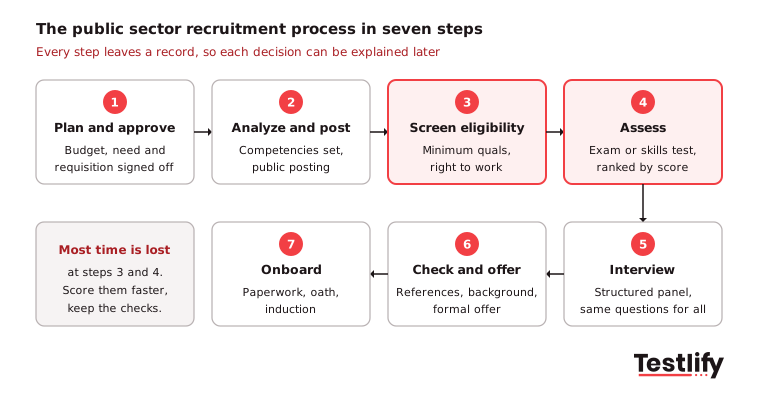
- Plan and approve: The hiring department confirms the budget and the need, and HR approves a requisition tied to a job classification.
- Analyze and post: HR confirms the competencies and minimum qualifications for the grade, then posts the vacancy publicly for a set period, often on an official jobs portal.
- Screen for eligibility: Applications are checked against minimum qualifications, citizenship or right to work, and any preference rules such as veterans' preference in the US.
- Assess: Eligible applicants take a civil service exam, a written exercise or a skills assessment, and are ranked by score.
- Interview: Top-ranked candidates meet a structured panel interview, where every candidate gets the same questions and scoring guide.
- Check and offer: References, background or security checks, and medical checks where the role needs them, then a formal offer.
- Onboard: Paperwork, any oath or declaration, and induction into the agency.
Steps 3 and 4 are where most time is lost. Manual eligibility review and paper-based exams can take weeks for a single posting with hundreds of applicants.
What are the biggest challenges in public sector recruitment?
The biggest challenges in public sector recruitment are finding qualified candidates, competing on pay, slow hiring processes, an aging workforce and the slow uptake of hiring technology. Agencies say pay and speed hurt most, because candidates who are also talking to private employers accept other offers first.
Recent surveys of public sector HR teams show the scale of the problem:
- Finding qualified candidates: The NEOGOV 2025 Trends Report, a survey of 1,005 US public sector HR professionals in January 2025, found that 62% of agencies still struggle to find qualified candidates. 51% named competitive salaries and 31% named a slow hiring process among their top two recruiting challenges.
- Pay: In the same survey, 69% of agencies said the top reason staff left in the past one to two years was a higher-paying job somewhere else.
- Retirements: The MissionSquare Research Institute 2025 workforce survey of 382 state and local HR professionals found 46% expect the biggest wave of retirements is still to come, while 61% have no succession planning process in place.
- Technology: NEOGOV found 65% of agencies have not started using AI in recruitment and 58% have no documented policy on its use.
There is some good news. MissionSquare found the share of governments calling 19 key occupations "hard to fill" has dropped by 10 percentage points or more since 2022. Candidate pools are growing, which moves the problem from finding applicants to screening them fairly and quickly.
What rules shape government hiring in 2026?
Government hiring in 2026 is shaped by the merit principle, equal opportunity law, preference rules such as veterans' preference, and recent reforms that push agencies toward job-related assessments. The details differ by country and level of government, but every system expects selection on ability, shown through evidence that can be checked.
- Merit and open competition. Appointments must go to the candidate who best meets the published criteria, after a fair and open process.
- Equal opportunity. Selection methods must be job-related and must not screen out protected groups without a clear reason tied to the job. Agencies should watch for common types of hiring bias at every stage.
- US federal: the Merit Hiring Plan. OPM and the Domestic Policy Council issued the Merit Hiring Plan on May 29, 2025. OPM's Merit Hiring Plan resources include guidance on technical and alternative assessments, the "rule of many" for ranking candidates, and February 2026 guidance on self-reported assessments. SHRM reports that the plan requires job-related assessments and aims to cut time-to-hire to under 80 days.
- UK Civil Service: Success Profiles. Departments assess candidates on up to five elements: ability, technical, behaviours, strengths and experience. GOV.UK's Success Profiles overview explains that each role uses only the elements that matter for it.
The direction in both systems is the same: less weight on self-rated questionnaires and years of experience, more weight on tested, job-related skills.
How can agencies make public sector recruitment faster and fairer?
Agencies make public sector recruitment faster and fairer by fixing the slowest steps, screening and assessment, rather than cutting the checks that protect fairness. The most useful changes are clear competencies, skills-based screening, structured interviews, shorter applications and automated scoring with a full audit trail.
- Define competencies before posting: Agree on the four to six competencies the grade needs and how each will be tested. This makes every later step faster and easier to defend.
- Replace degree filters with skills tests where the law allows: MissionSquare found that more than two-thirds of governments that dropped degree requirements for some roles saw more applicants, yet only 9% use skills assessments as an alternative to a degree.
- Shorten the application: Ask only for what eligibility needs. Move everything else to the assessment stage, where answers are scored.
- Score automatically, review by people: Automated scoring of objective questions clears the backlog, while panels review the shortlist and the evidence behind each score.
- Use structured panel interviews: The same questions and scoring guide for every candidate keeps interviews fair and comparable. See structured vs unstructured interviews.
- Sell the mission and the benefits: Job security, pensions, flexible work and public service are strong draws, so put them at the top of the posting.
- Plan for retirements: Use the same assessments on current staff to find who is ready to step up, before posting externally.
Pro tip: Publish how candidates will be assessed in the job posting, for example "a 40-minute online skills test, then a structured panel interview". Candidates trust a process they can see, and a published method is easier to defend if a decision is challenged.
How do skills assessments fit government hiring?
Skills assessments fit government hiring because they turn the competencies in a job classification into scores that can be compared, ranked and audited. Every applicant gets the same test under the same conditions, which is the same idea as a civil service exam, with faster scoring and better records.
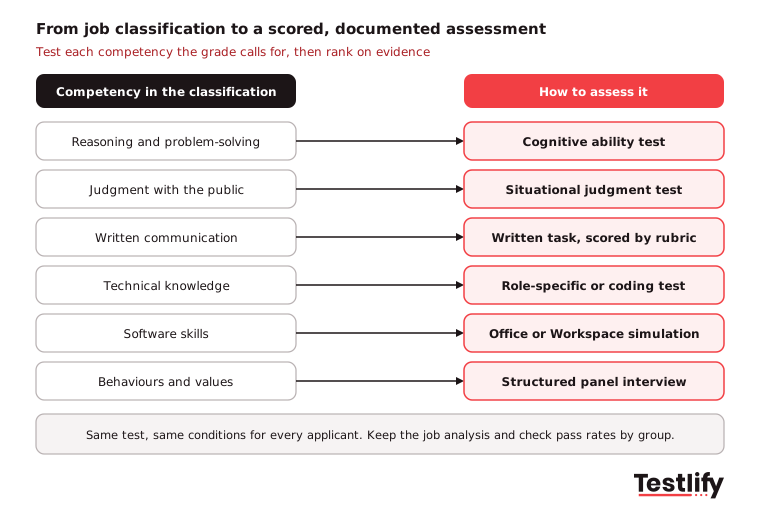
Competency in the classification | Assessment method | Example role |
|---|---|---|
Reasoning and problem-solving | Cognitive ability test | Policy analyst, inspector |
Judgment with the public | Situational judgment test | Caseworker, call handler |
Written communication | Written task, scored against a rubric | Clerk, officer |
Technical knowledge | Role-specific or coding test | IT specialist, engineer, accountant |
Software skills | MS Office or Google Workspace simulation | Administrator, finance assistant |
Language ability | Language test (CEFR levels) | Multilingual public-facing roles |
Behaviours and values | Structured panel interview | All roles |
Two cautions apply. First, every test must link to a real requirement of the job, so keep the competency analysis on file. Second, check pass rates by group after each round, so any test that screens out a protected group without a job reason is spotted early.
What should public sector hiring teams measure?
Public sector hiring teams should measure time to hire, the share of qualified applicants, how often roles are reposted, pass rates by group, offer acceptance and early turnover. Together these show whether hiring is fast, fair and finding people who stay.
Metric | What it tells you | How to use it |
|---|---|---|
Time to hire | Days from posting to accepted offer | Find the slowest step; the US federal goal is under 80 days |
Qualified applicant rate | Share of applicants who pass eligibility and assessment | Low rates point to a weak posting or the wrong channels |
Reposting rate | How often a vacancy is reopened for lack of qualified applicants | High rates point to pay or qualification problems |
Pass rates by group | Whether any step screens out a protected group | Review the test or step if the gap has no job reason |
Offer acceptance rate | Share of offers accepted | Low rates often mean pay or speed lost the candidate |
First-year turnover | Share of new hires who leave within a year | Links hiring quality to retention |
Key takeaway: Public sector recruitment does not have to choose between fair and fast. Clear competencies, scored skills assessments and structured interviews make hiring quicker and leave a better record than manual screening ever did.
How does Testlify support public sector recruitment?
Testlify supports public sector recruitment with role-specific skills assessments that score every applicant against the competencies a classification calls for, with results ranked and recorded. Agencies can build assessments from 3,500+ tests or write their own, and keep a full record of how each candidate was assessed.
- Competency-based tests. Cognitive ability, situational judgment, language, software and role-specific tests, plus 25+ question types for roles without an off-the-shelf test. See the Testlify test library.
- Fair, consistent conditions. Every candidate gets the same assessment, and 20+ proctoring checks protect test integrity. anti-cheating and proctoring
- Records for audit. Automated scoring, timestamped logs and CSV or PDF export keep the evidence behind every decision.
- Security and access. ISO 27001, SOC 2 Type II, GDPR and CCPA support, regional data residency and role-based access for panel members.
- Fits the existing stack. Two-way sync with 100+ ATS and HRIS platforms, assessments in 15+ languages, and white-label options so candidates stay on the agency's brand.
For a closer look at how this works for agencies, see Testlify for the public sector.
Frequently asked questions

Related resources
View all
Talent Acquisition
Hiring military veterans: a practical guide for employers in 2026

Talent Acquisition
Should job ads still list the years of experience qualified candidates need?

Talent Acquisition
Campus Recruitment: A 2026 Guide to Skills-First Hiring

Talent Acquisition
What is experiential recruiting

Talent Acquisition
Realistic Job Preview: Examples, Template and How-To (2026)

Talent Acquisition
Top talent acquisition solutions in 2026, compared
Get started.
Hire on proof, not resumes.
Run your first skills-based assessment free — no credit card required.