
Should job ads still list the years of experience qualified candidates need?
Years of experience is a weak stand-in for skill. Why job ads still use it, who it shuts out, and what hiring teams can check instead.

Years of experience is the number of years a person has spent in a role, field or with a tool. Most job ads use it as a shortcut for skill. But the years of experience qualified candidates bring show how long they have worked, not how well. The number in a job ad is usually a guess, and it quietly filters out people who could do the job.
TL;DR / Key Takeaways
- Years of experience measures time spent in a role, not skill, depth or results.
- Most job ads use the number as a shortcut, often because of ATS knockout questions, reused job descriptions and pay bands.
- Posting data shows employers cluster on round numbers like 5 and 10, so the figure is usually a guess.
- Year filters screen out career changers, early-career candidates, returners, older workers and self-taught talent. LinkedIn found a skills-based pool 6.1 times larger globally.
- Many employers are dropping the requirement from ads, but few have changed how they screen.
- Years still matter for licensed, safety-critical and some senior roles, where the rule or the exposure is the point.
- Replace the number with a capability statement, switch off year-based knockout questions, test skills early and use structured interviews.
 ChatGPT
 Gemini
 Claude
 Grok
 Perplexity
Do years of experience make candidates qualified?
Years of experience do not make a candidate qualified on their own. A year count shows time spent near the work, not the depth, recency or quality of what the person did in that time. Two people with five years in the same job title can have very different skills, because one may have repeated the same year five times.
Qualification is about whether someone can do the work the role needs today. That depends on:
- Scope: Did the person own the work or support someone who did?
- Recency: Is the experience with current tools and rules, or with versions that are gone?
- Relevance: Was the experience in a setting like yours, with similar volume, customers and constraints?
- Results: What changed because this person did the work?
A year count captures none of these. It is a proxy for a proxy: years stand in for experience, and experience stands in for skill.

Why did years of experience become a hiring filter?
Years of experience became a hiring filter because it is cheap to read, easy to compare and feels safe. A recruiter can scan a resume in seconds and check a date range. Measuring actual skill takes more effort, so the year count became the default.
A few habits keep it in place:
- ATS knockout questions: Many application forms ask "How many years of experience do you have with X?" and reject anyone below the line before a person reads the application.
- Copy and paste job descriptions: Old job ads get reused, and the number travels with them even when the role has changed.
- Risk avoidance: A hiring manager who picks the candidate with more years feels easier to defend if the hire goes wrong.
- Pay bands: Some companies tie grades to years, so the number in the ad mirrors an internal salary table rather than the work.
One example from work with hiring teams of a role where the years filter rejected someone who later proved strong, or a team that removed the knockout question and the result.]
Is the number in your job ad based on anything?
The number in most job ads is based on habit more than on the work. Recent posting data shows employers cluster on round numbers, which suggests the figure is picked, not measured.
A SeekerScore analysis of 247,239 active job postings taken in August 2026 found that 41% stated a years of experience number. Among those, "10 years" appeared 15.1 times more often than "9 years", and "5 years" appeared 3.1 times more often than "4 years". About 60.5% of stated requirements fell between 1 and 5 years. The study is self-published by a job seeker tool, so treat the exact figures as directional, but the pattern is hard to ignore.
Real skill does not jump at 5 or 10 years. If the difference between 4 and 5 years mattered to the job, ads would ask for 4 about as often as 5. They do not, which tells you the number is a round guess.
Pro tip: Before you post a role, ask the hiring manager to describe what a person with the required years can do that a person with one year less cannot. If nobody can answer, replace the number with that missing capability, or drop it.
Who gets filtered out by years of experience requirements?
Years of experience requirements filter out people whose skills came from a different path: career changers, self-taught workers, people returning after a break, and early-career candidates who built skills quickly. The filter also shrinks the pool for every role, which makes hard roles harder.

The LinkedIn Economic Graph report on skills-based hiring (March 2025) compared two pools: people who held the same job title in the past five years, and people whose skills overlapped at least half of the role's key skills. The skills pool was 6.1 times larger globally and 15.9 times larger in the United States. For AI roles the increase was 8.2 times, and it could raise the share of women in AI talent pools by up to 24%.
The groups most likely to miss a years filter:
- Career changers whose skills transfer but whose job titles do not match.
- Gen Z and early-career candidates. LinkedIn found the skills pool grew 6.8 times for Gen Z, more than for any other generation.
- Returners after caregiving, illness or a layoff, whose gap cuts their year count.
- Older workers, who can read a "3 to 5 years" range as a signal that the role wants someone younger.
- Self-taught and bootcamp talent, who learned on projects rather than in a job title.
Are employers really dropping years of experience requirements?
Employers are dropping years of experience requirements from many job ads, but less often from how they screen. The ad changes faster than the process behind it.
The posting data shows a real shift:
- Indeed Hiring Lab (May 2024) found the share of US postings with a specific years requirement fell from about 40% in April 2022 to 30% in April 2024. In high-wage sectors it fell from 66% to 44%.
- A Deel survey reported by Workplace Journal (June 2026) found 68% of hiring leaders have scaled back or removed experience requirements from entry-level ads, and 43% now rank learning speed as their top priority.
The same data has two warnings. First, tech is moving the other way. Indeed Hiring Lab (July 2025) found tech postings asking for 5 or more years rose from 37% in mid-2022 to 42% in mid-2025, while non-tech postings asking for 5 or more years fell from 16% to 11%.
Second, removing a line from an ad does not change who gets hired. Research from the Harvard Business School Project on Managing the Future of Work and the Burning Glass Institute found that about 45% of firms that dropped degree requirements changed "in name only", and the shift reached fewer than 1 in 700 hires.
Indeed data reported by UNLEASH (May 2025) shows the same gap for experience: 51% of hiring managers say skills matter more than degrees, titles or years, yet only 13% of skills-first employers have reduced required years. More than a quarter say they lack the tools to judge skills.
That last number is the real problem. Teams keep the year count because they have nothing better to put in its place.
When do years of experience still matter?
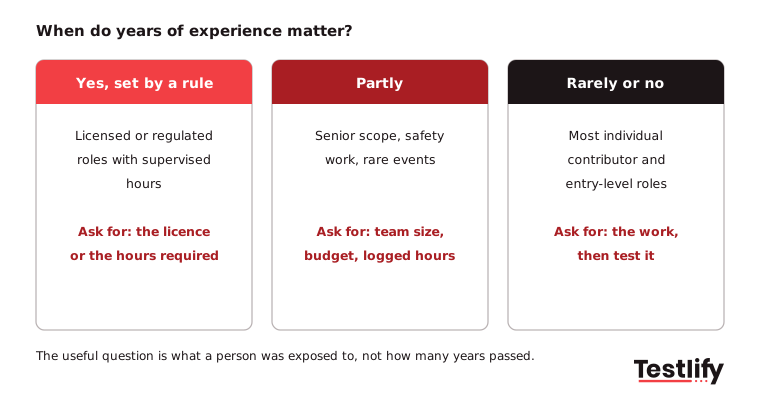
Years of experience still matter when time itself builds something a test cannot show quickly: judgement under pressure, exposure to rare events, or a legal requirement. Even then, the useful question is what the person has been exposed to, not how many years have passed.
Situation | Do years matter? | What to ask for instead of a bare number |
|---|---|---|
Licensed or regulated roles (nursing, engineering sign-off, audit) | Yes, when the regulator sets supervised hours | The licence or the supervised hours the rule requires |
Safety-critical work (heavy equipment, aviation, utilities) | Often | Logged hours on the specific equipment, plus a practical check |
Senior leadership with a large scope | Partly | Size of team, budget or P&L owned, and decisions made |
Roles that need rare events (incident response, restructuring) | Partly | Number and type of incidents handled, not years on call |
Most individual contributor roles | Rarely | The tasks and outcomes in the first 90 days, tested directly |
Entry-level roles | No | Learning speed, basics of the craft, and motivation |
Should job ads list the years of experience qualified candidates need?
Job ads should list the work qualified candidates need to do, not the years they spent getting there. Replace each years requirement with a capability statement, then decide how you will check it. The ad gets clearer, the pool gets wider, and the screen gets fairer.
Instead of | Write | Check it with |
|---|---|---|
5+ years of Excel | Builds models with lookups, pivot tables and scenario analysis for monthly reporting | A short spreadsheet task |
3 to 5 years in customer support | Resolves complex tickets in writing within your SLA and handles upset customers calmly | A written chat simulation |
7+ years in software engineering | Designs and ships a service end to end, reviews others' code and handles production incidents | A coding task and a design discussion |
10 years of sales experience | Has run full sales cycles above a named deal size with a named type of buyer | Deal walk-through in a structured interview |
2+ years of project management | Has planned and delivered a project with a budget, a deadline and several teams | Scenario questions on scope and risk |
For more on writing the ad itself, see how to write an effective job description.
What should hiring teams measure instead of years?
Hiring teams should measure the skills and behaviours the role uses every week, in the order they matter. The goal is evidence: a task, a sample or a structured answer that shows the person can do the work.
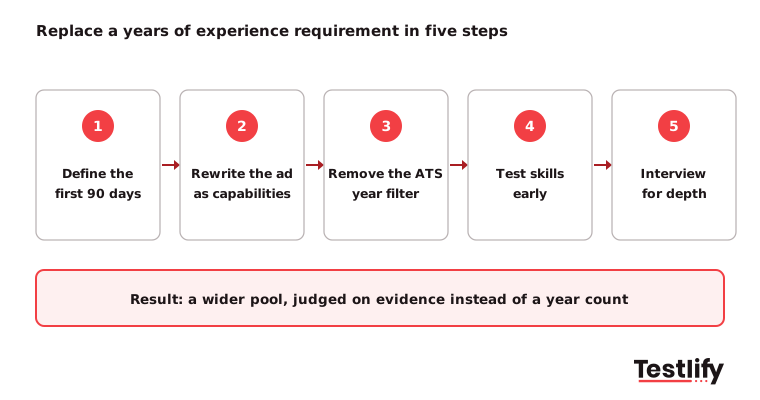
- Define the first 90 days: List the three to five things the new hire must deliver. These become your must-haves.
- Rewrite the ad: Turn each must-have into a capability statement, like the table above.
- Remove the knockout question: If your ATS rejects anyone under a year count, switch the question off or make it informational.
- Test skills early: Put a short, role-specific skills test before long interviews, so the team spends time on people who can do the work. A library like the Testlify test library covers role, software, coding, language and cognitive skills.
- Interview for depth. Use the same structured questions for every candidate and ask about scope, decisions and results.
For the wider shift behind this, read what skills-based hiring is and why it matters.
How do you tell real depth of experience from time served?
Real depth of experience shows up in the detail a candidate can give about decisions, trade-offs and mistakes. Time served shows up as job titles and dates with little behind them. Structured questions and a short work sample separate the two quickly.
Questions that surface depth:
- "Walk me through the hardest problem you solved in this area in the last year. What did you decide, and what would you change?"
- "What did you own, and what did you hand off to others?"
- "What changed in this field in the past two years, and how did your work change with it?"
- "Tell me about a time your first approach failed."
Candidates with real depth answer with specifics: numbers, names of tools, the reason behind a choice. Candidates with time but little depth stay general. Score every answer against the same guide, so a confident talker does not beat a quiet expert.
Key takeaway: A years of experience requirement measures time, not skill, and the number is usually a round guess. Keep years only where a rule or real exposure demands them. Everywhere else, write the work into the ad and check it with a task or structured interview.
What should you change in your next job ad?
Start with one open role. Find the years requirement, ask the hiring manager what it is meant to prove, and replace it with that capability plus a way to check it. Then switch off any ATS question that rejects candidates on a year count alone.
Track three numbers for that role: the size of the applicant pool, the share of candidates who pass the skills check, and how the new hire performs at 90 days. That gives you your own evidence, which beats any survey. For more ways to widen the pool, see how to find qualified candidates.
Frequently asked questions

Content Writer
Yashika Khandelwal is a Content Writer with 3+ years of experience creating research-backed content on hiring, talent assessment, and HR technology. She is a registered Organizational Psychologist and subject matter expert who combines behavioral science with practical recruitment insights to produce accurate, evidence-based content.
LinkedInRelated resources
View all
Talent Acquisition
Campus Recruitment: A 2026 Guide to Skills-First Hiring

Talent Acquisition
What is experiential recruiting

Talent Acquisition
Realistic Job Preview: Examples, Template and How-To (2026)

Talent Acquisition
Top talent acquisition solutions in 2026, compared

Talent Acquisition
Data-Driven Recruitment: Metrics, Steps and Why Synced Data Matters

Talent Acquisition
How to scale talent acquisition without losing quality?
Get started.
Hire on proof, not resumes.
Run your first skills-based assessment free — no credit card required.