
What is a hiring manager? Role and duties explained
A hiring manager owns the open role end to end, from the job description to the final hiring decision and onboarding.

Every open role has one person who lives with the hire long after the offer is signed. That person is the hiring manager, usually the leader the new hire will report to.
Recruiters run the process, but the hiring manager owns the outcome. Here is what the hiring manager role and duties involve, and how to make the partnership with recruiting work.
TL;DR:
- A hiring manager is the person who owns the open role, usually the new hire's future manager, not the recruiter who runs the process.
- Their core duties are four: define the role, evaluate candidates, decide and close, and onboard the new hire.
- Hiring managers write or approve the job description, interview finalists, and make the final hiring decision. Recruiters source and screen.
- Weak alignment between hiring managers and recruiters is the most common cause of a slow, inconsistent hiring process.
- Clear scoring criteria, agreed upfront with the recruiter, fix most of the back-and-forth on who to move forward.
- A skills assessment or a structured, scored interview gives a hiring manager comparable evidence instead of gut feel.
 ChatGPT
 Gemini
 Claude
 Grok
 Perplexity
What is a hiring manager?
A hiring manager is the person accountable for an open role, almost always the manager the new hire will report to once they start. They are the internal "client" of the hiring process: they define what success in the role looks like, and they live with the outcome of who gets hired.
A recruiter, by contrast, runs the hiring process itself. A hiring manager at a software company might be an engineering lead opening a backend role.
At a retail chain, the hiring manager might be a store manager filling a shift supervisor position. The title on the requisition rarely says "hiring manager", since the role belongs to whoever's team has the vacancy.

What does a hiring manager do?
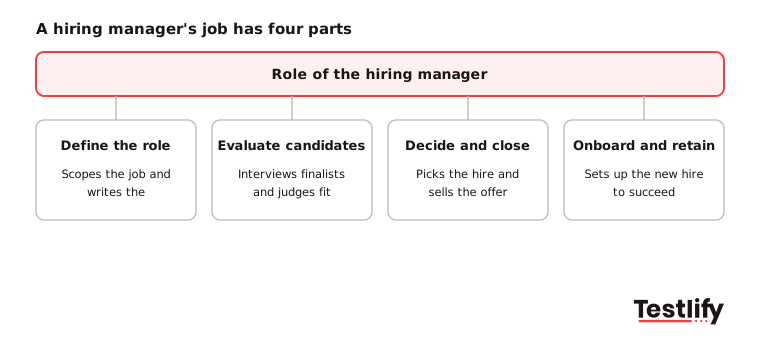
A hiring manager's duties fall into four parts: defining the role, evaluating candidates, deciding and closing, and onboarding the new hire. Each part needs a different kind of work from them.
Define the role
Hiring managers scope the job, set the budget and level with HR, and write or approve the job description. It should reflect what the role actually needs, not a wish list.
Evaluate candidates
Hiring managers review the shortlists the recruiter sends over and run the later interview rounds. They judge candidates against the agreed criteria rather than first impressions.
Decide and close
Hiring managers make the final call on who to hire and agree the offer terms with HR or finance. They often speak to the candidate directly to close the deal.
Onboard and retain
Hiring managers set 30, 60 and 90-day goals and make time for the new hire in their first weeks. They also give feedback early enough to fix problems before they become a reason to leave.
Pro tip: Write the scoring criteria for each interview round before you post the role, not after the first resume lands. Teams that agree on what a strong answer looks like in advance spend far less time arguing about candidates after the fact.
How is a hiring manager different from a recruiter?
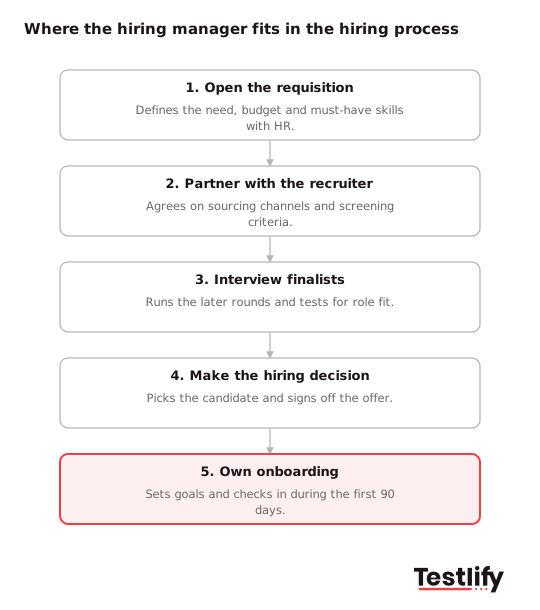
A hiring manager owns the hiring decision; a recruiter owns the hiring process that leads to it. A recruiter typically sources candidates, runs the first screen, and keeps the process moving on schedule.
The hiring manager sets the bar for the role, interviews finalists, and signs off on the hire.
Area | Hiring manager | Recruiter |
|---|---|---|
Owns | The decision and the outcome | The process and the pipeline |
Writes | Role requirements, final job description sign-off | Job ad copy, outreach messages |
Sources candidates | Rarely | Yes, through job boards, referrals, agencies |
Runs early screens | Rarely | Yes |
Runs final interviews | Yes | Sometimes sits in, rarely leads |
Makes the hire/no-hire call | Yes | Advises, does not decide |
Measured on | Quality of hire, team performance | Time to fill, pipeline volume |
In practice the two roles only work well together. A hiring manager with no recruiter support ends up doing sourcing and scheduling on top of their own job. A recruiter with a disengaged hiring manager ends up guessing what "a good fit" means, which slows every requisition down.
What skills does a good hiring manager need?
A good hiring manager needs to write a clear job description, interview well, judge evidence over gut feel, and move fast enough to keep candidates engaged. None of these come automatically with a management title, which is why many companies now train new managers on it directly.
- Interviewing, not just conversing: Asking the same structured questions of every candidate and scoring answers against the same rubric, instead of a loose chat that favors whoever is most likeable.
- Judging evidence over gut feel: Weighing a work sample, test score or portfolio more than how a candidate "seemed" in 30 minutes.
- Writing a job description that matches the real job: Listing the 3 to 5 things the role actually needs, not every skill that would be nice to have.
- Moving at the speed candidates expect: Returning feedback within days, since a slow hiring manager is one of the most common reasons a strong candidate accepts another offer first.
- Giving a reason, not just a score: Explaining to recruiters and candidates why someone did or did not advance, which keeps the pipeline and the candidate experience both intact.
What challenges do hiring managers face?
The two most common challenges hiring managers face are time pressure and misalignment with recruiting. Most run hiring on top of a full-time job leading their team, so interviews and feedback slip down the list.
SHRM's 2025 recruiting benchmarking research measures how many requisitions each recruiter carries, a workload most hiring managers never see.
A second challenge is misalignment with the recruiter on what "right" looks like for the role. Without agreed must-have skills, salary range and timeline, hiring managers tend to reject candidates late for reasons the job description could have caught.
How can hiring managers work better with recruiters?
Hiring managers work better with recruiters when both agree on the role's must-haves, the interview scorecard and the timeline before the search starts, not after the first round of interviews. LinkedIn Talent Solutions' recruiting metrics cheat sheet lists hiring manager satisfaction alongside time to hire and candidate satisfaction as core recruiting metrics, which signals how much the relationship itself affects results.
A short intake call before sourcing, a shared interview scorecard and a weekly five-minute check-in on open roles cover most of what goes wrong. Skills assessments and structured interview scoring give both sides the same evidence, so decisions and shortlists rest on the same criteria.
Testlify gives hiring managers scored, role-specific evidence to judge candidates, instead of relying on a resume or gut feel. Choose from 3,500+ validated tests in the test library, then share interview scorecards with the whole hiring team.
Want to see how it works on your own roles? Book a demo with the Testlify team.
Frequently asked questions (FAQs)

People and Talent Partner
Arushi Shah runs day-to-day talent acquisition and candidate experience at Testlify. She writes on interviewing, structured hiring, and giving candidates a fair, fast process.
LinkedInRelated resources
View all
Talent Acquisition
Contingent workforce management: a guide for hiring teams

Talent Acquisition
Public sector recruitment: a practical guide for hiring teams

Talent Acquisition
Hiring military veterans: a practical guide for employers in 2026

Talent Acquisition
Should job ads still list the years of experience qualified candidates need?

Talent Acquisition
Campus Recruitment: A 2026 Guide to Skills-First Hiring

Talent Acquisition
What is experiential recruiting
Get started.
Hire on proof, not resumes.
Run your first skills-based assessment free — no credit card required.