
Testlify vs Toggl Hire: A detailed comparison
Discover the perfect solution for evaluating your candidates’ skills with Testlify. Dive into our comprehensive Testlify vs Toggl Hire…
Toggl has sunset Toggl Hire. Its own site now reads "Toggl Hire is retiring from recruitment," new signups are closed, and existing users are being pointed to Toggl's time-tracking and planning tools instead. If you built your screening on Toggl Hire, the question is no longer "Testlify or Toggl Hire?" It is "what replaces the skills tests, the two-minute video answers and the built-in pipeline, and what will it cost?" This page answers that with Toggl's last published pricing, Testlify's live pricing, a feature table with only verifiable rows, and a migration path.
TL;DR
- Toggl Hire is being retired by Toggl. There is no published end date, so plan the move now rather than waiting for a cutoff email.
- Toggl Hire's last pricing page listed a Free plan, Starter at $199 a month billed annually and Premium at $349. Testlify's Starter plan is $139 a month billed annually for 100 candidate credits, with a 7-day free trial and a 30-day money-back guarantee.
- The two products overlap on skills tests and async video, but Testlify goes further on question types (25+, including Excel, Sheets and coding in a real editor), proctoring (three presets plus phone-as-second-camera monitoring) and interviewing (one-way, conversational AI video and AI phone).
- Testlify has honest gaps too: no permanent free plan, credits that do not roll over, Chromium-only test taking, and ATS integrations sold as an add-on on self-serve tiers.
- Migration is mostly a mapping exercise: export your Toggl data, rebuild each test from Testlify's library or from a job description with AI, pilot one role, then connect your ATS.
 ChatGPT
 Gemini
 Claude
 Grok
Grok Perplexity
Is Toggl Hire shutting down?
Yes. Toggl's own page states: "We've decided to sunset Toggl Hire so we can focus on building new tools to help you grow your business." Toggl has not published a shutdown date, and the Toggl Hire pricing page now redirects to Toggl's main site. Treat the product as closed to new customers and time-limited for existing ones (Toggl, 2026).
That matters for how you read every "Toggl Hire alternative" article, including this one. The old comparison question (which tool has more checkmarks) is gone. The useful question is what you will lose in the move and what you can gain. Toggl Hire's strengths were real: a built-in hiring pipeline, unlimited candidates on paid plans, quick template tests and short async video answers. A replacement has to cover those before it earns credit for anything extra.

Who are the main Toggl Hire competitors?
Toggl Hire competitors fall into three groups: skills assessment platforms (Testlify, TestGorilla, Vervoe, iMocha, Xobin, Canditech), async video interviewing tools (Spark Hire, Willo, HiPeople) and developer-only screening tools (HackerRank, Codility, HackerEarth). Directory sites most often surface TestGorilla, Spark Hire and HackerEarth as the closest matches, but none of those three covers the full Toggl Hire bundle on its own.
The reason is the bundle itself. Toggl Hire sold one product that did three jobs: a light applicant pipeline, a template-based skills test and a two-minute video question. Developer screeners cover one job. Video tools cover one job. Only the broad assessment platforms cover two of the three, and only a few of those also ship a pipeline for teams that never bought an ATS. So the shortlist for most former Toggl Hire teams is shorter than the listicles suggest.
How do you compare Toggl Hire alternatives?
Compare Toggl Hire alternatives on six things: depth of the test library and question types, anti-cheating controls, interview formats, whether it fits your ATS situation, the pricing model (per candidate versus flat subscription), and migration support. Score each tool on those six before you look at a single checkmark table, because every vendor builds its own table to win.
A useful frame here is the Testlify Multi-Signal Talent Evaluation Model: combine several role-relevant signals (a skills assessment, a work sample, an interview, references, reviewer feedback) rather than trusting one test score or one polished interview. Toggl Hire's design already pointed this way with test plus video plus homework. Whatever you pick next should let you keep stacking signals, not shrink back to a single quiz.
Two research findings back this up. A 2022 reanalysis of selection-method validity by Sackett and colleagues placed structured interviews among the strongest predictors of job performance and put years of education and general years of experience among the weaker ones (Journal of Applied Psychology, 2022). And a meta-analysis by Kuncel and colleagues found that combining assessment data mechanically predicts outcomes as well as or better than experts recombining the same data by judgment (Journal of Applied Psychology, 2013). In plain terms: test what the job needs, score it consistently, and let people decide with the numbers in front of them.
What should a Toggl Hire software alternative include?
A Toggl Hire software alternative should include, at minimum: custom skills tests you can build or edit, a question library wide enough to cover non-technical roles, some form of async video question, anti-cheating controls, a way to move candidates through stages (built in or via your ATS), and pricing that does not punish a team hiring for three roles a quarter. Anything beyond that (coding environments, AI interviews, item-level analytics) is where the alternatives separate.
Pro Tip: Before you evaluate anything, export the pass rates and completion rates from your Toggl Hire tests. They are your baseline. If the replacement tool's pilot shows a lower completion rate on the same role, the assessment is too long or too hard, not the candidates.
Testlify vs Toggl Hire: how do the features compare?
Testlify covers everything Toggl Hire sold (custom tests, async video, a hiring pipeline, AI grading and AI-use detection) and adds question types, proctoring depth and interview formats Toggl Hire never listed. The table below only includes rows both products documented publicly. The Toggl Hire column comes from its last archived pricing page (July 2025); the Testlify column comes from the live product and pricing page.
Capability | Testlify | Toggl Hire (last published) |
|---|---|---|
Status in 2026 | Active, 7-day free trial | Being sunset by Toggl; new signups closed |
Test library | 3,500+ tests, 180k+ validated questions | 20k+ question library covering 200+ skills |
Custom tests | Custom questions, three difficulty levels, fixed or randomized question banks | Templates only on Free; fully custom on Starter and above |
Question types | 25+, including Google Docs, Sheets and Slides tasks, Word, PowerPoint and Excel tasks, typing, file upload, coding, video, audio and AI interview | Multiple choice and open-ended, plus homework assignments |
Coding tests | Browser VS Code editor, single or multi-file projects, up to 20 visible or hidden test cases, SQLite test cases, AI-assisted "vibe coding" tasks | Not listed on its pricing page |
Video interviews | One-way async, two-way conversational AI video, audio and voice questions, AI phone interviews; selectable avatars and voices; automatic multilingual transcripts | Async two-minute video answers; intro video from the employer |
AI grading | AI auto-scoring of open answers, files and code; reviewer can hide the AI score or exclude it from the final average | AI grading on a 0 to 100 scale with evaluation notes |
AI-use detection | AI checker labels an answer Human, AI generated or Mixed; AI-tool and browser-extension detection during the session | Automatic AI detection on open-text and coding answers |
Anti-cheating | Standard, Strict and Custom presets; photo ID with face match, webcam snapshots, screen and session recording, tab-switch and multi-monitor detection, phone-as-second-camera monitoring | Randomized question combinations and "unique anti-cheating features" |
Hiring pipeline | Built-in mini ATS (job requisitions, application form, job-board publishing, applied to shortlisted pipeline) plus 100+ ATS integrations | Built-in pipelines, careers page, application pages; job openings capped per plan (1, 3, 6, 7+) |
Candidate volume | Credit-based: one credit per started assessment | Unlimited candidates on all plans; Free plan shows only 30 days of candidate data |
Analytics | Per-question difficulty index, discrimination index and quality-risk flag; percentile benchmarking; PDF, CSV and transcript exports | Assessment, candidate-source, job and workspace analytics on Premium |
Security and access | SAML SSO and 2FA (paid add-on on self-serve tiers), SCIM provisioning, custom roles, audit logs on Enterprise | Passkeys and 2FA; SSO on Premium and above |
Integrations | 100+ ATS integrations ($2,388 a year add-on on self-serve tiers, included on Custom), webhooks, API | Slack, Gmail, API access |
Entry price | $139 a month billed annually (Starter, 100 credits a year) | Free plan; $199 a month billed annually (Starter) |
Read the "Candidate volume" row twice. It is the single biggest model difference. Toggl Hire let you invite unlimited candidates for a flat fee. Testlify charges one credit per started assessment. For a team screening 40 applicants for one role a quarter, Testlify's Starter tier (100 credits a year) is cheaper than Toggl Hire's Starter was. For a team inviting 500 applicants a month to a top-of-funnel quiz, the credit model costs more, and you should say so in your budget rather than discover it in month two.
Toggl Hire test vs Testlify assessment: what differs?
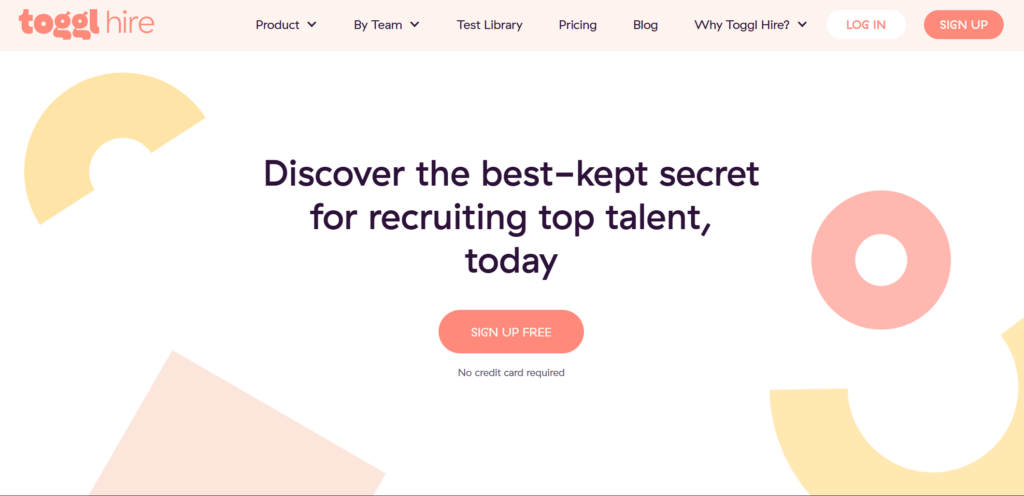
A Toggl Hire test was a short, template-based quiz: multiple-choice and open-ended questions drawn from a 20k+ question library across 200+ skills, auto-graded, with a pass threshold that could auto-reject. A Testlify assessment is a multi-section evaluation that can mix 25+ question types, including real work in Excel, Sheets or a coding editor, and it reports item-level statistics on every question.
The difference shows up most for non-technical roles. Toggl Hire tested knowledge about a skill. Testlify can test the skill itself: a candidate for an operations role builds a pivot table in a live spreadsheet, a marketing candidate edits a real Google Doc, an analyst runs a query against a SQLite test case. Candidates need to be signed in to Google and Microsoft accounts for the office-app sections, which is a small setup cost for a much better signal.
Two smaller differences matter to whoever owns the test. First, Testlify shows a difficulty index, a discrimination index and a quality-risk flag per question, so you can see which items separate strong candidates from weak ones and which are just noise. Toggl Hire's analytics were pipeline-level. Second, Testlify's question banks can be fixed (everyone sees the same items) or variable (random draw from a larger pool), and the product warns you that a small bank raises the chance of overlapping questions. That warning is the honest version of "randomized tests."
One thing Toggl Hire did that you should replicate: instant candidate feedback. Toggl Hire showed candidates their results right after the test. Testlify lets you turn on "see your results now" for candidates and collects candidate ratings after each section. Leave those on. Candidates who see their score treat the assessment as fair, and that is worth more to your completion rate than any single question.
How does Toggl Hire pricing compare to the alternative?
Toggl Hire's last pricing page listed four tiers: Free at $0, Starter at $199 a month billed annually ($239 monthly), Premium at $349 a month billed annually ($419 monthly), and a custom-priced Business plan. Testlify's live pricing starts at $139 a month billed annually for 100 candidate credits, then $279 for 300 credits and $699 for 1,000, with Premium, Enterprise and Custom on request.
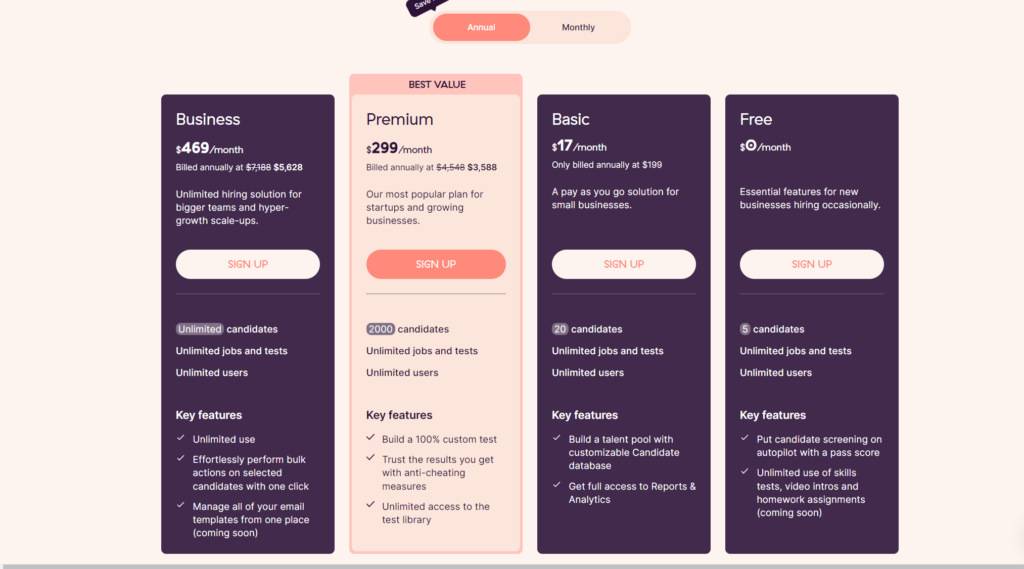
The screenshot above shows an earlier Toggl Hire tier structure. Toggl changed its plans more than once, and the table below reflects the last pricing page Toggl published, captured in July 2025 (Toggl Hire pricing, archived). Testlify figures are from the Testlify pricing page.
Plan | Toggl Hire (annual billing) | Testlify (annual billing) |
|---|---|---|
Free | $0: 1 active job, 1 skills test, candidate data for 30 days | No permanent free plan; 7-day free trial with no card, 30-day money-back guarantee |
Entry tier | Starter $199/mo ($239 monthly): 3 active jobs, unlimited custom tests and candidates, async interviews | Starter $139/mo ($1,668/yr): 100 credits, 3 seats, $21 per extra credit |
Mid tier | Premium $349/mo ($419 monthly): 6 active jobs, analytics, automations, SSO | Basic $279/mo ($3,348/yr): 300 credits, 5 seats, $14 per extra credit |
Upper tier | Business: custom pricing, 7+ jobs, success manager, migration support | Business $699/mo ($8,388/yr): 1,000 credits, 10 seats, $10 per extra credit |
Enterprise | Included in Business (custom) | Premium (3,000 credits), Enterprise (10,000) and Custom (25,000+) on contact |
Extra seats | Not stated | $15 per seat per month on every tier |
Add-ons | None listed | White labeling $2,388/yr; 100+ ATS integrations $2,388/yr; SAML SSO and 2FA; AI phone interviews $0.18 per minute |
Price protection | Not stated | Price locked for 24 months; 25% non-profit discount |
So which is cheaper? It depends on volume, and the honest answer has two halves. Below roughly 100 assessed candidates a year, Testlify's Starter tier undercuts what Toggl Hire's Starter cost, and you get a much wider library for it. Above a few hundred started assessments a year, Toggl Hire's flat unlimited-candidate fee was the better deal, and the equivalent Testlify tier is Business at $699 a month. If you need ATS integration on a self-serve tier, add $2,388 a year to the Testlify side. Do that math before the demo, not after.
Put the subscription next to the cost of getting a hire wrong and the tool price shrinks. SHRM's benchmarking data put the average cost per hire at nearly $4,700, and many employers estimate the total cost of a new hire at three to four times the role's salary once training and lost productivity are counted (SHRM, 2022). One avoided mis-hire on a $60,000 role pays for a year of any tier in this table.
Why is Testlify the best of the alternatives to Toggl Hire?
Testlify is the best Toggl Hire alternative for teams that want to keep the "test first, then talk" workflow and add rigor to it: deeper tests, real proctoring, AI interviews with a human in charge of the decision, and a pipeline for teams that never bought an ATS. It is not the best fit for teams that only want a free unlimited quiz. Here is the case, gaps included.
Key features
Four capabilities matter most to a former Toggl Hire team. The first is the question-type range described above, especially the Google and Microsoft office tasks and the coding editor, which turn "does this person know Excel" into "watch this person use Excel." Explore the software skills tests and coding tests to see what that looks like per role.
The second is proctoring you can dial up or down. Testlify ships Standard, Strict and Custom presets, and the Strict end goes well past randomized questions: photo ID verification with a face match, webcam snapshots at an interval you set, screen and session recording, tab-switch and multi-monitor detection, and an option where the candidate's phone becomes a second camera pointed at them and their screen. The candidate cannot start until that phone camera is live. Flags come back as green, yellow ("a quick manual review is recommended") or red, and auto-termination is a separate opt-in with a threshold you set, so a flag is evidence for a human, not an automatic rejection. Face verification data is deleted after 30 days. The full range is on the online proctoring page.
Why does that matter now? A Gartner survey of 3,290 job candidates in late 2024 found that 39% had used AI during the application process, and a follow-up survey of 3,000 candidates in mid-2025 found 6% admitted to interview fraud, meaning they posed as someone else or had someone pose as them (Gartner, 2025). Toggl Hire's AI detection caught pasted AI text. It did not verify who was sitting the test.
The third is interviewing. Toggl Hire's two-minute async video answer maps directly onto Testlify's one-way video question, so nothing is lost there. What is added: two-way conversational AI video interviews with selectable avatars, voices and personas, custom prompts, attempt and recording-time limits, preparation time before recording starts, and outbound AI phone interviews billed at $0.18 a minute. Every interview gets an automatic transcript in the language the candidate spoke, and the reviewer sees the video, the transcript and an interview report. AI scores are labeled "for guidance only," and you can keep them out of the final average entirely. The one thing Testlify does not do is schedule live human panel interviews. See the video interviewing tool for the formats.
The fourth is the pipeline question, and it has two answers. If you already run an ATS, Testlify plugs in as the screening and interviewing layer through 100+ ATS integrations and leaves your ATS as the system of record; candidates who clear a cutoff score can auto-advance to the next ATS stage. If you do not run an ATS (which describes many Toggl Hire customers, because the pipeline was the reason they bought it), Testlify ships a simple built-in ATS: create a job requisition, publish it to job boards, take applications through a form, and move candidates from applied to reviewed to shortlisted. It is deliberately basic. It is also enough for a 30-person company hiring six people a year, and it means one tool instead of two. Our guide on choosing the right ATS integration covers the first path in detail.
Pros
- 25+ question types including real Google and Microsoft office tasks, typing, file upload and a browser VS Code coding editor with test cases.
- Three proctoring presets, photo ID with face match, and phone-as-second-camera monitoring as a hard gate.
- One-way, conversational AI video and AI phone interviews in one product, with multilingual transcripts and a human override on every AI score.
- Per-question difficulty and discrimination indexes, so you can fix a bad item instead of guessing.
- Built-in mini ATS for teams without one, and 100+ integrations for teams with one.
- 7-day free trial with no card, 30-day money-back guarantee, price locked for 24 months.
Cons
- No permanent free plan. Toggl Hire's $0 tier has no Testlify equivalent beyond the 7-day trial.
- Credits are charged per started assessment and do not roll over, so high-volume top-of-funnel quizzing costs more than Toggl Hire's flat fee did.
- ATS integrations, white labeling and SSO are paid add-ons on the self-serve tiers ($2,388 a year each for the first two), included only on Custom.
- Candidates must use Chrome or Edge on a desktop; the mobile app is a fallback for recording audio and video, not a way to sit a full assessment.
- No scheduling of live human interview panels.
Best for
Companies under about 200 employees where the founder, an operations lead or a small talent team owns hiring and wants evidence before the first call: agencies, professional-services firms, retail and construction businesses hiring for skilled non-technical roles, plus any team that hires developers and wants a real coding environment rather than a quiz. Testlify has a skills assessment platform overview if you want the whole product in one place.
Pricing
Starter $139 a month billed annually (100 credits), Basic $279 (300 credits), Business $699 (1,000 credits); monthly billing is $198, $398 and $998 for 10, 30 and 100 credits. Premium, Enterprise and Custom are quoted. Full detail is in the pricing table above.
How do you switch from Toggl Hire to Testlify?
Switching from Toggl Hire to Testlify takes four steps: export your Toggl Hire data while you still can, map each Toggl Hire test to a Testlify test or rebuild it, pilot one open role with proctoring on, then connect your ATS or turn on the built-in pipeline. Most teams can do this in two to three weeks without pausing hiring.
- Export first. Pull your job openings, candidate records and test results out of Toggl Hire now, while your login still works. Toggl has not published an end date, and a sunset with no date is a sunset that can end any week.
- Map the tests. List every Toggl Hire test you ran in the last year with its pass rate. For each, either pick a matching test from Testlify's 3,500+ tests or generate a first draft from the job description with Testlify's AI assessment builder, which produces up to 20 questions from a pasted JD or uploaded PDF. Edit the draft; never ship it raw.
- Pilot one role with proctoring on. Run the new assessment on one live requisition using the Standard preset. Compare completion rate and median score against your Toggl Hire baseline. If completion drops, shorten the assessment before you blame the candidates.
- Connect the pipeline. Teams with an ATS turn on the integration and set the cutoff score for auto-advance. Teams without one create the requisition inside Testlify and publish it to job boards from there.
Here is what that looks like in practice, as an illustration rather than a case study. A 45-person marketing agency used Toggl Hire's Starter plan for account manager and paid-media roles: a template test, a two-minute video answer, a pipeline with three stages. On Testlify, the same flow becomes a two-section assessment (a situational judgment section plus a live Google Sheets task built from the agency's own reporting template), a one-way video question with the same prompt, and the built-in pipeline. The agency assesses perhaps 60 candidates a year, so the Starter tier covers it. What changed is not the workflow. It is that the spreadsheet task now shows who can actually build the client report.
The wider context is worth one sentence. Employers surveyed for the World Economic Forum's Future of Jobs Report 2025 expect 39% of workers' core skills to change by 2030, and 63% already name skill gaps as the biggest barrier to transforming their business (World Economic Forum, 2025). A test that measures the skill, not the claim about the skill, is how a small company keeps up with that without a talent analytics team. Our overview of skills-based hiring covers the approach in more depth.
Ready to replace Toggl Hire?
Start a 7-day free trial of Testlify, rebuild your first Toggl Hire test from a job description, and run it on one open role this week. If you want a walkthrough of the migration steps for your specific stack, book a demo and bring your Toggl Hire test list.
FAQs
Related resources
View all
Competitor Comparisons
Testlify vs Searchlight: A detailed comparison
Competitor Comparisons
Testlify vs SalesDrive: A detailed comparison
Competitor Comparisons
Testlify vs Paradox: A detailed comparison
Competitor Comparisons
Testlify vs Drawmetrics: A detailed comparison
Competitor Comparisons
Testlify vs EVA: A detailed comparison
Competitor Comparisons
Testlify vs Pulsifi: A detailed comparison
Get started.
Hire on proof, not resumes.
Run your first skills-based assessment free — no credit card required.