
7 tools to improve confidence in hiring decisions
Seven tools that turn gut-feel hiring into decisions backed by evidence, plus how to run the debrief and check that your hires work out.

Tools to improve confidence in hiring decisions are the methods and software that replace gut feel with evidence. There are seven: a role scorecard, skills assessments, work samples, structured interviews, proctoring and identity checks, reference checks and outcome tracking. Each one removes a specific doubt, so the team can explain why it picked one candidate over another.
 ChatGPT
 Gemini
 Claude
 Grok
 Perplexity
TL;DR
- The 7 tools: role scorecard, skills assessments, work samples, structured interviews, proctoring and identity checks, reference checks, outcome tracking.
- Where to start: a scorecard plus one role-specific skills test. Every other tool scores against the scorecard.
- The newest risk: AI-written answers and stand-in candidates. Gartner found 39% of candidates used AI while applying.
- How to decide: written scores before the debrief, a minimum score on every must-have skill, and a written reason for any override.
- How to check it worked: compare hiring scores with 90-day performance and early exits, every quarter.

What makes a hiring decision confident?
A hiring decision is confident when the team can explain it. That means knowing which skills mattered, how each finalist scored, what evidence sits behind each score, and why the winner beat the runner-up. If the reason is "the hiring manager liked them," the decision is a guess, however sure it feels.
A confident decision is not the same as a fast or unanimous one. It is one that holds up when someone asks "why this person?"
Confidence matters because hiring has not become easier. SHRM's 2026 Talent Trends report found that 68% of HR professionals still have difficulty recruiting for full-time roles. When good candidates are scarce, a wrong call costs more and a slow call loses the candidate. The real cost of a bad hire includes lost time, rehiring and team disruption.
Why do hiring teams lack confidence in their decisions?
Hiring teams lack confidence when they cannot see clear evidence behind a choice. The usual causes are vague role criteria, resumes that show claims instead of skills, unstructured interviews where each interviewer asks different questions, and debriefs where the loudest voice wins.
The gap shows up in the data. LinkedIn's Future of Recruiting 2025 found that 89% of talent acquisition professionals say measuring quality of hire will become more important. Only 25% are highly confident they can measure it.
Four doubts come up again and again in hiring debriefs:
- Can they do the job? A resume lists tools and titles, not how well the person uses them.
- Did we compare fairly? Different questions for different candidates make scores impossible to line up.
- Is the work really theirs? AI-written answers and stand-in candidates make remote results harder to trust.
- Are we biased? First impressions, affinity and recency shape opinions when there are no written criteria. See the common types of hiring bias for how each one creeps in.
Each of the seven tools below removes one or more of these four doubts.
Which tools improve confidence in hiring decisions?
The seven tools to improve confidence in hiring decisions are a role scorecard, skills assessments, work samples, structured interviews, proctoring and identity checks, reference checks and outcome tracking. Used together, they cover every stage, from defining the role to checking whether the hire worked out.
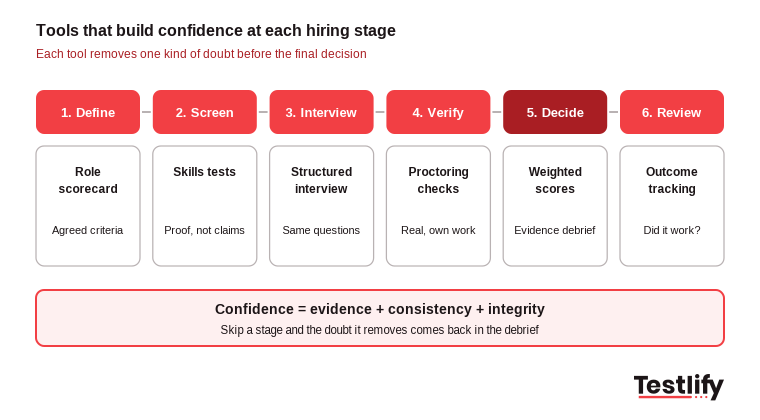
Tool | Doubt it removes | Stage | What good looks like |
|---|---|---|---|
Role scorecard | "What are we hiring for?" | Before sourcing | 4 to 6 weighted skills, must-haves marked |
Skills assessments | "Can they actually do it?" | Screening | Role-specific tests, auto-scored |
Work samples and simulations | "Can they do our version of it?" | Screening or mid-stage | A real task from the role, same for all |
Structured interviews | "Did we compare fairly?" | Interviews | Same questions, rubric per answer, calibrated interviewers |
Proctoring and identity checks | "Is this their own work?" | Any remote stage | Checks matched to the risk, flags reviewed by a person |
Reference checks | "Will past behavior repeat?" | Final stage | Questions tied to scorecard skills |
Outcome tracking | "Did our process work?" | 90 days after hire | Scores compared with performance |
1. Role scorecard
A role scorecard lists the skills the job needs, how much each one matters, and which ones are must-haves. The hiring manager and recruiter agree on it before the first resume arrives. Every later tool scores against the same list, so an interview scorecard and a test report speak the same language. Build this first. Every other tool works better once the team has agreed what "good" means.
2. Skills assessments
Skills assessments test what a candidate can do, not what the resume says. Use role-specific tests for hard skills, cognitive ability tests for problem solving, and situational judgment tests for how people handle real work situations. Automatic scoring measures every candidate with the same rubric, at any volume.
3. Work samples and simulations
Work samples ask candidates to do a small piece of the real job: write a support reply, debug a function or build a spreadsheet model. They answer the hiring manager's favorite question, "but can they do it here?" They also give interviewers something concrete to discuss.
4. Structured interviews
A structured interview asks every candidate the same questions in the same order and scores each answer against a rubric. Structure turns interviews from conversations into comparable evidence. Read how to run one in this guide to structured interviews.
Structure only works if interviewers read the rubric the same way. Before a hiring round, have interviewers score two or three sample answers on their own, then compare. Where scores differ by more than one point, agree what a strong answer looks like. This is called calibration, and it keeps a "4 out of 5" from one interviewer equal to a "4" from another.
5. Proctoring and identity checks
Proctoring and identity checks confirm that the person who took the test is the person you will hire, and that the answers are their own. This risk is growing fast.
A Gartner survey of 3,290 candidates found 39% used AI during the application process. Of those, 29% used it to write answers to assessment questions. In a separate 2025 survey, Gartner found 6% of candidates admitted to interview fraud, such as having someone else sit the interview. Gartner predicts that by 2028, one in four candidate profiles worldwide could be fake.
Most teams under-use the checks they already have. Across 240,725 proctored assessments on Testlify (as of September 2026), session recording was switched on in 87.3%. Every other control, including face detection and multiple-monitor detection, was on in under 5%. In the same data, the AI-plugin check flagged 1,078 candidates. Recording alone shows what happened after the fact. Match the checks to the risk: identity checks for remote roles, AI detection for written and coding tasks.
6. Reference checks
Reference checks add an outside view of past behavior. They work best when the questions map to the scorecard skills instead of asking "would you rehire them?" See the best practices for reference checks for question ideas.
7. Outcome tracking
Outcome tracking compares hiring scores with how each person performs after joining. Without that loop, a team never learns whether its confidence was earned. Most applicant tracking systems and assessment platforms can export scores for this check.
How do scorecards and assessments make hiring decisions more objective?
Scorecards and assessments make hiring decisions more objective by fixing the criteria before anyone meets a candidate. Everyone is then scored against the same list. The debate moves from "who did we like?" to "who showed the skills we agreed on, and by how much?"
How does weighted scoring work?
Weighted scoring, sometimes called a hiring decision matrix, is the simplest way to combine the evidence:
- List the skills. Take 4 to 6 skills from the scorecard and mark the must-haves.
- Weight each skill. Give each a weight so the total is 100%. For example: 40% technical skill, 25% problem solving, 20% communication, 15% role knowledge.
- Set the gates. Decide the minimum score for each must-have skill. A candidate below the gate is out, whatever the total.
- Score from evidence. Use test results for the skills the test measures, and rubric scores from structured interviews for the rest.
- Multiply and add. Multiply each skill score by its weight and add them up. The total is comparable across candidates.
Here is a quick example. Candidate A scores 80 on the technical test and 60 in communication. Candidate B scores 70 and 80. On those two skills, both earn 44 weighted points (80 x 40% + 60 x 20% for A, 70 x 40% + 80 x 20% for B). If the communication gate is 70, Candidate A is out before totals matter. The gate turned a debate into a decision.
Keep the tests job-related. The EEOC's guidance on employment tests says employers should make sure tests are tied to the job and do not screen out protected groups without a business reason. Job-related tests are fairer, and they are more convincing in a debrief.
How do you run a hiring decision meeting with confidence?
A confident hiring decision meeting runs on written evidence collected before the discussion starts. Each interviewer submits scores alone. The team then checks must-have gates, compares weighted totals, discusses only the gaps, and records a reason for any override.
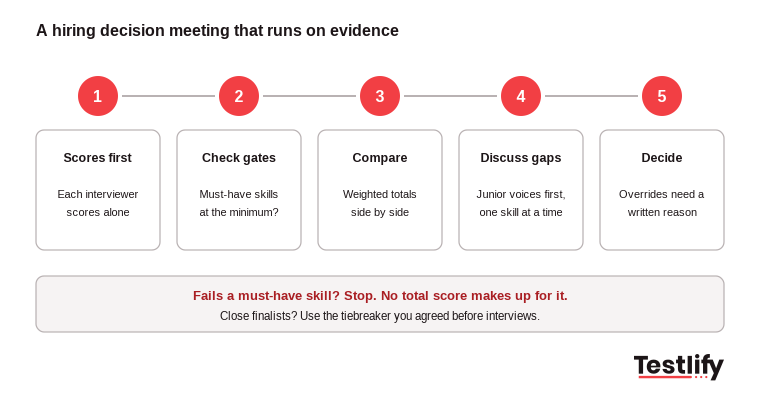
- Scores first. Every interviewer submits a scorecard before seeing anyone else's. This stops the first opinion in the room from anchoring the rest.
- Check the gates. Remove anyone below a must-have threshold. No strong total makes up for a missing core skill.
- Compare the evidence. Put finalists side by side on each skill, with the test result or answer behind every score.
- Discuss the gaps. Talk only about skills where scores disagree. Let junior interviewers speak first so senior voices do not sway them.
- Decide and record. If the team overrules the scores, write down the specific observation behind it. A gut feeling that cannot be written down should not decide the hire.
The debrief is where confidence most often breaks. Good evidence gets talked over when nobody wrote it down first, which is why step 1 comes before any discussion.
How do you choose tools to improve confidence in hiring decisions?
Start with the doubt that costs you most. If hires fail on skill, start with assessments. If interviewers disagree, start with structured interviews and scorecards. If remote results feel unreliable, start with proctoring and identity checks.
Then test any tool against these questions:
- Role fit: Does it cover the roles you hire for, technical and non-technical, at the levels you need?
- Evidence: Can a reviewer see the answer or task behind every score, not just a number?
- Consistency: Does every candidate for a role get the same questions, scoring and time?
- Integrity: What does it detect? Look for tab switching, copy and paste, AI-assisted answers and impersonation.
- Fairness and compliance: Has the vendor completed an independent bias audit? In New York City, Local Law 144 requires a bias audit within one year before an automated employment decision tool is used, plus notice to candidates.
- Workflow: Do scores sync back to your applicant tracking system, so the debrief has everything in one place?
- Candidate experience: Is the test a sensible length, mobile friendly and available in the candidate's language?
Pilot the tool on one live role before rolling it out. Compare the shortlist it produces with the one your team would have picked without it. Then ask the hiring manager which shortlist they would rather interview.
How do you know your hiring decisions are getting better?
Hiring decisions are getting better when the scores you used to choose people match how those people perform. Track four numbers for every hire, 90 days after the start date, and review them each quarter by role.
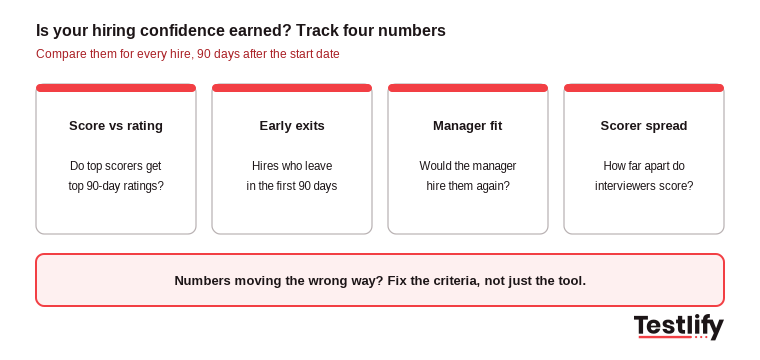
Metric | How to measure it | What it tells you |
|---|---|---|
Score vs rating | Compare hiring scores with 90-day manager ratings | Whether your criteria predict the job |
Early exits | Share of hires who leave in the first 90 days | Whether the role and person matched |
Manager fit | Ask the manager "would you hire them again?" | Whether the decision still feels right |
Scorer spread | Gap between interviewers' scores for the same answer | Whether interviewers need calibration |
If top scorers are not your top performers, change the criteria or the weights before changing the tool. For more on the measure itself, see how to improve quality of hire.
How does Testlify help teams hire with confidence?
Testlify helps teams hire with confidence by putting skills tests, AI interviews, proctoring and scored reports in one platform. Every candidate for a role takes the same assessment, is scored on the same criteria, and reaches the hiring manager with evidence attached.
- Skills evidence: A library of 3,500+ tests covers role-specific, coding, cognitive, situational judgment, language and personality tests. 25+ question types let you build custom work samples. Browse the test library.
- Structure built in: The AI test builder turns a job description into a role-specific assessment and suggests competencies and scoring criteria. Structured AI interviews by video, voice or chat ask every candidate the same questions.
- Integrity checks: 20+ proctoring checks, including AI assistance detection, copy and paste tracking, face detection and tab proctoring, flag results a reviewer should look at. See anti-cheating and proctoring.
- Scores you can compare: Weighted scoring, per-skill breakdowns, benchmarking and AI-written strengths and gaps give the debrief one shared view. See reporting and analytics.
- Global hiring: Assessments run in 15+ languages.
Ready to make your next hire with confidence?
Pick one open role, build a scorecard, and test the shortlist on real skills before the first interview. Start a 7-day free trial of Testlify, no credit card required, and see how scored evidence changes your next debrief.
Frequently asked questions

Content Writer
Yashika Khandelwal is a Content Writer with 3+ years of experience creating research-backed content on hiring, talent assessment, and HR technology. She is a registered Organizational Psychologist and subject matter expert who combines behavioral science with practical recruitment insights to produce accurate, evidence-based content.
LinkedInRelated resources
View all
Candidate assessment
What tools support voice responses for language proficiency testing?

Candidate assessment
Comment les évaluations intégrées à l'ATS fluidifient-elles les processus de recrutement ?
Candidate assessment
How to assess financial modeling and accounting skills pre-hire?

Candidate assessment
How do assessment libraries cover niche skills?

Candidate assessment
What’s the best way to combine psychometric tests with skills tests?

Candidate assessment
How to use AI to tailor assessments to job descriptions
Get started.
Hire on proof, not resumes.
Run your first skills-based assessment free — no credit card required.