
Testlify vs VeloxHire: Which AI interviewing platform is best for recruiters?
Testlify vs VeloxHire: Compare AI interviews, proctoring, resume screening, pricing, and ATS integrations to choose the best interviewing platform.
Recruitment is no longer just about scanning resumes and scheduling endless interviews. As hiring volumes increase and competition for top talent intensifies, recruiters are turning to AI-powered interviewing platforms to bring speed and objectivity into their hiring workflows.
Two platforms often discussed in this space are Testlify and VeloxHire. Both leverage artificial intelligence to streamline the interview process, automate early-stage screening, and reduce the workload of recruiters.
As a recruiter, before choosing a platform, ask yourself:
- Do you need only AI interviews or a complete skill-based assessment system
- Is automated resume screening important for your hiring workflow
- How critical are anti-cheating and proctoring features for your roles
- Do you require deep analytics and benchmarking analytics
- Will the platform integrate seamlessly with your ATS
- Are you hiring occasionally or running continuous large-scale recruitment campaigns
The answers to these questions will determine which platform delivers long-term value for your recruitment strategy.
 ChatGPT
 Gemini
 Claude
 Grok
Grok Perplexity
What is Testlify?
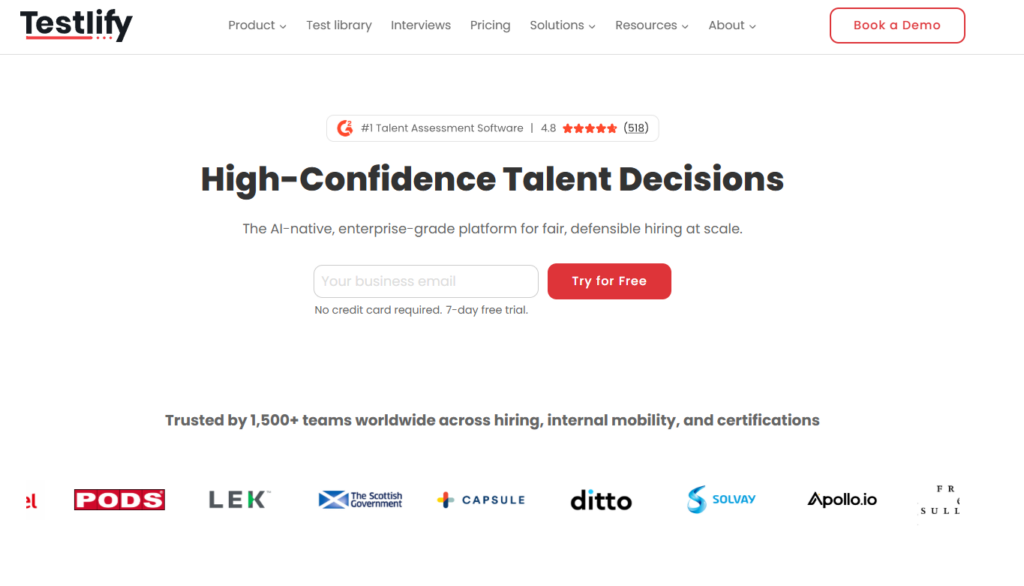
Testlify is a leading AI native interviewing and skills assessment platform that features conversational AI interviews and 3,500+ role-specific tests available in 8+ languages, enabling companies to hire confidently across global talent markets.
Additionally, Testlify also offers a comprehensive suite of psychometric tests to help evaluate candidates’ cognitive abilities, personality traits, and job fit.
How Testlify works
Testlify is designed to help recruiters evaluate candidates’ skills and ascertain their true potential. Here is how the platform works:
1. Create AI interviews
Testlify allows recruiters to design custom interviews and assessments tailored to particular job roles. Hiring teams can choose from an extensive library of 150+ interview templates or build their own from scratch.
The platform supports AI-powered interviews in chat, voice, and video formats, enabling candidates to engage in realistic job scenarios such as handling customer complaints, presenting ideas, or solving workplace challenges
Recruiters can also create custom assessments by choosing from a library of 3500+ role-specific tests or leveraging AI to generate custom questions. The platform supports diverse question formats, including multiple-choice, open-ended, and even coding challenges.
2. Send candidate invitations
Invite candidates instantly via automated email links. No account registration is required, reducing friction and improving completion rates. Automated reminders and follow-ups ensure timely participation while minimizing manual effort.
3. Built-In anti-cheating and proctoring measures
Testlify protects assessment integrity with advanced proctoring features, including dual-camera proctoring, screen recording, AI-assistance detection, location tracking, and more, to ensure honest participation.
4. AI-powered evaluation and behavioral analysis
Testlify uses AI to analyze candidate responses across all interview formats, allowing recruiters to gain a well-rounded understanding of each candidate’s strengths and potential. The system evaluates:
- Answer relevance and accuracy
- Communication clarity and tone
- Verbal and non-verbal cues
- Confidence and emotional intelligence
- Behavioral patterns
Recruiters can also manually review recordings and reports for additional validation.
5. Reporting and analytics
Testlify automatically scores interviews and generates detailed performance reports. Insights are broken down by skill, question type, and overall score to support data-driven hiring decisions.
6. Integration with applicant tracking systems (ATS)
Testlify integrates with 100+ applicant tracking systems and HR tools, enabling seamless data synchronization across hiring stages.
Candidate profiles, interview results, and evaluation reports are automatically updated within existing recruitment systems. This ensures smoother collaboration between recruiters, hiring managers, and HR teams while reducing manual data entry.
7. Data compliance
Testlify is GDPR compliant and backed by SOC 2 Type II, AICPA, and ISO 27001 certifications. The platform ensures strong data governance, secure admin controls, comprehensive audits, and robust privacy protection.

What is VeloxHire?
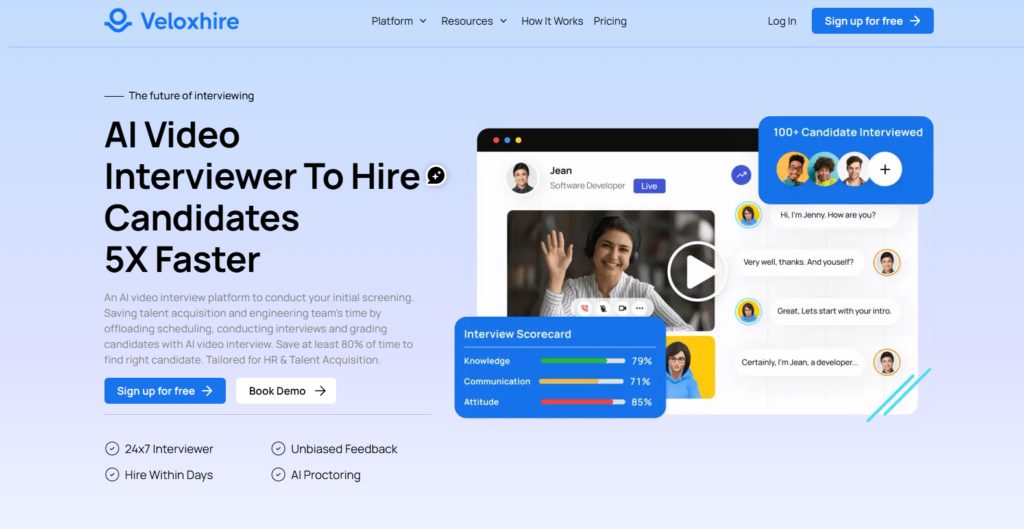
VeloxHire positions itself primarily as an AI video interview platform focused on automating the initial candidate screening process. The platform uses a basic AI interviewer to conduct video interviews and evaluate candidate responses.
Recruiters can also manually create role-specific assessments, invite candidates, and allow the AI system to conduct interviews.
How VeloxHire works
VeloxHire simplifies early-stage screening by automating video interviews and shortlisting. Here is a clearer breakdown of its process:
Step 1: Create your assessment
Define the skills, experience level, and personality traits you are looking for. You can select job-specific topics and customize interview criteria to match your role requirements.
Step 2: Let the AI conduct the interview
Invite candidates with a single click and allow the AI interviewer to conduct the video interview. The system asks role-relevant questions, records responses, and evaluates candidates based on predefined criteria. Interviews are available 24/7, eliminating scheduling challenges.
Step 3: Review the top candidates
After evaluation, the platform generates structured feedback and highlights the top-performing candidates. Recruiters can review detailed insights and focus primarily on the AI shortlisted top 10 percent.
Step 4: Make the final hiring decision
Recruiters can now confidently move forward with offers and close positions faster.
Testlify vs VeloxHire: Detailed comparison
While both Testlify and VeloxHire automate early-stage candidate screening, the real distinction lies in how deeply they evaluate candidates beyond just recorded responses. For recruiters focused on hiring accuracy, structured validation, and multi-dimensional insights, this difference plays a defining role in long-term hiring success.
Testlify vs VeloxHire: AI Interviews and assessment depth
AI interviewing tools are not all built the same. While both platforms automate early-stage interviews, the depth, flexibility, and overall assessment intelligence vary significantly. For recruiters who care about hiring accuracy, this distinction is critical.
Testlify AI interviewing experience
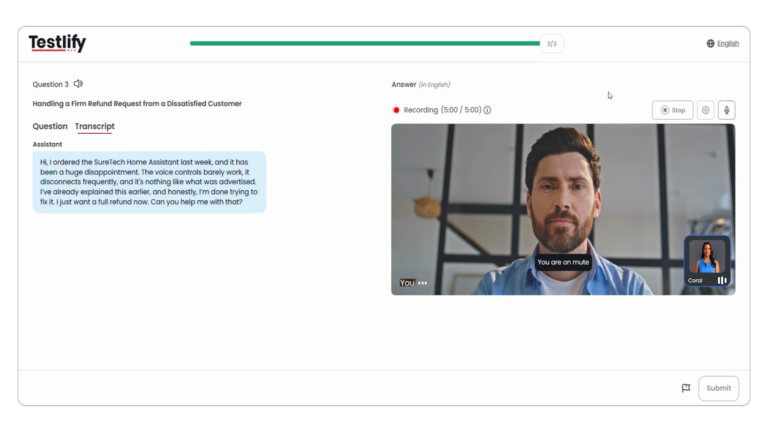
Testlify offers conversational AI interviews across chat, voice, and video formats. This multi-format approach allows recruiters to choose the most relevant method based on the role rather than forcing every candidate into a single video interview structure.
The platform simulates realistic job scenarios and evaluates candidates across multiple performance dimensions, including:
- Answer relevance and accuracy
- Communication clarity and tone
- Verbal and nonverbal cues
- Confidence and emotional intelligence
- Behavioral patterns
Beyond AI interviews, Testlify provides access to 3,500-plus validated role-specific tests in 16+s. Recruiters can create custom assessments, apply weighted scoring, and combine structured tests with conversational interviews for a layered evaluation process.
This ensures hiring decisions are based on validated skills and behavioral insights, not just recorded responses.
VeloxHire AI interviewing experience
VeloxHire primarily focuses on AI-led video interviews for initial screening. Recruiters create a job assessment, invite candidates, and allow the AI interviewer to conduct automated video interviews.
The system dynamically adapts questions during the session and evaluates responses before shortlisting candidates. It often highlights the top 10 percent based on AI grading
While this approach reduces scheduling friction and speeds up first-round screening, the evaluation model remains largely centered around video interactions without the broader skill testing ecosystem that is seen in platforms such as Testlify.
What does this mean for recruiters?
If your hiring strategy relies only on replacing first-round interviews with AI video calls, a video-focused tool may seem sufficient.
However, if your goal is to measure technical ability, communication skills, and behavioral traits accurately, a multi-dimensional assessment platform, like Testlify, is the best choice.
Testlify gives recruiters the freedom to combine conversational AI interviews with role-specific skill tests, assign weighted scoring rubrics, and have AI analyze assessment results. This helps recruiters identify top talent easily while significantly cutting down on repetitive evaluation efforts.
Testlify vs VeloxHire: Automation, workflow efficiency, and ATS integrations
Speed matters in modern recruitment, but speed without structure can lead to poor hiring decisions. The real advantage of AI interviewing platforms lies in how well they automate workflows while maintaining evaluation quality.
Testlify automation and workflow efficiency
Testlify offers end-to-end automation that goes beyond conducting interviews. The platform supports automated candidate invitations, reminders, and follow-ups to improve completion rates and reduce recruiter workload
One of its strongest advantages is AI-powered resume screening. Testlify automatically pulls resumes from your ATS, evaluates them against role-specific criteria, assigns match scores, and labels candidates based on role fit
Qualified candidates can be automatically shortlisted and moved to assessments, while unqualified applicants can be filtered out, saving hours of manual screening.
In addition, Testlify integrates with 100+ ATS platforms and HR tools, ensuring seamless data synchronization across the hiring funnel. Resume scores, interview results, and assessment reports are synced back into your existing system, eliminating the need for manual data entry.
This makes Testlify ideal for recruiters who require structured workflows, centralized data visibility, and collaboration across hiring managers.
VeloxHire automation and workflow efficiency
VeloxHire focuses on automating the initial screening stage. The platform allows recruiters to invite candidates and let the AI interviewer conduct video interviews without scheduling coordination.
It also manages no-shows and shortlists candidates automatically after evaluation. The dashboard enables recruiters to compare profiles and review AI-generated feedback for decision-making.
While this significantly reduces the effort involved in first-round interviews, the workflow is primarily centered around video screening automation rather than a full funnel recruitment ecosystem with deep ATS connectivity.
What this means for recruiters
If your main bottleneck is scheduling and conducting first-round interviews, VeloxHire may offer convenience.
However, if you are looking to automate resume screening, candidate shortlisting, assessment distribution, scoring, reporting, and ATS synchronization in one unified workflow, Testlify provides a far more comprehensive solution.
For growing teams and enterprise recruiters, having automation across the entire hiring funnel rather than just the interview stage can make a measurable difference in efficiency and hiring accuracy.
Testlify vs VeloxHire: Anti-cheating and proctoring capabilities
In remote hiring, assessment integrity is just as important as automation. Without strong anti-cheating measures, AI interviews and online tests can lose credibility. Recruiters need assurance that candidate responses reflect real skill, not external assistance.
Testlify anti-cheating and advanced proctoring features
Testlify offers a comprehensive proctoring framework designed to maintain assessment integrity across interviews and skill tests
Its anti-cheating capabilities include:
- Face detection
- Photo id verification
- Webcam snapshots
- Full-screen mode
- Force full-screen mode
- Dual camera proctoring
- Copy/paste tracking
- Mouse-out tracking
- IP proctoring
- Live video monitoring
- Question randomization
- Honesty Agreements
- Question-level activity logs
- AI assistance detection
- Screen recording
- Live environment check
- System requirement check
- Enforce internet speed check
- Focus guard (Anti-Cheat Mode)
- Talking prohibition
These layered safeguards make Testlify particularly suitable for technical roles, remote hiring, and high-stakes assessments where authenticity is critical.
VeloxHire anti-cheating approach
VeloxHire includes AI proctoring and emphasizes fair AI-based evaluation during video interviews. The platform records and analyzes candidate responses as part of its screening process.
However, its documentation primarily focuses on AI-driven grading and structured feedback rather than offering a broad suite of advanced proctoring controls across multiple assessment formats
What this means for recruiters
For roles where skill validation, compliance, and authenticity are critical, a robust proctoring system becomes non-negotiable.
If your hiring involves technical testing, certifications, campus hiring, or remote assessments at scale, Testlify provides stronger safeguards and layered monitoring capabilities.
While VeloxHire supports fair AI-based video evaluation, Testlify delivers a more comprehensive integrity framework that ensures hiring decisions are based on verified and genuine performance.
Testlify vs VeloxHire: Reporting, analytics, and hiring insights
Data-driven hiring goes beyond simply assigning scores to candidates. It uncovers performance trends, defines what top talent truly looks like, and equips recruitment teams with the insights they need to make the right decisions at scale.
Testlify reporting and analytics
Testlify provides detailed, multi-dimensional reporting that goes beyond a simple pass or fail score. Recruiters receive breakdowns by skill, question type, and overall performance, helping them understand exactly where a candidate excels or needs improvement.
The platform also includes benchmarking analytics, allowing organizations to compare candidates against industry standards and internal performance data. This is especially valuable for recruiters undertaking high-volume hiring initiatives
Key reporting strengths of Testlify include:
- Skill-wise performance breakdown
- Behavioral analysis insights
- AI-generated performance summaries
- Global caniodate benchmarking comparisons
- Exportable reports in PDF, CSV, and Excel formats
Because Testlify combines resume screening, skill assessments, and conversational AI interviews, recruiters get a unified candidate profile instead of fragmented data points.
VeloxHire reporting and analytics
VeloxHire focuses on delivering curated shortlists and interview insights that help teams make quick decisions during the initial screening phase.
While this approach simplifies early-stage evaluation, it is primarily centered around video interview feedback rather than layered analytics across multiple assessment categories.
What this means for recruiters
If your hiring decisions depend on quick shortlists from first-round interviews, VeloxHire provides structured summaries that support rapid screening.
However, if you are building a skill-based hiring framework where every decision needs to be backed by measurable data, benchmarking, and detailed performance analytics, Testlify offers significantly deeper insight.
Testlify vs VeloxHire: Candidate experience and accessibility
A strong hiring process shapes how candidates perceive your employer brand. An AI interviewing platform should create a seamless, accessible, and fair experience without adding unnecessary friction.
Testlify candidate experience
Testlify offers a flexible and inclusive interview experience through chat, voice, and video format. This allows recruiters to match the interview format to the role while giving candidates a more natural way to demonstrate their skills.
Candidates can access interviews directly through automated email invitations without mandatory account creation, reducing barriers to participation.
The platform also supports multilingual assessments in 16+s, enabling organizations to evaluate global talent fairly and effectively
Since Testlify combines resume screening, structured skill tests, and conversational AI interviews, candidates are evaluated holistically rather than being judged solely on one video interaction.
VeloxHire candidate experience
VeloxHire centers the experience around AI video interviews. Candidates are invited to participate in automated video calls where the AI interviewer asks role-specific questions.
The platform removes scheduling friction and allows interviews to happen without recruiter coordination
However, since the process is primarily video-focused, candidates who may perform better in written or structured skill-based assessments have fewer alternative formats to demonstrate their skills.
What this means for recruiters
In competitive talent markets, a structured yet adaptable assessment experience can significantly improve both hiring accuracy and employer brand perception.
For recruiters seeking a more inclusive candidate journey that adapts to different roles, skill sets, and communication styles, Testlify is the stronger choice given the nature of the platform.
Testlify vs VeloxHire: Customer support and onboarding
Adopting an AI interviewing platform is not just about picking the one with the best features. It is also about how quickly your team can implement the system, resolve issues, and maximize value from day one.
Strong onboarding and responsive support can significantly impact long term success.
Testlify customer support
Testlify is known for its hands-on onboarding and responsive human support. New customers receive structured guidance to set up assessments, configure workflows, and integrate with existing ATS platforms.
The platform offers:
- Dedicated onboarding assistance
- Priority support for enterprise clients
- Multi-channel human support
- A detailed help center with documentation and best practice guides
This level of support is particularly valuable for growing teams or enterprises implementing structured skill-based hiring practices at scale into their existing workflows.
VeloxHire customer support
VeloxHire provides email support under its starter plan and priority support in higher tiers. Enterprise plans include dedicated account management
The support model is structured around plan tiers, with higher levels of assistance available as organizations upgrade.
While this approach works for companies seeking basic operational help, the platform documentation emphasizes automation and simplicity rather than in-depth onboarding frameworks, which can be a cause for concern for enterprises.
What this means for recruiters
If you are implementing AI interviewing as a long-term hiring strategy, having guided onboarding and responsive human support can make a measurable difference.
Testlify’s proactive onboarding and enterprise-level support provide recruiters with greater confidence during adoption and scaling. For organizations that value partnership and structured implementation, this can be a decisive advantage over platforms that primarily offer tier-based support access.
Testlify vs VeloxHire: Pricing plans
Pricing plays an important role in choosing an AI interviewing platform, especially when hiring volume fluctuates. Recruiters must evaluate not just the cost per interview, but also the long-term scalability, feature access, and overall value delivered at each tier.
Testlify pricing plans
Testlify offers a tiered subscription model designed to scale from startups to enterprise-level organizations. Pricing plans begin at 139 dollars per month and scale up to enterprise and unlimited options, depending on hiring volume and feature requirements
The platform uses a credit-based system, allowing teams to manage candidate assessments efficiently while maintaining access to advanced features such as:
- Conversational AI interviews
- 3,500 plus skill tests
- AI resume screening
- Advanced proctoring
- Benchmarking analytics
- 100+ ATS integrations
For organizations running continuous or large-scale recruitment campaigns, this structured pricing model provides predictability and cost efficiency over time. Most importantly, pricing is aligned with a full hiring ecosystem rather than being limited to video interview automation alone.
VeloxHire pricing plans
VeloxHire follows a per-interview pricing model, starting at 299 rupees per interview under its starter plan. It also offers premium and enterprise tiers with higher interview limits and expanded recruiter access
The pay-as-you-go approach may appeal to startups or companies hiring occasionally, as there is no heavy upfront subscription commitment.
However, since the platform is primarily centered around AI video interviews, pricing largely reflects access to automated screening rather than a comprehensive assessment ecosystem.
What this means for recruiters
If you hire occasionally and want a flexible pay-per-interview structure, VeloxHire may seem convenient. But if you are building a scalable, skill-driven hiring strategy that includes resume screening, structured assessments, AI interviews, and detailed analytics, Testlify delivers better ROI.
For growing teams and enterprises, investing in a platform that supports the entire hiring funnel often proves more cost-effective than paying separately for fragmented tools.
Final thoughts
Both Testlify and VeloxHire bring automation into modern recruitment, but the depth of impact they create is very different.
VeloxHire focuses primarily on automating AI video interviews for early-stage screening. For teams that simply want to replace first-round calls with AI-led conversations, it can offer convenience and speed.
However, as outlined throughout this article, Testlify combines conversational AI interviews, 3,500+ validated skill tests, AI resume screening, advanced proctoring, benchmarking analytics, and 100+ ATS integrations into one unified hiring ecosystem.
Instead of automating just one stage, Testlify transforms the entire recruitment funnel into a skills-first, data-driven process.
If your goal is not just to interview faster but to hire smarter, reduce bias, validate skills with integrity, and scale recruitment confidently, Testlify clearly delivers stronger long-term value.
Ready to see the difference in action?
Book a demo with Testlify today and discover how you can identify top talent with precision, automate your hiring workflow end-to-end, and make every hiring decision backed by real skill data.

Director of Marketing
Akash Patange is the Director of Marketing at Testlify, where he works closely with HR leaders and recruiters to help organizations improve hiring outcomes. He writes about talent assessment, recruitment technology, and data-driven hiring practices.
LinkedInRelated resources
View all
Video Interviewing Tools Comparison
Testlify vs Ribbon.ai: Which is the best AI video interviewing platform
Video Interviewing Tools Comparison
Testlify vs Metaview: Which AI recruiting platform in 2026?
Video Interviewing Tools Comparison
Testlify vs Willo: Which Interviewing Platform is Best for You?
Video Interviewing Tools Comparison
Testlify vs Sapia.ai: Which AI Interviewing Platform is Best for You?
Video Interviewing Tools Comparison
Testlify vs Hyring: Detailed in-depth comparison guide
Video Interviewing Tools Comparison
Testlify vs InCruiter: Which AI powered interviewing platform is best for you?
Get started.
Hire on proof, not resumes.
Run your first skills-based assessment free — no credit card required.