
Testlify vs Willo: Which Interviewing Platform is Best for You?
Compare Testlify vs Willo to discover which interviewing platform best supports recruiters in meeting their hiring goals
Testlify and Willo both put a candidate on camera before anyone books a call, and that is where the resemblance ends. Willo is a focused one-way video interview tool. Testlify is an assessment platform that also runs one-way video, two-way conversational AI interviews and outbound AI phone screens, so the honest question is not which product is better. It is whether your shortlist needs one hiring signal or several.
That distinction decides the whole evaluation. Read on for what each tool actually does, where each one stops, and which hiring volumes each suits.
 ChatGPT
 Gemini
 Claude
 Grok
Grok Perplexity
TL;DR
- Willo does async video screening well and keeps it simple. If your only gap is "watch 300 people answer five questions without booking 300 calls", it covers that.
- Testlify treats the interview as one signal next to skills tests, coding work samples, cognitive and personality measures, then scores them together.
- Testlify's interviewing is broader than one-way video: two-way conversational AI, voice, and outbound AI phone interviews billed at $0.18 per minute.
- Neither tool schedules live human interview panels. If that is the gap you are filling, both are the wrong purchase.
- Pick on signal count, not feature count. One signal is cheap and fast. Several signals are what hold up when a hiring manager disagrees with your shortlist.

What is a Willo AI interview?
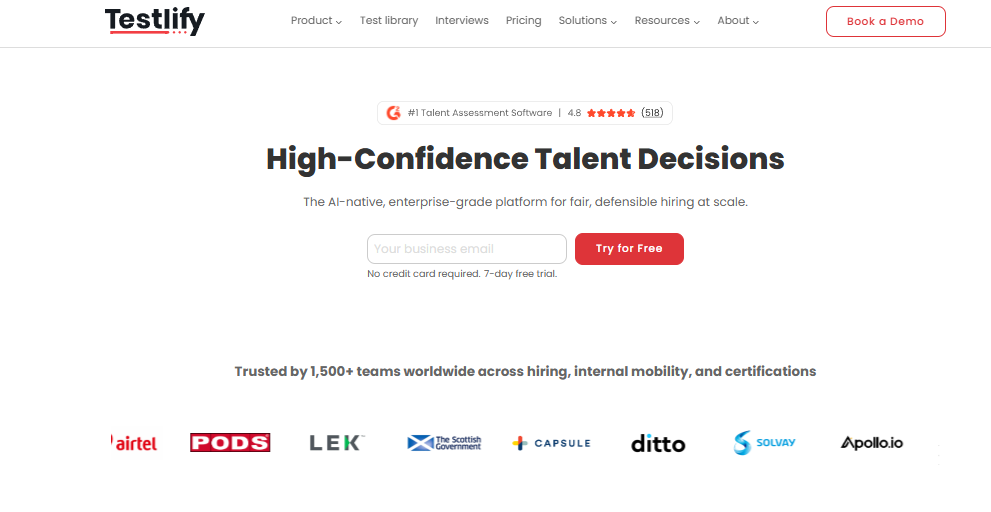
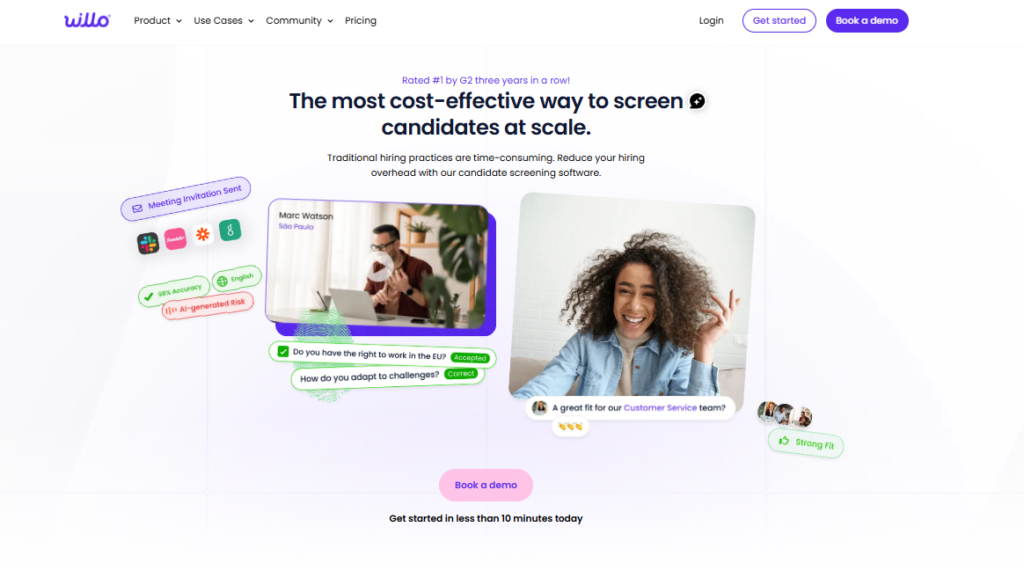
A Willo AI interview is an asynchronous screening interview: you write the questions, candidates record video, audio or text answers on their own schedule, and Willo's AI transcribes each response and summarises it for the reviewer. Nobody schedules anything. The AI reads and ranks; it does not conduct the conversation.
Willo layers two AI products on top of that recording flow. Its intelligence feature transcribes every answer and pulls out a short summary of skills and gaps. Its insights feature scores applicants against a definition of a strong candidate that you write yourself, then ranks the pool by how closely each person matches. Willo states plainly that it does not score facial expression, voice pattern or any biometric signal, which is a deliberate design choice and a sensible one.
The product supports more than 18 languages and mixes response types in a single interview, so one question can take video and the next can take a file upload or a multiple-choice answer. For teams whose bottleneck is genuinely scheduling, that is often enough.
Hireflix vs Willo and other async tools
Buyers rarely look at Willo on its own. The comparison set usually includes Hireflix, Spark Hire, Jobma and a handful of similar one-way video products, and the differences between them are smaller than the marketing suggests. They all record async answers, they all transcribe, and most now summarise with AI.
So choosing inside that set comes down to price per role, how the review screen handles a large pool, and whether the tool bills per live job or per candidate. Choosing outside it is a different decision entirely, and that is the one this page is about: whether an async video tool alone tells you enough to make an offer.
What does Testlify do that Willo cannot?
Three things, and only the third is about video. Testlify runs more interview formats, it measures whether someone can do the work, and it produces integrity evidence for remote assessment. Each is worth a section.
One-way, two-way and phone interviews in one product
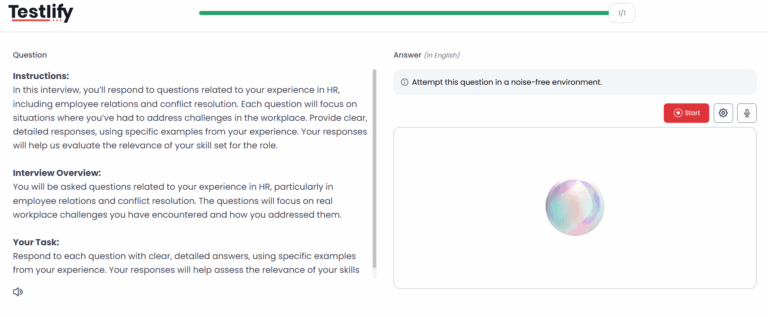
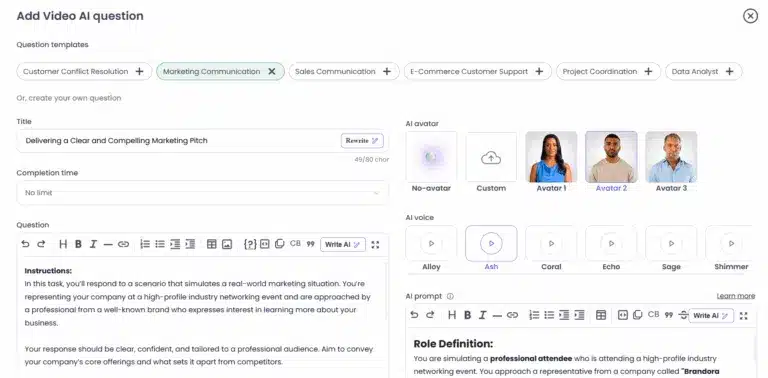
Testlify records one-way async video the way Willo does. It also runs a two-way conversational AI interview, where the AI asks a question, waits, and follows up. Candidates see "You're muted while the AI is speaking", which tells you the turn-taking is real rather than a stack of pre-recorded prompts. There is an outbound AI phone interview too, billed at $0.18 per minute, for roles where candidates are more reachable on a call than in a browser.
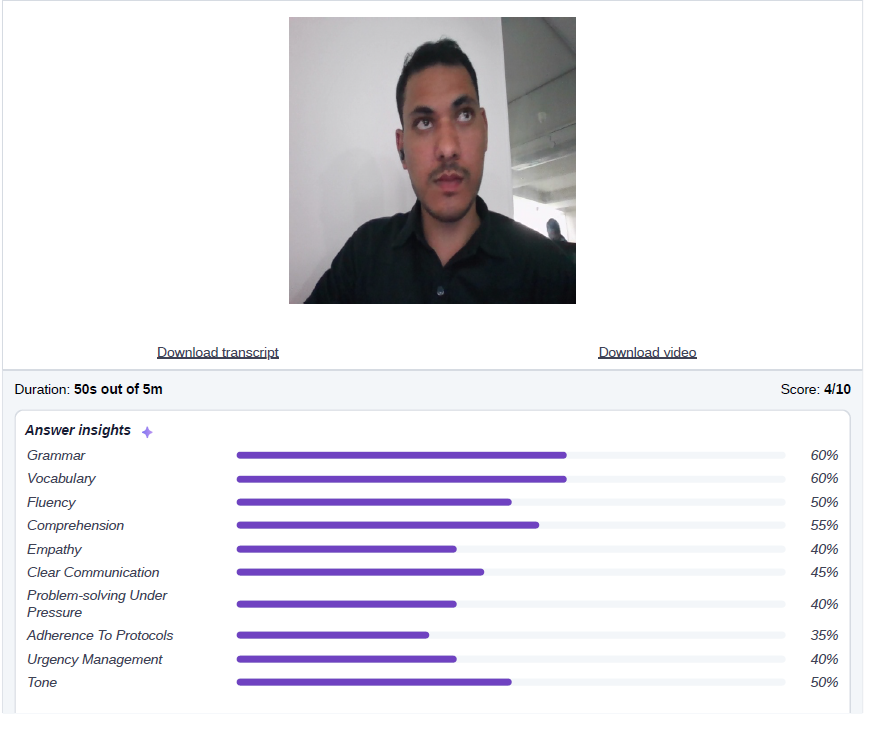
The configuration is where the gap widens. You pick the AI avatar and voice, write the persona and the prompt, or start from one of 150+ interview templates. You set how many attempts a candidate gets (including no limit), how long each recording runs up to a 5 minute ceiling, how much preparation time they see before recording auto-starts, and the recording language. Transcripts generate automatically and multilingually, with the AI detecting the spoken language for any recording of at least 30 seconds.
Evidence that someone can do the work
An interview answer tells you how a person talks about their work. It does not tell you whether they can do it. Testlify closes that gap with a library of 3,500+ tests across 4500+ job roles, which is the part of the product Willo has no equivalent for.
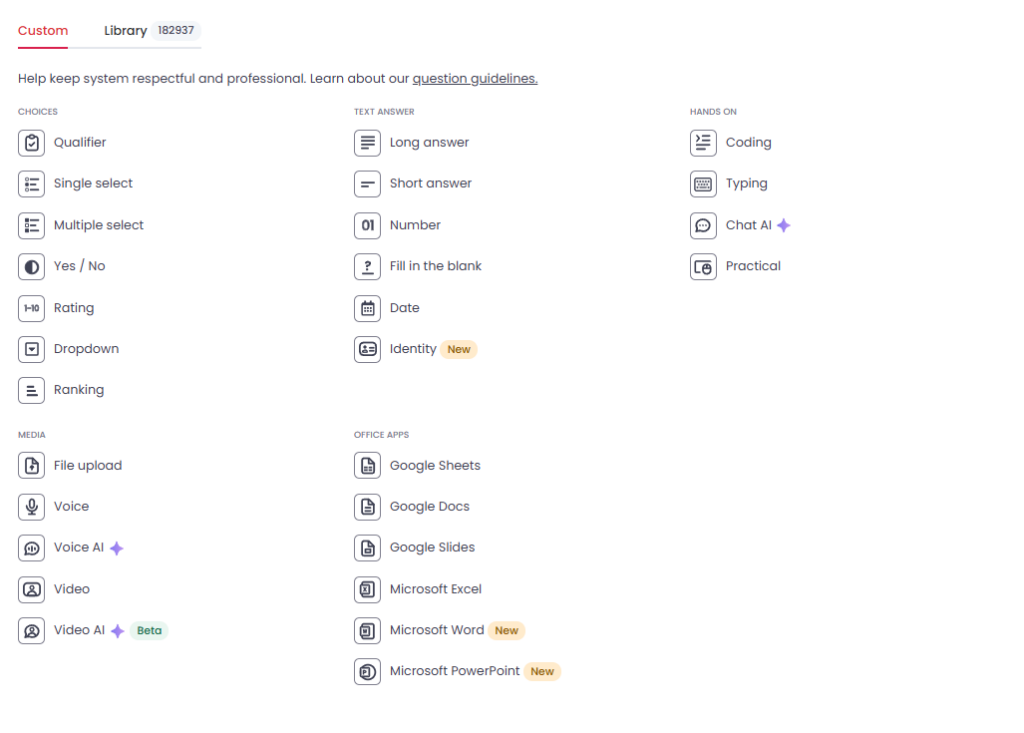
That includes coding questions in an embedded VS Code editor with up to 20 test cases, single-file or multi-file projects, and SQLite database test cases. It includes live work in the real office applications: Google Docs, Sheets and Slides, plus Word, Excel and PowerPoint. There is a typing test scored by default on 60% accuracy and 40% speed, with the weighting configurable. And there is vibe coding, where candidates direct AI tools toward a working solution instead of writing every line by hand, which is closer to how a lot of engineering actually gets done in 2026.
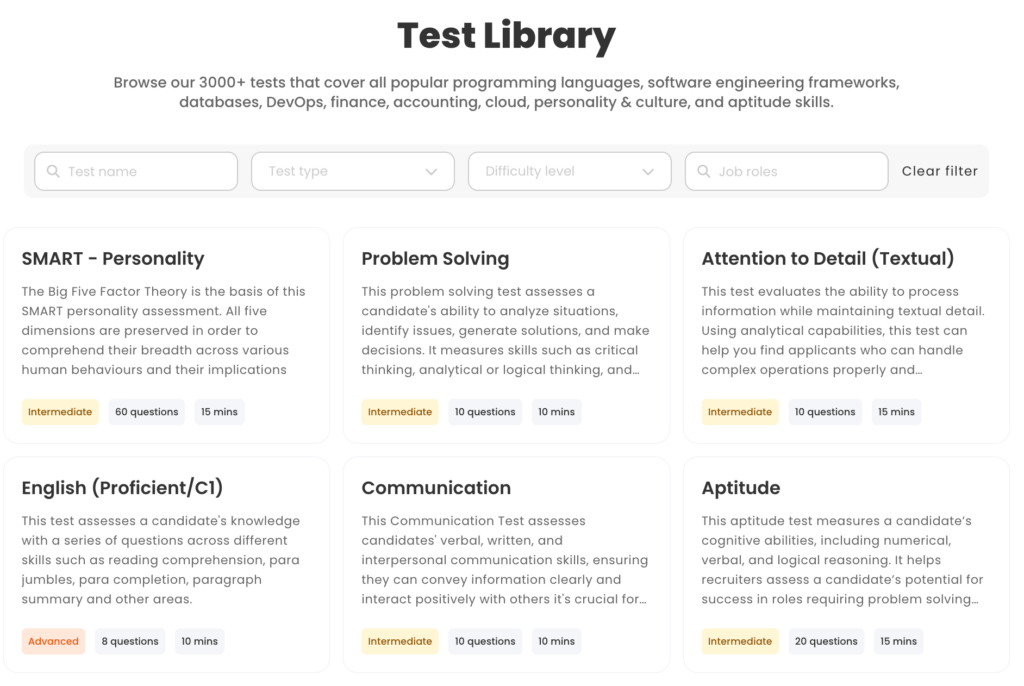
Scoring runs at three levels: question, test, and overall assessment. Tests can be weighted from x0 to x5, so a coding exercise can count five times what a culture questionnaire counts. Recruiters also get item-level psychometrics that test publishers usually keep to themselves, including a difficulty index, a discrimination index and a quality risk flag for questions with very low accuracy or high skip rates.
Integrity evidence for remote assessment
Willo deliberately stays out of proctoring. Testlify goes the other way, with three presets (Standard, Strict and Custom) and measures covering identity, environment and browser behaviour: photo ID verification with a face match against the ID, tab-switch detection, multi-monitor restriction, copy-paste tracking and AI-tool detection.
The standout is dual-device proctoring, where the candidate's phone becomes a second camera positioned to capture both the person and their laptop screen. It is a hard gate, not a suggestion: the assessment will not start until mobile monitoring is active. No mainstream competitor ships it.
What the recruiter sees is deliberately evidence-first. A green flag means nothing unusual happened. A yellow flag says some behaviour was not ideal and a quick manual review is recommended. A red flag means cheating was confirmed. Auto-termination exists but is a separate opt-in setting with a threshold you choose, so a flag never rejects anyone on its own. Face verification data is deleted after 30 days and candidates can withdraw consent at any time.
How do the two platforms compare?
The table below is the short version. Read the Con row carefully, because it is the part most comparison pages skip.
Capability | Testlify | Willo |
|---|---|---|
One-way async video | Yes | Yes, the core product |
Two-way conversational AI interview | Yes, with avatar, voice, persona and custom prompts | No |
Outbound AI phone interview | Yes, $0.18 per minute | No |
Automatic transcripts | Yes, multilingual, 30 seconds minimum | Yes |
AI summary and ranking | Yes, with human override toggles | Yes, ranked against your own blueprint |
Skills and coding assessments | 3,500+ tests | No |
Office application work samples | Google Docs, Sheets, Slides, Word, Excel, PowerPoint | No |
Proctoring and integrity | Three presets plus dual-device monitoring | Not offered |
Item-level psychometrics | Difficulty, discrimination and quality-risk indices | No |
Live human interview panel scheduling | No | No |
Where Testlify stops
Two limits are worth knowing before you buy. Testlify does not schedule live human interview panels, so calendar coordination for a four-person loop still belongs to your ATS or a scheduling tool. And assessments run on Chromium desktop browsers: candidates on Safari or Firefox are asked to switch to Chrome or Edge, and the mobile app is a capture fallback for recording video and audio rather than a way to sit a full assessment on a phone.
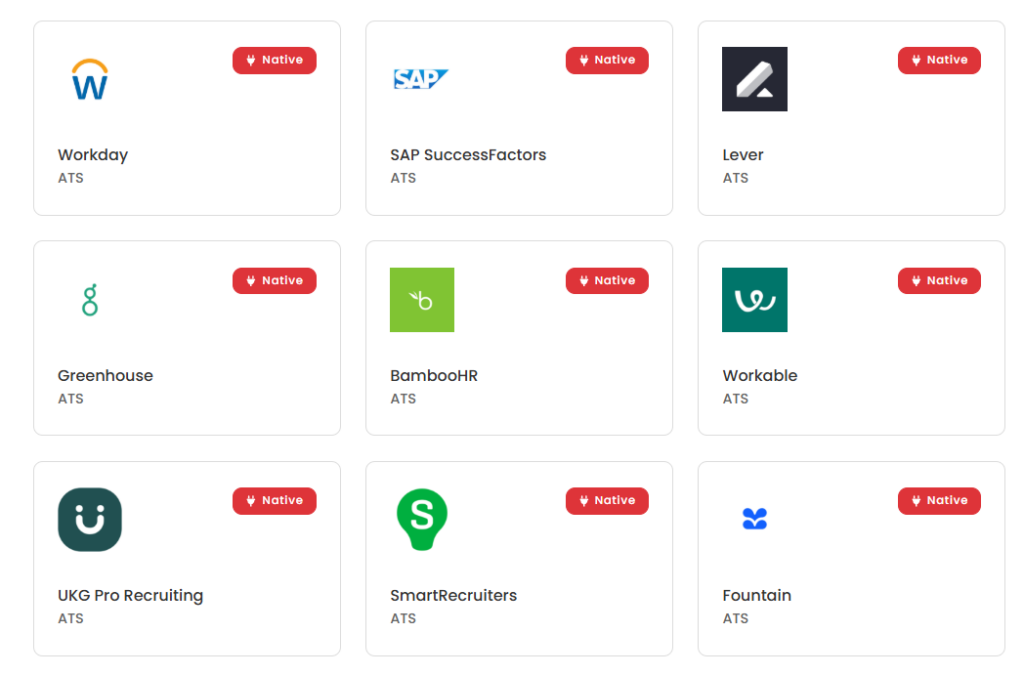
On applicant tracking, Testlify does not try to replace a system of record. If your team already runs Greenhouse, Workday or Lever, Testlify plugs in as the screening and interviewing layer and leaves the ATS in charge, across 100+ integrations sold as a $2,388 per year add-on on the self-serve tiers and included on Custom. Teams with no ATS at all get a simple built-in pipeline: job requisitions, an application form, job-board publishing, and an applied to reviewed to shortlisted to rejected flow. It is deliberately basic, and it is not a substitute for a dedicated ATS.
Which platform should you choose?
Choose Willo when async video is the whole job. A recruiting team screening high volumes for roles where communication is the main thing being judged, with a trusted ATS already in place and no appetite for a second system, will get value out of Willo quickly and will not miss what it leaves out.
Choose Testlify when the interview is not enough on its own. Agencies hiring account and creative staff, construction and retail employers hiring at volume, and finance teams hiring for measurable technical skill all share the same problem: a polished recorded answer is a weak predictor of output. Those teams need work samples next to the interview, not instead of it.
The signal-count question, framed properly
The Testlify Multi-Signal Talent Evaluation Model is the useful lens here. It says a candidate should not advance because of one strong resume, one polished interview or one test score, but because several role-relevant signals point the same way. Assessments, interviews, simulations, references and reviewer feedback each add context and each cover a different blind spot. One signal is fragile. Several create confidence.
Applied to this decision, the model turns a feature argument into an arithmetic one. An async video tool gives you one signal, captured well. If that signal alone has been producing shortlists your hiring managers accept, adding a platform is overhead you do not need. If your shortlists keep falling apart at the technical stage, the fix is not better video.
The research points the same direction. The most recent major reanalysis of selection-method validity, by Sackett and colleagues, revised many long-standing estimates downward while still placing structured interviews among the stronger predictors of job performance, and years of education and general experience among the weaker ones. The exact coefficients remain contested in print. The ranking of structured over unstructured evaluation is the part that survives every reanalysis, and it is the part worth designing around.
Pro tip: Before you compare pricing, write down the last five hires that did not work out and mark which stage should have caught each one. If four of the five were capability misses, a video tool will not fix your funnel no matter how good its transcripts are.
What the AI scoring rules mean for your shortlist
Anything that scores candidates automatically now sits inside a regulatory perimeter, and buyers should ask about it directly. New York City's Local Law 144 requires that an automated employment decision tool has been subject to a bias audit within one year of its use, that the audit results are publicly available, and that candidates get notice at least 10 business days before the tool is used. Enforcement began on 5 July 2023.
The European position is broader. Annex III of the EU AI Act classifies AI systems used for recruitment or selection of people as high risk, naming the analysis and filtering of applications and the evaluation of candidates specifically.
This is why the human-override controls matter more than the model quality. Testlify ships the disclaimer in the product: AI scores and insights are for guidance only, and human judgment makes the final decision. Displaying the AI score to a reviewer is a toggle, and so is including it in the final average, so a team can run AI scoring as purely advisory. Individual questions can be routed to a named human for manual review. Willo's choice to exclude facial, vocal and biometric scoring is a defensible answer to the same pressure, arrived at from the other end.
Ready to run better interviews?
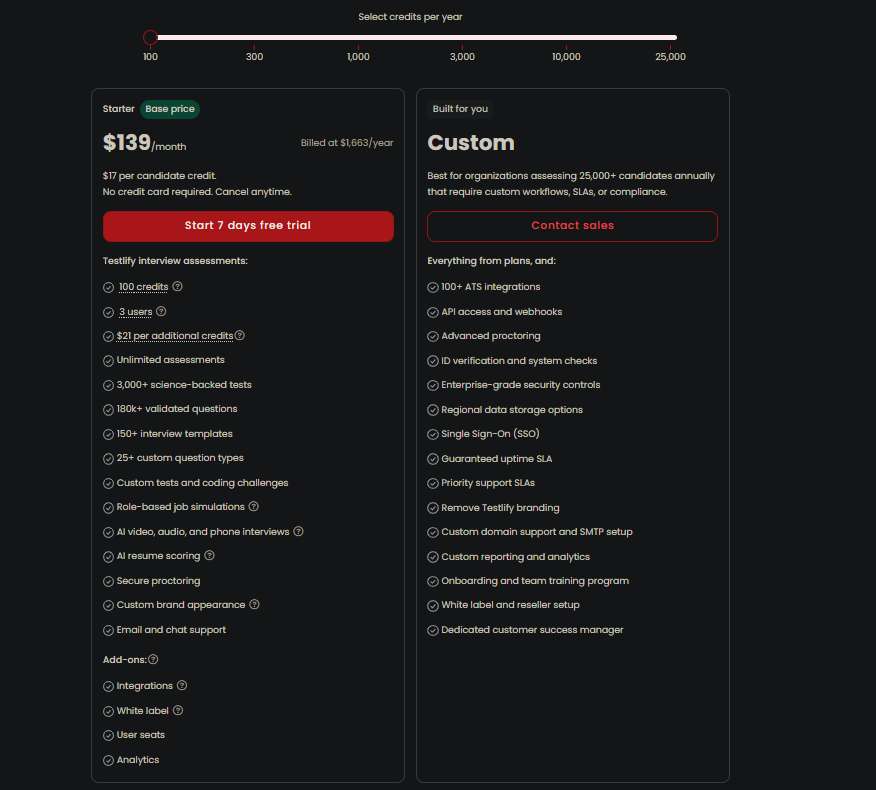
The fastest way to settle this is to run one role through both approaches and compare the shortlists. Testlify offers a 7-day free trial with no card required, and annual plans start at $139 a month for 100 candidate credits. To walk through conversational AI interviews and the assessment library against a live requisition, book a demo with the Testlify team, or start with the AI interview product tour and the full test library. Teams hiring engineers should look at the coding assessment range first, and current pricing sits on the plans page.
FAQs

Related resources
View all
Video Interviewing Tools Comparison
Testlify vs Sapia.ai: Which AI Interviewing Platform is Best for You?
Video Interviewing Tools Comparison
Testlify vs Hyring: Detailed in-depth comparison guide
Video Interviewing Tools Comparison
Testlify vs InCruiter: Which AI powered interviewing platform is best for you?
Video Interviewing Tools Comparison
Testlify vs Spark Hire: Skills Tests or Video Interviews
Video Interviewing Tools Comparison
Testlify vs VidCruiter: Which Wins for Skills-Based Hiring?
Video Interviewing Tools Comparison
Testlify vs Alex AI: Which AI Interviewing Platform Is Best?
Get started.
Hire on proof, not resumes.
Run your first skills-based assessment free — no credit card required.