
Testlify vs Metaview: Which AI recruiting platform in 2026?
Compare Testlify vs Metaview on resume screening, analytics, interviews and more to find the best AI recruiting platform for your hiring success
Hiring has fundamentally changed. Resumes are no longer reliable indicators of performance, and interviews are often inconsistent. In this environment, artificial intelligence (AI) in recruitment platforms is no longer an optional add-on but a practical necessity for teams seeking to identify top talent efficiently.
However, not all AI recruiting platforms solve the same problem. Some tools are designed to enhance recruiter productivity by automating tasks such as note-taking and candidate sourcing. Others are designed to improve hiring quality by validating real skills, structuring interviews, and reducing unconscious bias in decision-making.
This distinction matters. Platforms like Metaview focus on AI-generated interview notes, sourcing assistance, and conversation insights, helping recruiters save time and stay organized.
In contrast, Testlify is built around structured skills assessment, conversational AI interviews, resume screening, and benchmarking analytics. Its primary objective is to accurately measure candidate skills and competencies before hiring decisions are made.
For talent leaders, the real question is not which platform uses AI, but which platform delivers measurable improvement in hiring outcomes.
In this comparison of Testlify vs Metaview, we examine their capabilities across skills validation, interviewing, automation, analytics, compliance, and long-term hiring impact to determine which solution provides stronger value for modern recruiting teams.
 ChatGPT
 Gemini
 Claude
 Grok
Grok Perplexity
Platform overview
Choosing between two AI recruiting platforms requires clarity on what each one is fundamentally designed to do. While both operate in the hiring technology space, their core objectives are very different.
What Is Testlify?
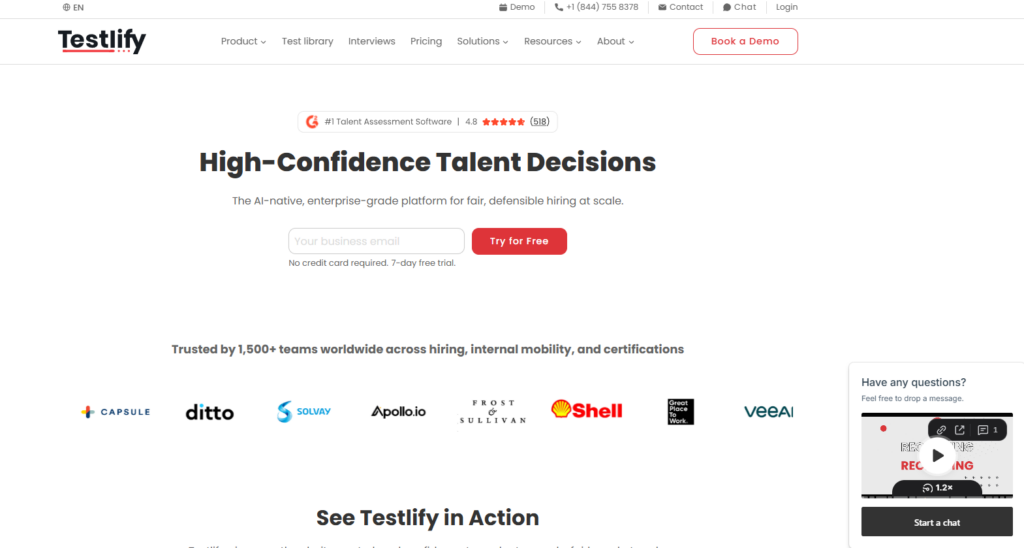
Testlify is an AI native skills assessment and interviewing platform built to help organizations hire top talent based on proven skills. At its core, Testlify focuses on structured, skill-based hiring through:
- 3,500+ validated skill tests across 4,500 plus job roles in 16+s
- Conversational AI interviews in chat, voice, and video formats
- AI-powered resume screening with job fit scoring
- Advanced anti-cheating and proctoring controls
- Benchmarking analytics and detailed reporting
- Integration with 100-plus ATS and HR systems
The platform is designed to standardize the candidate screening process, reduce recruiter bias, and provide measurable insights before final hiring decisions are made.
What Is Metaview?
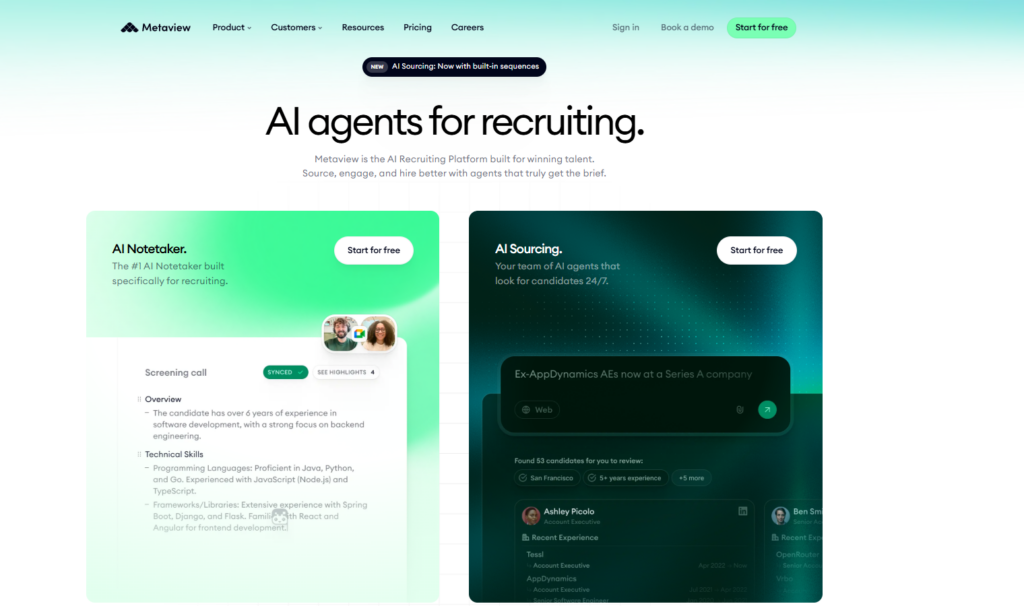
Metaview is positioned as an AI recruiting platform that supports recruiters through automation and conversation intelligence. Its primary capabilities include:
- AI-generated interview notes
- Customizable interview note templates
- An AI sourcing agent that scans and evaluates candidate profiles
- Conversation filtering and extracting actionable insights from candidate interviews
- AI-powered job post recommendations
Metaview is built to reduce administrative effort and help recruiters capture insights from interviews more efficiently. However, it does not provide structured skills assessments, AI interviews, or advanced proctoring controls, making it less suitable for high-stakes hiring.

Testlify vs Metaview: Detailed comparison
To understand which platform delivers a stronger impact for modern hiring teams, it is essential to compare their capabilities across the areas that directly influence the recruitment process
Testlify vs Metaview: Skills assessment and hiring accuracy
The foundation of strong hiring decisions is objective skill validation. Without structured assessments, hiring teams rely heavily on resumes and subjective interviews, both of which are prone to bias and inconsistency. This is where the difference between Testlify and Metaview becomes significant.
Testlify is built around validated skills testing. The platform offers a test library of 3,500+ pre-validated skills tests, such as:
- Role-specific tests
- Cognitive ability tests
- Blue-collar hiring tests
- Programming tests
- Software skills tests
- Psychometric tests
- Situational judgment tests
- Live coding tests
- Typing tests
- Language tests
Recruiters can also create custom assessments using multiple question formats, including conversational AI-powered chat, voice, and video interviews. Weighted scoring allows hiring managers to prioritize the competencies that matter most for a role
Benchmarking analytics further enables organizations to compare candidates against industry standards.
Metaview does not provide structured skills testing or assessment frameworks. Its intelligence is derived from analyzing conversations and extracting insights from interviews, not from validating competencies before or during the evaluation process.
Why this difference matters
When hiring decisions are made without standardized skill measurement:
- Interview outcomes vary across interviewers
- Bias increases
- Mis-hire risk rises
- High performers may be overlooked
Testlify directly addresses these risks by embedding objective, role-specific tests into the hiring workflow. Every candidate is measured against the same structured criteria, ensuring fairness and comparability.
Metaview enhances visibility into conversations, but it does not replace the need for validated assessment.
Verdict
If the priority is improving hiring accuracy, reducing bias, and ensuring candidates can actually perform the job, Testlify delivers substantially stronger value. Metaview may improve recruiter efficiency, but Testlify improves hiring outcomes.
Testlify vs Metaview: AI Interviewing Capabilities
Interviews remain one of the most crucial stages of the hiring process. Yet in many organizations, they are unstructured, inconsistent, and difficult to evaluate objectively. AI can either enhance documentation or fundamentally improve how interviews are conducted. This is where the difference between Testlify and Metaview becomes clear.
Testlify offers conversational AI interviews across chat, voice, and video formats. These interviews are designed to simulate real job scenarios, allowing candidates to demonstrate problem-solving ability, communication skills, and role-specific expertise.
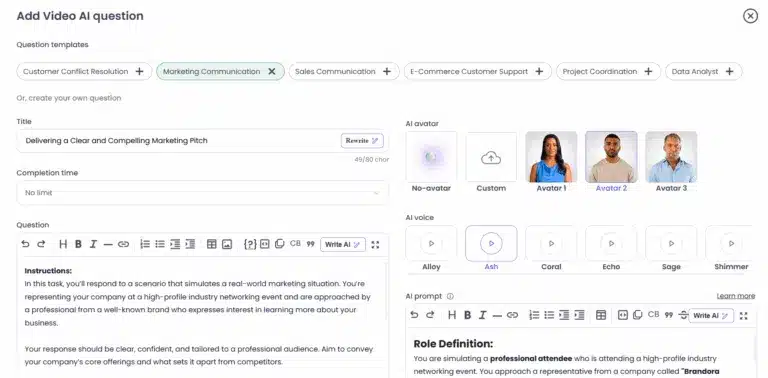
The key highlights of Testlify’s conversational AI interviews include:
- Structured AI-driven interview flows
- Role-specific interview simulations
- Automated scoring based on answer relevance and verbal cues
- AI Insights, which shows the strengths and weaknesses of the interviewed candidates
- Manual review options for added control
- Integrated anti-cheating and advanced proctoring measures to ensure interview integrity
This creates a standardized and measurable interview experience. Every candidate is evaluated using the same criteria, reducing interviewer bias and ensuring consistent assessment quality.
Metaview focuses on AI-generated interview notes and customizable note templates. Its primary goal is to capture and organize conversation details during live interviews.
While this improves documentation and collaboration, it does not structure or validate the interview process itself.
Verdict
When evaluating interview capabilities through the lens of hiring impact, the difference is decisive. Testlify transforms interviews into objective evaluation frameworks that directly improve hiring accuracy.
Importantly, Testlify’s AI interviews also automate initial candidate screening at scale. Instead of recruiters manually conducting early-stage interviews, the platform can evaluate large applicant pools consistently and identify top talent based on predefined role-specific criteria.
Metaview enhances how interviews are documented, but it is not capable of automating the interview process.
For organizations looking to streamline early-stage screening, reduce bias, and confidently identify top performers, Testlify delivers substantially greater strategic value.
Testlify vs Metaview: Maintaining assessment integrity
As remote hiring becomes standard practice, ensuring assessment integrity is no longer an easy task. When evaluations are conducted online without safeguards, the risk of external assistance, impersonation, and AI-generated responses increases significantly.
For organizations that rely on skill-based hiring, the credibility of results is critical. This is another area where the difference between Testlify and Metaview is substantial.
Testlify includes advanced anti-cheating and proctoring capabilities designed specifically for structured evaluations. These include:
- Face detection
- Photo id verification
- Webcam snapshots
- Full-screen mode
- Force full-screen mode
- Dual camera proctoring
- Copy/paste tracking
- Mouse-out tracking
- IP proctoring
- Live video monitoring
- Question randomization
- Honesty Agreements
- Question-level activity logs
- AI assistance detection
- Screen recording
- Live environment check
- System requirement check
- Enforce internet speed check
- Focus guard (Anti-Cheat Mode)
- Talking prohibition
These advanced proctoring controls ensure that assessments reflect genuine candidate ability and provide hiring teams with confidence in the fairness of the evaluation process.
Metaview does not provide any anti-cheating or advanced proctoring features since the platform is primarily focused on note-taking.
Why assessment integrity matters
Without advanced proctoring and anti-cheating features:
- Assessment results can be manipulated
- High-performing candidates may be unfairly disadvantaged
- Hiring decisions become less reliable
- Compliance risks increase
Testlify addresses these challenges directly by embedding integrity controls into the assessment workflow itself.
Verdict
For organizations conducting remote assessments at scale, Testlify provides essential security and compliance safeguards. Metaview does not address assessment integrity, making Testlify the stronger choice for secure and reliable skill validation.
Testlify vs Metaview: AI resume Screening and talent filtering
One of the biggest bottlenecks in modern hiring is resume screening. Recruiters spend hours reviewing applications, often relying on keyword matching or subjective judgment. The real challenge is not just filtering resumes faster, but identifying genuinely qualified candidates.
Testlify offers AI-powered resume screening designed to evaluate candidates against predefined role-specific criteria. The system assigns explainable job fit scores and categorizes candidates as high, medium, or low match based on measurable alignment.
Key capabilities of Testlify include:
- Automated resume evaluation against hiring criteria
- AI-driven job fit scoring
- Automatic shortlist and rejection workflows
- Seamless syncing of assessment results to 100+ ATS platforms
What makes this powerful is the integration between resume screening and skills assessment. Candidates who pass the resume screening can automatically proceed to structured testing, ensuring that shortlisting is validated by actual competency.
Metaview provides an AI sourcing agent that scans and evaluates profiles across the web based on recruiter input. While this helps identify potential candidates proactively, it does not replace structured resume evaluation or connect sourcing directly to validated skill assessments.
Verdict
Testlify goes beyond filtering candidates. It evaluates alignment against role-specific criteria, assigns transparent job fit scores, and seamlessly transitions qualified candidates into validated assessments.
Metaview strengthens sourcing visibility, but it does not provide structured screening or competency validation. For organizations that want screening to improve hiring outcomes rather than just speed up resume review, Testlify is the more strategic and impactful solution.
Testlify vs Metaview: Reporting and analytics
Hiring decisions should be backed by measurable data, not fragmented interview notes or isolated impressions. As organizations scale, leadership teams need visibility into candidate performance, skill benchmarks, and evaluation consistency. This is where analytics move from being helpful to being essential.
Testlify provides structured assessment-driven analytics designed to support objective decision-making. Its extensive reports include:
- Skill level breakdowns by competency
- Question-level performance insights
- Weighted scoring visibility
- AI-generated performance overviews
- Benchmarking against industry standards
- Exportable reports in PDF, Excel, and CSV formats
Because Testlify’s reports are tied directly to validated assessments and structured interviews, the insights are performance-based rather than perception-based. Hiring managers can clearly see how candidates compare across predefined criteria, making collaboration more objective and defensible.
Metaview, on the other hand, focuses only on conversation intelligence. Recruiters can filter interviews, extract specific data points such as compensation discussions, and receive alerts based on conversation content.
While this improves visibility into hiring discussions, it does not provide competency benchmarking or structured performance comparisons.
Verdict
Testlify delivers analytics that measure capability, whereas Metaview delivers analytics that summarize conversations. For organizations aiming to standardize hiring quality across departments and geographies, measurable skills and competency data carry greater long-term value.
For talent leaders focused on building high-performing teams through objective measurement, Testlify delivers stronger and more actionable insights.
Testlify vs Metaview: Pricing plans
The real question when choosing an AI recruitment platform is not just what a platform costs, but what it improves. Stronger hiring accuracy, reduced mis-hire risk, and faster time to shortlist directly influence organizational performance.
Testlify pricing plans details
Testlify offers transparent and scalable pricing plans designed to support teams of different sizes. Plans start at 139 dollars per month and scale through business, premium, enterprise, and unlimited tiers.
- Starter plan: Ideal for small teams and startups, this plan starts at $198/monthnth (billed at $1,663/year) and includes 100 candidate credits at $17 per credit with support for 3 users.
- Starter: Designed for growing businesses, the Starter starts at $279/month (billed at $3,343/year) and includes 300 credits at $11 per credit with support for 5 users.
- Starter: Built for scaling teams, this plan costs $699/month (billed at $4,192/year) and includes 1,000 credits at $8 per credit with 10 users.
- Premium plan: Suited for high-growth organizations, the Premium plan includes 3,000 credits and supports 20 users, with pricing available upon contacting the sales team.
- Enterprise plan: Designed for large enterprises, this plan includes 10,000 credits and supports 30 users with pricing available upon contacting the sales team.
- Enterprise Plus plan: Designed for large-scale hiring programs, this plan includes 25,000 credits and supports up to 40 users, with pricing details available after contacting the sales team.
- Unlimited plan: For companies seeking unrestricted access, Testlify offers an unlimited plan that includes unlimited candidate credits and full platform functionality, with pricing available on request from the sales team.
This allows startups, mid-sized companies, and global enterprises to adopt structured skill-based hiring without unpredictable pricing structures. More importantly, Testlify’s value is tied to measurable outcomes:
- Reduced screening time through AI resume scoring
- Lower mis-hire risk through validated assessments
- Faster decision-making with automated scoring and global benchmarking
- Reduced bias through weighted scoring
Metaview pricing plans details
Metaview structures its pricing primarily around its AI Notetaker and enterprise recruiting suite. The plans are:
- Free AI Notetaker at 0 dollars with limited monthly conversations
- Pro AI Notetaker at 50 dollars per user per month, billed annually or 60 dollars billed monthly
- Enterprise AI Notetaker with tailored pricing
- AI Recruiting Platform with tailored enterprise pricing
Additionally, Metaview’s pricing is centered around conversation capture, sourcing, reports, and job post support rather than structured skill validation.
Verdict
Pricing should reflect impact, not just access to features. Metaview offers accessible entry points for AI note-taking, starting with a free tier and scaling to per-user pricing for advanced usage.
This model works well for teams primarily looking to improve documentation and recruiter efficiency. However, efficiency gains alone do not directly improve hiring quality.
Testlify structures its pricing around a comprehensive hiring system that includes resume screening, validated skill assessments, conversational AI interviews, advanced prcotoring features, and benchmarking analytics.
The investment is tied to measurable improvements in candidate evaluation, reduced mis-hire risk, and stronger decision consistency. For organizations focused on improving hiring accuracy, building a skills-first process, and reducing costly hiring mistakes, Testlify delivers stronger strategic value per dollar spent.
Final thoughts
Throughout this comparison, the distinction between the two platforms is clear. Metaview enhances recruiter productivity through AI-generated notes, sourcing assistance, and conversation insights.
These features help teams stay organized and save time. However, saving time is not the same as improving hiring quality.
Testlify is built around structured, skills-first hiring. From AI-powered resume screening and conversational AI interviews to validated skill tests and global benchmarking analytics, Testlify strengthens the foundation of hiring decisions.
If your priority is measurable hiring improvement rather than workflow enhancement alone, Testlify stands out as the best AI recruitment platform in the market.
Ready to transform your hiring process?
Experience how our innovative conversational AI interviews, validated skill tests, and intelligent AI resume screening can elevate your recruitment outcomes.
Book a demo with Testlify today and see how we can help you 6x recruitment efficiency and identify top talent with ease.
Frequently asked questions (FAQs)

Related resources
View all
Video Interviewing Tools Comparison
Testlify vs Willo: Which Interviewing Platform is Best for You?
Video Interviewing Tools Comparison
Testlify vs Sapia.ai: Which AI Interviewing Platform is Best for You?
Video Interviewing Tools Comparison
Testlify vs Hyring: Detailed in-depth comparison guide
Video Interviewing Tools Comparison
Testlify vs InCruiter: Which AI powered interviewing platform is best for you?
Video Interviewing Tools Comparison
Testlify vs Spark Hire: Skills Tests or Video Interviews
Video Interviewing Tools Comparison
Testlify vs VidCruiter: Which Wins for Skills-Based Hiring?
Get started.
Hire on proof, not resumes.
Run your first skills-based assessment free — no credit card required.