
Testlify vs Sapia.ai: Which AI Interviewing Platform is Best for You?
Compare Testlify vs Sapia.ai features, AI interviews, test library, proctoring, pricing, and more to find which is the best interviewing platform in 2026
Testlify is the stronger choice when you need to verify real, role-specific skills, while Sapia.ai fits high-volume, text-only behavioral screening. If you want one platform that scores technical, cognitive, and behavioral ability, backed by proctoring and chat, voice, and video AI interviews, Testlify wins this comparison. If your only goal is a quick chat screen at scale, Sapia.ai covers a narrower slice.
The stakes behind that choice keep rising. The World Economic Forum estimates that 39% of workers’ core skills will change by 2030, so a resume tells you less about who can do the job today. At the same time, 88% of organizations now use AI in at least one business function, and hiring is one of them. This comparison uses the Testlify Multi-Signal Talent Evaluation Model as its lens: one signal is fragile, and confident hiring comes from combining several role-relevant signals, not from a single chat transcript.
TL;DR: Testlify vs Sapia.ai
- Best overall for skills-based hiring: Testlify pairs a 3,500+ test library with chat, voice, and video AI interviews in one place.
- Best for high-volume text screening: Sapia.ai runs a low-pressure text-only chat interview that scales well for entry-level, frontline roles.
- Depth of assessment: Testlify tests coding, cognitive, and role-specific skills; Sapia.ai reads written answers only and has no test library.
- Assessment integrity: Testlify adds proctoring, ID checks, and AI-assistance detection; Sapia.ai relies on text safeguards, with no webcam or live monitoring.
- Pricing: Testlify is transparent and self-serve with a free trial; Sapia.ai is quote-based and aimed at enterprise volume.
At a glance | Testlify | Sapia.ai |
|---|---|---|
Interview formats | Chat, voice, video | Text chat only |
Test library | 3,500+ tests | None |
Proctoring | Full suite | Text safeguards only |
ATS integrations | 100+ | 5+ |
Pricing | Transparent, free trial | Quote-based |
Best fit | Skills-based, role-specific hiring | High-volume text screening |
 ChatGPT
 Gemini
 Claude
 Grok
Grok Perplexity
What is Testlify?
Testlify is a leading AI-powered skills assessment and interviewing platform designed to help organizations make faster, smarter hiring decisions. With 3,500+ role-specific tests available in 16+ languages, it enables companies to confidently evaluate talent across global markets while maintaining consistency, accuracy, and compliance.
Beyond technical and job-based assessments, Testlify also offers a comprehensive suite of psychometric tests that measure cognitive ability, behavioral traits, and overall job fit, helping recruiters build high-performing teams with confidence.
How Testlify works
1. Create tailored interviews and assessments
Testlify helps recruiters design conversational AI interviews tailored to specific job roles. The platform supports AI-powered interviews in chat, voice, and video formats, enabling candidates to engage in realistic job scenarios such as handling customer complaints, presenting ideas, or solving workplace challenges
Recruiters can also create custom assessments by choosing from a library of 3500+ role-specific tests or using AI to generate custom questions. The platform supports diverse question formats, including multiple-choice, open-ended, and even coding challenges.
2. Invite candidates
Once an interview is set up, Testlify makes it easy to send out candidate invitations. You can share a public link (no login needed) or email candidates directly. The platform is mobile-friendly and requires no account creation for candidates.
Recruiters can customize invite and rejection emails, and 24×7 candidate support is available to ensure a smooth experience.
3. Advanced anti-cheating and proctoring
Testlify includes a full suite of proctoring tools to guarantee interview integrity. The system records interview sessions (with periodic webcam snapshots) so you can verify identity and behavior.
It tracks IP/location to detect proxy attempts, disables copy-paste and flags tab-switching, and randomizes question order to deter sharing. It even scans answers for AI-generated or plagiarized content
4. Reporting and Analytics
After completion, Testlify generates detailed reports for each candidate. Recruiters get score breakdowns by skill, question-level stats, and interview evaluations. You can benchmark scores and flag any anomalies. This data-driven reporting makes it easy to compare candidates objectively.
For example, Testlify’s AI Insights show clear pros/cons for each candidate and help you identify top performers.
5. Integration with applicant tracking systems (ATS)
To simplify the hiring workflow, Testlify integrates with 100+ ATS platforms, including Greenhouse, Lever, and Recruitee. This allows you to effortlessly import candidates’ profiles, compare assessment results and make data-driven hiring decisions.
6. Data compliance
Testlify is GDPR compliant and prioritizes the security of your recruitment data. It features advanced admin management, strong security integrations, rigorous data governance, comprehensive audits, and strong privacy protections, all backed by SOC 2 Type II, AICPA, and ISO 27001 certifications.

What is Sapia.ai?
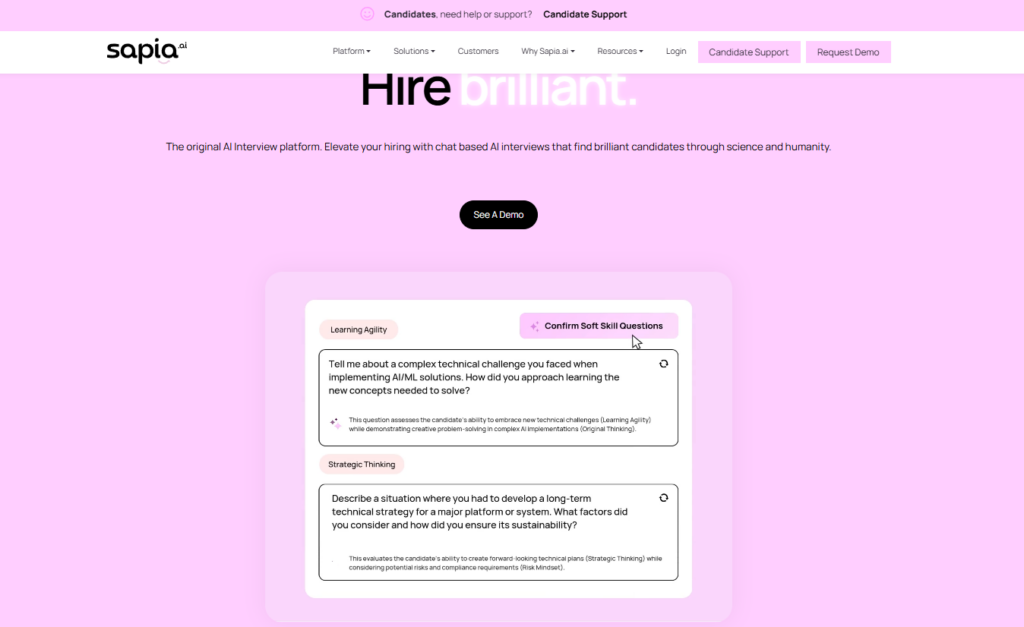
Sapia.ai offers an AI Chat Interview platform that replaces initial screening calls with a structured, text-based interview. Candidates respond to standardized behavioral prompts via chat, and the system uses rubric-based scoring and large language models to evaluate communication skills, personality traits, and core competencies.
While this approach helps automate early-stage screening and generate a quantified talent profile, it primarily focuses on conversational analysis rather than comprehensive skill validation.
Compared to Testlify’s broader ecosystem of conversational AI interviews, technical and psychometric tests, Sapia’s model is more limited in scope, making it better suited for basic screening rather than deep, role-specific hiring decisions.
How Sapia.ai works
1. Create chat interviews
Sapia starts by working with your team to define the target competencies or values for the role. You can even have a team of psychologists help craft interview questions for each role type.
Typically, behavioral/situational questions are set. This creates a structured interview rubric where every candidate will be asked the same questions in the same order.
2. Candidate completes chat interview
Applicants access the interview via a link shared in the job post or ATS. They respond to all questions through a text-only chat interface, with no video or audio required. The format is mobile-friendly, untimed, and allows candidates to pause and resume, creating a low-pressure experience.
3. AI-driven evaluation and feedback
Sapia’s Chat Interview engine analyzes each response using a combination of rubric-based scoring and large language model reasoning. Candidates are scored against defined competencies, and the platform automatically ranks applicants. The system also undergoes bias audits to support fairness and provides automated feedback to candidates after completion.
4. Shortlist candidates
The system outputs a curated shortlist of top performers. Recruiters get a ranked list with explainable scores and a detailed talent profile for each candidate.
These profiles highlight trait scores (e.g., communication skill, teamwork, values alignment) and even recommend follow-up questions to probe development areas. Recruiters then decide whom to move on to live interviews.
Which platform runs better AI interviews?
Testlify runs richer AI interviews. It evaluates candidates through chat, voice, and video, so you can measure written reasoning, verbal fluency, and presence in job-like scenarios. Sapia.ai runs a single text-chat interview, which works for basic screening but cannot read tone, confidence, or non-verbal cues.
Interview format | Testlify | Sapia.ai |
|---|---|---|
Audio interviewing (Voice AI) | ✓ | ✗ |
One-way audio interview | ✓ | ✗ |
Video interviewing (Video AI) | ✓ | ✗ |
One-way video interview | ✓ | ✗ |
Chat simulation (Chat AI) | ✓ | ✓ |
Custom interview questions creation | ✓ | ✓ |
Testlify delivers highly immersive, multi-format AI interviews built to mirror real workplace scenarios. Instead of limiting evaluation to static questions, it places candidates in practical, job-relevant simulations so hiring teams can assess applied skills, adaptability, and communication in context. It supports:
Chat AI: Assess problem-solving, written communication, and critical thinking by engaging candidates in realistic text-based scenarios, like handling a billing dispute or calming an angry customer.
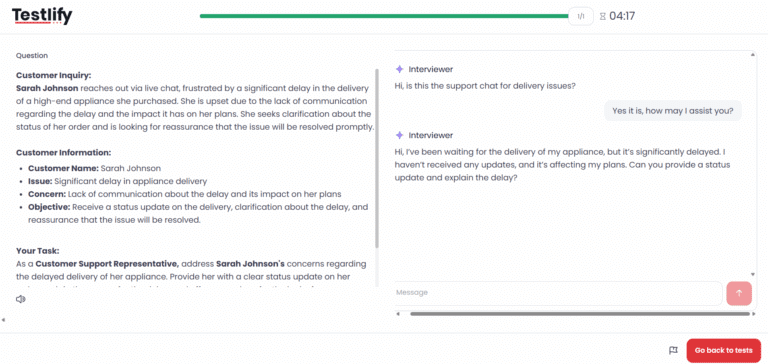
Voice AI: AI voice interviews will evaluate candidates’ verbal fluency, clarity, persuasion, and tone through role-specific, simulated job conversations. This approach allows recruiters to identify top candidates for sales, customer support, and other client-facing roles where communication drives performance.
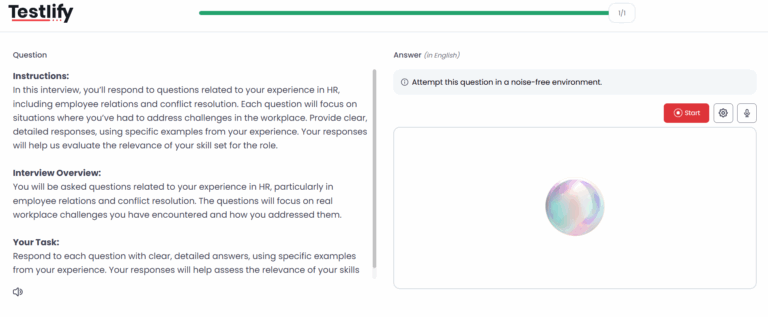
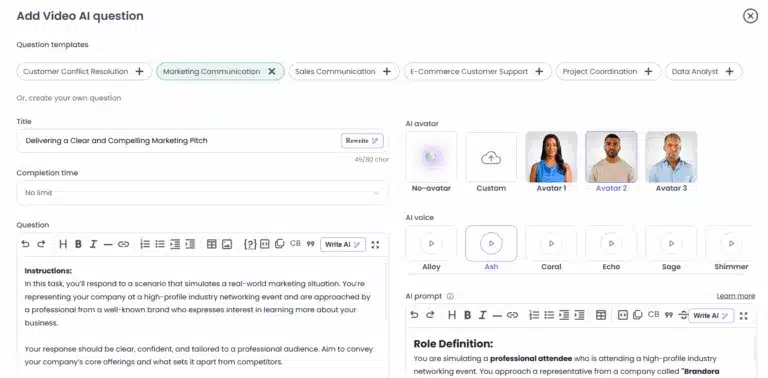
Video AI: uses AI-powered avatar-led asynchronous video interviews to simulate complex job scenarios. This allows recruiters to evaluate non-verbal communication, confidence, presence, and emotional intelligence alongside content quality, delivering a more complete view of candidate readiness.
Sapia.ai delivers a fully text-based AI chat interview experience through its Smart Interviewer. Candidates respond to questions in a chat interface, and the system analyzes their responses to evaluate competencies, communication skills, and personality traits.
While this approach standardizes screening and removes visual bias, it significantly limits the depth of assessment. Because Sapia operates only in a text format, it cannot evaluate verbal fluency, tone, persuasion skills, confidence, or non-verbal communication cues.
Verdict: Testlify offers a significantly more comprehensive conversational AI interviewing solution than Sapia.ai. While Sapia limits assessment to text-based chat responses, Testlify enables recruiters to evaluate candidates across chat, voice, and video formats, delivering deeper insights into communication skills and job readiness.
For organizations seeking complete, role-specific evaluation rather than basic screening, Testlify is the stronger choice.
Does Sapia.ai have a real test library?
No. Sapia.ai has no test library and scores written chat answers against behavioral competencies. Testlify offers 3,500+ validated tests across coding, cognitive ability, software skills, personality, and role-specific knowledge, so you can verify what a candidate can actually do before the first interview, not just how they describe themselves.
Test library features | Testlify | Sapia.ai |
|---|---|---|
Role-specific tests | ✓ | ✗ |
Coding tests | ✓ | ✗ |
Cognitive ability tests | ✓ | ✗ |
Programming tests | ✓ | ✗ |
Number of programming languages supported | 45+ | ✗ |
Situational judgment tests | ✓ | ✗ |
Typing test | ✓ | ✗ |
Software skills tests | ✓ | ✗ |
Non-technical tests | ✓ | ✗ |
Psychometric tests | ✓ | ✗ |
Personality tests | ✓ | ✗ |
Motivation test | ✓ | ✗ |
Assessment templates | ✓ | ✗ |
Custom assessments creation | ✓ | ✗ |
Testlify offers one of the most extensive assessment libraries in the market. The platform provides 3,500+ validated skill tests covering 4,500+ job roles across technical, cognitive, language, behavioral, and domain-specific categories.
Recruiters can select ready-to-use assessments or uses Testlify’s AI-powered test builder to customize questions, combine multiple skill areas into a single assessment, or tailor evaluations to specific job requirements. This flexibility allows hiring teams to assess both hard and soft skills within a structured, measurable framework.
Sapia.ai does not offer a traditional test library. Instead, the platform focuses exclusively on structured, text-based behavioral interviews. Candidates respond to open-ended prompts in a chat format, and the system evaluates competencies based on written answers.
There are no built-in technical tests, coding assessments, multiple-choice exams, or domain-specific skill validations. Any role-specific or technical evaluation must be conducted separately through another tool or stage in the hiring process.
Verdict: Testlify provides a significantly broader and more versatile assessment ecosystem, enabling recruiters to evaluate technical, cognitive, and behavioral skills within a single platform.
In contrast, Sapia.ai’s interview-only model lacks structured skill testing capabilities, making Testlify the stronger choice for identifying top talent.
Testlify vs Sapia.ai: Custom question types
Assessment features | Testlify | Sapia.ai |
|---|---|---|
Custom assessment builder | ✓ | ✗ |
Custom coding questions | ✓ | ✗ |
Multiple-choice questions | ✓ | ✗ |
Short answer questions | ✓ | ✗ |
Long answer questions | ✓ | ✗ |
Rating questions | ✓ | ✗ |
Date questions | ✓ | ✗ |
Fill in the blanks | ✓ | ✗ |
Microsoft Word/Excel/PowerPoint questions | ✓ | ✗ |
Google Docs/Slides/Sheets questions | ✓ | ✗ |
Qualifier questions | ✓ | ✗ |
File upload questions | ✓ | ✗ |
Assessments curated by I/O psychologists | ✓ | ✗ |
Quality check | ✓ | ✗ |
Testlify gives recruiters full flexibility to design assessments using a wide range of question formats. Hiring teams can combine single-select, multiple-choice, fill-in-the-blank, coding challenges, Google Doc or Sheet exercises, and custom audio or video interview prompts within a single test.
This multi-format capability allows organizations to directly evaluate practical, job-specific hard skills alongside communication and reasoning abilities. Whether hiring developers, marketers, analysts, or sales professionals, recruiters can tailor question types to reflect real-world job tasks.
Sapia.ai focuses exclusively on structured, open-text behavioral questions delivered through chat. The question format itself remains fixed as written responses, but the content is customized.
While this approach allows strong alignment on behavioral evaluation, it does not support varied question formats such as coding tasks, multiple-choice assessments, document-based exercises, or multimedia responses.
Verdict: Testlify offers far greater flexibility in question formats, making it better suited for assessing technical, analytical, and role-specific hard skills. Sapia.ai provides strong customization of behavioral content but remains limited to text-based prompts, making Testlify the more versatile solution for diverse hiring needs.
Testlify vs Sapia.ai: White-labeling capabilities
Features | Testlify | Sapia.ai |
|---|---|---|
Candidate experience | ||
Customizable email templates | ✓ | ✗ |
Mobile-friendly | ✓ | ✓ |
Candidate support | ✓ | ✓ |
Welcome video | ✓ | ✗ |
Average assessment length | 40-60 minutes | – |
Assessment attempts | Customizable | – |
Enterprise friendly | ||
White label | ✓ | ✗ |
Custom branding | ✓ | Limited |
ATS integrations | 100+ | 5+ |
User, role, and access management | ✓ | ✓ |
Bulk candidate invite | ✓ | ✓ |
Share the public link invite with candidates | ✓ | ✓ |
Candidate pipeline management | ✓ | ✓ |
Internationalization | ✓ | – |
Campus hiring support | ✓ | ✗ |
Dedicated account manager | ✓ | ✗ |
Testlify offers a dedicated white-label option that allows organizations to fully align the candidate experience with their brand. Recruiters can remove Testlify branding, add their company logo, customize brand colors, and personalize assessment interfaces and email invitations.
This ensures a smooth, professional brand experience from the first candidate touchpoint, reinforcing employer branding throughout the hiring journey.
Sapia.ai does not prominently position white-labeling as a core feature. While some branding adjustments may be possible within the client environment, the chat interview experience is typically delivered within Sapia’s platform interface and styling.
As a result, organizations may have less control over fully customizing the candidate-facing experience compared to platforms that prioritize white-label functionality.
Verdict: For companies that prioritize a fully branded candidate journey, Testlify offers stronger white-labeling capabilities. Sapia.ai provides a structured interview experience but offers more limited brand customization in comparison.
Which platform has stronger proctoring?
Testlify has far stronger proctoring. It layers ID verification, webcam snapshots, tab and copy-paste monitoring, full-screen enforcement, and AI-assistance detection to protect assessment integrity. Sapia.ai runs async text chats, so it leans on plagiarism and AI-text checks alone, with no webcam or live monitoring to confirm who is answering.
Anti-cheating & proctoring features | Testlify | Sapia.ai |
|---|---|---|
Session recording | ✓ | ✗ |
Snapshot capturing | ✓ | ✗ |
Mouse tracking | ✓ | ✗ |
Disabled copy-paste | ✓ | ✓ |
Microphone and camera access | ✓ | ✗ |
Location access | ✓ | ✗ |
IP address tracking | ✓ | ✗ |
Question-level activity logs | ✓ | ✗ |
Full-screen mode | ✓ | ✗ |
Force full-screen mode | ✓ | ✗ |
Tab proctoring | ✓ | ✗ |
AI assistance detection | ✓ | ✓ |
Restrict multiple monitors | ✓ | ✗ |
Randomization of question sequence | ✓ | ✗ |
Time limit on tests | ✓ | ✓ |
Screen sharing | ✓ | ✗ |
Dual camera proctoring | ✓ | ✗ |
Honesty agreement | ✓ | ✗ |
Testlify is built with enterprise-grade security and advanced proctoring capabilities. The platform offers live proctoring, session recording, webcam snapshots, full-screen enforcement, and AI-driven cheat detection to maintain assessment integrity.
It actively flags suspicious behaviors such as multiple people appearing on screen, tab switching, or potential use of external AI tools. Testlify can also verify candidate identity by matching a photo ID with the live webcam feed. This layered security approach makes it particularly suitable for high-stakes, technical, or compliance-sensitive hiring.
Sapia.ai conducts asynchronous, text-based chat interviews, so traditional video proctoring tools such as webcams or live monitoring are not part of its model. Instead, Sapia focuses on text-based safeguards.
The platform disables copy-paste functionality during interviews and scans responses for plagiarism or AI-generated content. It has developed detection mechanisms to flag answers potentially generated by tools like ChatGPT.
However, without video monitoring or behavioral tracking, its security framework remains limited to written-response analysis.
Verdict: Testlify provides a far more comprehensive anti-cheating ecosystem through features such as dual camera proctoring, AI assistance detection, and more.
Sapia.ai offers plagiarism detection measures but lacks multi-layered proctoring controls, making Testlify the stronger choice for organizations that require high assessment integrity.
How do the ATS integrations compare?
Testlify connects to 100+ applicant tracking systems, including Workday, Greenhouse, Lever, and SAP SuccessFactors, so results sync straight into your pipeline. Sapia.ai integrates with a smaller set of enterprise systems through APIs and webhooks. Both push scored shortlists back to the ATS, but Testlify covers more tools out of the box.
Testlify offers 100+ pre-built integrations with leading applicant tracking systems. These include platforms such as Workday, Greenhouse, BambooHR, SAP, and Zoho Recruit.
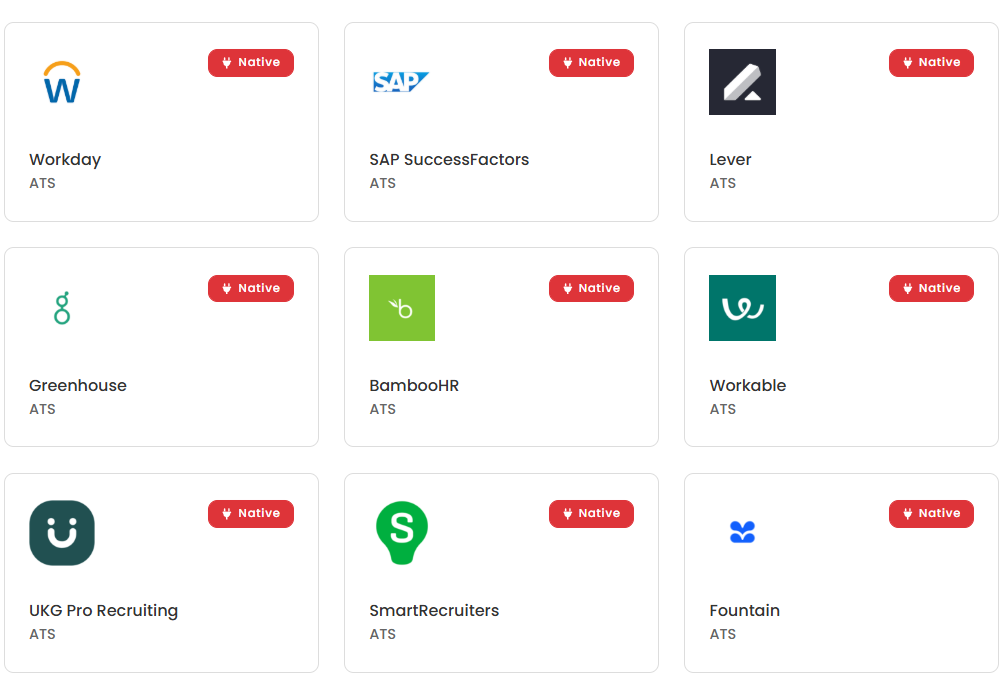
This extensive integration ecosystem enables smooth syncing of candidate data, assessment results, and hiring workflows directly within the recruiter’s existing ATS environment, reducing manual effort and improving process efficiency.
Sapia.ai typically integrates as an overlay within an organization’s existing ATS using APIs or webhooks. Recruiters can trigger Sapia’s chat interview at the application stage, and scored shortlists are automatically pushed back into the hiring workflow.
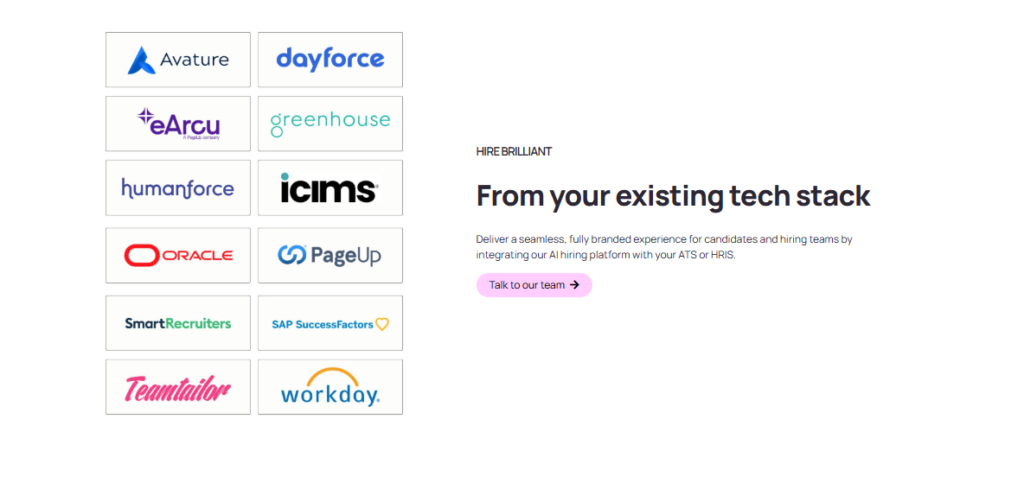
Sapia supports integrations with systems such as Workday, SAP SuccessFactors, and SmartRecruiters, focusing on flexible connectivity without requiring companies to change their existing ATS infrastructure.
Verdict: Testlify offers better integration support overall, enabling smoother connectivity and workflow automation across a wider range of ATS platforms. While Sapia.ai provides flexible API-based integrations with major systems, Testlify delivers a more reliable and scalable integration ecosystem for growing hiring teams.
Which gives you deeper reporting?
Testlify gives deeper, skill-level reporting. Its report cards break performance down by skill, question difficulty, and benchmark, and let you compare candidates side by side. Sapia.ai produces behavioral talent profiles scored on traits like communication and teamwork, which helps for soft-skill screening but is thinner on technical, role-specific detail.
Reporting & analytics | Testlify | Sapia.ai |
|---|---|---|
Detailed reports | ✓ | ✓ |
Public link to share reports and scorecards | ✓ | ✓ |
Exportable/downloadable reports | ✓ | ✓ |
Recruiting analytics | ✓ | ✓ |
Candidate benchmarking | ✓ | ✓ |
Completion rate and response insights | ✓ | ✓ |
Testlify delivers detailed, skill-based analytics designed to support data-driven hiring decisions. Recruiters receive comprehensive report cards that break down performance by skill category, question difficulty, and benchmark comparisons.
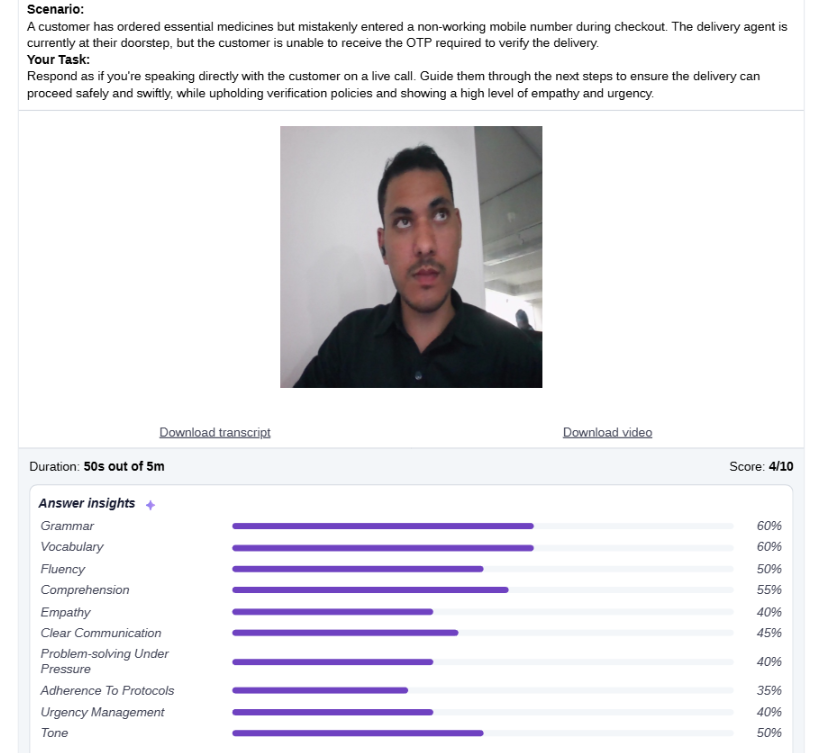
Its dashboards allow side-by-side candidate comparisons, highlighting strengths, weaknesses, and performance trends against historical norms. This makes it easier for hiring teams to identify top performers based on measurable, role-specific criteria.
Sapia.ai generates structured talent profiles for each candidate based on chat interview responses. These profiles include weighted scores across core competencies such as communication, teamwork, and values alignment.
Recruiters can compare multiple candidate profiles and review competency-based insights along with suggested follow-up interview questions. The analytics focus primarily on behavioral and personality metrics rather than technical or hard-skill breakdowns.
Verdict: Both platforms provide actionable insights, but their focus differs. Testlify emphasizes skill-level analytics and measurable test performance, making it stronger for technical and role-based hiring decisions.
Sapia.ai concentrates on competency and personality profiling, which is useful for behavioral evaluation but less comprehensive for multi-skill assessment needs.
Testlify vs Sapia.ai: Customer support
Customer support | Testlify | Sapia.ai |
|---|---|---|
24/7 support | ✓ | ✗ |
On-call support | ✓ | ✗ |
Email support | ✓ | ✓ |
Product demo | ✓ | ✓ |
Training & onboarding tour | ✓ | ✓ |
Testlify offers 24×7 customer support via chat and email, ensuring recruiters receive timely assistance at every stage of the hiring process. The platform also provides structured onboarding resources, including product tours, documentation, and training materials.
Enterprise plans include a dedicated account manager to support large-scale implementations and ongoing optimization. Many users highlight the responsiveness and reliability of its support team.
Sapia.ai showcases customer success stories on its website, but it does not explicitly mention 24×7 support availability. Its model emphasizes consultative onboarding and guided rollout rather than clearly defined round-the-clock helpdesk access.
Verdict: Both platforms offer onboarding and implementation support, but Testlify stands out with clearly stated 24×7 assistance and structured support tiers.
Sapia.ai provides consultative guidance during setup, yet Testlify offers more visible and continuous support coverage for recruitment teams operating at scale.
How do Testlify and Sapia.ai price?
Testlify uses transparent, self-serve pricing with a free trial and credit-based plans, so teams can start without a sales call. Sapia.ai does not publish pricing and runs quote-based enterprise deals aimed at high-volume hiring. For most teams that want to test a tool first, Testlify is easier to buy and budget.
Testlify pricing
Testlify offers flexible pricing plans that scale with your business, providing everything from basic assessments for startups to advanced features for enterprise-level hiring.
- Starter plan: Ideal for small teams and startups, this plan starts at $139/month (billed at $1,663/year) and includes 100 candidate credits at $17 per credit with support for 3 users.
- Starter: Designed for growing businesses, the Starter starts at $279/month (billed at $3,343/year) and includes 300 credits at $11 per credit with support for 5 users.
- Starter: Built for scaling teams, this plan costs $699/month (billed at $4,192/year) and includes 1,000 credits at $8 per credit with 10 users.
- Premium plan: Suited for high-growth organizations, the Premium plan includes 3,000 credits and supports 20 users, with pricing available upon contacting the sales team.
- Enterprise plan: Designed for large enterprises, this plan includes 10,000 credits and supports 30 users, with pricing available upon contacting the sales team.
- Enterprise plus plan: Designed for large-scale hiring programs, this plan includes 25,000 credits and supports up to 40 users, with pricing details available upon contacting the sales team.
- Unlimited plan: For companies seeking unrestricted access, Testlify offers an unlimited plan that includes unlimited candidate credits and full platform functionality, with pricing available on request from the sales team.
Sapia.ai does not publicly list standard pricing on its website. Instead, pricing is typically enterprise-focused and quote-based, requiring organizations to contact the sales team for a custom proposal.
Verdict: Testlify offers greater pricing transparency, flexibility, and accessibility through its credit-based model and free trial. Sapia.ai’s quote-based enterprise pricing may suit large organizations, but Testlify provides a more straightforward and scalable option for teams seeking clarity and control over costs.
Pro Tip: Do not judge an AI hiring tool by its interview format alone. Match the tool to your biggest bottleneck. If you are buried in high-volume applications, a fast text screen helps; if a wrong hire is expensive, weight skills tests and proctoring more heavily. With US median job tenure down to 3.9 years, per the Bureau of Labor Statistics, you will run this screen often, so pick the platform that scales with how you actually hire.
Final thoughts
Testlify and Sapia.ai both use AI to improve hiring efficiency, but Testlify delivers a far more complete and scalable solution for modern recruitment teams.
Testlify goes beyond basic conversational screening by combining a massive test library, AI-powered chat, voice, and video interviews, advanced proctoring, custom branding, and deep analytics within a single platform.
While Sapia.ai provides structured, text-based behavioral interviews, its scope remains limited to chat-only screening.
For recruiters who require technical assessments, multi-format AI interviews, identity verification, and enterprise-grade security controls, Testlify is the best AI interviewing tool available in the market
See Testlify in action
Put role-specific tests and multi-format AI interviews to work on your next hire. Book a demo and see how Testlify helps you hire faster and with more confidence.
Key takeaways
- Match the tool to the job, not the trend. Testlify verifies skills across coding, cognitive, and behavioral tests, so it fits role-specific hiring where a wrong hire is costly. Choosing on skills evidence beats choosing on interview format.
- Sapia.ai is a screening layer, not a full assessment. Its text-chat interview scores behavior and communication at volume, which means most teams still pair it with a separate skills test for technical roles.
- Multi-format interviews read more signal. Chat, voice, and video capture reasoning, fluency, and presence that a text-only transcript cannot, which matters most for sales, support, and client-facing hires.
- Integrity scales with stakes. Proctoring, ID checks, and AI-assistance detection protect high-stakes or remote hiring; if your roles are low-risk and high-volume, lighter text safeguards may be enough.
- Transparent pricing shortens the buying cycle. Testlify lets teams trial and budget without a sales call, while quote-based tools like Sapia.ai suit planned enterprise rollouts more than quick evaluation.
- Combine signals for confident decisions. The Multi-Signal Talent Evaluation Model advances candidates when several role-relevant signals agree, which reduces the risk of a single strong interview masking a weak skills fit.
Frequently asked questions (FAQs)

Related resources
View all
Video Interviewing Tools Comparison
Testlify vs Hyring: Detailed in-depth comparison guide
Video Interviewing Tools Comparison
Testlify vs InCruiter: Which AI powered interviewing platform is best for you?
Video Interviewing Tools Comparison
Testlify vs Spark Hire: Skills Tests or Video Interviews
Video Interviewing Tools Comparison
Testlify vs VidCruiter: Which Wins for Skills-Based Hiring?
Video Interviewing Tools Comparison
Testlify vs Alex AI: Which AI Interviewing Platform Is Best?
Video Interviewing Tools Comparison
Testlify vs Jobma: Which interviewing platform is best for recruiters in 2026
Get started.
Hire on proof, not resumes.
Run your first skills-based assessment free — no credit card required.