
Testlify vs InCruiter: Which AI powered interviewing platform is best for you?
Testlify vs InCruiter: See how Testlify’s conversational AI interviews and other features make it the more reliable AI powered interviewing platform in 2026
In 2026, conversational AI interviews are quickly becoming foundational to modern hiring strategies. Forward-thinking HR teams use them to simulate real job scenarios, assess decision-making in context, and generate structured insights for every candidate.
Two platforms frequently used by HR and talent acquisition teams are Testlify and InCruiter. Both offer conversational AI interviews; however, their core philosophies differ.
InCruiter blends AI with human-led interview services and modular tools for technical hiring. Testlify, in contrast, is built as a conversational AI-first hiring ecosystem. The platform is designed to simulate real workplace situations, evaluate candidates against defined industry benchmarks, and automatically surface behavioral insights at scale.
In this detailed comparison guide, we take a focused look at how each platform (Testlify vs InCruiter) approaches candidate evaluation at scale.
 ChatGPT
 Gemini
 Claude
 Grok
Grok Perplexity
What is Testlify?
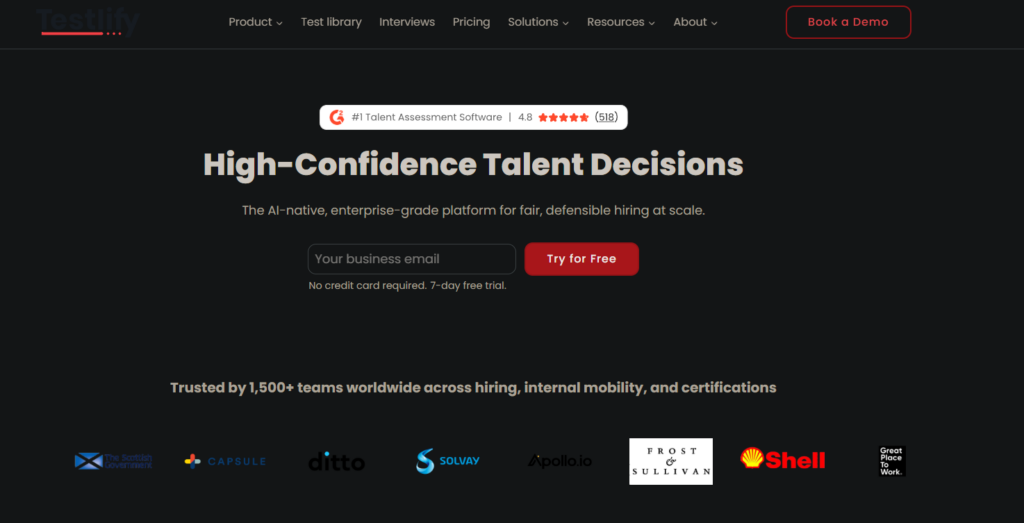
Testlify is a leading interviewing and skills assessment platform that features conversational AI interviews and 3,500+ role-specific tests available in 15+ languages, enabling companies to hire confidently across global talent markets.
The platform empowers HR teams to design conversational AI interviews across chat, voice, and video formats that mirror real workplace interactions, such as resolving customer complaints or dealing with a workplace conflict.
This approach directly addresses one of the biggest problems in hiring today: the gap between what candidates say they can do and what they can actually perform on the job. By simulating real job scenarios, the platform tests how candidates actually think, communicate, and solve problems on the job, leading to more reliable hiring decisions.
Beyond conversational AI interviews, Testlify offers:
- 3,500+ role-specifc tests across 4,500+ job roles in 50+ industries
- Psychometric tests to assess candidates’ mindset and cultural fit
- 15+ custom question types, including MCQs, custom coding questions, file upload questions, and more
- Advanced anti-cheating features such as dual camera proctoring, AI assistance detection, and more.
- 100+ ATS integrations for seamless workflow automation
- Benchmarking analytics and AI-generated performance overviews
How does Testlify work?
Testlify is designed to help recruiters evaluate candidates’ skills and ascertain their true potential. Here is how the platform works:
1. Create tailored AI interviews
Testlify enables hiring teams to design customized interviews for any role. Recruiters can select from an extensive library of role-based templates or build their own conversational interview flows from scratch.
In addition, recruiters can build comprehensive assessments by choosing from a library of 3,500+ role-specific tests or using AI to generate custom questions instantly.
2. Send candidate invitations
Once the interview or assessment is configured, recruiters can invite candidates through automated email links. Candidates can access the assessment instantly without creating an account, reducing friction and improving completion rates.
Automated reminders and follow-ups ensure that candidates complete interviews on time. This significantly reduces manual coordination and administrative overhead for HR teams while maintaining a smooth candidate experience.
3. Built-in anti-cheating and proctoring measures
To preserve assessment integrity, Testlify incorporates advanced proctoring and anti-cheating capabilities directly into the platform. These include dual webcam proctoring, screen recording, AI assistance detection, location tracking, copy-paste monitoring, and activity logs.
These safeguards ensure that assessments reflect genuine skill and individual performance, even in remote hiring environments.
4. AI-powered evaluation and behavioral analysis
Testlify uses artificial intelligence to analyze candidate responses across all interview formats. The system evaluates:
- Answer relevance and accuracy
- Communication clarity and tone
- Verbal and non-verbal cues
- Confidence and emotional intelligence
- Behavioral patterns
Video and voice interviews are analyzed alongside written responses, allowing recruiters to gain a well-rounded understanding of each candidate’s strengths and potential. Recruiters can also manually review recordings and reports for additional validation.
5. Reporting and analytics
The platform automatically scores interviews and assessments using AI. Recruiters then automatically receive detailed reports that break down performance by skill area, question type, and overall competency level.
Benchmarking insights and performance summaries help HR teams compare candidates objectively and identify top performers with confidence.
6. Integration with applicant tracking systems
Testlify integrates with more than 100 applicant tracking systems and HR tools, enabling seamless data synchronization throughout the hiring lifecycle.
Candidate profiles, assessment results, and interview reports are automatically updated within existing recruitment systems. This streamlines collaboration between recruiters and hiring managers while eliminating manual data entry.
7. Data compliance and security
Testlify is GDPR compliant and designed with enterprise-grade security standards. The platform includes advanced administrative controls, strong security integrations, structured data governance, and regular compliance audits.
Security and privacy measures are backed by SOC 2 Type II, AICPA, and ISO 27001 certifications, ensuring that candidate data is protected at every stage of the hiring process.

What is InCruiter?
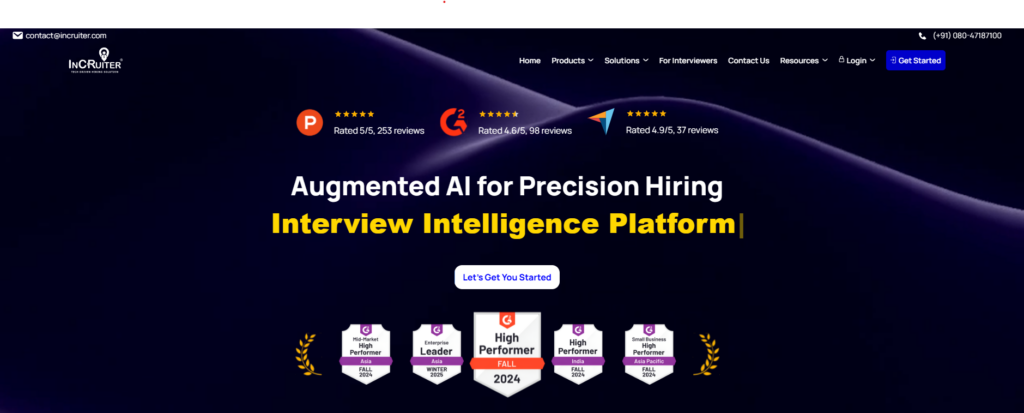
InCruiter is an AI-powered interview platform that helps organizations automate and manage candidate screening using conversational AI interviews, live video interviews, and advanced proctoring tools. It also offers an Interview as a Service model, enabling companies to leverage a network of expert interviewers to conduct technical and non-technical interviews at scale.
InCruiter approaches hiring with a hybrid model that combines AI interview software with human-led interview services.
Its product suite includes:
- Conversational AI interviewer (IncBot) that conducts live AI-driven interviews
- Interview as a Service (IncServe) supported by a network of 4,500+ expert interviewers across 250+ technologies
- AI-powered phone screening via IncScreen
- Video interview software with AI-generated questions and behavioral tracking
- Proctoring tools, including eye tracking, tab switch alerts, and multi-face detection via InProctor
How InCruiter works
InCruiter follows a structured, AI-driven interview workflow, and here is how the platform works for recruiters
1. Create a position
Begin by entering the job title, required skills, and experience level. You can upload an existing job description or use AI to generate one, along with suggested mandatory and optional skills.
2. Set up the interview
Choose the relevant position, select the interview format, and configure screening questions. Recruiters can manually add questions or leverage AI to generate role-specific, competency-based prompts.
3. Send interview invites
Invite candidates through secure private or public links, either individually or in bulk. Automated notifications help streamline coordination and reduce manual follow-ups.
4. AI conducts live interviews
The conversational AI interviewer engages candidates in real time, asks structured and follow-up questions, analyzes responses, and adapts dynamically based on answers.
5. Receive detailed feedback reports
After completion, the platform generates structured feedback reports that include interview transcripts, skill-based scoring, identified strengths and weaknesses, and an overall hiring recommendation.
Testlify vs InCruiter: Side-by-side comparison
Evaluation area | Testlify | InCruiter |
|---|---|---|
Core positioning | AI native skills assessment and conversational AI interviewing platform built for scalable hiring | Hybrid AI interview software with Interview as a Service and technical interview support |
Conversational AI interview formats | Chat AI, Voice AI, and Video AI | AI live video interviews and AI phone screening |
Interview approach | Conversational AI interviews paired with role-specific tests to assess candidate skills accurately | AI conducts interviews, captures transcripts, and generates detailed performance feedback for each candidate |
Evaluation intelligence | AI scoring based on answer relevance, verbal cues, behavioral insights, weighted scoring, with recruiter override options | Skill scores, transcript-based reports, real-time interviewer feedback |
Benchmarking analytics | Industry and role-based benchmarking analytics | Detailed session reports and proctoring summaries |
Test library size | 3,500+ tests across 4,500+ roles in 50+ industries | Coding assessments and technical interview focus |
Assessment types | Role-specific tests | Coding compiler |
Proctoring and anti-cheating | Dual camera proctoring, AI assistance detection, screen recording, focus guard, IP tracking | Eye tracking, multi-face detection, tab switch alerts, device screenshots |
ATS integrations | 100+ ATS integrations | External ATS support and built-in ATS |
Scheduling tools | Automated invites and reminders | Calendar integration with Google Meet and Microsoft Teams |
Reporting and exports | AI overviews, detailed analytics, exportable reports in CSV and PDF formats | Structured feedback reports, transcripts, and proctoring summary reports |
Compliance | GDPR, SOC 2 Type II, AICPA, ISO 27001 | ISO 27001, GDPR, SOC2 |
Pricing transparency | Clearly defined tiered pricing with per-credit cost visibility | Pricing not specified in documentation |
Scalability model | AI-driven evaluation that scales without adding interviewers | Hybrid model scaling through AI tools and human interview panels |
Now we will compare Testlify and InCruiter in detail across areas such as conversational AI interviews, assessment depth, integrations, reporting intelligence, and pricing structure to help HR teams determine which platform best suits their hiring needs.
Testlify vs InCruiter: Conversational AI interviews
If conversational AI represents the future of hiring, then the sophistication of that AI determines whether an organization is simply automating interviews or fundamentally transforming talent evaluation.
When comparing Testlify and InCruiter, the distinction is not about the presence of conversational AI. It is about the depth of intelligence, contextual understanding, and structured competency mapping.
Built for real job simulation
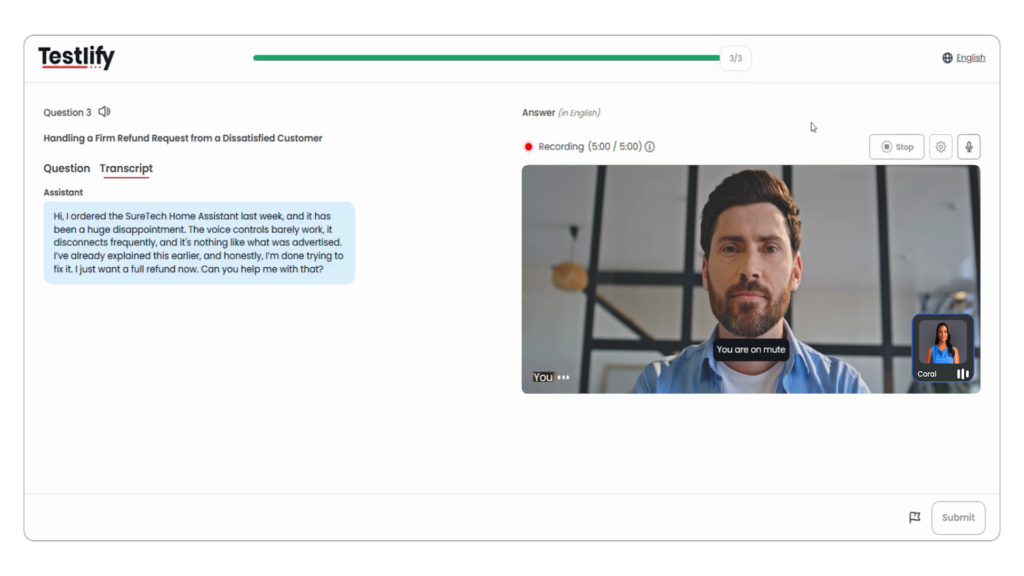
Testlify is designed as a conversational AI-first hiring platform. Its interviews span chat, voice, and video formats and are structured to simulate real workplace situations instead of replicating traditional interview scripts.
Candidates engage in role-play scenarios such as handling objections, resolving workplace conflicts, or responding to customer challenges. The AI evaluates:
- Contextual relevance of responses
- Communication clarity and structure
- Tone and confidence
- Emotional intelligence and behavioral signals
This approach elevates hiring from question answering to performance demonstration. The system then interprets responses within structured competency frameworks aligned to job performance.
InCruiter’s conversational AI conducts live interviews and generates transcripts with feedback reports. Similarly, the platform’s AI recruiter can assess candidate responses and probe with follow-up questions.
While this provides strong automation capabilities, the focus leans toward structured Q&A and interview workflow efficiency rather than deep behavioral modeling.
Key takeaway: Testlify prioritizes contextual simulation and behavioral interpretation, whereas InCruiter primarily focuses on AI-assisted interview execution.
Evaluation intelligence beyond transcripts
Testlify’s scoring engine analyzes both what candidates say and how they communicate it. It provides:
- Instant AI scoring based on answer relevance and verbal cues
- Behavioral and emotional intelligence insights
- Weighted scoring aligned to critical competencies
- Manual override options for recruiter validation
- Benchmarking analytics to compare candidates objectively
This hybrid AI and recruiter-controlled model ensures structured consistency while maintaining oversight. The outcome is not merely a feedback report. It is a competency profile that supports objective hiring decisions.
InCruiter generates structured feedback reports with skill scores, and recommendationsand supports real-time interviewer feedback during interview sessions. The platform also features transcription capabilities that allow recruiters to convert spoken responses into structured text for review
However, its evaluation framework emphasizes reporting and documentation rather than advanced behavioral benchmarking.
Key takeaway: Testlify converts conversational data into benchmark-driven intelligence. InCruiter digitizes interview workflows but places less emphasis on structured competency mapping.
Maintaining interview integrity in the age of generative AI
As generative AI tools become widely accessible, protecting interview integrity has become a critical priority for recruiters and talent leaders. With candidates now able to use LLM platforms such as ChatGPT to generate answers in real time and even simulate expertise, traditional interview formats are increasingly vulnerable to manipulation.
To address these emerging risks and ensure every assessment reflects genuine ability, Testlify integrates advanced proctoring and anti-cheating capabilities, including:
- Face detection
- Photo id verification
- Webcam snapshots
- Full-screen mode
- Force full-screen mode
- Dual camera proctoring
- Copy/paste tracking
- Mouse-out tracking
- IP proctoring
- Live video monitoring
- Question randomization
- Honesty Agreements
- Question-level activity logs
- AI assistance detection
- Screen recording
- Live environment check
- System requirement check
- Enforce internet speed check
- Focus guard (Anti-Cheat Mode)
- Talking prohibition
The inclusion of AI-assisted detection positions Testlify as future-ready for remote hiring environments where candidates may rely on external tools.
InCruiter provides strong monitoring features such as eye movement tracking, multi-face detection, tab switch alerts, and device screenshots. However, the absence of explicit AI assistance detection may become increasingly relevant as candidates leverage generative tools during interviews.
Key takeaway: Testlify’s built-in AI assistance detection, combined with its comprehensive proctoring controls, gives recruiters greater confidence that they are evaluating real skills, making it a more desired choice than InCruiter.
Testlify vs InCruiter: Test library and assessment coverage
While conversational AI defines the interview experience, the breadth and depth of a platform’s assessment library determine how comprehensively HR teams can evaluate talent across roles, industries, and hiring stages.
This is where the structural advantage of Testlify becomes particularly clear when compared to InCruiter.
Assessment volume and role coverage
Testlify offers more than 3,500 assessments mapped to over 4,500 job roles across 50 plus industries. This allows HR teams to move beyond ad hoc interview questions and deploy standardized skill evaluations across technical, non-technical, and blue-collar roles.
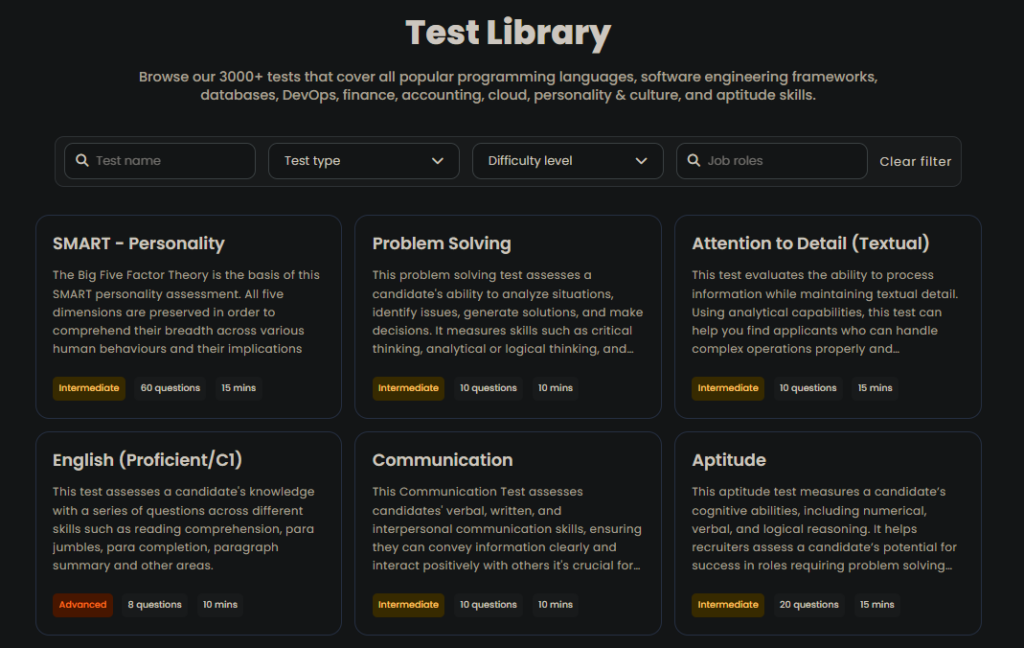
The breadth of coverage means organizations can:
- Maintain consistency across global hiring programs
- Evaluate both hard and soft skills within a single platform
- Scale assessments across departments without building tests from scratch
Testlify supports a wide spectrum of assessment types, including
- Cognitive ability tests (e.g., problem-solving, logical reasoning, attention to detail)
- Role-specific tests (e.g., tailored assessments for various job roles)
- Blue-collar hiring tests (e.g., practical skill assessments for blue-collar roles)
- Programming tests (e.g., coding, algorithm design, technical proficiency)
- Software skills tests (e.g., Microsoft Office, CRM systems, other software tools)
- Psychometric tests (e.g., personality traits, emotional intelligence, behavioral tendencies)
- Situational judgment tests (e.g., decision-making, conflict resolution, judgment in real-life situations)
- Live coding tests (e.g., real-time coding challenges and assessments)
- Typing tests (e.g., speed, accuracy, data entry proficiency)
- Language tests (e.g., proficiency in speaking and writing specific languages)
In addition, the platform supports more than 15 custom question types, including AI-powered chat, video, and audio interviews, open-ended questions, file uploads, coding challenges, and structured scoring mechanisms
This flexibility allows HR teams to build layered assessments that combine technical proficiency, behavioral evaluation, and cognitive ability within a single workflow.
InCruiter integrates a code compiler within video interviews and supports AI-generated role-specific questions. Its strength lies in technical interview execution and proctored coding environments. However, the platform’s documentation emphasizes interview execution and monitoring capabilities and does not feature a test library covering multiple roles and indsutries.
Strategic insight: Testlify offers significantly broader role-based assessment coverage, making it better suited for organizations hiring across diverse functions rather than only technical pipelines.
Structured benchmarking
Testlify includes benchmarking analytics that allow organizations to compare candidates against industry-level performance standards. Recruiters can assign weighted scoring to prioritize critical competencies and adjust scores when necessary.
This ensures that hiring decisions are anchored in measurable performance indicators rather than isolated interview impressions.
InCruiter generates detailed feedback reports and proctoring summaries. These provide structured documentation of candidate performance. However, the platform does not highlight industry-level benchmarking or competency-weighted scoring frameworks at the same depth.
Key takeaway: InCruiter is well-suited for technical interviews and proctored assessments. However, for organizations that want a unified platform to evaluate cognitive abilities, behavioral traits, and technical skills consistently, Testlify is the stronger choice.
Testlify vs InCruiter: ATS integrations
For HR leaders, even the most advanced AI interview technology must answer a practical question: How easily does it integrate into existing hiring workflows, and how effectively can it scale without increasing operational complexity?
When evaluating Testlify and InCruiter, the distinction becomes clear in how each platform approaches automation, integration, and long-term hiring infrastructure.
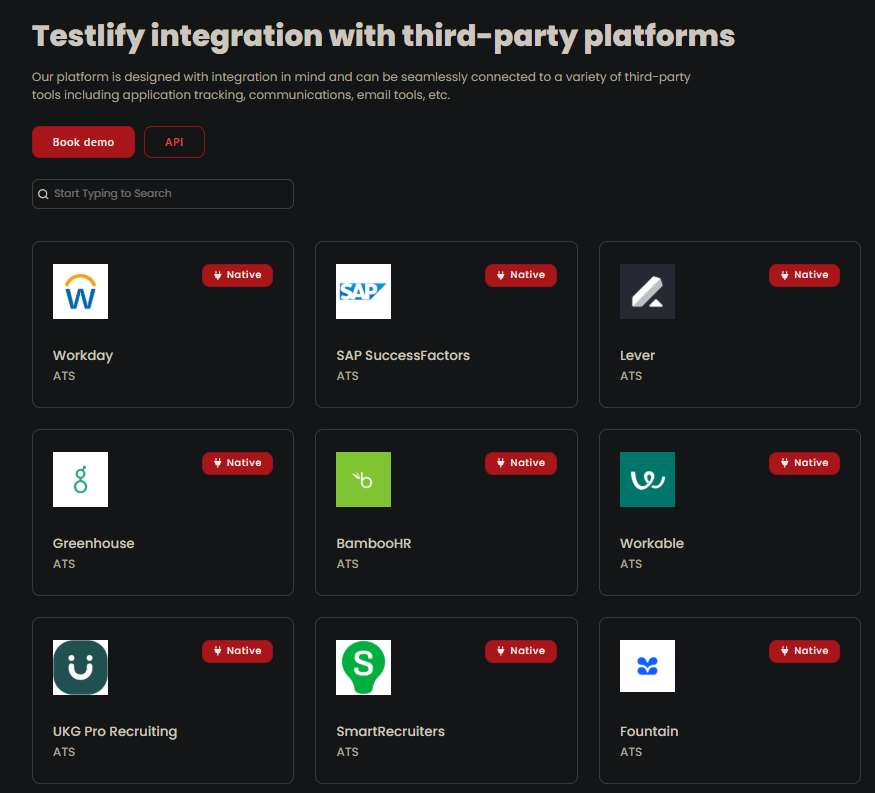
Testlify integrates with more than 100 applicant tracking systems and HR tools. This level of compatibility allows HR teams to:
- Sync candidate profiles and assessment results automatically
- Eliminate manual data entry between systems
- Maintain centralized hiring records
- Enable collaboration between recruiters and hiring managers within existing workflows
For enterprise environments where multiple stakeholders rely on ATS-driven processes, this integration depth ensures that AI interviews and assessments function as a seamless extension of the current hiring stack rather than a disconnected tool.
InCruiter offers integrations with external ATS platforms alongside its own built in ATS, while also enabling interview scheduling through Google Meet and Microsoft Teams integrations.
These platform supports interview coordination and scheduling efficiency. However, the emphasis appears stronger on interview execution management rather than deep ecosystem integration across large ATS networks.
Key takeaway: For HR leaders prioritizing scalability and operational efficiency, Testlify offers deeper ATS ecosystem integration that embeds seamlessly into existing hiring workflows, whereas InCruiter is more focused on interview execution and coordination.
Testlify vs InCruiter: Reporting and analytics
Hiring decisions should be driven by structured intelligence, not isolated impressions. The depth of reporting and benchmarking capabilities directly impacts hiring accuracy.
Testlify approaches reporting not as an afterthought, but as a decision intelligence layer designed to turn interview and assessment data into structured hiring insights. The platform provides:
- Instant AI-based scoring across conversational AI interviews and skill tests
- Behavioral and emotional intelligence insights
- Benchmarking analytics to compare candidates across roles and industries
- AI generated performance overviews
- Exportable reports in PDF and CSV formats for stakeholder review
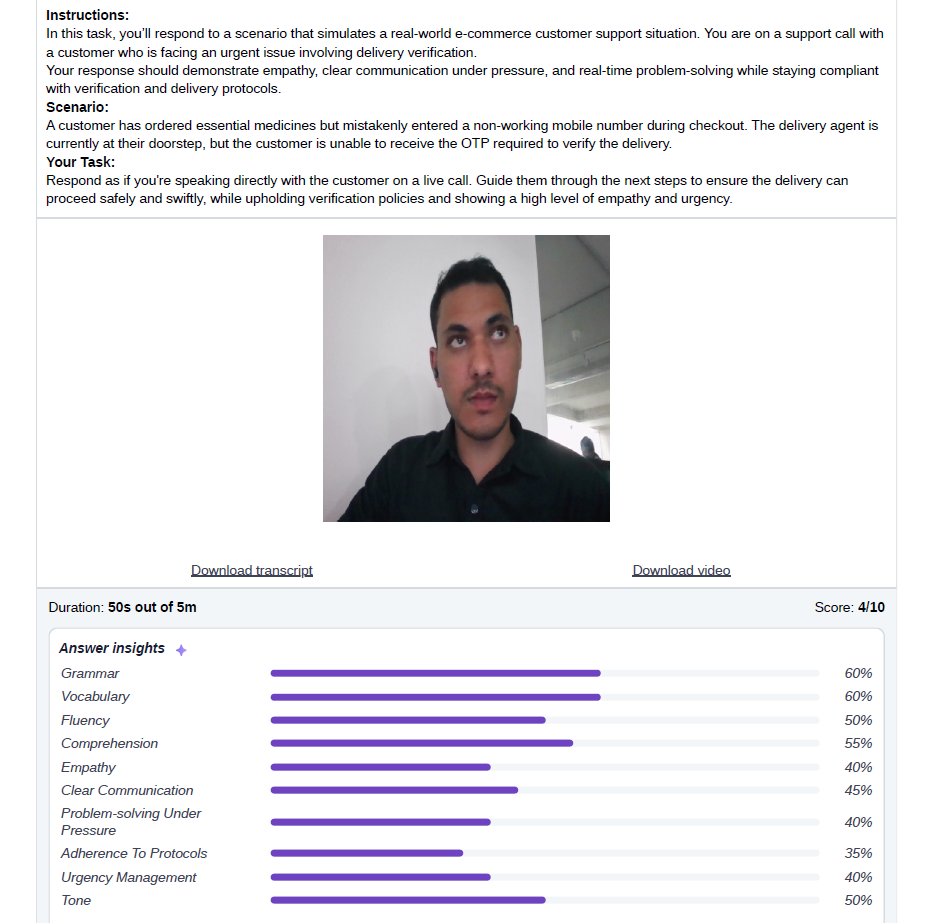
The inclusion of benchmarking analytics is particularly important for HR leaders seeking objective comparison standards across departments or hiring cycles.
InCruiter generates detailed feedback reports with transcripts, strengths, weaknesses, and recommendations. It also provides proctoring summaries and behavioral tracking data during video interviews
These reports offer clear documentation of candidate performance. However, the platform emphasizes session reporting and monitoring insights rather than structured benchmarking intelligence across roles and industries.
Key takeaway: Testlify delivers stronger data aggregation and comparative analytics capabilities for long-term workforce planning.
Testlify vs InCruiter: Pricing and scalability
Pricing transparency and scalability are critical for HR leaders evaluating long-term hiring infrastructure. Beyond features, the cost structure determines how predictably a platform can scale with hiring demand.
Here is how Testlify and InCruiter compare based on the documented information.
Testlify pricing structure
Testlify offers flexible pricing plans that scale with your business, providing everything from basic assessments for startups to advanced features for enterprise-level hiring.
- Starter plan: Ideal for small teams and startups, this plan starts at $198/monthnth (billed at $1,663/year) and includes 100 candidate credits at $17 per credit with support for 3 users.
- Starter: Designed for growing businesses, the Starter starts at $279/month (billed at $3,343/year) and includes 300 credits at $11 per credit with support for 5 users.
- Starter: Built for scaling teams, this plan costs $699/month (billed at $4,192/year) and includes 1,000 credits at $8 per credit with 10 users.
- Premium plan: Suited for high-growth organizations, the Premium plan includes 3,000 credits and supports 20 users, with pricing available upon contacting the sales team.
- Enterprise plan: Designed for large enterprises, this plan includes 10,000 credits and supports 30 users with pricing available upon contacting the sales team.
- Enterprise Plus plan: Designed for large-scale hiring programs, this plan includes 25,000 credits and supports up to 40 users, with pricing details available upon contacting the sales team.
- Unlimited plan: For companies seeking unrestricted access, Testlify offers an unlimited plan that includes unlimited candidate credits and full platform functionality, with pricing available on request from the sales team.
Several strategic advantages emerge from this structure:
- Clear cost per candidate visibility
- Gradual reduction in per-credit cost as volume increases
- Defined user limits aligned with team size
- Scalability from startup hiring to enterprise programs
- Budget forecasting without dependency on negotiated service contracts
InCruiter pricing structure
Based on the available information, specific pricing tiers, per candidate costs, or structured subscription plans are not detailed on the InCruiter’s website.
Given that InCruiter operates a hybrid model that includes a network of more than 4,500 expert interviewers, pricing is likely customized depending on:
- Interview volume
- Technical specialization requirements
- Service level agreements
- Scope of Interview as a Service engagement
While customized pricing can accommodate complex hiring scenarios, it introduces less upfront visibility into cost per hire modeling and long-term scaling economics.
Final thoughts
For HR teams thinking strategically about long-term hiring, the best interviewing platforms go beyond feature lists. It comes down to these key questions:
- Which platform truly replicates on-the-job performance using conversational AI?
- Which delivers deeper behavioral intelligence rather than surface-level transcripts?
- Which provides broader assessment coverage across diverse roles and industries?
- Which integrates seamlessly into enterprise hiring workflows without increasing operational overhead?
If your goal is to hire based on real skills, reduce unconscious bias, and build a structured hiring system that scales, Testlify is the stronger interviewing platform.
Its conversational AI interviews simulate real job situations and ensure candidates are assessed on demonstrated skills. The platform further strengthens hiring accuracy with more than 3,500 role-specific tests, benchmarking analytics, and advanced anti-cheating safeguards.
Book a demo with Testlify today to discover how our platform can drive up to 6x better hiring decisions and stronger business outcomes.
Frequently asked questions (FAQs)

Related resources
View all
Video Interviewing Tools Comparison
Testlify vs Spark Hire: Skills Tests or Video Interviews
Video Interviewing Tools Comparison
Testlify vs VidCruiter: Which Wins for Skills-Based Hiring?
Video Interviewing Tools Comparison
Testlify vs Alex AI: Which AI Interviewing Platform Is Best?
Video Interviewing Tools Comparison
Testlify vs Jobma: Which interviewing platform is best for recruiters in 2026
Video Interviewing Tools Comparison
Testlify vs Talently.ai: Detailed Comparison
Video Interviewing Tools Comparison
Testlify vs VeloxHire: Which AI interviewing platform is best for recruiters?
Get started.
Hire on proof, not resumes.
Run your first skills-based assessment free — no credit card required.