
Testlify vs Hyring: Detailed in-depth comparison guide
Compare Testlify vs Hyring to find the best AI interviewing platform for your recruitment needs
Short answer first. Pick Testlify if you hire for more than one kind of role and need to measure what a candidate can actually do, not just how well they talk about it. Pick Hyring if the only job to be done is replacing screening calls with automated AI interviews, where its free tier makes the experiment cheap.
Both platforms sell the same headline: an AI that interviews candidates so your team stops burning hours on first-round calls. They get there very differently, and the gap shows up in what you pay, what you can prove afterwards, and how hard it is to fake your way through.
The pressure to automate is real. SHRM's 2025 Talent Trends research found that 43% of organizations now use AI in HR, up from 26% a year earlier, with recruiting the most common place it lands. But a tool that records answers and never measures a skill leaves a widening hole, because the World Economic Forum puts 39% of core job skills on track to change by 2030. Interviewing faster does not help if you are still guessing at ability.
 ChatGPT
 Gemini
 Claude
 Grok
Grok Perplexity
TL;DR: Testlify vs Hyring at a glance
- Best for interview-only automation: Hyring. Two-way live AI interviews, a free tier with 50 credits a month, and paid plans from $79/month.
- Best for mixed hiring: Testlify. AI interviews plus 3,500+ skills tests across 4500+ job roles, so the interview is one signal among several.
- Cheapest per interview: Hyring, clearly. One credit buys one AI video interview, and a Hyring resume screen costs a quarter of a credit.
- Strongest integrity controls: Testlify. Dual-device proctoring turns the candidate's phone into a second camera, which is the one check a second screen cannot dodge.
- Watch the add-ons on both sides: Testlify sells white labeling and its 100+ ATS integrations at $2,388/year each on self-serve plans. Hyring holds white labeling and SSO for Enterprise.
- Honest overlap: if you only ever run one interview round for one role type, the broader platform is money you do not need to spend.

What does each platform actually do?
Testlify is a pre-hire assessment and interviewing platform. Skills tests, coding work, cognitive and personality assessments, one-way and two-way AI interviews, proctoring, reviewer scoring and reference checks sit in one product, and it also ships a simple built-in hiring pipeline (job requisitions, an application form, job-board publishing) for teams that have no applicant tracking system yet. Teams that already run one keep it as the system of record and plug Testlify in as the screening layer.
Hyring is an AI-native recruiting suite built around the interview itself. Six products carry the load: an AI video interviewer, an AI coding interviewer, an AI phone screener, an AI resume screener, an English proficiency test, and Hyring Meet for live calls with an AI copilot taking notes and scoring in real time. It also runs a jobseeker side and a recruiter-partner marketplace, which is unusual and tells you who the product is built around.
So the split is not subtle. Hyring turns interviews into a scored, searchable funnel. Testlify turns the whole screening stage into evidence, of which the interview is one piece.
How do the AI interviews compare?
Both run interviews without a human present, score them, and hand back a report. Testlify gives you more knobs on how the interview behaves. Hyring gives you a faster path from job post to first scored interview.
Testlify AI interviews
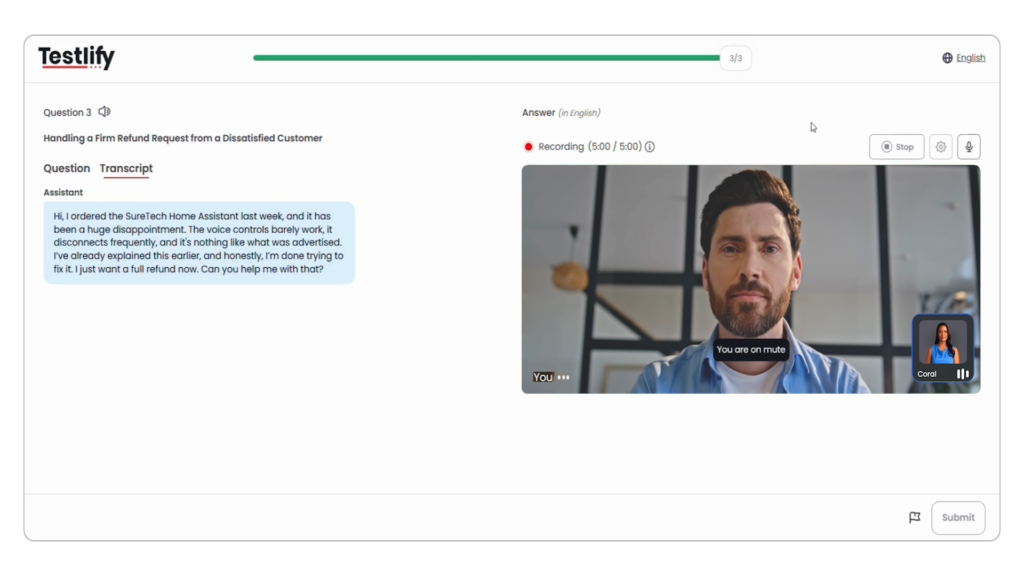
Testlify runs four interview formats: one-way asynchronous video, two-way conversational AI video, voice and audio questions, and outbound AI phone interviews billed at $0.18 per minute. During a live voice interview the candidate is muted while the AI speaks, which is a small detail that tells you it is genuine turn-taking rather than a recording with pauses.
The configuration is where it earns its keep:
- Interviewer setup: pick the AI avatar, the AI voice, a persona and the context it works from, then write custom prompts or start from one of 150+ interview templates.
- Recording controls: set the number of attempts (including no limit), recording time, completion time, preparation time before recording auto-starts, and the recording language. Video responses cap at five minutes each.
- Retakes are honest: a reattempt deletes the previous take rather than quietly keeping both.
- Transcripts: generated automatically, with the spoken language auto-detected, for any recording of at least 30 seconds.
- Review tools: view or download the video and audio, download the transcript, replay the screen, and regenerate the interview report.
Voice-led screening gets its own treatment for volume roles, and the audio interview format for call center hiring is the clearest example of it working at scale.
One boundary worth stating plainly: Testlify does not schedule live human interview panels. If you need calendar coordination for a four-person loop, that is a different tool. And the Chat AI question type shows in the product as coming soon, so treat chat-based interviewing as not yet available.
Hyring AI interviews
Hyring runs one-way async interviews and two-way live ones. In its own words, the two-way interviewer asks the next question based on the candidate's actual answer, not a fixed script, which is the same adaptive behavior Testlify's conversational format uses.
Three things stand out. You can present the interview as a voice-only agent, a ready-made digital avatar, or an AI Twin built from your own photo and voice, which is a genuinely different idea and a nice touch for an agency putting its own recruiter's face on the screen. It supports 11 interview languages: English, Spanish, German, Hindi, Korean, Mandarin Chinese, Portuguese, French, Japanese, Russian and Polish. And every interview returns an overall score, skill ratings, a fit level and a transcript, scored against criteria you weight yourself.
The limit is scope. The interview is the assessment. There is no separate test the candidate sits, so the evidence you end up with is what someone said in a conversation, however well scored.
Verdict
For interview mechanics alone, this is close, and the AI Twin gives Hyring a real edge on employer branding at the low end. Testlify pulls ahead on control: per-question timing, attempt limits, prep time, persona and prompt authoring, and the ability to place that interview inside a longer evaluation instead of making it the whole thing.
Which platform measures skills, not just answers?
This is the fork in the road, and it decides most purchases here. Employers have already moved this way, too. In NACE's Job Outlook 2026 survey, 70% of employers reported using skills-based hiring, up from 65% the year before, and they apply it most heavily at the interview stage (87%). Skills-based hiring at the interview stage means the interview is testing something specific, which is exactly what a question bank and a scoring rubric give you.
Testlify test library and question types
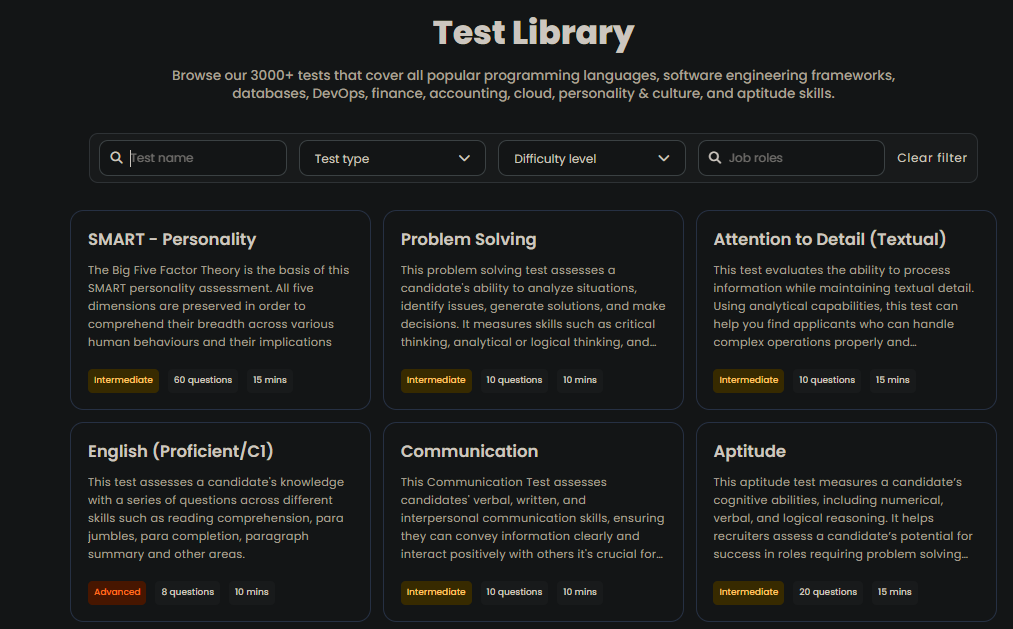
Testlify ships 3,500+ tests across blue collar, coding, cognitive ability, engineering, language, personality and culture, programming, psychometric, role-specific, situational judgement, software skills, simulation and gamified categories, each at three difficulty levels.
The question types are where the range shows. More than 25 of them, including single and multiple select, ranking, fill in the blank with dropdown blanks, file upload, practical hands-on submissions, typing tests scored on 60% accuracy and 40% speed by default, and live coding assessments in an embedded VS Code editor with up to 20 test cases, hidden or visible, including SQLite database cases. Office-app questions run inside the real products: Google Docs, Sheets and Slides, Microsoft Word, Excel and PowerPoint.
Two features are unusual enough to name. Vibe coding lets candidates direct AI tools to reach a working solution instead of writing every line by hand, which is how a lot of engineering work now actually happens. And item-level psychometrics (difficulty index, discrimination index, a quality-risk flag for questions with very low accuracy or high skip rates) are surfaced to recruiters, not buried in a research team's dashboard. That is test-publisher territory, and it is how you find out that your "hard" question is really just a badly worded one.
What Hyring tests
Hyring's testing is inside the interview, with two exceptions that matter. The AI coding interviewer runs proctored coding sessions in a real executable IDE across 20 languages and returns a benchmarked report on code quality and problem-solving, which is a serious technical screen. And the English proficiency test scores against CEFR levels, which is a genuine, standards-based measure and useful for support, sales and BPO hiring.
Outside those, there is no library of validated role tests. For a sales, finance, operations or administrative role, the evidence is the conversation plus whatever the resume screener extracted. That is the gap tests built for a specific job are meant to fill.
Verdict
Testlify wins this on breadth, and it is not close. The reason it matters is the same reason the World Economic Forum found 63% of employers naming skills gaps as their biggest barrier to transformation: you cannot close a gap you never measured. Hyring's coding interviewer and CEFR test are strong where they apply. They just do not cover the roles most teams fill.
This is the thinking behind the Testlify Multi-Signal Talent Evaluation Model: combine several role-relevant signals, such as assessments, interviews, simulations, references and reviewer feedback, rather than advancing someone on one strong showing. One signal is fragile. A candidate who interviews beautifully and cannot do the work is the most expensive mistake in hiring, and one interview, however well scored, is one signal.
How do they stop AI-assisted cheating?
Ask any recruiter running remote screens what changed in the last two years and this is it. A candidate can now run a second screen with an answer assistant listening to the interview and feeding lines in real time. Some of these tools market themselves on being undetectable.
Candidates are not comfortable with the arms race either. Gartner found that just 26% of job applicants trust AI to evaluate them fairly. Heavy-handed monitoring on top of an AI interviewer is a good way to lose the candidates you wanted.
Testlify integrity controls
Testlify sells three presets: Standard for balanced flexibility, Strict for maximum security with enforced controls, and Custom.
Identity and environment
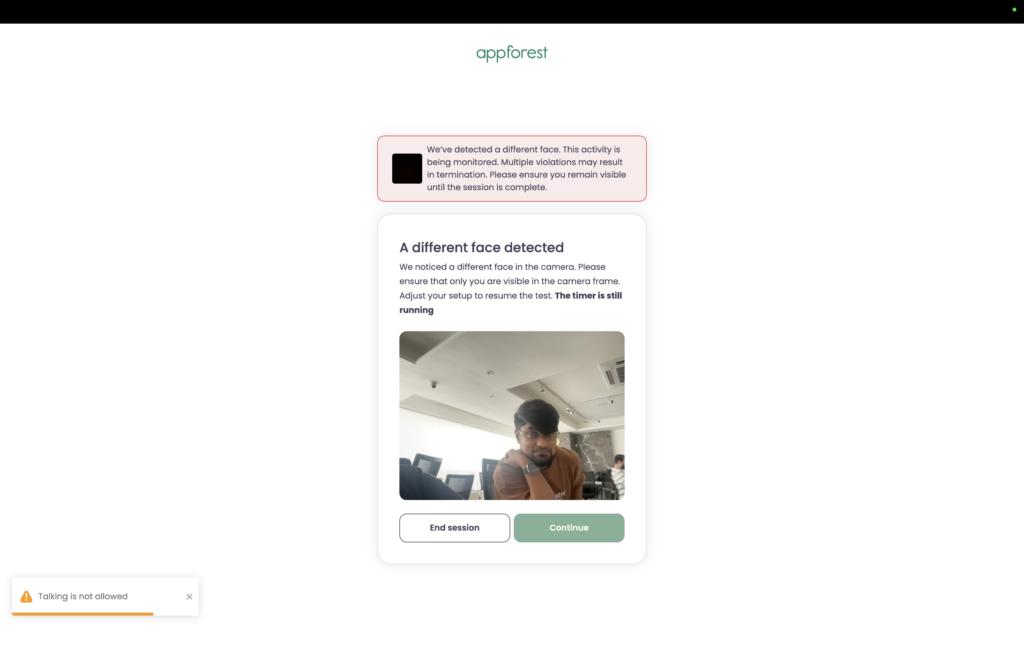
Photo ID verification with a face match against the ID, face detection and single-presence checks, multiple-face and different-person detection, periodic webcam snapshots at an interval you set, IP proctoring, location tracking, private-invite verification and a candidate honesty agreement.
Device and activity monitoring
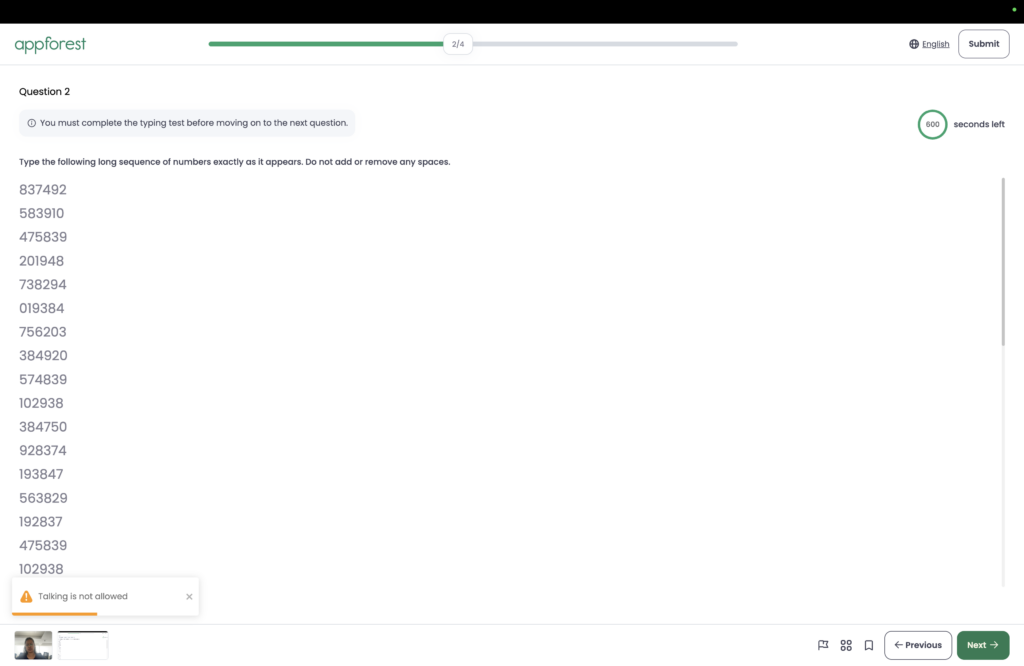
Full-screen enforcement, tab-switch detection, Focus Guard, multi-monitor restriction, browser-extension and AI-tool detection, screen and camera recording, mouse out-of-window tracking, screenshot-attempt monitoring, and per-question activity and timing logs.
The standout is dual-device proctoring. The candidate's phone becomes a second camera positioned to capture both them and their laptop screen, and it is a hard gate: the assessment will not start until mobile monitoring is active, and ending it mid-session is logged and reported. A second monitor feeding answers is invisible to a webcam pointed at a face. It is not invisible to a phone filming the desk.
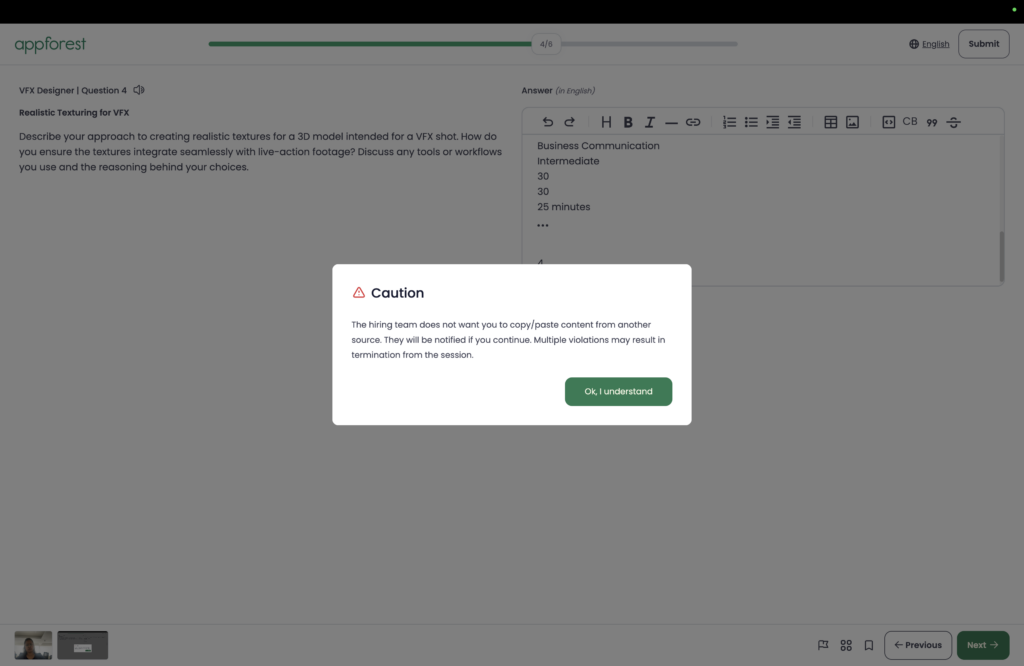
What the recruiter sees is deliberately evidence-first. A green flag means nothing suspicious was observed. Yellow means some behavior was not ideal and a quick manual review is recommended. Red means cheating was confirmed. Auto-termination exists but is opt-in with a violation threshold you set, so a flag is evidence for a human to weigh, not an automatic rejection. Face verification data is deleted after 30 days and candidates can withdraw consent, which is the part your legal reviewer will ask about.
What Hyring detects
Hyring proctors every interview and flags tab-switching and screen activity, identity and face checks, audio anomalies that suggest a second speaker, and AI-generated or plagiarized answers. Its own framing is that a passing score should reflect the candidate, not a script, a stand-in or a chatbot. For a single interview session that is a sensible set of checks, and the AI-answer detection is the right instinct.
Verdict
Hyring covers the interview well. Testlify covers the whole session, and adds the two controls that actually beat a second-screen assistant: multi-monitor restriction and dual-device proctoring. If you hire for roles where a wrong hire is expensive to unwind, that difference is the reason to pay more.
Pro tip: Before you compare detection features, decide which roles genuinely need Strict mode. Running maximum proctoring on a junior support hire costs you good candidates who find it invasive. Save the hard controls for the roles that carry money, data or safety risk, and let the rest run on the lighter preset.
What do the candidate reports tell you?
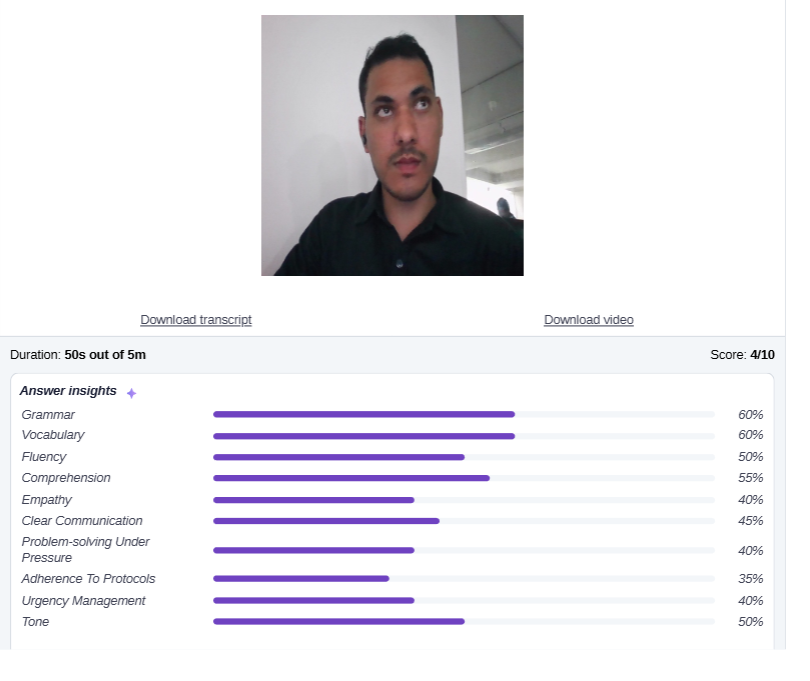
Both platforms return a scored report. The difference is how much of the hiring decision the report can carry.
Testlify reporting
Scoring happens at three levels: question, test and overall assessment. Any question can be marked non-scorable. Tests can be weighted from x0 to x5, so a coding test can count five times what a culture questionnaire does, or you can let total score set the weighting automatically. Benchmarking gives percentile, percentile rank and candidate rank against other candidates and other reviewers.
Reports run wide: development, DISC, CEFR, cultural fit, conflict management, interview reports, compliance reports, 360 feedback, reviewer score reports and score logs, exportable as PDF, ZIP or CSV, with granular control over what a shared report shows.
The compliance story is the human-in-the-loop wiring. The product itself says AI scores and insights are for guidance only and that human judgment should make the final call. Displaying AI scores to reviewers is a toggle, and so is including the AI score in the final average, so a team can run AI scoring as advisory only. Individual questions can be routed to a named human for manual review. If your legal team is watching NYC Local Law 144 or the EU AI Act, that configuration is the evidence they will want.
Hyring reporting
Hyring returns an overall score, skill ratings, a fit level, a transcript and an evidence-backed report on every interview, with communication and skill ratings, sentiment analysis on the Business plan, and coding performance analysis from the coding interviewer. Fit Score Weightage lets you decide which criteria carry weight. Data retention runs up to 90 days on Business.
Verdict
For interview evidence, Hyring's reporting is clean and enough. Testlify's reporting spans more of the funnel and holds the controls that make an AI-assisted decision defensible later. Structured evidence is also what the research keeps rewarding: the largest modern reanalysis of selection-method validity still places structured interviews among the strongest predictors of job performance, well ahead of years of education or general experience. Structure is the active ingredient, in both products.
Testlify vs Hyring pricing: what you pay
Both sell credits. A credit means something different on each side, which is why per-interview comparisons mislead.
Testlify pricing
On annual billing, Testlify plans run:
- Starter: $139/month, billed $1,668/year, 100 credits, 3 seats, $16.68 per credit.
- Basic: $279/month, billed $3,348/year, 300 credits, 5 seats, $11.16 per credit.
- Business: $699/month, billed $8,388/year, 1,000 credits, 10 seats, $8.39 per credit.
- Premium, Enterprise and Custom: 3,000, 10,000 and 25,000+ credits, priced by sales, with 20, 30 and 40 seats.
Monthly billing is a different ladder for the same names: Starter $198 for 10 credits, Basic $398 for 30, Business $998 for 100. One credit covers one started assessment by a qualified candidate, credits do not roll over, and extra seats are $15 each per month. There is a 7-day free trial with no card, a 30-day money-back guarantee, and pricing locked for 24 months.
Read the add-on line before you budget. Branding the candidate experience as your own and the 100+ ATS integrations are $2,388/year each on the self-serve tiers, included only on Custom, alongside SAML SSO and 2FA. Metered items sit on top: AI phone interviews at $0.18 per minute, face verification at $0.50 per attempt.
Hyring pricing
Hyring's ladder is shorter and starts at zero:
- Free: $0, 50 credits a month, 1 seat, 1 active job post, one-way and two-way interviews, English only with one AI voice.
- Pro: $79/month, 50 credits a month, 5 seats, 10 active job posts, AI avatar with 11 languages, integrity checks, core ATS integrations.
- Business: $239/month, 50 credits a month, 15 seats, unlimited job posts, AI Twin, sentiment analysis, 90-day retention, 45-minute interviews, all 24 ATS integrations and API.
- Enterprise: custom, 10,000+ credits, white-label branding, SSO, data residency.
A credit buys one AI video interview, one coding interview, one English test or one Hyring Meet session. A phone screening costs half a credit and a resume screen a quarter, so the top of the funnel is cheap. Extra credits run $1.00 to $4.00 depending on volume.
Verdict
Work an example. A team screening 300 candidates a year with one AI interview each spends 300 credits. On Hyring Pro that fits inside the included 600 credits a year, so the bill is $948. On Testlify Basic, 300 credits costs $3,348, because a Testlify credit buys a full assessment (tests, interview, proctoring, reports) rather than one conversation.
Hyring is cheaper. Say it plainly. The question is what the gap buys. If those 300 candidates need a skills test as well, the interview-only tool sends you shopping for a second platform, a second contract and a second set of reports to reconcile by hand. If they do not, the cheaper tool is the right answer and nobody should talk you out of it. One more line to check on both sides: Hyring bundles 24 ATS integrations into a $239/month plan, while Testlify prices its 100+ integrations as a $2,388/year add-on until you reach Custom. On integrations alone, Hyring is the better deal at the low end.
Which platform should you pick?
Category | Testlify | Hyring |
|---|---|---|
Core positioning | Pre-hire assessment and interviewing platform | AI-native interviewing and screening suite |
Interview formats | One-way video, two-way conversational AI video, voice and audio, outbound AI phone | One-way video, two-way live video, AI phone screener, Hyring Meet |
Interviewer presentation | Selectable AI avatar, AI voice, persona, custom prompts, 150+ templates | Voice-only, ready-made avatar, or AI Twin from your photo and voice |
Languages | Auto-detected multilingual transcripts, real-time test translation | 11 interview languages |
Skills testing | 3,500+ tests | AI coding interviewer (20 languages), CEFR English test |
Psychometrics | Difficulty index, discrimination index, quality-risk flags per question | Not offered |
Proctoring | Three presets, dual-device phone camera, multi-monitor restriction, AI-tool detection, green/yellow/red evidence flags | Tab and screen activity, identity and face checks, audio anomalies, AI-generated answer detection |
Human override | AI score display and inclusion are toggles, manual review routing | Recruiter-set fit criteria and weighting |
ATS | 100+ integrations ($2,388/year add-on on self-serve, included on Custom), plus a simple built-in pipeline | Core integrations on Pro, all 24 plus API on Business |
Entry price | $139/month annual, 100 credits/year | Free tier, then $79/month with 50 credits/month |
Best fit | Mixed-role hiring where the evidence has to hold up | Interview-heavy screening at low cost |
Pick Hyring if you are an agency or a small team running high volumes of similar interviews, you want a free tier to test on real candidates this week, and the interview transcript plus a fit score is the evidence you need. The AI Twin and the 11 languages make it a strong fit for distributed screening.
Pick Testlify if you fill different kinds of roles, if someone will eventually ask why a candidate was rejected, or if you need to prove a skill rather than infer it. Teams under 200 people tend to feel this fastest, because one person owns hiring alongside another job and cannot afford to run two tools and stitch the reports together.
Ready to see it on your own roles?
Book a demo and bring a live job description. The fastest way to settle a comparison is to build the assessment you would actually send, on the role you are actually hiring for.
FAQs

Related resources
View all
Video Interviewing Tools Comparison
Testlify vs InCruiter: Which AI powered interviewing platform is best for you?
Video Interviewing Tools Comparison
Testlify vs Spark Hire: Skills Tests or Video Interviews
Video Interviewing Tools Comparison
Testlify vs VidCruiter: Which Wins for Skills-Based Hiring?
Video Interviewing Tools Comparison
Testlify vs Alex AI: Which AI Interviewing Platform Is Best?
Video Interviewing Tools Comparison
Testlify vs Jobma: Which interviewing platform is best for recruiters in 2026
Video Interviewing Tools Comparison
Testlify vs Talently.ai: Detailed Comparison
Get started.
Hire on proof, not resumes.
Run your first skills-based assessment free — no credit card required.