
30 scenario based interview questions to ask candidates
Thirty scenario questions for hiring teams, grouped by skill and role, with what strong answers include, red flags and how to score them.

A candidate can give a polished answer about last year and still freeze on day one. Scenario based interview questions fix that by placing the candidate inside a realistic work problem and asking what they would do.
Below are 30 scenario based interview questions, grouped by skill and role. Each one comes with what a strong answer includes, the red flag to listen for and a simple way to score it.
TL;DR:
- Scenario based interview questions put a candidate in a realistic job situation and ask what they would do, so you hear their judgment instead of a rehearsed story.
- Situational questions are the short, single-problem version. Behavioral questions ask about the past. Use both in one structured interview.
- Write every scenario from a real task in the job, and agree on what a strong answer sounds like before the first interview.
- Score each answer on a 1 to 5 scale with an example per level, and have each interviewer score alone before the debrief.
- A good answer clarifies the problem, protects the customer or team, acts in a sensible order and closes the loop. A red flag is blaming others or skipping straight to a fix.
- For high-volume roles, move the first round of scenarios into a situational judgment test or an AI interview and keep live time for finalists.
 ChatGPT
 Gemini
 Claude
 Grok
 Perplexity
What are scenario based interview questions?
Scenario based interview questions are hypothetical, job-specific problems that ask a candidate to explain how they would respond. A typical example is a client who emails at 6 p.m. to say tomorrow's delivery is wrong while your manager is offline.
The candidate must then explain what they would do. The answer shows judgment, priorities and communication in one go.
They suit candidates without direct experience, are hard to answer with a memorized story, and are easy to compare when every candidate gets the same scenario, the core idea of a structured interview.

How are scenario, situational and behavioral questions different?
Scenario, situational and behavioral questions differ in time frame and scope. Situational questions pose one short hypothetical problem.
Scenario questions are usually richer, with several people, constraints or steps. Behavioral questions ask about the past, and all three work well in a structured interview.
Feature | Scenario based | Situational | Behavioral |
|---|---|---|---|
Time frame | Hypothetical, future | Hypothetical, future | Real, past |
Typical opener | "Here is the situation. Walk me through what you would do." | "What would you do if..." | "Tell me about a time when..." |
Scope | Several steps, people or constraints | One problem | One past event |
Best for | Judgment in complex, role-specific work | Quick checks of priorities and values | Proven experience in similar roles |
Works for new grads | Yes | Yes | Only partly |
Main risk | Candidates say the ideal answer, not what they would do | Answers stay shallow | Polished stories that are hard to verify |
The US Office of Personnel Management describes the same split in its guidance on structured interviews: situational questions ask what applicants would do, and behavioral questions ask about past behavior. For the behavioral side, see our guide to behavioral based interviews.
Which scenario based interview questions test problem solving?
Problem solving scenarios show whether a candidate finds the real cause before acting, works with incomplete information and checks the result. Pair them with a problem solving test for analytical roles.
1. You find a serious error in a report that has already gone to a client. What do you do?
- Tests: Ownership and judgment.
- Strong answer: Confirms the error, tells the manager quickly, prepares a corrected version and explains how to stop it happening again.
- Red flag: Waiting to see if anyone notices.
2. Sales of your best product drop 20% in a month and nobody knows why. How would you find out?
- Tests: Structured thinking.
- Listen for: Splitting the problem (region, channel, price, competitor, data error) and checking the cheapest causes first.
- Red flag: Jumping to one theory with no way to test it.
3. You need to make a decision today, but you only have half the information you would like. What do you do?
- Tests: Comfort with uncertainty.
- Strong answer: Names what is known, the risk of waiting, a reversible first step and who to inform.
- Red flag: Refusing to decide or deciding alone on a gut feeling.
4. A process your team uses every day keeps causing small delays. Nobody has asked you to fix it. What would you do?
- Tests: Initiative.
- Listen for: Measuring the delay, suggesting a small fix to the owner and getting agreement before changing things.
- Red flag: Changing the process quietly without telling anyone.
Which scenario questions test customer service?
Customer service scenarios show how a candidate stays calm, protects the relationship and works within policy. They suit support, retail and contact center roles, alongside a customer service test.
5. A customer is shouting on the phone because their order is late for the second time. What do you say first?
- Tests: Composure and empathy.
- Strong answer: Lets the customer finish, apologizes without excuses, confirms the facts and gives a clear next step with a time.
- Red flag: Quoting policy before listening.
6. A customer asks for a refund that is outside company policy. They have been loyal for years. How do you handle it?
- Tests: Judgment within rules.
- Listen for: Checking who can approve an exception, offering what is allowed and explaining the decision honestly.
- Red flag: Promising something they cannot deliver.
7. A customer asks a product question you cannot answer. What do you do?
- Tests: Honesty.
- Strong answer: Says "I will find out," gives a time, checks with the right person and comes back on time.
- Red flag: Guessing to sound confident.
8. You notice the same complaint coming in from several customers in one week. What would you do?
- Tests: Pattern spotting.
- Listen for: Logging the cases, flagging the trend to the product or operations owner and telling customers when it is fixed.
- Red flag: Solving each ticket and never raising the pattern.
Which scenario questions test teamwork and conflict handling?
Teamwork scenarios show whether a candidate deals with friction directly, fairly and privately. Use our soft skills interview question bank for more prompts on collaboration.
9. Two teammates disagree about how to finish a shared task, and the deadline is in two days. What do you do?
- Tests: Mediation.
- Strong answer: Hears both sides, brings the discussion back to the goal and the deadline, and agrees on one plan with an owner.
- Red flag: Picking the side of the person they like more.
10. A colleague keeps missing their part of a project, and it is slowing you down. How do you handle it?
- Tests: Direct communication.
- Listen for: A private conversation first, asking what is blocking them and only then involving the manager.
- Red flag: Complaining to others or quietly doing the work for them.
11. A coworker takes credit for your idea in a team meeting. What would you do?
- Tests: Maturity.
- Strong answer: Raises it calmly with the coworker afterwards and makes their own contributions visible in future, without a public scene.
- Red flag: Correcting them angrily in front of the team.
12. Your manager gives you feedback you think is unfair. How do you respond?
- Tests: Openness.
- Listen for: Asking for specific examples, separating what is fair from what is not, and agreeing on what to change.
- Red flag: Getting defensive or ignoring it.
Which scenario based interview questions work for leaders and managers?
Leadership scenarios show how a candidate balances results, people and fairness. For team leader and manager roles, strong answers protect the team's trust while still holding people to a standard.
Use these alongside a leadership test when you hire people managers at scale.
13. A strong performer on your team has started missing deadlines and seems withdrawn. What do you do?
- Tests: People leadership.
- Strong answer: Has a private, curious conversation, offers support, agrees on clear expectations and checks in again.
- Red flag: A formal warning before any conversation.
14. Leadership announces a change your team strongly dislikes. You have to roll it out. How do you do it?
- Tests: Change management.
- Listen for: Explaining the why, hearing concerns honestly, passing useful feedback upward and setting a clear start date.
- Red flag: Blaming senior leadership in front of the team.
15. Your team misses its quarterly target for the first time. What are your next steps?
- Tests: Accountability.
- Strong answer: Reviews what happened without blame, separates causes the team controls from those it does not, and sets two or three fixes with owners.
- Red flag: Only listing outside causes.
16. Two senior managers give you conflicting instructions on the same project. What do you do?
- Tests: Judgment and upward management.
- Listen for: Bringing both together, laying out the trade-off and asking them to agree.
- Red flag: Following whoever is more senior without saying anything.
Which scenario questions test time management and adaptability?
Time management and adaptability scenarios show how a candidate sets priorities when everything feels urgent and how they react when plans change. Strong answers rank work by impact, tell people early and adjust the plan.
17. You have two urgent deadlines on the same day and can only meet one. What do you do?
- Tests: Prioritizing.
- Strong answer: Checks the impact of each, talks to both stakeholders early and agrees on a new date for one.
- Red flag: Missing both while trying to do everything.
18. You are halfway through a project when the client changes the main requirement. How do you respond?
- Tests: Flexibility.
- Listen for: Confirming the new scope, showing the effect on time and cost, and agreeing on the change in writing.
- Red flag: Quietly absorbing the change and missing the deadline.
19. Your company moves to a new tool that you have never used, starting next week. What would you do?
- Tests: Learning agility.
- Strong answer: Finds training or a colleague who knows it, practices on real work early and shares tips.
- Red flag: Waiting for someone to teach them.
20. Your manager is away and an urgent request arrives that is outside your normal job. How do you handle it?
- Tests: Initiative within limits.
- Listen for: Checking who else can decide, handling what is safe to handle and keeping a clear record for the manager.
- Red flag: Ignoring it because it is not their job.
Which scenario questions test ethics and judgment?
Ethics scenarios show whether a candidate does the right thing when it costs them something. For a structured version at scale, a situational judgment test covers these choices with scored options.
21. You see a colleague logging hours they did not work. What do you do?
- Tests: Integrity.
- Strong answer: Raises it with the colleague or the manager through the proper channel, based on facts.
- Red flag: Saying it is none of their business.
22. A client offers you an expensive gift after you closed a deal. How do you respond?
- Tests: Awareness of policy.
- Listen for: Checking the gifts policy, declining or declaring it, and thanking the client politely.
- Red flag: Accepting it without telling anyone.
23. You are asked to share a customer's data with another team, but you are not sure it is allowed. What do you do?
- Tests: Data care.
- Strong answer: Pauses, checks the data policy or asks the privacy owner, and only shares what is approved.
- Red flag: Sharing it because a senior person asked.
24. You realize a target you promised the team is not realistic. What would you do?
- Tests: Honesty.
- Listen for: Telling people early, explaining why and proposing a revised plan.
- Red flag: Hiding it until the deadline.
Which scenario based interview questions fit specific roles?
Role-specific scenarios test the judgment a particular job needs every week. Here are six, from project managers to SOC analysts.
Teams can draft more from a job description with the AI interview question generator.
25. Project manager: A key supplier tells you, two weeks before launch, that they will deliver a month late. What do you do?
- Tests: Risk handling.
- Strong answer: Checks the critical path, looks for options (another supplier, a partial launch, moving scope), tells sponsors early with a recommendation and updates the plan.
- Red flag: Hoping the supplier catches up.
26. Scrum master: The product owner keeps adding work in the middle of a sprint. How do you handle it?
- Tests: Agile coaching.
- Listen for: A private conversation about the cost of mid-sprint changes, using the backlog for new work and raising it at the retrospective.
- Red flag: Accepting every change or refusing all of them.
27. Data analyst: A dashboard you built shows revenue up 30% overnight, and a director is about to present it. What do you do?
- Tests: Data checking.
- Strong answer: Warns the director straight away, checks for duplicate rows, joins or pipeline errors, and confirms the number before it is shared.
- Red flag: Assuming the number is right because the query ran.
28. SQL or data engineer: A query that used to take seconds now takes 20 minutes in production. How do you find the cause?
- Tests: Technical problem solving.
- Listen for: Checking the execution plan, recent data growth, missing or changed indexes and recent code changes, then testing a fix away from production.
- Red flag: Adding indexes at random in production.
29. SOC analyst: You see an alert for a login from an unusual country on a finance manager's account at 2 a.m. What are your steps?
- Tests: Incident response.
- Strong answer: Checks the context (travel, VPN, other alerts), follows the runbook, contains the account if it looks real and escalates with clear notes.
- Red flag: Closing the alert as a false positive without checking.
30. Sales representative: A prospect says your price is 25% higher than a competitor's and asks for a discount. What do you say?
- Tests: Value selling.
- Listen for: Asking what the prospect is comparing, linking price to their problem and only trading a discount for something in return.
- Red flag: Offering the discount straight away.
How do you score answers to scenario questions?
Answers to scenario questions are scored on a 1 to 5 scale, with a short example of what each level sounds like for that exact question. Every interviewer scores alone first, then the panel compares notes and talks only about scores that are far apart.
Anchored examples keep scoring consistent across interviewers.Here is the scale for question 5, the customer shouting about a late order:
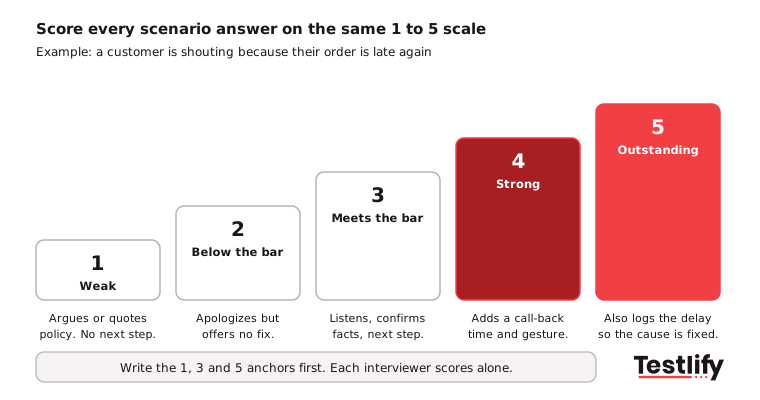
This kind of scale is called a behaviorally anchored rating scale. Add it to your interview scorecard so every interviewer sees the same anchors.
Pro tip: Write the 1, 3 and 5 anchors before the first interview from real great and poor answers. Fill in 2 and 4 later.
How do you write your own scenario question?
Writing your own scenario question starts with a real, recurring task from the job, not a puzzle. Turn that task into a short situation with one or two tensions, agree on what a strong answer includes, then test it on a current employee.
Five steps cover it.
- Pick a real moment: Ask the hiring manager for a situation that happened in the last three months and that a new hire will face in their first 90 days.
- Add tension: Include one or two real constraints, such as a deadline, an unhappy customer, missing information or a conflict between two people.
- Keep it short: Three or four sentences, with no trick details and no company jargon a new hire would not know.
- Define a strong answer: List the three to five things a strong answer covers and the most common red flag, then write the 1, 3 and 5 anchors.
- Test it: Try the question on one or two people already doing the job well. If they struggle, the scenario is unclear, not hard.
Keep every scenario tied to the job. The EEOC's guidance on prohibited practices says pre-employment questions should be limited to what is needed to judge qualifications, and employers cannot ask about disability before a job offer.
Avoid scenarios that invite answers about family, religion, health or age.
How should candidates answer scenario based questions?
Candidates answer scenario based questions best by thinking aloud in a clear order: clarify the situation, state the goal, walk through the steps and say how they would check the result. The STAR method (situation, task, action, result) gives that order, and a past example makes the answer more believable.
- Clarify first: Asking one or two questions, such as "Is the customer's account at risk?", shows judgment rather than hesitation.
- Say what comes first and why: Interviewers listen for priorities, so name the first step and the reason.
- Include the people: Mention who you would inform or involve, not only what you would do yourself.
- Close the loop: End with how you would check the outcome and stop the problem coming back.
Candidates who have never faced the situation should say so and reason through it. Our guide to the STAR interview method covers it in more depth.
When should you use scenario questions in hiring?
Scenario questions fit best after the first screen, once you know a candidate meets the basic requirements. Use three to five per interview, chosen for the skills that matter most in the role.
For high-volume hiring, move the first set of scenarios into an online test and keep live interview time for the finalists.
- Low-volume or senior roles: Ask scenarios live, with a panel, and probe with follow-ups such as "What if the client says no?"
- High-volume roles: Use a situational judgment test so every applicant faces the same scenarios with scored options, then discuss one or two scenarios live.
- Remote first rounds: Run scenarios as one-way video or AI interviews so candidates can answer at any time and every answer is scored against the same criteria.
Testlify supports both routes, with a library of 3,500+ tests that includes situational judgment, customer service and leadership tests. Chat AI interviews can put scenario questions to candidates and score every answer.
Assessments run in 15+ languages with 20+ proctoring checks. Our explainer on how situational judgment tests find the best fits shows how the scored options work.
Key takeaway: Scenario based interview questions only help when every candidate gets the same scenario and every interviewer scores it against the same anchors. Write them from real work, score them alone, then compare.
Ready to test judgment before the interview?
Put your best scenarios in front of every applicant, not just the few who reach a live interview. Start a 7-day free trial of Testlify, no credit card required, and add a situational judgment test or an AI interview to your next role.
Prefer a walkthrough first? Book a demo to talk through your hiring needs with the Testlify team.
Frequently asked questions (FAQs)

People and Talent Partner
Arushi Shah runs day-to-day talent acquisition and candidate experience at Testlify. She writes on interviewing, structured hiring, and giving candidates a fair, fast process.
LinkedInRelated resources
View all
Interview questions
30 Selenium interview questions to ask and what strong answers sound like

Interview questions
Situational based interview questions: 30 examples for hiring teams

Interview questions
40 healthcare interview questions to ask candidates, with strong answers

Interview questions
35 cultural fit interview questions to ask candidates

Interview questions
30 academic advisor interview questions to ask in 2026

Interview questions
30 banker interview questions to ask in 2026
Get started.
Hire on proof, not resumes.
Run your first skills-based assessment free — no credit card required.