
35 cultural fit interview questions to ask candidates
A list of 35 interview questions on values, work style, teamwork and culture add, with what to listen for and a simple way to score answers.

A candidate can pass every skills test and still struggle once they join your team. Most TA teams have lived it: the interview felt great, then the hire clashed with how the team works.
Cultural fit interview questions fix this when every candidate hears the same ones and every answer is scored against agreed behaviours. This guide gives you 35 of them, with what to listen for, a 1 to 5 scoring guide and questions to avoid.
TL;DR:
- 35 cultural fit interview questions in seven groups: values, work style, teamwork, conflict and feedback, adaptability, motivation and culture add.
- Each question comes with what a strong answer shows and the red flag to watch for.
- Prepare first: turn 4 to 6 company values into behaviours you can observe.
- Score every answer on a 1 to 5 scale, alone, before the debrief.
- Skip questions about age, religion, family plans or other protected characteristics.
 ChatGPT
 Gemini
 Claude
 Grok
 Perplexity
What are cultural fit interview questions?
Cultural fit interview questions are interview questions that show how a candidate behaves at work: what they value, how they like to work, how they handle conflict and change, and what keeps them motivated. The goal is to predict whether the person will do well in your team, not whether interviewers like them.
Most hiring teams ask these questions in the second or third round, after a skills check. Culture fit only matters once you know the person can do the job.
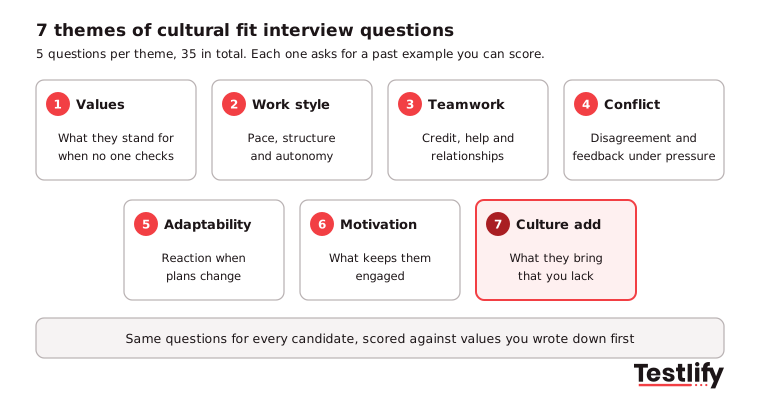
Cultural fit is also easy to get wrong. Without structure, "fit" turns into "people like us", which narrows the team and invites bias.
The questions below avoid that, because each one asks for behaviour you can observe and score. For the wider debate, see culture fit vs skill fit.

What is the difference between culture fit and culture add?
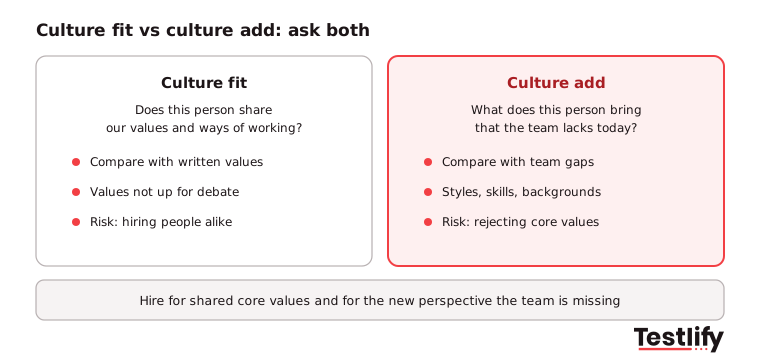
Culture fit asks whether a candidate shares the values and ways of working your team already has. Culture add asks what new perspective, skill or habit the candidate would bring.
Strong hiring teams check both: shared core values keep the team working together, and new perspectives stop it from thinking the same way.
Comparison | Culture fit | Culture add |
|---|---|---|
Core question | Does this person share our values and ways of working? | What does this person bring that the team lacks? |
What you compare against | Your written values and team norms | The gaps in your current team |
Main benefit | Faster ramp-up, fewer clashes | New ideas, less groupthink |
Main risk | Hiring people who look and think alike | Hiring someone who rejects core values |
Best used for | Values that are not up for debate (honesty, respect) | Styles, backgrounds and skills that can vary |
Pro tip: Split your values into two lists before you interview. "Must share" values like integrity are fit questions, and everything else, like how people brainstorm, is culture add.
How do you prepare before asking cultural fit questions?
Preparing for cultural fit questions means turning your company values into behaviours an interviewer can see. A value like "ownership" is hard to score as written.
A behaviour like "flags a missed deadline before it is missed" can be scored. Teams that skip this step end up scoring gut feel.
Clear expectations matter on both sides of the table. A new hire who understands your culture from day one can start work with confidence.
- Write down 4 to 6 values your team really works by, not the ones on the website poster. The organizational culture glossary entry is a good starting point.
- Describe each value as behaviour, and for each one, write what "strong" and "weak" look like in a real week.
- Pick 1 or 2 questions per value from the list below, so every candidate hears the same set.
- Agree on the scoring scale before the first interview, not in the debrief.
- Brief every interviewer, including the hiring manager, so no one adds their own "vibe" questions.
Which cultural fit interview questions reveal values?
Values questions reveal what a candidate prioritizes when there is no one watching or when they have to make a difficult choice. Focus on real situations and past decisions rather than hypothetical opinions, then compare their answers with the values that matter most to your organization.
Tell me about a time you had to choose between getting something done quickly and doing it properly. What did you do?
Listen for: a clear explanation of the decision, an understanding of the trade-off, and honesty about the outcome.
Red flag: pretending there was no trade-off or blaming the deadline for the decision.
Which of our company values resonates with you most, and when have you demonstrated it at work?
Listen for: a specific value supported by a genuine example from the candidate’s experience.
Red flag: repeating language from the company’s careers page without being able to explain how they have lived that value.
Tell me about a company decision you disagreed with. How did you handle it?
Listen for: raising concerns respectfully through the appropriate channels and supporting the final decision once it was made.
Red flag: quietly resisting the decision, undermining it, or discussing it negatively with colleagues.
What could make you leave a job within your first three months?
Listen for: reasonable deal-breakers that are compatible with the realities of the role and working environment.
Red flag: a deal-breaker that directly conflicts with a core part of the position.
Tell me about a time you noticed a colleague cutting corners. How did you respond?
Listen for: addressing the issue appropriately while balancing accountability, fairness, and the circumstances involved.
Red flag: ignoring the behaviour or immediately blaming or reporting the colleague without first understanding the situation
Which questions show how a candidate likes to work?
Work style questions help you understand whether a candidate’s preferred way of working matches the role’s pace, structure, autonomy, and communication style. Be transparent about how the team operates so you can identify mismatches before they become performance or retention issues.
Walk me through what a productive Workday looks like for you, from start to finish.
Listen for: how the candidate plans their day, manages priorities, stays focused, and communicates with others.
Red flag: a preferred routine or working environment that is fundamentally different from what the role requires.
Do you prefer clear instructions or a broad goal you can take ownership of? Can you give me an example?
Listen for: self-awareness, independence, and the ability to adapt to different levels of direction.
Red flag: a rigid preference for one working style that the team cannot consistently provide.
How do you usually keep your teammates or manager updated on your work?
Listen for: a communication style that fits the team’s setup, whether that involves written updates, quick calls, or regular meetings.
Red flag: no consistent habit of keeping others informed about progress or blockers.
Tell me about a period when you had to do repetitive work for an extended time. How did you stay focused?
Listen for: practical strategies for maintaining focus and consistent quality during routine tasks.
Red flag: a strong dislike of repetitive work when it is a regular part of the role.
Think about a manager who brought out your best work. What did they do that worked well for you?
Listen for: preferences that align with the hiring manager’s actual leadership and communication style.
Red flag: expectations or management needs that the hiring manager is unlikely to be able to provide.
Which questions show how a candidate works with a team?
Teamwork questions reveal how candidates collaborate, share credit, ask for support, and build strong working relationships. Focus on recent examples and ask about the candidate’s specific contribution, since broad answers can make it difficult to separate individual effort from the team’s overall result.
Tell me about a recent team project you were proud to be part of. What was your specific role?
Listen for: a clear contribution from the candidate, along with genuine recognition of what their teammates brought to the project.
Red flag: taking personal credit for every success or placing every failure on someone else.
How did you build relationships with your teammates during your first month at your last job?
Listen for: intentional efforts to connect, understand how people work, and build trust early.
Red flag: waiting for colleagues to initiate every interaction.
Tell me about a time you needed help from a teammate. How did you approach them, and what happened?
Listen for: a willingness to ask for help early and communicate clearly about what they needed.
Red flag: claiming they rarely or never need help from others.
If a colleague took credit for your idea during a meeting, how would you handle it?
Listen for: a calm, professional response that protects their contribution without creating unnecessary conflict.
Red flag: public confrontation, passive aggression, or holding onto resentment.
What do you do when you finish your work but notice that a teammate is falling behind?
Listen for: offering practical support while respecting the teammate’s ownership of their work.
Red flag: refusing to help because the task is technically outside their responsibilities.
Which questions test how candidates handle conflict and feedback?
Conflict and feedback questions reveal how a candidate handles pressure, disagreement, and criticism, which can strongly influence team dynamics. Push candidates for specific examples, including what was said, how they responded, and what changed afterward.
Tell me about a real disagreement you had with a colleague. How did you resolve it?
Listen for: active listening, respectful communication, and a focus on reaching a shared outcome.
Red flag: treating the disagreement as something to win rather than an opportunity to find a solution.
What is the most useful critical feedback you have received? What did you change as a result?
Listen for: a specific example that led to a measurable or observable change in behaviour.
Red flag: becoming defensive or being unable to identify meaningful feedback they have acted on.
Tell me about a time you were wrong at work. How did you realize it, and what did you do next?
Listen for: taking ownership, acknowledging the mistake quickly, and taking steps to correct it.
Red flag: shifting responsibility to colleagues, managers, or external circumstances.
How do you prefer to receive feedback: through regular one-to-ones, informal conversations, or formal reviews?
Listen for: a clear preference and an openness to receiving feedback in a way the manager can reasonably support.
Red flag: showing little interest in receiving feedback or rejecting feedback altogether.
If your work was criticized in front of the team, how would you respond in the moment and afterward?
Listen for: staying composed in the moment and following up privately to understand the feedback and address the issue.
Red flag: reacting with anger, becoming defensive, or withdrawing from the conversation.
Which questions check adaptability?
Adaptability questions reveal how a candidate responds when priorities shift, plans change, or they need to work outside their usual approach. Focus on what they did in the early stages of the change, especially for roles where priorities and processes can move quickly.
Tell me about a time your priorities changed overnight. What did you do first?
Listen for: quick reprioritization, clear communication, and a practical approach to getting back on track.
Red flag: prolonged frustration or difficulty adjusting to the new priorities.
Tell me about a time when weeks of work became irrelevant because plans changed. How did you respond?
Listen for: the ability to move forward, identify lessons, and apply them to future work.
Red flag: blaming managers, teammates, or circumstances without reflecting on what they could have done differently.
Tell me about a time you had to learn a new tool or process quickly. How did you approach it?
Listen for: a proactive learning approach, such as self-teaching, seeking guidance, practicing, or using available resources.
Red flag: waiting for someone else to provide extensive training before getting started.
Tell me about a time you had to work closely with someone whose working style was very different from yours.
Listen for: a willingness to adapt, communicate, and find ways to work effectively despite differences.
Red flag: avoiding the person or expecting them to change their approach entirely.
If you noticed that a team’s usual way of doing something was inefficient, how would you approach changing it?
Listen for: evidence, patience, collaboration, and an effort to build support before introducing change.
Red flag: forcing the change without considering others, or abandoning the idea as soon as there is resistance.
Which questions reveal motivation and growth?
Motivation questions reveal what keeps a candidate engaged and whether the role can meet those expectations. Look for alignment between what motivates the candidate and what the role offers in terms of growth, pace, ownership, and recognition.
What type of work gives you the most energy? Can you share a recent example?
Listen for: a clear connection between the candidate’s interests and the core responsibilities of the role.
Red flag: their strongest sources of motivation come from tasks the role rarely involves.
What would you like to learn or become better at over the next 12 months?
Listen for: learning goals that the role, team, or company can realistically support.
Red flag: their goals suggest they are preparing for a different type of role.
Which achievement from the past two years are you most proud of, and why?
Listen for: what the candidate values most, whether that is impact, learning, ownership, or recognition.
Red flag: they cannot clearly explain their contribution or take ownership of the result.
What would you hope to have accomplished in your first six months here?
Listen for: specific and realistic goals that show they understand the role and what success could look like.
Red flag: vague expectations or no clear understanding of the role’s responsibilities.
If this role did not work out after six months, what do you think would be the most likely reason?
Listen for: honest self-awareness and an understanding of the conditions they need to perform well.
Red flag: saying nothing could go wrong or being unable to identify any potential challenges.
Which culture-add questions should you ask?
Culture-add questions show what a candidate would bring that your team does not have yet. Ask them alongside the fit questions, not instead of them, since shared values and new thinking can go together.
What would you bring to this team that it might be missing today?
Listen for: a specific skill, perspective, or experience that directly supports the role and complements the existing team.
Red flag: a generic list of strengths with no connection to the team or role.
Tell me about a time you introduced a new idea or way of working to a team. What happened?
Listen for: a practical idea that was tested, adopted, and supported by others, along with evidence of its impact.
Red flag: ideas that were never implemented or examples that focus only on the idea itself.
From what you have seen of our company so far, what would you change?
Listen for: thoughtful, informed suggestions that show the candidate has researched the company and can offer constructive feedback.
Red flag: having no perspective or offering harsh criticism without understanding the context.
Tell me about a time when a different background or point of view helped your team avoid a mistake.
Listen for: an example that shows the candidate values different perspectives and understands how they can improve decision making.
Red flag: treating differences as a source of conflict rather than an opportunity to make better decisions.
How do your colleagues benefit from working with you?
Listen for: specific examples of how the candidate has supported teammates, improved collaboration, or helped others succeed.
Red flag: responses focused only on the candidate’s individual achievements.
Key takeaway: The best cultural fit interview questions ask for past behaviour, link to a written value, and come with a red flag the interviewer knows in advance. Five to eight of them per interview is enough.
How do you score answers to cultural fit interview questions?
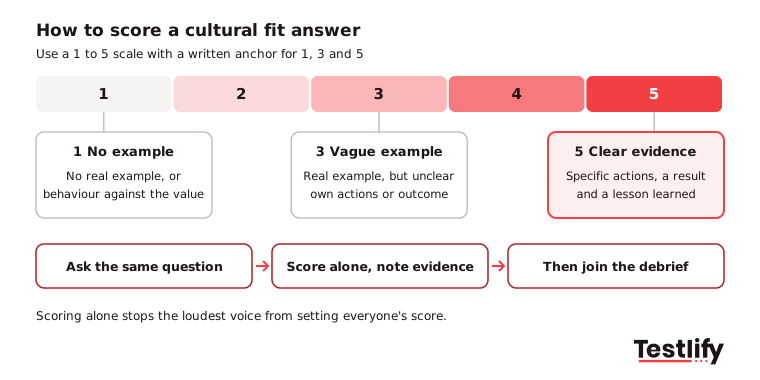
Scoring cultural fit interview questions works best on a simple 1 to 5 scale with a written anchor for 1, 3 and 5. Each interviewer scores alone and writes down the evidence before the debrief, so the loudest voice cannot set everyone's score.
Score | What the answer looks like | Example for "Tell me about a real disagreement" |
|---|---|---|
1 | No example, or behaviour that goes against the value | "I avoid conflict, I just do what I am told" |
3 | A real example, but vague on their own actions or the outcome | "We disagreed on a plan and in the end it worked out" |
5 | A specific example, clear personal actions, a result and a lesson | "I asked for a call, heard her concerns, we tested both options and kept hers" |
LinkedIn's Future of Recruiting 2025 report found that 89% of TA professionals say quality of hire will matter more. Only 25% are highly confident they can measure it.
Written scores per value give you data you can later compare with performance and retention.
For more on running the same questions for every candidate, see how structured interviews work and how to determine a candidate's cultural fit.
Which cultural fit questions should you never ask?
Cultural fit questions should never touch protected characteristics such as age, religion, national origin, disability, pregnancy or family plans. Personal-life questions can be used as evidence of discrimination, even when the interviewer meant no harm.
The EEOC's guidance on prohibited practices says pre-employment questions should be limited to what is essential to judge whether someone is qualified. Laws differ by country, so check local rules too.
Avoid asking | Why it is risky | Ask this instead |
|---|---|---|
"Where are you originally from?" | Can reveal national origin | "Are you authorized to work in this country?" |
"Do you have kids, or plan to?" | Family status, pregnancy | "This role has some evening work. Can you meet that schedule?" |
"What church or clubs do you belong to?" | Religion and other protected groups | "What do you do to keep learning outside work?" (optional) |
"How old are you?" or "When did you graduate?" | Age | "Do you meet the minimum age for this role?" |
"Would you join us for drinks after work?" | Excludes people for religious, health or family reasons | "How do you like to get to know a new team?" |
Also drop the "would I have a beer with this person" test, because liking someone is not the same as fit. For more on fairness, read ethical considerations in culture fit assessments.
How does Testlify help you assess culture fit?
Testlify helps hiring teams check culture fit with structured data before and during the interview, so the conversation starts from evidence. The Cultural Fit test, personality tests and AI interviews all score every candidate on the same criteria.
- Cultural Fit test. Use the Cultural Fit test to check core values such as accountability, collaboration, integrity, adaptability and respect for diversity. It also covers traits like conflict resolution and stress management, and takes 25 minutes.
- Personality tests. Add the Big Five personality test to see work style and temperament. It sits in a library of 3,500+ validated tests, alongside DISC and picture-based options.
- Structured AI interviews. Chat AI interviews ask every candidate the same questions and score each answer. Voice AI and Video AI interviews work the same way, and reviewers can see the answer behind every score.
- Question ideas in seconds. The free AI interview question generator drafts behavioral and role-based questions you can add to the list above.
Use the test to shortlist and the questions in this list for the human round. The interviewer can then probe the values where a candidate scored lowest.
Ready to put this into practice? Book a demo to see how Testlify pairs a Cultural Fit test with structured interviews for your next shortlist.
Frequently asked questions (FAQs)

People and Talent Partner
Arushi Shah runs day-to-day talent acquisition and candidate experience at Testlify. She writes on interviewing, structured hiring, and giving candidates a fair, fast process.
LinkedInRelated resources
View all
Interview questions
30 academic advisor interview questions to ask in 2026

Interview questions
30 banker interview questions to ask in 2026

Interview questions
Web designer interview questions: 25 to ask and what good answers sound like

Interview questions
Truck driver interview questions: 40 to ask and how to score them

Interview questions
Marketing internship interview questions: 30 to ask and what to listen for

Interview questions
Interior designer interview questions: 40 to ask in 2026
Get started.
Hire on proof, not resumes.
Run your first skills-based assessment free — no credit card required.