
40 healthcare interview questions to ask candidates, with strong answers
Forty questions for hiring nurses, aides and healthcare staff, grouped by skill, with the strong answers and red flags to listen for.

One weak hire on a busy ward can put patients at risk before anyone notices. Your interview questions are the first place to catch that risk.
Healthcare interview questions work when they ask for real past examples or realistic scenarios, and every interviewer scores the answers against the same criteria. This list gives recruiters, HR partners and nurse managers 40 questions grouped by skill, each with a strong answer and a red flag.
Job seekers can read it the other way round, as a guide to what interviewers want to hear.
TL;DR:
- The best healthcare interview questions ask for a specific past example or a realistic scenario, then probe for what the candidate did and why.
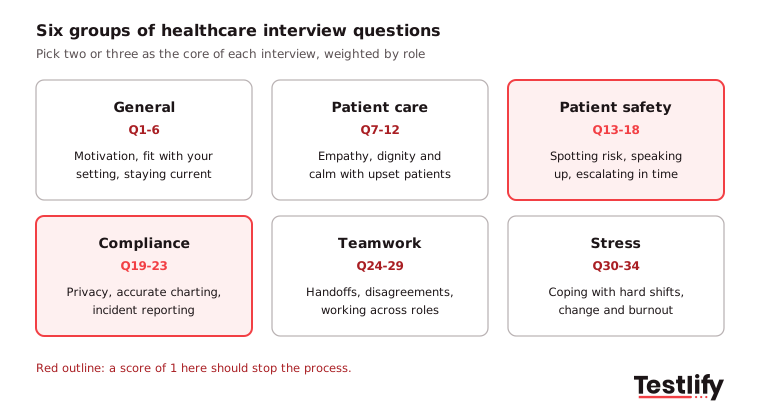
- Group questions by what the role can least afford to get wrong: patient safety, empathy, documentation and privacy, teamwork, and stress.
- Write down what a strong answer includes before the first interview, and score every answer on the same 1 to 5 scale.
- Never ask about a candidate's health, disability or medications before a job offer. Ask whether they can do the job's tasks instead.
- Test knowledge, such as HIPAA rules or medical terminology, with a short skills test. Save interview time for judgment and behavior.
- Healthcare hiring volume is high: the US Bureau of Labor Statistics projects about 1.9 million openings a year in healthcare occupations.
 ChatGPT
 Gemini
 Claude
 Grok
 Perplexity
What makes healthcare interview questions different?
Healthcare interview questions differ from general interview questions because the cost of a weak hire falls on patients, not only on the team. A poor answer about handling a medication error or a confused patient points to a real safety risk, so interviewers need questions that test judgment, care and compliance together.
Hiring teams also face steady volume. The Bureau of Labor Statistics healthcare outlook projects about 1.9 million openings each year across healthcare occupations, with employment growing much faster than the average for all jobs.
With that many interviews to run, consistency matters as much as the questions themselves. A structured interview (same questions, same scoring, every candidate) is the simplest way to get it right

What are the best general healthcare interview questions?
The best general healthcare interview questions test motivation, fit with your care setting and how candidates keep their skills current. These openers appear in almost every healthcare interview, so the value comes from listening past the rehearsed first answer and asking one follow-up.
1. Why did you choose healthcare, and why this setting in particular?
- Strong answer: a specific reason tied to patients or a type of care, plus something concrete about your hospital, clinic or service.
- Red flag: only pay, schedule or "I like helping people" with nothing behind it.
2. What does good patient care look like to you?
- Strong answer: safety, dignity, clear communication and follow-through, with an example from their own work.
- Red flag: a textbook definition with no example.
3. How do you stay current with changes in clinical practice or regulations?
- Strong answer: named habits such as required training, unit huddles, professional bodies or a recent change they put into practice.
- Red flag: "I learn on the job" with no example of a recent update.
4. Which part of this role do you expect to find hardest?
- Strong answer: an honest, specific challenge and a plan for it.
- Red flag: "Nothing", or a fake weakness.
5. Tell me about a piece of feedback that changed how you work.
- Strong answer: who gave it, what they changed and what improved.
- Red flag: defensiveness, or blaming the person who gave the feedback.
6. Why are you leaving your current role?
- Strong answer: a clear, professional reason connected to what this role offers.
- Red flag: harsh criticism of past employers or patients.
Which patient care and empathy questions should you ask?
Patient care and empathy questions show how a candidate treats people who are scared, in pain or confused. Strong candidates describe calm, specific actions and respect for the patient's choices.
Weak candidates talk about "difficult patients" without asking why the patient was struggling.
7. Tell me about a time a patient or family member was upset with you. What did you do?
- Strong answer: listened first, found the real cause, explained what they could and could not change, and followed up.
- Red flag: the story ends with the patient labeled "difficult" and nothing learned.
8. How would you explain a procedure to a patient who is anxious and has limited English?
- Strong answer: an interpreter service, plain words, the teach-back method and checking understanding.
- Red flag: relying on a family member or child to translate medical details.
9. Describe a time you went beyond your normal duties for a patient.
- Strong answer: a real, small act inside their scope, such as staying to finish a conversation or finding a resource.
- Red flag: a story where they broke policy to help.
10. How do you respond when a patient refuses care or medication?
- Strong answer: respects the patient's right to refuse, explores the reason, informs the right clinician and documents it.
- Red flag: pressuring the patient or quietly skipping the documentation.
11. Tell me about a time you had to share bad news or a delay with a patient.
- Strong answer: honest, kind and timely, within their scope, with a clear next step.
- Red flag: avoiding the conversation or passing it on without telling anyone.
12. How do you keep a patient's dignity during personal care?
- Strong answer: privacy, explaining each step, asking consent and letting the patient do what they can.
- Red flag: focus on speed alone.
Emotional intelligence sits behind most of these answers, so listen for self-awareness as much as for the story.
Which patient safety and judgment questions reveal good clinical sense?
Patient safety and judgment questions show whether a candidate notices risk, speaks up and follows escalation rules when things go wrong. These questions matter most for clinical roles, and the follow-up "What would you do differently?" often tells you more than the first answer.
13. Tell me about a mistake you made at work and what happened next.
- Strong answer: owns it, reported it, explains the fix and what changed after.
- Red flag: no mistake ever made, or a mistake that was hidden.
14. Describe a time you noticed a safety risk that others had missed.
- Strong answer: what they saw, who they told and how it was resolved.
- Red flag: noticed it but "it was not my job".
15. What would you do if you believed a colleague was about to make a medication error?
- Strong answer: stops the action politely but clearly, checks the order, escalates if needed.
- Red flag: stays quiet to avoid conflict with a senior colleague.
16. Your shift is short two people and three patients need you at once. How do you decide who comes first?
- Strong answer: a clear way of ranking urgency, asking for help and telling waiting patients what is happening.
- Red flag: "I just work faster."
17. When do you escalate a concern instead of handling it yourself?
- Strong answer: knows the limits of their scope and the escalation chain, with an example.
- Red flag: never escalates, or escalates everything.
18. Tell me about a time you followed a protocol you disagreed with.
- Strong answer: followed it, raised the concern through the right channel and explains the outcome.
- Red flag: ignored the protocol because they knew better.
Pro tip: Ask the same follow-up after every safety story: "What would you do differently next time?" A candidate who can answer it calmly is far more likely to report problems once hired.
Which compliance and documentation questions should you ask?
Compliance and documentation questions check that a candidate protects patient privacy and keeps accurate records under time pressure. Anyone who has worked in a regulated setting should talk about HIPAA, charting standards and incident reporting without being prompted.
19. A friend asks you about a patient they know is on your unit. What do you say?
- Strong answer: politely refuses to share anything and explains why.
- Red flag: "I would just tell them they are fine."
20. How do you keep documentation accurate on a busy shift?
- Strong answer: charts close to the time of care, uses the system's checks, never charts care before it happens.
- Red flag: catches up on notes at the end of the week.
21. What do you do if you realize you charted something incorrectly?
- Strong answer: corrects it using the approved process, with a dated note, and tells the right person if care was affected.
- Red flag: deletes or overwrites the entry.
22. Which electronic health record systems have you used, and what slowed you down?
- Strong answer: names systems and a practical workaround or training step.
- Red flag: claims expert level but cannot describe a single task.
23. Tell me about a time you reported an incident or near miss.
- Strong answer: knows the reporting route, reported promptly and focused on fixing the process.
- Red flag: sees reporting as getting someone in trouble.
Which teamwork and communication questions work best in healthcare?
Teamwork and communication questions work best when they ask about handoffs, disagreements and working across roles, because most care errors start with a gap between people. Listen for respect toward every role, from physicians to environmental services staff.
24. Walk me through how you hand over a patient at the end of a shift.
- Strong answer: a structured handover, such as a standard checklist, with time for questions.
- Red flag: "I tell them anything important."
25. Tell me about a disagreement with a colleague or doctor. How was it resolved?
- Strong answer: raised it privately, focused on the patient, reached a decision and moved on.
- Red flag: the conflict is still running, or they went around the person.
26. How do you work with a new colleague who is struggling?
- Strong answer: offers help, shares tips, tells a supervisor if patient safety is at risk.
- Red flag: "Not my responsibility."
27. Describe a time you coordinated care with another department.
- Strong answer: who they contacted, how they followed up and the result for the patient.
- Red flag: no example of working beyond their own unit.
28. How do you communicate with a patient's family when the patient does not want them told everything?
- Strong answer: respects the patient's wishes and privacy, and involves the care team.
- Red flag: shares details because "family has a right to know".
29. What do you do when instructions from two seniors conflict?
- Strong answer: clarifies with both, puts patient safety first, documents the decision.
- Red flag: picks whichever is easier.
Which stress and resilience questions should you ask healthcare workers?
Stress and resilience questions show how a candidate copes with long shifts, emotional cases and constant change. Healthcare teams lose good people to burnout, so you want candidates with real coping habits and the sense to ask for support.
30. Tell me about your hardest shift. How did you get through it?
- Strong answer: what made it hard, what they did in the moment and how they recovered after.
- Red flag: no hard shift, or a story with no coping at all.
31. How do you handle the loss of a patient or a very emotional case?
- Strong answer: names healthy routines, debriefs and support they use.
- Red flag: "It does not affect me."
32. What do you do when you feel close to burnout?
- Strong answer: spots early signs, talks to a manager, uses available support.
- Red flag: works through it until they quit.
33. How do you react when a process or system changes with little notice?
- Strong answer: asks questions, learns it fast, shares tips with others.
- Red flag: complains and keeps the old way.
34. How do you stay focused during repetitive tasks late in a shift?
- Strong answer: checklists, double-checks on high-risk steps, short breaks where allowed.
- Red flag: no answer for fatigue.
Which questions suit healthcare managers and administrators?
Healthcare managers and administrators need questions about staffing, budgets, quality and leading people through change. These roles shape the environment everyone else works in, so ask for numbers and outcomes, not only intentions.
35. How have you handled a staffing shortage on your unit or team?
- Strong answer: short-term cover plus a longer fix, such as cross-training or changed schedules, with a result.
- Red flag: relies on overtime only.
36. Tell me about a quality or patient experience score you improved.
- Strong answer: the starting point, what they changed and the result.
- Red flag: no measure mentioned.
37. Your budget is cut by 10 percent. What do you protect, and what do you change?
- Strong answer: protects safe staffing and care quality, looks at waste and process first.
- Red flag: cuts frontline staff first without thinking about safety.
38. How do you handle a team member who is skilled but disrespectful to colleagues?
- Strong answer: addresses it early with specific examples, sets expectations and follows up.
- Red flag: tolerates it because the person is hard to replace.
39. How do you prepare your team for an audit or inspection?
- Strong answer: ongoing readiness, regular checks and clear owners, not a last-minute scramble.
- Red flag: only prepares the week before.
40. How do you decide who to hire for your team?
- Strong answer: clear criteria, a skills check and a consistent interview.
- Red flag: "I go with my gut."
For single roles, Testlify also publishes role question sets, for example pharmacy technician interview questions and medical coder interview questions.
Which healthcare interview questions should you avoid?
Healthcare interview questions to avoid include anything about a candidate's health, disability, medications, pregnancy, age, religion or family plans. In a medical setting these can feel natural to ask, but they can expose the employer to discrimination claims.
The EEOC's guidance on pre-employment inquiries says an employer may not ask a job applicant whether they have a disability, or ask medical questions, before making a job offer. Employers may ask whether the applicant can perform the job and how they would do it.
Instead of asking | Ask this |
|---|---|
"Do you have any back problems?" | "This role involves lifting and moving patients. Can you do that, with or without an accommodation?" |
"Are you on any medication?" | Nothing before the offer. Any medical exam comes after a conditional offer and applies to everyone in the role. |
"Do you have young children?" | "This role includes rotating night shifts. Can you work that schedule?" |
"How old are you?" | "Do you hold a current license for this role?" |
Key takeaway: Ask about the job's tasks, schedule and licenses, never about the person's health or private life.
How should you score answers to healthcare interview questions?
Answers to healthcare interview questions should be scored on a shared 1 to 5 scale, agreed before the first interview, with notes on the evidence behind each score. A shared scale stops one interviewer's "great" from meaning another interviewer's "fine".
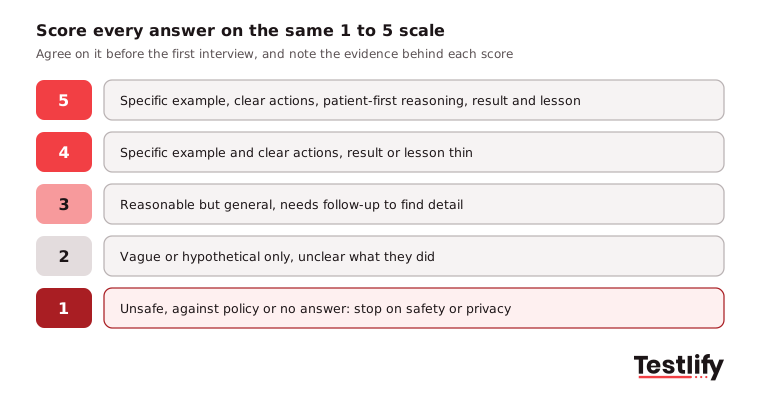
Score each competency separately, then compare notes in the debrief. Any 1 on a patient safety or privacy question should stop the process, whatever the total.
Which questions fit which healthcare roles?
Healthcare roles need different weights for each question group. A nurse and a medical receptionist both need empathy, but only one needs deep clinical judgment questions.
Pick two or three groups as the core of each interview and use one or two questions from the rest.
Role type | Examples | Core question groups | Skills to test before the interview |
|---|---|---|---|
Clinical | Registered nurse, LPN, CNA | Patient safety, patient care, teamwork | Clinical knowledge, medical terminology |
Patient support | Patient care technician, home health aide | Patient care, stress, teamwork | Empathy, basic care procedures |
Front desk and admin | Medical receptionist, patient registrar, billing | Compliance and documentation, patient care | HIPAA, data entry, typing |
Leadership | Nurse manager, practice manager, administrator | Manager questions, teamwork, compliance | Healthcare management, situational judgment |
Where should a skills test replace an interview question?
A skills test should replace any interview question that checks knowledge with a right answer, such as HIPAA rules, medical terminology or billing codes. Interview time is expensive, and it is better spent on judgment, care and behavior, which need a conversation.
Assessing skills accurately is the gap most teams feel. A short skills test gives every candidate the same measured check before the interview starts.
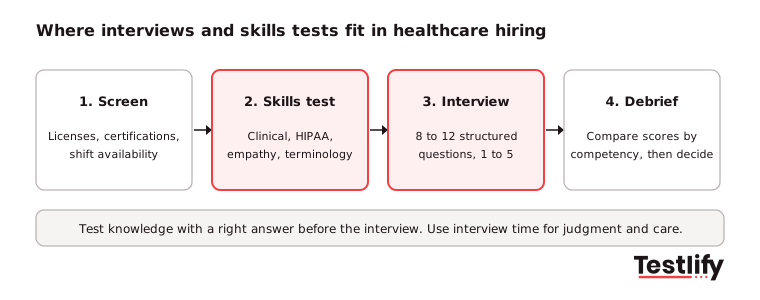
A simple order for healthcare hiring:
- Screen for licenses and must-haves: Check required certifications and shift availability first.
- Send a short skills test: Use a role test such as the registered nurse test, certified nursing assistant test, patient care technician test or medical receptionist test, plus a HIPAA test or empathy test where it fits.
- Run the structured interview: Use 8 to 12 questions from this list, weighted by role type, scored on the 1 to 5 scale.
- Debrief on evidence: Compare scores by competency, not overall impressions.
Testlify's library has 3,500+ tests, including healthcare tests like the ones above, and one-way video interviews let candidates answer a few of these questions on their own time before a live round. For more on healthcare screening, see pre-hire assessments for the healthcare industry and how to assess soft skills in healthcare hiring.
Ready to hire healthcare staff on evidence?
Pair these questions with a role-specific skills test so interviews focus on judgment and care. Browse the healthcare tests in the Testlify test library or see how Testlify supports healthcare hiring.
Book a demo to see how Testlify fits your healthcare hiring process. You can also start a 7-day free trial with no credit card.
Frequently asked questions (FAQs)

People and Talent Partner
Arushi Shah runs day-to-day talent acquisition and candidate experience at Testlify. She writes on interviewing, structured hiring, and giving candidates a fair, fast process.
LinkedInRelated resources
View all
Interview questions
35 cultural fit interview questions to ask candidates

Interview questions
30 academic advisor interview questions to ask in 2026

Interview questions
30 banker interview questions to ask in 2026

Interview questions
Web designer interview questions: 25 to ask and what good answers sound like

Interview questions
Truck driver interview questions: 40 to ask and how to score them

Interview questions
Marketing internship interview questions: 30 to ask and what to listen for
Get started.
Hire on proof, not resumes.
Run your first skills-based assessment free — no credit card required.