
Situational based interview questions: 30 examples for hiring teams
Thirty what-would-you-do interview questions grouped by skill, with what a strong answer shows, red flags and a simple 1-3-5 scoring scale.

Situational based interview questions describe a realistic problem from the job and ask the candidate what they would do. They are hypothetical and look forward: "What would you do if a client rejected your plan an hour before launch?" Because every candidate gets the same problem, you can compare how each one thinks, not how well each one tells a story about their past.
 ChatGPT
 Gemini
 Claude
 Grok
 Perplexity
TL;DR
- Situational based interview questions: Hypothetical "what would you do if..." questions built from real problems in the role. Every candidate gets the same problem, so answers are easy to compare.
- Versus behavioral questions: Situational questions look forward, while behavioral questions ask about the past. Scenario-based questions are longer, multi-step cases.
- Best fit: Use them for entry-level hires and career changers, because candidates do not need past experience to answer.
- How many to ask: Pick 4 to 6 questions per interview, each tied to one skill the role needs. Ask every candidate the same ones.
- Scoring: Write a 1-3-5 scoring guide before the interview. Score the reasoning, not the polish of the answer.
- Volume hiring: Run the first round as a situational judgment test or a structured AI interview. Save live questions for the shortlist.

What are situational based interview questions?
Situational based interview questions are interview questions that place the candidate in a hypothetical but realistic work situation and ask how they would handle it. The interviewer is not looking for one correct answer. The interviewer is looking at how the candidate reads the problem, what they weigh, who they involve and what they do first.
The SHRM interview questions tool describes the situational technique as giving the candidate "a hypothetical scenario" and asking how they would respond, and advises choosing questions from the competencies that matter most for the job.
Most situational questions follow one of three patterns:
- What would you do if: "What would you do if two senior stakeholders gave you conflicting instructions?"
- How would you handle: "How would you handle a customer who is angry about a delay you did not cause?"
- You notice that: "You notice a colleague has entered the wrong figures in a client report. What happens next?"
Situational questions are one part of a structured interview, where every candidate for a role answers the same questions and is scored on the same criteria.
How are situational questions different from behavioral and scenario-based questions?
Situational questions differ from behavioral questions in time frame: situational questions ask what a candidate would do in the future, while behavioral questions ask what they did in the past. Scenario-based questions are a longer, multi-step version of a situational question, often a small case with several decisions.
Many guides use the three terms as if they mean the same thing. They overlap, but each one tests something slightly different, and mixing them in one question makes answers hard to score.
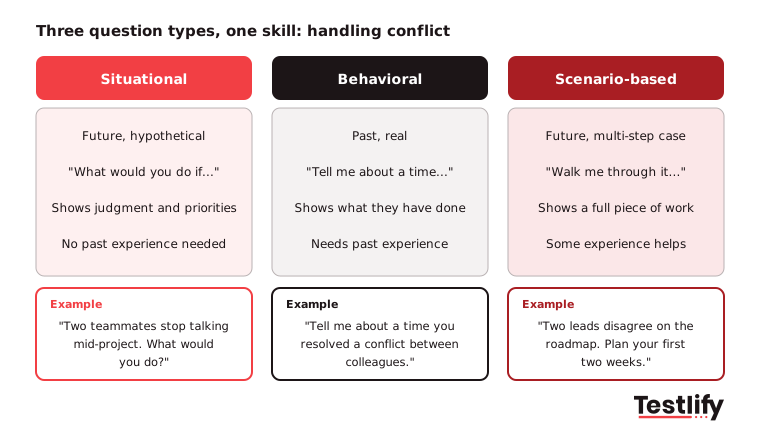
Situational question | Behavioral question | Scenario-based question | |
|---|---|---|---|
Time frame | Future, hypothetical | Past, real | Future, hypothetical |
Typical opening | "What would you do if..." | "Tell me about a time when..." | "Here is the situation. Walk me through it." |
Length | One problem, 2 to 4 minute answer | One story, 3 to 5 minute answer | Several steps, 10 to 20 minutes |
What it shows | Judgment, priorities, problem solving | What the candidate has actually done | How the candidate handles a full piece of work |
Needs past experience | No | Yes | Some |
Answer structure | Approach, actions, expected outcome | STAR (situation, task, action, result) | Plan, trade-offs, decisions, checks |
Example (conflict skill) | "Two teammates stop speaking to each other mid-project. What would you do?" | "Tell me about a time you resolved a conflict between colleagues." | "You inherit a team where two leads disagree on the roadmap. Plan your first two weeks." |
Behavioral questions are covered in depth in our guide to the behavioral based interview. Many hiring teams pair the two: a situational question to see the candidate's thinking, then a behavioral follow-up ("Have you faced something like that? What did you do?") to check it against real experience.
Why should hiring teams ask situational interview questions?
Hiring teams should ask situational interview questions because they put every candidate in front of the same job problem, which makes answers easier to compare than open conversation. They also work for candidates who have not done the job before, which widens the pool for entry-level and hard-to-fill roles.
That second point matters because many roles are hard to fill. Questions that do not depend on a matching job history let you assess more people fairly.
The main benefits for a hiring team:
- Fair comparison: Every candidate solves the same problem, so differences in the answers come from the candidates, not from the conversation.
- No experience needed: Graduates, career changers and people moving up from frontline roles can show judgment without a matching job title.
- Less rehearsed answers: Candidates often prepare polished stories for "tell me about a time". A new hypothetical problem is harder to script.
- Job preview: The questions show candidates what the work is really like, so some opt out early and the ones who stay know what they signed up for.
- Clear scoring: A defined problem makes it possible to write what a weak, good and strong answer looks like before the interview.
What are the best situational based interview questions to ask?
The best situational based interview questions to ask are built from real problems in the role and test one skill each. The 30 questions below are grouped by the skill they test. Under each one is what a strong answer shows and the red flag to watch for. Swap in your own products, customers and tools to make them specific.
Problem solving and judgment
- "A key system your team depends on goes down an hour before a client deadline. What would you do?" Strong answer: contains the damage, tells the client early and honestly, finds a workaround, then looks for the cause. Red flag: waits for someone else to fix it.
- "You find a serious error in a report that has already gone to senior leaders. What happens next?" Strong answer: flags it quickly, brings a corrected version and explains the impact. Red flag: hopes nobody notices.
- "You are asked to cut a project budget by 20% without moving the deadline. How would you approach it?" Strong answer: asks what matters most, lists options and trade-offs, agrees the cut with stakeholders. Red flag: cuts quality quietly.
- "Data from two sources gives you different answers to the same question. What would you do?" Strong answer: checks definitions and dates, finds the source of the gap, states which number they trust and why. Red flag: picks the one that suits them.
- "You notice a process that wastes hours every week, but nobody has asked you to fix it. What would you do?" Strong answer: measures the waste, suggests a change to the owner, offers to run a small trial. Red flag: changes it alone without telling anyone.
Customer service
- "A customer demands a refund outside your policy and asks for your manager. What would you do?" Strong answer: listens, explains the policy calmly, looks for what they can offer, escalates when it is warranted. Red flag: argues, or breaks policy to end the call.
- "A customer asks a product question you cannot answer. How would you handle it?" Strong answer: says so honestly, finds out, follows up by a set time. Red flag: guesses.
- "A loyal client is angry about a delay your team did not cause. What would you say?" Strong answer: apologizes for the experience without blaming others, explains next steps, owns the follow-up. Red flag: blames another team in front of the client.
- "You have five customers waiting and one of them is very upset. Who do you help first and why?" Strong answer: gives a clear way to prioritize, keeps others informed while waiting. Red flag: no logic, or ignores everyone else.
- "A customer shares a complaint about you on social media. What would you do?" Strong answer: stays calm, follows company policy, involves the right team, fixes the underlying issue. Red flag: replies publicly in anger.
Teamwork and conflict
- "Two teammates stop talking to each other in the middle of a project. What would you do?" Strong answer: speaks to each one privately, finds the real issue, refocuses them on the shared goal, escalates if it continues. Red flag: takes a side.
- "A colleague keeps missing deadlines that affect your work. How would you handle it?" Strong answer: raises it directly and kindly, asks what is getting in the way, agrees a plan, then escalates if needed. Red flag: complains to others first.
- "Your team rejects an idea you strongly believe in. What would you do next?" Strong answer: asks why, takes the feedback seriously, improves the idea or commits to the team decision. Red flag: pushes it through anyway.
- "A colleague takes credit for your work in a meeting. How would you respond?" Strong answer: stays professional, clarifies their part with facts, raises it privately afterwards. Red flag: an angry public response, or silence that builds resentment.
- "You are paired with a teammate whose working style is the opposite of yours. How would you make it work?" Strong answer: talks through how each likes to work, splits tasks to suit both, agrees check-ins. Red flag: says they would rather work alone.
Prioritization and time management
- "Your manager and a senior stakeholder each give you an urgent task due today. What would you do?" Strong answer: clarifies real deadlines and impact, gets the two to agree a priority, tells both what will happen. Red flag: tries to do both badly and says nothing.
- "You realize you will miss a deadline you committed to. When and how do you tell people?" Strong answer: tells them as soon as they know, explains why, offers a new date or a partial delivery. Red flag: waits until the deadline passes.
- "A new request arrives that would take a full day, and your week is already full. What would you do?" Strong answer: checks priority with the requester or manager, says what would move if they take it on. Red flag: says yes to everything.
- "You are given a task with unclear instructions and the person who set it is away for a week. How would you proceed?" Strong answer: finds other sources, writes down assumptions, starts on the parts that are clear. Red flag: waits a week.
Leadership and people management
- "A high performer on your team starts missing deadlines and seems disengaged. What would you do?" Strong answer: has a private, caring conversation, looks for causes, agrees support and a check-in. Red flag: goes straight to a warning.
- "You have to deliver an unpopular decision from leadership to your team. How would you do it?" Strong answer: explains the reason honestly, listens to concerns, takes questions back up the line. Red flag: blames leadership to stay popular.
- "Two strong candidates want the same promotion and only one can get it. How would you handle the conversation with the other?" Strong answer: gives honest, specific reasons, agrees a development plan and a timeline. Red flag: vague promises.
- "A team member makes a mistake that costs a client. What would you do?" Strong answer: fixes the client issue first, then reviews what happened without blame, changes the process. Red flag: public blame.
- "You join as a new manager and the team is used to working with very little structure. What would you change first?" Strong answer: listens before changing, picks one or two changes with clear reasons. Red flag: rewrites everything in week one.
Ethics and integrity
- "You see a colleague bending a safety or compliance rule to save time. What would you do?" Strong answer: stops the risk, raises it with the colleague, reports it if it continues. Red flag: "It is not my business."
- "A client offers you an expensive gift after you close a deal. How would you respond?" Strong answer: checks the company gift policy, declines or declares it. Red flag: keeps it quietly.
- "Your manager asks you to present numbers in a way you think is misleading. What would you do?" Strong answer: raises the concern with the manager, suggests an honest version, escalates if pressed. Red flag: goes along with it.
Adaptability and change
- "Halfway through a project, the company changes its strategy and your work is no longer a priority. What would you do?" Strong answer: accepts it, saves what is useful, hands over cleanly, moves to the new priority. Red flag: keeps working on the old plan.
- "You are asked to use a new tool you have never seen, starting tomorrow. How would you get up to speed?" Strong answer: names concrete steps (docs, a colleague, a test run) and asks for help early. Red flag: avoids the tool.
- "Your team moves from office-based to fully remote with a week's notice. What would you do to keep work on track?" Strong answer: sets up clear channels, check-ins and shared task lists. Red flag: no plan beyond "carry on as usual."
Key takeaway: Pick 4 to 6 questions, one for each skill the role needs most, and write your own red flags for each. A question without a scoring guide is just a conversation.
How do you score answers to situational interview questions?
Answers to situational interview questions are scored best on a short anchored scale, such as 1 to 5, where each score has a written description of what that answer sounds like. Interviewers score each answer on its own, write the evidence beside the score, and compare scores only after every interviewer has finished.
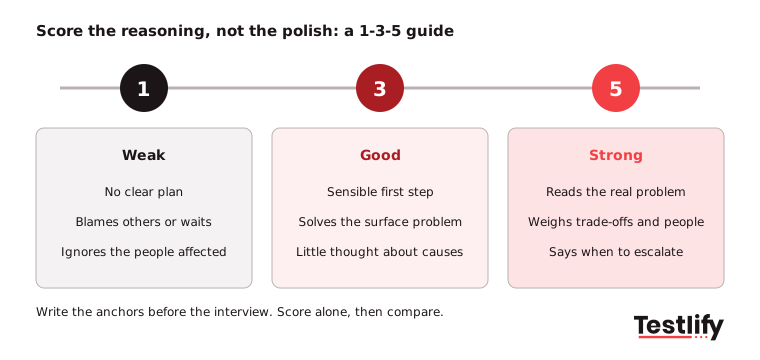
Here is an example guide for question 12 (a colleague who keeps missing deadlines):
Score | What the answer sounds like |
|---|---|
1, weak | Complains to the manager or other teammates first, or does nothing. No plan. |
3, good | Raises it with the colleague directly and agrees a new deadline. Little thought about why it is happening. |
5, strong | Raises it privately and kindly, asks what is in the way, agrees a plan and a check-in, and says when and how they would escalate. Keeps the shared goal in view. |
A few rules keep scoring fair:
- Score the reasoning: A confident, fluent answer is not the same as a sound one. Look for what the candidate weighs and why.
- Use follow-up probes: Plan one or two follow-ups for each question, such as "What if that did not work?" Ask them of every candidate.
- Write evidence, not impressions: Note what the candidate said, not "seemed strong".
- Score alone, then compare: Discuss scores only after each interviewer has written their own.
A scoring guide with written anchors like this is often called a behaviorally anchored rating scale (BARS). Put the questions and anchors on one interview scorecard so every interviewer works from the same sheet.
Pro tip: If you cannot write what a 5 answer sounds like, the question is too vague. Rewrite it with a clearer problem before you use it.
How do you write situational questions for a specific role?
Situational questions for a specific role are written from real moments in that job, not from a generic list. Start with the skills that separate strong performers from average ones, then turn the situations where those skills showed up into hypothetical questions with a clear problem and a scoring guide.
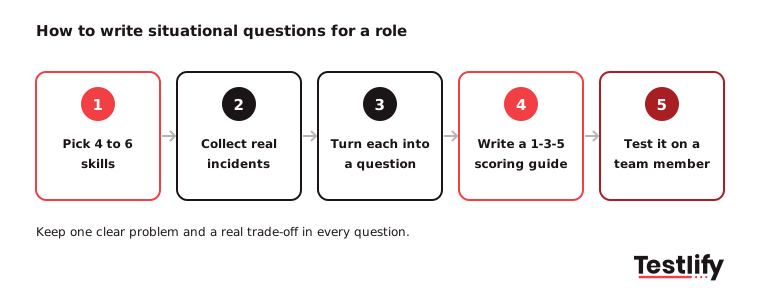
- Pick 4 to 6 skills: Take them from the job description and the hiring manager. Fewer skills, tested well, beat a long list.
- Collect real incidents: Ask top performers and the manager for moments where the skill made a big difference, good or bad.
- Turn each incident into a question: Remove names and details that only insiders would know. Keep one clear problem and a real trade-off.
- Write the scoring guide: Describe a 1, 3 and 5 answer and one or two follow-up probes before anyone is interviewed.
- Test it once: Try the question on a current team member. If the answer surprises you, adjust the question or the anchors.
The US Office of Personnel Management's guidance on structured interviews follows the same pattern: build questions from job-related incidents, ask every applicant the same questions and probes, and score answers against set benchmarks.
What mistakes should you avoid with situational questions?
The most common mistakes with situational questions are questions with an obvious right answer, questions that only insiders can answer, and no written scoring guide. Each one makes answers look similar or depend on luck, which defeats the point of asking.
- Obvious answers: "Would you lie to a customer?" tells you nothing. Add a real trade-off, such as a target that tempts people to cut corners.
- Insider knowledge: A question that needs your internal systems or jargon favors internal candidates. Describe the situation in plain terms.
- Mixing time frames: "Tell me about a time... and what would you do now?" is two questions. Ask them separately and score them separately.
- Different questions for different candidates: Changing the question on the fly makes scores impossible to compare. Read it as written.
- Too many questions: Ten rushed questions give thinner evidence than five with follow-ups.
- Scoring on style: Fluent speakers and native speakers are not better problem solvers by default. Score what they would do, not how they say it.
Switching from open conversation to set questions is a big part of the move from unstructured to structured interviews, which we compare in structured vs unstructured interviews.
When should you use a situational judgment test instead of interview questions?
A situational judgment test is the better choice when you have many candidates for the same role and need the same situational questions scored the same way before anyone is interviewed. Live situational questions work best later, on a shortlist, when an interviewer can probe the answers.
A situational judgment test presents short work scenarios with set response options and scores every candidate automatically. Testlify's situational judgment tests cover decisions such as conflict resolution, prioritization, ethical choices and leadership, and sit in a library of 3,500+ tests that includes the customer service test, the problem solving test and the leadership and people management test.
For open-ended answers at volume, you can ask the same situational questions in a structured AI interview by chat, voice or video. Testlify's Chat AI interviews ask each candidate the same questions and score every response against the criteria you set, with 20+ proctoring checks to keep answers the candidate's own.
Stage | Best format | Why |
|---|---|---|
First screen, many applicants | Situational judgment test | Same scenarios, automatic scoring, no interviewer time |
First screen, open answers | Structured AI interview | Same questions, scored against your criteria, any time zone |
Shortlist interview | Live situational questions | Follow-up probes, two-way conversation |
Final round | Situational plus behavioral follow-ups | Checks thinking against real experience |
For a deeper look at how these tests work, read how situational judgement tests find the best fits.
Ready to put situational questions to work?
Situational questions work best when every candidate gets the same problem and every answer is scored against the same guide. Use the 30 questions above for your next shortlist, and move the first round into a test so interviewers only meet candidates who already showed sound judgment. Browse the Testlify test library or start a 7-day free trial, no credit card needed.
Frequently asked question (FAQs)

Related resources
View all
Interview questions
40 healthcare interview questions to ask candidates, with strong answers

Interview questions
35 cultural fit interview questions to ask candidates

Interview questions
30 academic advisor interview questions to ask in 2026

Interview questions
30 banker interview questions to ask in 2026

Interview questions
Web designer interview questions: 25 to ask and what good answers sound like

Interview questions
Truck driver interview questions: 40 to ask and how to score them
Get started.
Hire on proof, not resumes.
Run your first skills-based assessment free — no credit card required.