
30 academic advisor interview questions to ask in 2026
A hiring committee guide to interviewing academic advisors: 30 questions, red flags, a role-play exercise and a simple 1 to 5 scoring scale.

Advisors often decide whether a student stays enrolled or quietly drops out. Yet many interviews reward the most likeable candidate, not the one who gives the best guidance.
These academic advisor interview questions give your hiring committee a fair way to compare candidates on evidence. Use them to test how candidates handle course planning, policy, privacy and student setbacks, and score every answer on the same scale.
TL;DR
- 30 academic advisor interview questions, grouped by what each set reveals: background, philosophy, behavioral, scenario, ethics and caseload.
- Each set lists the signs of a strong answer and the red flags to watch for.
- A transcript role-play shows how a candidate advises a real student file.
- A 1 to 5 scoring scale keeps every panel member judging the same evidence.
- A short list of questions to avoid keeps the process fair.
- A skills test before the interview lets the panel spend interview time on finalists.
 ChatGPT
 Gemini
 Claude
 Grok
 Perplexity
What does an academic advisor interview assess?
An academic advisor interview assesses whether a candidate can guide students through real decisions, follow policy with care and protect student records. The graphic below maps the skills your panel should look for, and the sections that follow turn each one into questions.
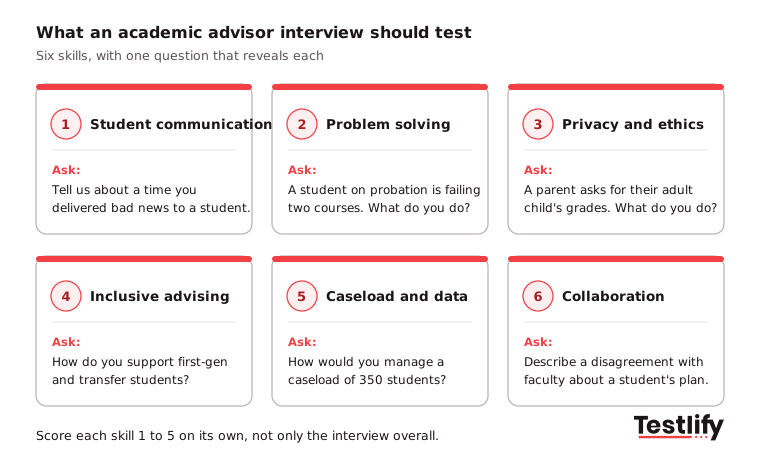
The job itself explains the list. O*NET's profile for educational, guidance and career advisors lists academic advisor as a sample title and puts active listening, speaking and critical thinking at the top of the skills the role needs.
Its top tasks include counseling students on course selection and career planning, reviewing transcripts against graduation requirements, and keeping accurate student records.
Demand stays steady. The US Bureau of Labor Statistics counts 389,500 jobs in this occupation in 2025 and projects about 27,800 openings a year through 2035, so most advising offices hire every year.
Keeping new advisors matters just as much. Tyton Partners' Driving Toward a Degree 2024 report found that nearly a third of primary-role advisors had been in their role for under two years, and about one in five advisors with caseloads over 400 students said they were unlikely to stay in the role for five more years.
A clear, consistent interview helps you hire people who will stay.

Which general academic advisor interview questions should you ask?
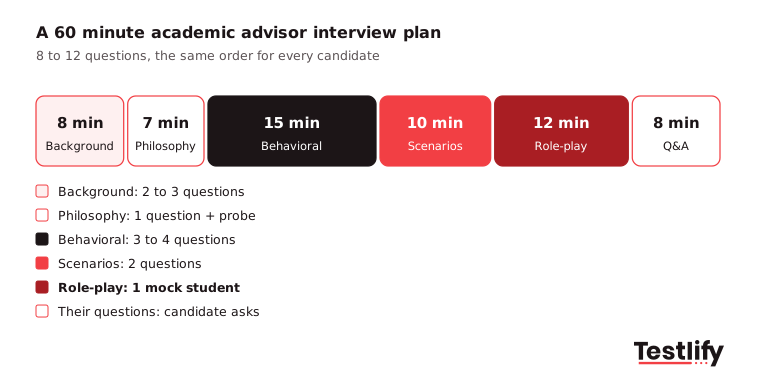
General academic advisor interview questions open the conversation and test whether the candidate understands the role and your institution. Use them to check motivation, relevant experience and research into your students, then move quickly to questions that ask for real examples.
Why do you want to work as an academic advisor here?
A strong answer names something specific about your students or programs. A red flag is a generic answer that would fit any college.
Walk us through your advising or student-facing experience.
Look for direct contact with students and a clear sense of what they owned. Teaching, tutoring, residence life and admissions all count.
What do you know about our student population?
Strong candidates mention the mix you serve, such as first-generation, transfer, online or adult learners.
Which advising model have you worked in?
Prescriptive, developmental and appreciative advising each suit different offices. Look for a candidate who can explain how they adapted to the model they had.
What has been your most rewarding moment with a student?
The best answers center the student's result, not the advisor's praise.
What advising philosophy questions reveal the most?
Advising philosophy questions show how a candidate thinks about the student relationship, and they appear in almost every academic advisor interview. A good philosophy answer is short, practical and backed by an example. A memorized paragraph with no story behind it tells you little.
What is your advising philosophy?
Look for a clear belief, such as "students own their plan and I help them see their options", followed by how that shows up in a real appointment.
How do you define success for a student you advise?
Strong answers go beyond grades to persistence, a plan the student believes in and knowing where to get help.
How do you balance giving students direct answers with helping them decide for themselves?
Good advisors adjust: firm guidance on deadlines and requirements, coaching on choices like a major.
How do you build trust with a student in a 20-minute appointment?
Listen for listening: names, open questions, and one clear next step.
Pro tip: Ask the philosophy question early and come back to it after a scenario. Ask, "How did your answer just now reflect the philosophy you described?" Candidates with a real philosophy connect the two easily.
Which behavioral academic advisor interview questions work best?
Behavioral academic advisor interview questions ask for a real past situation, because what a candidate did before is better evidence than what they say they would do. Ask for a specific example, then probe for the situation, the action they took and the result.
Tell us about a time you had to deliver bad news to a student.
Look for honesty, care in how the news was framed, and a concrete next step for the student.
Describe a time you helped a student who was close to dropping out.
Strong answers show early warning signs noticed, referrals made and a follow-up.
Tell us about a time you disagreed with a faculty member about a student's plan.
Look for respect for faculty, a focus on the student, and a resolution that followed policy.
Describe a time you made a mistake in advice you gave.
The best candidates own it, fix it quickly and change their process so it does not happen again.
Tell us about a time you had to learn a complex policy fast.
Look for a method: source documents, a colleague check, then a simple explanation for students.
Describe your busiest registration period and how you managed it.
Good answers mention triage, templates, group sessions and protecting time for urgent cases.
The NACADA Clearinghouse makes the same point in its guidance for advising administrators: break the job into its essential functions, build questions around each one, and ask every candidate the same questions. See how to set that up in our guide to structured interviews.
Which scenario questions test real advising judgment?
Scenario questions put the candidate in a situation they will face in the first month, so they show judgment, policy sense and tone at once. Give each scenario in writing or read it aloud, allow a moment to think, and listen for how the candidate gathers facts before giving advice.
- A student on academic probation is failing two courses at midterm. What do you do?
- A student wants to change from nursing to business in their junior year. How do you advise them?
- A student misses three appointments in a row and does not reply to email. What next?
- A transfer student is upset that half of their credits did not transfer. How do you handle the meeting?
- A student tells you they are struggling with anxiety and thinking of leaving. What do you say and do?
Scenario | Strong answer shows | Red flag |
|---|---|---|
Probation and failing at midterm | Asks about causes, explains options like withdrawal deadlines, refers to tutoring, sets a follow-up | Lectures the student or only quotes policy |
Late change of major | Runs a degree audit, maps credits that carry over, discusses cost and time honestly | Talks the student out of it without asking why |
Missed appointments | Tries a different channel, checks early-alert data, involves the right office | Closes the file and waits for the student |
Credits did not transfer | Explains the decision, knows the appeal process, builds a fast plan forward | Blames the other institution or the registrar |
Anxiety and thinking of leaving | Listens, refers to counseling the same day, knows crisis steps, follows up | Tries to act as a counselor or ignores the signal |
We have seen the same pattern in advising searches again and again: the candidate who asks one more question usually gives the better advice.
Key takeaway: In every scenario, the best candidates ask a question before they give an answer. Advisors who jump straight to a solution often solve the wrong problem.
What FERPA and ethics questions should you include?
FERPA and ethics questions check that a candidate will protect student records and act with integrity under pressure. Academic advisors see grades, holds and personal details every day, so a single careless reply to a parent or a colleague can become a privacy complaint for the institution.
A parent calls and asks for their adult child's grades. What do you do?
A strong answer explains that records are released only with the student's written consent or under a listed exception, and stays polite and helpful about what the parent can do next.
A student asks you to bend a deadline rule for them. How do you respond?
Look for fairness and knowledge of the formal exception or petition route.
A colleague shares a student's personal story in the break room. What would you do?
Strong candidates name the issue, raise it privately and know where to escalate.
The privacy rules come from the Family Educational Rights and Privacy Act, known as FERPA. You do not need candidates to quote it, but you do need them to know when to stop and check.
Which questions test caseload, data and technology skills?
Caseload and technology questions show whether a candidate can keep hundreds of students on track without losing the personal touch. Modern advising runs on degree audit tools, student information systems, early-alert platforms and a lot of email, so organization and comfort with data are part of the job.
How would you manage a caseload of 350 students?
Look for segmenting students by risk, proactive outreach before key dates, and notes that a colleague could pick up.
Which degree audit or student information systems have you used?
The tool matters less than how fast they learned it and how they spot errors in an audit.
How do you use data to decide which students to contact first?
Strong answers mention early-alert flags, midterm grades, registration holds and credits earned.
How do you write appointment notes?
Good notes are short, factual and written for the next advisor. Ask for an example.
How do you run an academic advisor role-play exercise?
An academic advisor role-play exercise gives the candidate a mock student file and a 10 to 15 minute appointment with a committee member playing the student. Role-plays are the closest the interview gets to the real job, and candidates often report a "fake transcript" exercise as the most telling part of advising interviews.
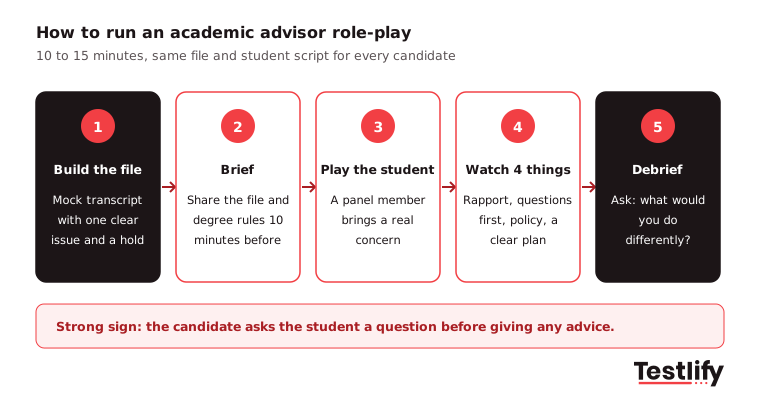
- Build the file: Create a mock transcript with one clear issue, such as low grades in major courses, a missing requirement and a hold.
- Brief the candidate: Share the file 10 minutes before the interview, with the degree requirements for the program.
- Play the student: Have one committee member play a student with a real concern, like wanting to drop a course or change majors.
- Watch for four things: Opening rapport, questions before advice, accurate use of policy, and a clear plan the student can repeat back.
- Debrief: Ask the candidate, "What would you do differently?" Self-awareness here is a strong sign.
Keep the same file and the same student script for every candidate, or you cannot compare them. Across the teams we work with, a consistent role-play does more to separate candidates than any extra round of questions.
How should you score academic advisor interview answers?
Scoring academic advisor interview answers works best with a 1 to 5 scale and short anchors that every panel member agrees on before the first interview. Each interviewer scores alone, then the committee meets to compare, so one strong voice does not decide for the group.
Score | What the answer looks like |
|---|---|
5 | Specific example, student at the center, correct policy, clear next step and a reflection on what was learned |
4 | Specific example and sound judgment, with one small gap such as no follow-up |
3 | Reasonable but general answer, few details, policy roughly right |
2 | Vague or hypothetical when an example was asked for, or policy wrong in a minor way |
1 | No example, wrong on privacy or policy, or dismissive of the student |
Score each skill from the skills map, not just the overall interview. A candidate can be a 5 on empathy and a 2 on caseload management, and that tells you exactly what to coach in the first 90 days.
For a ready template, see what goes into an interview scorecard.
What questions should you avoid in an academic advisor interview?
Questions to avoid in an academic advisor interview are any that touch age, religion, national origin, disability, pregnancy, family plans or other protected traits. These questions are unrelated to how someone advises students, and asking them can expose the institution to a discrimination claim.
The EEOC's page on prohibited employment practices says pre-employment questions should be limited to what is needed to judge whether a person is qualified, and that employers may not ask about disability before an offer. In practice:
- Ask "Can you work evening advising sessions during registration weeks?" not "Do you have children?"
- Ask "Are you legally able to work in the US?" not "Where were you born?"
- Ask about experience with students from many backgrounds, not about the candidate's own background.
Train every panel member on these rules, including faculty who rarely sit on staff searches.
How can a skills test before the interview help?
A skills test before the interview lets the committee check communication, empathy and judgment on every applicant before anyone spends an hour in a panel. Interviews then go deeper on the finalists instead of repeating basic screening, and every candidate is judged on the same evidence.
Retention is a strong reason to get this right. According to CUPA-HR's 2025 Employee Retention Survey of 3,791 higher education staff at 505 institutions, one in four said they were likely or very likely to look for a new job in the next year, with higher pay the top reason.
Each early exit sends the office back to hiring during the busiest weeks of the year.
Testlify lets advising offices build that first screen from 3,500+ tests. Useful picks for this role include the communication test, the empathy test, and the active listening test, plus situational judgment questions built around your own advising scenarios.
One-way video questions can carry the philosophy question, so the panel watches answers before the first call. See how education teams set this up in our guide to pre-hire assessments for the education industry, and for wider higher education hiring, our strategies to hire higher education talent.
Ready to screen advisor candidates on skills first?
Testlify lets you pick the tests that match your advising office and see every applicant scored on the same scale before the first panel. Book a demo to see how it works, or start a 7-day free trial of Testlify with no credit card required.
Frequently asked questions (FAQs)

People and Talent Partner
Arushi Shah runs day-to-day talent acquisition and candidate experience at Testlify. She writes on interviewing, structured hiring, and giving candidates a fair, fast process.
LinkedInRelated resources
View all
Interview questions
30 banker interview questions to ask in 2026

Interview questions
Web designer interview questions: 25 to ask and what good answers sound like

Interview questions
Truck driver interview questions: 40 to ask and how to score them

Interview questions
Marketing internship interview questions: 30 to ask and what to listen for

Interview questions
Interior designer interview questions: 40 to ask in 2026

Interview questions
40 electrician interview questions and what good answers sound like
Get started.
Hire on proof, not resumes.
Run your first skills-based assessment free — no credit card required.