
Recruitment vs talent acquisition: Key differences
Discover the key differences between recruitment and talent acquisition, their best practices, challenges, and how to choose the right hiring strategy for your business.

 ChatGPT
 Gemini
 Claude
 Grok
Grok Perplexity
TL;DR
- 46% of employers cite finding qualified candidates as their biggest challenge in 2026.
- 70% of experienced professionals are not actively looking for a new role at any given time.
- Referral hires close 55% faster than candidates sourced through traditional job boards, making employee referral programs one of the highest-ROI talent acquisition investments available to enterprise HR teams.
- Organizations with pre-built talent pipelines fill critical roles 2x faster and achieve 3x higher offer acceptance rates than organizations that source reactively after a vacancy opens.
- Companies with strong employer branding report 50% lower cost-per-hire compared to organizations without a formal employer brand program.
- Skills-based organizations are more likely to place candidates in roles where they can perform and stay long-term, which is why assessments are now a core component of the talent acquisition strategy.
Recruitment fills today’s vacancy, whereas talent acquisition builds tomorrow’s team.
Most enterprise HR functions understand both terms, but many still run them as a single process, which produces reactive sourcing when the situation demands proactive pipeline work and slow hiring when speed matters most.
This guide helps you understand the difference between recruitment and talent acquisition, covers when each approach fits your hiring context, and outlines the best practices that produce results in both scenarios.

What is recruitment?
Recruitment is the short-term process of identifying, attracting, screening, and selecting candidates to fill an immediate job vacancy. It is a reactive approach triggered by an open position rather than by a workforce plan.
Recruitment uses standardized tools and channels to reach active job seekers and move them through a structured hiring process. Recruiters rely on a combination of sourcing methods to fill roles efficiently:
- Job postings on career sites and job boards
- Applicant tracking systems (ATS) for screening and pipeline management
- Employee referrals and internal mobility programs
- Video interviews for initial candidate evaluation at scale
Some organizations outsource recruitment to external agencies for high-volume or specialist roles where internal capacity is constrained. Maintaining an in-house recruiter gives stronger control over hiring quality and cultural alignment, while agencies trade that control for speed and specialist reach.
Recruitment works well for industries with predictable, repeating vacancy patterns such as retail, customer service, and hospitality. Its reactive structure makes it less effective for long-term workforce planning or roles where the strongest candidates are not actively searching.
What is talent acquisition?
Talent acquisition is a long-term, strategic approach to building the workforce a business will need over the next 12 to 36 months. It encompasses workforce planning, employer branding, and relationship-building with passive candidates before vacancies open.
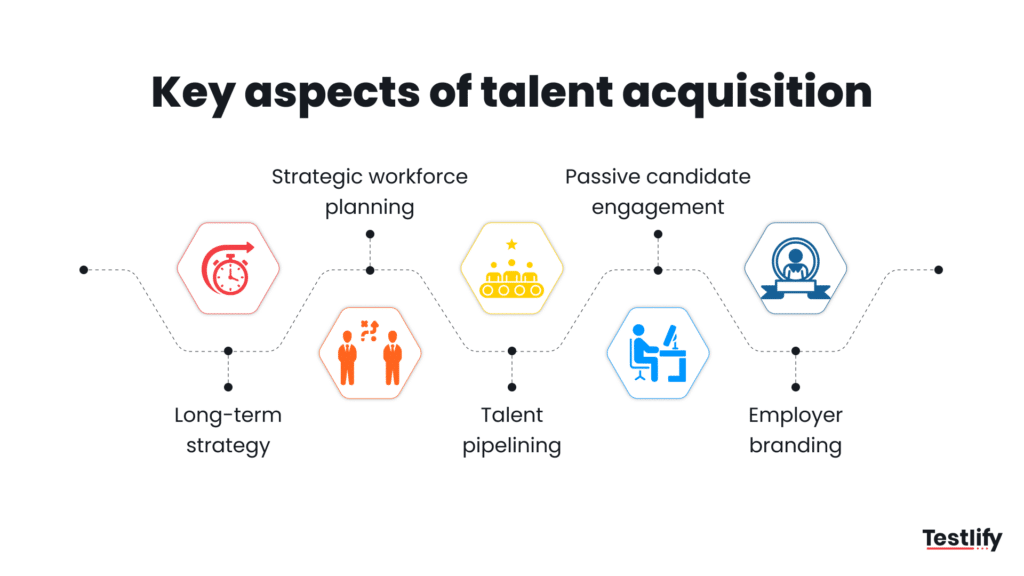
Talent acquisition professionals build relationships with skilled professionals through social media recruiting, university partnerships, employee referral programs, and industry networking.
A well-executed talent acquisition strategy produces a pre-vetted talent pipeline that the organization can draw from the moment a critical role opens. Companies that invest in talent acquisition report faster time-to-fill on hard-to-source roles.
For leadership and business-critical positions, talent acquisition is the only approach that reliably reaches the 70% of professionals who are not actively looking for a new role at any given point.
How do recruitment and talent acquisition differ?
The core difference is time horizon: recruitment operates vacancy by vacancy while talent acquisition operates on a workforce-planning basis.
Applying recruitment logic to a role that requires talent acquisition thinking is one of the most common reasons enterprise hiring slows down or produces candidates who do not meet the quality bar.
87% of companies now use AI somewhere in their recruiting process, but technology does not close this gap on its own. The gap between recruitment and talent acquisition is a strategic intent gap that determines how quickly an organization can respond when a critical role opens unexpectedly.
Dimension | Recruitment | Talent Acquisition |
|---|---|---|
Approach | Reactive: fills positions as they become vacant | Proactive: anticipates future talent needs before vacancies arise |
Time horizon | Short-term: priority is filling the role quickly | Long-term: priority is building a sustainable talent pipeline |
Sourcing methods | Job boards, ATS, direct applications, active candidates only | Networking, passive sourcing, referrals, social media, alumni outreach |
Candidate evaluation | Assessed on immediate job-specific skills and availability | Assessed on long-term cultural fit, leadership potential, and growth trajectory |
Employer branding | Not a primary focus; emphasis is on filling the vacancy | Core investment; strong branding reduces cost-per-hire by 50% at scale |
Relationship management | Minimal: relationship typically ends at hire or rejection | Ongoing: pre-hire and post-rejection relationships maintained in pipeline |
Best suited for | High-volume, predictable roles: retail, hospitality, customer service | Specialist, leadership, and hard-to-fill roles: tech, healthcare, finance |
Key Takeaway: Recruitment and talent acquisition are not interchangeable. Using recruitment logic to fill a specialist or leadership role consistently produces slower time-to-fill, lower offer acceptance rates, and higher mis-hire costs compared to a talent acquisition approach.
Should your company recruit or acquire talent?
The right answer depends on three factors: role type, the cost of a mis-hire, and whether the strongest candidates are actively or passively in the market. High-volume roles with predictable patterns and large active talent pools fit a recruitment model, whereas specialist and leadership roles fit a talent acquisition model.
If your organization faces high employee turnover, talent acquisition addresses the root cause more effectively than recruitment because it builds a pre-vetted pipeline rather than restarting sourcing each time a vacancy opens.
Organizations with pre-built talent pipelines fill critical roles 2x faster and report 3x higher offer acceptance rates than those sourcing reactively.
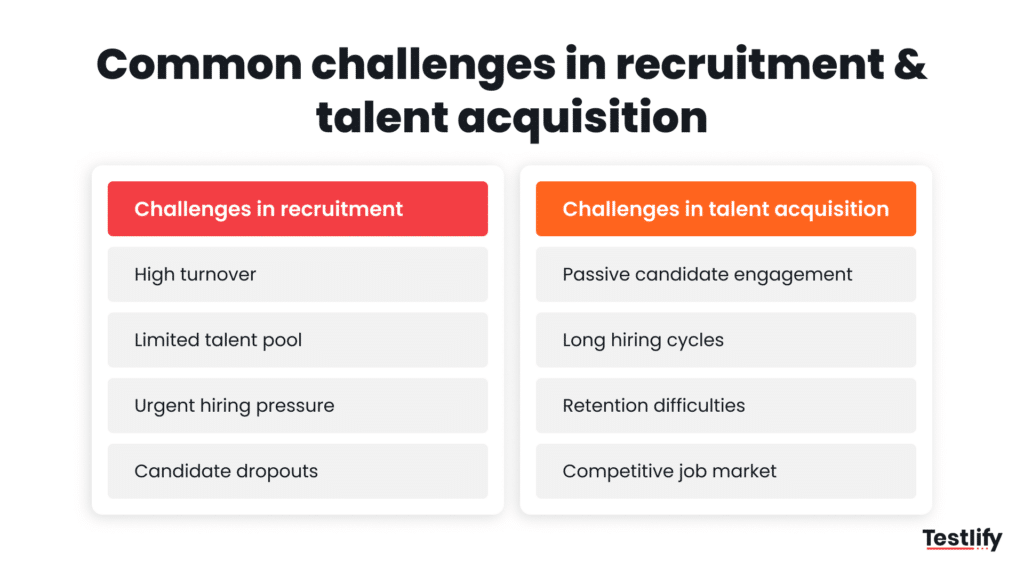
If your industry has a talent shortage or your most critical roles require specialized expertise that cannot be developed internally within 6 months, talent acquisition is the stronger investment.
The most effective enterprise hiring strategies combine recruitment and talent acquisition, using recruitment to fill high-volume, time-sensitive vacancies and talent acquisition to build a sustainable pipeline for hard-to-fill roles.
Best practices for recruitment and talent acquisition
The practices that improve recruitment outcomes are not the same ones that improve talent acquisition outcomes. Matching the right technique to the right hiring context is where enterprise HR teams find the largest gains in velocity and quality of hire.
Best practices for recruitment
Effective recruitment requires process efficiency and measurement discipline. The goal is to reduce time-to-hire and cost-per-hire without sacrificing quality, which means knowing exactly where candidates drop out and which sourcing channels deliver the best return.
- Screen with structured assessment: Adding a skills assessment before first-stage calls produces a scored shortlist rather than a judgment-based one, reducing the time hiring managers spend on candidates who do not meet the competency threshold.
- Diversify sourcing channels: Expand beyond job boards by combining employee referrals and specialist recruitment agencies for roles where active-candidate pools are thin.
- Communicate clearly at every stage: Providing status updates at defined intervals and setting clear expectations reduces candidate dropout before the offer stage, where attrition is most costly.
- Track the metrics that predict hiring quality: Monitor quality-of-hire at 90 days, offer acceptance rate, and screen-to-qualified ratio alongside time-to-fill. For a full breakdown, see our guide to recruitment KPIs.
Best practices for talent acquisition
Talent acquisition ROI is built through consistency rather than campaign bursts. A talent community maintained through regular touchpoints produces warmer candidates and faster time-to-offer than a pipeline built reactively each time a critical role opens.
- Build and maintain a talent pipeline: Engage with passive candidates and maintain a pre-vetted pool for the role families your business hires repeatedly. Organizations with pre-built pipelines fill critical roles 2x faster and achieve 3x higher offer acceptance rates than organizations sourcing reactively.
- Invest in employer branding: A visible, credible employer brand is the highest-ROI talent acquisition investment an HR team can make, reducing sourcing costs while attracting higher-quality candidates.
- Use data to drive sourcing decisions: Predictive analytics and pipeline funnel data identify which channels produce the highest-quality candidates at the lowest cost per qualified applicant, making sourcing investment decisions defensible.
- Align onboarding with acquisition goals: Connect structured onboarding with the talent acquisition cycle to track whether pipeline hires outperform reactive hires on 12-month tenure.
Pro Tip: The organizations that outperform on hiring speed and quality are almost always those that invested in talent pipelines before the market tightened, not after.
Final thoughts
Recruitment and talent acquisition are complementary tools applied to different hiring contexts: recruitment for speed and volume, talent acquisition for quality and pipeline continuity. Testlify gives enterprise HR teams the assessment layer that makes both approaches more effective.
Whether you are screening a high-volume recruitment pipeline or evaluating finalists in a long-cycle talent acquisition process, Testlify’s 3,500+ role-specific assessments produce scored, comparable candidate data at every stage.
Book a demo to see how Testlify helps your team screen smarter, shortlist faster, and hire with greater confidence.
Frequently asked questions (FAQs)

B2B SaaS Content Writer
Rishav Kumar is a B2B SaaS content writer with 4 years of experience. He loves crafting engaging content. Always exploring fresh ideas, he's passionate about helping businesses grow through impactful writing.
LinkedInRelated resources
View all
Hiring Guide
How to succeed at recruiting generation Z employees?

Hiring Guide
Heuristic Bias in Hiring: Types and How to Reduce It

Hiring Guide
5 high volume recruitment strategies to adopt in 2026

Hiring Guide
Talent matching: what it is and how it works

Hiring Guide
What is interview scheduling and how to do it?

Hiring Guide
What is affinity bias and how to avoid it in 2026?
Get started.
Hire on proof, not resumes.
Run your first skills-based assessment free — no credit card required.