
Talent matching: what it is and how it works
Discover what talent matching is, how it works, the pros and cons, leading platforms, and the future of AI-driven hiring in today’s workforce.

Talent matching is how you line up a person’s real skills against what a role actually needs, instead of guessing from a resume. Get it right and the shortlist is stronger before the first interview. Get it wrong and you pay for it twice: once in a slow hire, and again when the wrong person leaves.
The stakes are rising because the skills underneath most jobs keep shifting. McKinsey research found that 87% of companies worldwide either already have a skills gap or expect one within a few years, split between 43% who see it today and 44% who expect it inside five years. The World Economic Forum puts a number on the churn: employers expect 39% of workers’ core skills to change by 2030. When the ground moves that fast, matching people to roles by title alone stops working.
 ChatGPT
 Gemini
 Claude
 Grok
Grok Perplexity
TL;DR
- Talent matching connects what a person can actually do to what a role needs, using measured skills instead of resume guesswork.
- It comes in two forms: internal (moving current employees into new roles) and external (screening new candidates).
- Done well, it cuts mismatched hires, speeds up shortlisting, and improves retention because people land in work that fits their strengths.
- The skills gap is the reason it matters now: McKinsey research found 87% of companies already face a skills gap or expect one soon.
- A good platform scores role-relevant skills, keeps a human in the decision, and plugs into your ATS. Testlify covers the assessment and screening part of that stack.

What is talent matching?
Talent matching is the process of finding the right people by comparing their skills and experience to the competencies a specific role requires. It uses assessments, data, and AI-assisted scoring to weigh what a person can do against what the job demands, then leaves the final hiring call to a human.
There are two types. Internal talent matching moves existing employees into new roles or projects inside the same organization. External talent matching finds new candidates outside the company who hold the skills you need. Both answer the same question: who is the closest fit for this work, and how do we know?
How does talent matching work?
Talent matching works by gathering data on a role and on candidates, using technology to compare the two, and refining the criteria with feedback after each hire. It runs in six practical steps.
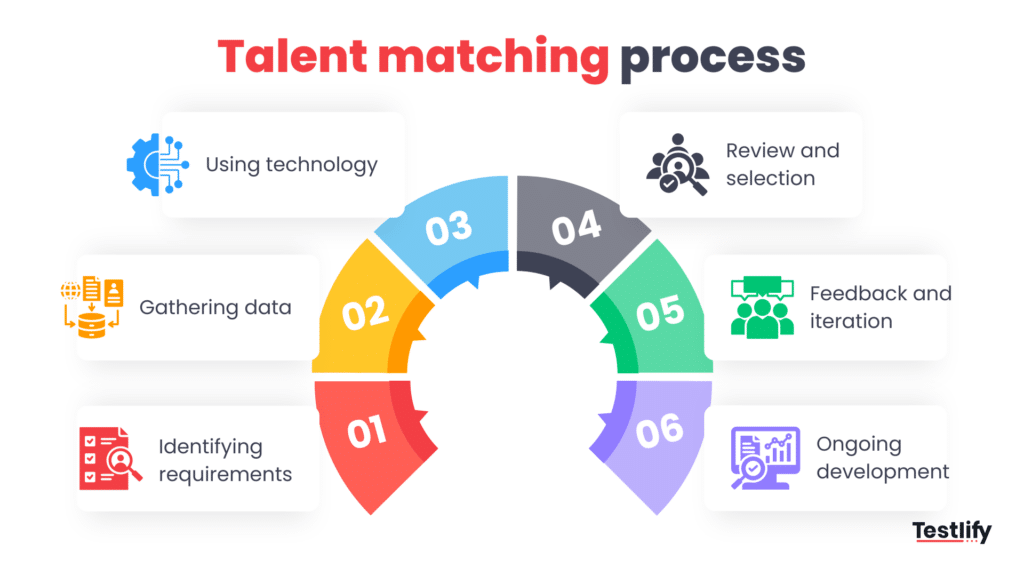
- Define the role. Set out the skills, experience, and outcomes the role needs in a clear job description. Short on time? Testlify has a free AI job description generator to start from.
- Gather evidence. Collect resumes and applications for external hiring, or skills profiles and performance data for internal moves. Add a skills test where it matters so you measure ability, not just claims.
- Score the fit. A talent management system or ATS with AI scoring compares each candidate’s skills to the role and ranks the closest matches.
- Review with people. Your hiring team reviews the ranked matches, weighs culture add and growth potential, and interviews the strongest fits. The system suggests; humans decide.
- Collect feedback. After a hire, ask the hiring manager what the match got right and wrong, and feed that back into the criteria.
- Keep tuning. Refresh benchmarks and weights as the role changes, so the match stays honest a year from now.
Internal vs external: what is the difference?
Internal talent matching redeploys people you already employ; external talent matching brings in new hires. Internal is faster and cheaper because the skills data already exists, but the pool is small. External hiring widens the pool at the cost of more screening. Most teams run both, and the table below shows when each earns its place.
Dimension | Internal talent matching | External talent matching |
|---|---|---|
Talent source | Current employees | New candidates |
Primary objective | Redeploy existing talent | Acquire new talent |
Speed to fill | Faster, skills data already available | Slower, requires sourcing and screening |
Cost | Lower, minimal hiring costs | Higher, includes sourcing and recruitment expenses |
Time to productivity | Shorter, employees know the business | Longer, onboarding and ramp-up required |
Hiring risk | Lower, performance history is known | Higher, limited real-world performance data |
Skills visibility | Based on internal assessments and records | Based on resumes, assessments, and interviews |
Best for | Internal mobility, promotions, succession planning | Business expansion, new capabilities, hard-to-fill roles |
Candidate experience | Boosts engagement and career growth | Builds employer brand and talent pipeline |
Employee retention | Improves retention by creating growth opportunities | Does not directly improve retention of existing staff |
Learning needs | Upskilling or reskilling may be required | Candidates often bring required skills immediately |
Cultural fit | Already aligned with company culture | Must be evaluated during hiring |
Diversity of ideas | Limited to existing workforce | Brings fresh perspectives and experiences |
Innovation potential | Builds on existing institutional knowledge | Introduces new skills and external best practices |
Data available | Rich internal performance and skills data | Limited to hiring-stage information |
Compliance considerations | Easier to manage internally | Additional background checks and documentation required |
Scalability | Limited by current workforce size | Larger talent pool with broader reach |
Main challenge | Smaller pool for niche or emerging skills | More competition for top talent |
Success metrics | Internal mobility, retention, promotion rate | Quality of hire, time-to-fill, cost-per-hire |
Ideal use cases | Career progression, succession, urgent backfills | Growth hiring, new markets, specialized expertise |
What are the benefits of talent matching?
The core benefit is a better fit between person and role, which then pays off across speed, cost, and retention. Here is where the value shows up.
- Stronger fit. Matching on measured skills puts people in roles they can actually do, so they ramp faster and stay longer. Gallup found that when people apply their strengths daily, they are 6x as likely to be engaged at work.
- Faster shortlists. Scoring skills against the role surfaces is the closest fit without reading every resume by hand.
- Lower hiring cost. Fewer mismatches mean fewer rehires. Gallup estimates that replacing an employee costs one-half to two times their annual salary, roughly 50% to 200% of the pay for that role.
- Internal mobility. Employees find new roles that fit their skills, which supports career growth and keeps knowledge in-house.
- Less bias. Data-driven scoring on job-relevant skills reduces the pull of names, schools, and gut feel, if the tests behind it are fair.
- Higher retention. People in work that suits their strengths are more engaged and less likely to leave, which lowers turnover.
What are the challenges of talent matching?
Talent matching is only as good as the data and the criteria behind it. Four problems trip teams up most often.
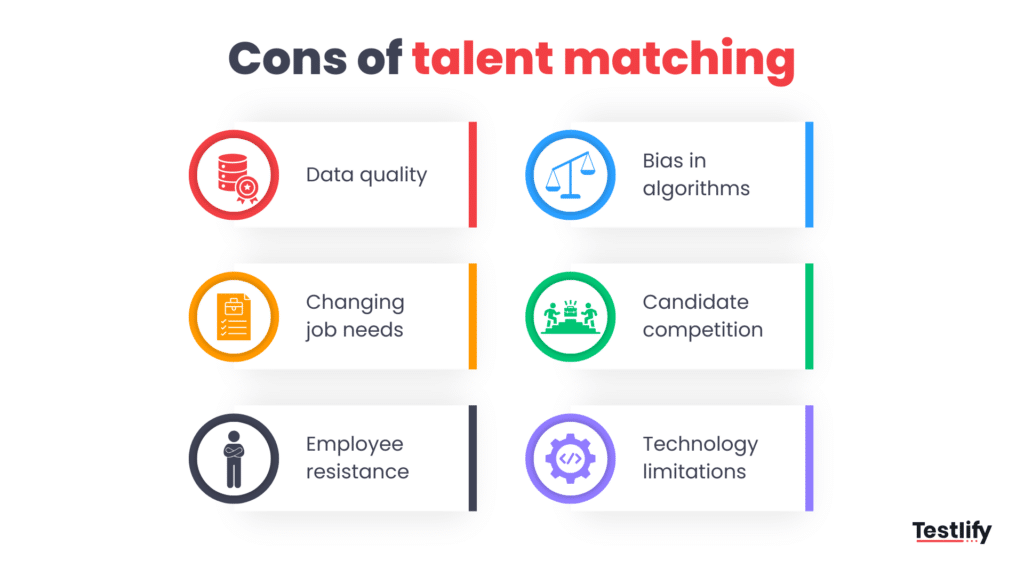
- Patchy data. If candidate or role data is thin or out of date, the match is a guess dressed up as a score. Fix the inputs first.
- Biased algorithms. A model trained on biased hiring history will repeat it. Audit the criteria and check outcomes across groups; do not assume the software is neutral.
- Moving targets. Roles change fast, and stale benchmarks match people to a job that no longer exists. With 39% of core skill sets set to shift by 2030, the criteria need regular refreshes.
- Over-trusting the score. A match score is evidence, not a verdict. Culture add, motivation, and growth potential still need a human read.
What is a talent matching platform?
A talent matching platform is software that compares candidate skills, experience, and preferences against role requirements and ranks the closest fits. It uses assessments, data analytics, and AI to turn scattered signals into a shortlist your team can act on.
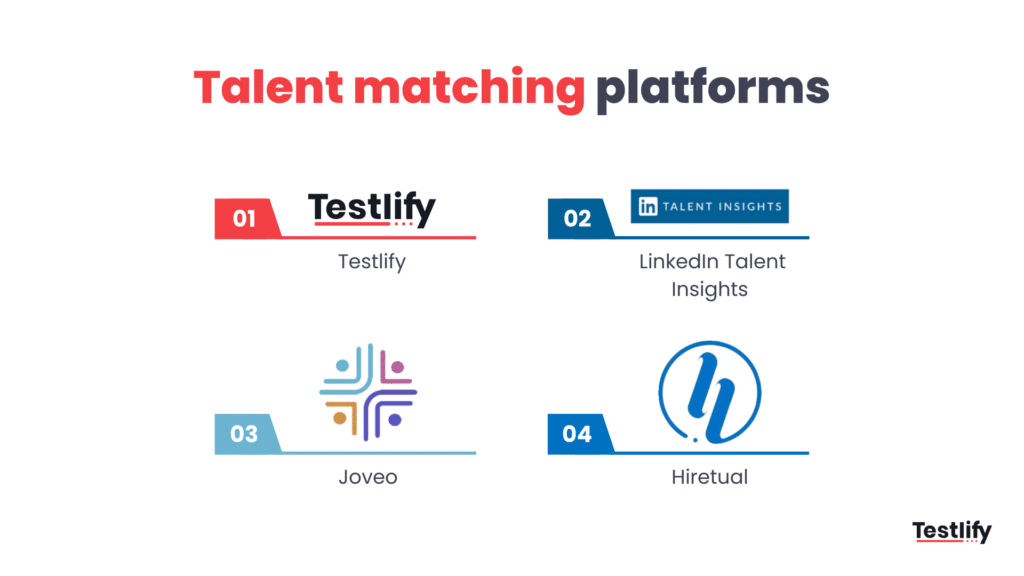
Strong platforms share a handful of features:
- Skills assessment. Measures ability directly so the ranking rests on evidence, not self-reported claims.
- Role-relevant scoring. Weighs the skills that matter for the role, not a generic checklist.
- Bias controls. Scores on job-relevant data and supports fair, structured review.
- Talent pipelines. Keeps a pool of assessed candidates ready when a role opens.
- ATS integration. Pushes the shortlist into the system your team already uses.
How do you choose a talent matching platform?
Choose a talent-matching platform by starting with the role, not the tool. Map the competencies the role needs, decide what evidence proves each one, then buy the software that measures that evidence and fits your workflow. That order is the Testlify Competency-to-Evidence Matrix: define the role, connect each competency to a measurable signal (an assessment, a work sample, a structured interview), and score candidates on those signals rather than on a resume.
Weigh candidates against five practical criteria:
- Assessment depth. Does it test the skills your roles actually need, across technical and soft skills?
- Fairness and integrity. Can you audit the scoring, and does it guard against cheating so results hold up?
- Human-in-the-loop. Does it hand people clear evidence to decide with, rather than a black-box verdict?
- Integrations. Does it connect to your ATS so the shortlist does not live in a silo?
- Reporting. Can you see skill-level breakdowns and compare candidates side by side?
Pro tip: before you compare vendors, write the one competency you cannot afford to get wrong for the role and the exact test that would prove it. If a platform cannot measure that, it will not fix your matching, no matter how good the AI looks in the demo.
A quick worked example: a 300-person software company hiring a mid-level data analyst maps the role to three must-have competencies: SQL, business communication, and problem-solving. It sets a SQL test, a short written brief, and a case interview as the evidence for each. Candidates who clear the SQL and brief move to the interview, so the hiring manager spends time only on people who have already proved the hard skills. The 40-resume pile becomes a 6-person shortlist scored on the same yardstick.
What is the future of talent matching?
The future of talent matching is skills-first and AI-assisted, with people still holding the decision. As roles keep changing, teams will lean harder on skills data to match talent to work, both inside and outside the company. The WEF’s Future of Jobs report expects churn on a large scale by 2030: 170 million new roles created, 92 million displaced, for a net gain of 78 million jobs, and job disruption touching 22% of roles.
That churn rewards teams who can read skills quickly and redeploy people fast. Expect richer skills profiles, matching that spans internal and external pools at once, and tighter links between pre-hire evidence and post-hire performance. The constant is the guardrail: AI surfaces and ranks the evidence, and a person makes the call. For a wider view of where this is heading, see how skills mismatch is reshaping hiring.
Key takeaways
- Match on skills, not titles. Talent matching compares measured ability to role needs, which matters because 87% of companies already face or expect a skills gap. Score the skills that predict success and the shortlist improves before you interview anyone.
- Run both internal and external. Internal matching is faster and cheaper but limited by a small pool; external widens reach at a higher screening cost. Using both means you fill niche roles without overpaying to source common ones.
- Fit drives retention and cost. People who use their strengths are 6x as likely to be engaged, and replacing a bad hire costs 50% to 200% of the role’s salary. Better matching protects both numbers at once.
- Guard against bad data and bias. A match is only as fair as its inputs, so audit the criteria and refresh benchmarks as roles change; with 39% of core skills shifting by 2030, stale weights match people to jobs that no longer exist.
- Keep humans in the decision. Treat AI scores as evidence for a person to weigh, not a verdict. That is what keeps matching defensible and catches the culture-add signals data misses.
- Start with the role, then pick the tool. Map competencies to evidence first, then choose a platform that measures that evidence and connects to your ATS. The tool follows the plan, never the other way around.
Frequently asked questions (FAQs)

Related resources
View all
Hiring Guide
What is interview scheduling and how to do it?

Hiring Guide
What is affinity bias and how to avoid it in 2026?

Hiring Guide
HR checklist for 2026: Key steps you can’t miss

Hiring Guide
White Collar vs Blue Collar Jobs: Key Differences (2026)

Hiring Guide
Practical tips for HR to optimize working days

Hiring Guide
What is involuntary turnover? Formula, types, best practices
Get started.
Hire on proof, not resumes.
Run your first skills-based assessment free — no credit card required.