
What is predictive validity and why do recruiters need it?
Discover what predictive validity is and why it matters in recruitment. Learn how data-driven tools like Testlify can help build a future-ready workforce.

Are you investing weeks into hiring a candidate, only to realize months later that they aren’t a good fit for the role? That is very frustrating, isn’t it?
A report published by Forbes points out that a bad hire could cost a company up to 30% of the employee’s annual salary or $240,000 for senior roles. This underscores the urgent need for tools to forecast success before hiring.
That’s where predictive validity might help you out! It is a metric that assists recruiters in identifying candidates who are not only impressive on paper but are also likely to thrive in their roles over time.
For recruiters, grasping the concept of predictive validity goes beyond just reducing hiring risks. It’s about creating a team that drives long-term growth and reduces turnover.
In this guide, we’ll explore what predictive validity is, why it’s important, and how it can help you to create a stronger workforce.
 ChatGPT
 Gemini
 Claude
 Grok
Grok Perplexity
What is predictive validity?
Predictive validity refers to psychometrics and statistics concepts that evaluate how well a test or tool can predict future behavior or performance.
In simpler terms, It is a type of validity that measures whether the results of an assessment today can accurately forecast future outcomes, such as job success or task performance.
For example, in recruitment, a pre-employment test with strong predictive validity ensures that candidates who score high test scores are likely to excel in their roles. This makes it a powerful tool for organizations looking to reduce hiring risks. Predictive validity works by examining the relationship between two key factors:
- Test results
- Future performance
The strength of the connection is often measured using a correlation coefficient, which indicates how closely the test results are related to actual job success.
The stronger the positive correlation between these two, the higher the test’s predictive validity. For example, a correlation coefficient of 0.7 or above typically indicates strong predictive power.
This idea is commonly applied in fields such as recruitment, education, social science research, and psychology.

Why is predictive validity important in recruitment?
Every hiring decision carries significant weight, and the consequences of a bad hire can ripple across an organization. It is not only a matter of replacement costs but also how a bad hire impacts the team’s morale.
Additionally, it can disrupt the workflow and slow down productivity. This is why predictive validity is not just a theoretical idea—it’s a practical answer to one of the biggest challenges in recruitment.
Predictive validity enables recruiters to move past guesswork and intuition by offering a dependable method for evaluating candidates.
For example, a test designed with high validity might evaluate a candidate’s analytical abilities and show a strong positive correlation with their future performance in problem-solving roles.
Moreover, predictive validity helps minimize the chances of hiring mismatches, which are a significant factor in high employee turnover.
When candidates are selected based on role requirements and future performance potential, they are more likely to thrive. They also tend to stay with the company longer. This improves retention rates and builds more substantial, more unified teams.
Integrating tools that carry high predictive validity into their recruitment strategies helps businesses not just hire for today but invest in tomorrow.
How Testlify’s assessments ensure high predictive validity?
In recruitment, tools with high predictive validity are the cornerstone of successful hiring. Testlify stands out by offering assessments that go beyond generic testing. Here’s how Testlify achieves high predictive validity while adding real value to recruitment.
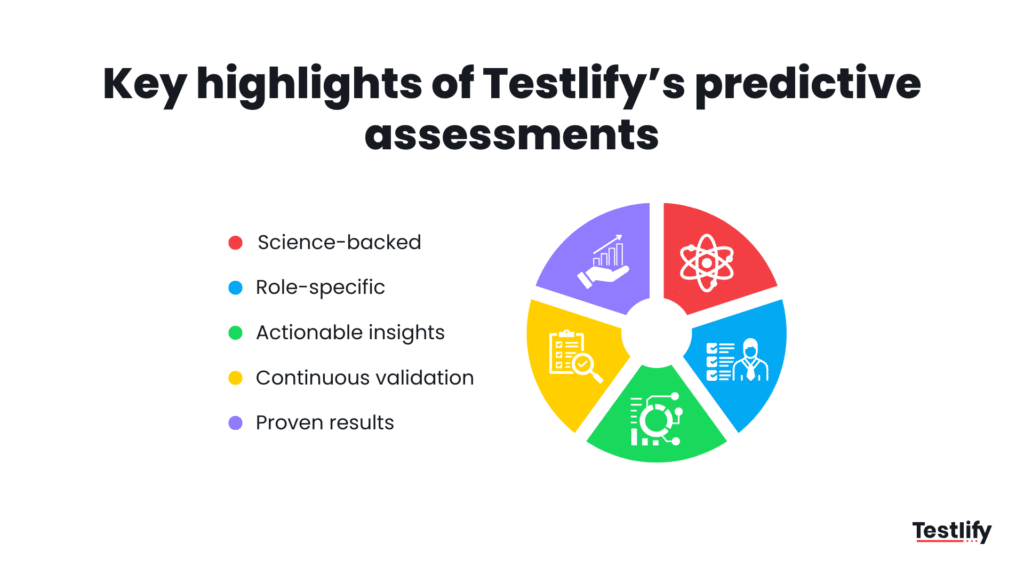
- Built on science and data: Testlify’s tests are grounded in psychometrics and data-backed methodologies. They are designed to measure the exact skills and traits linked to job success. Whether it’s problem-solving or communication, every test is validated to ensure it predicts real-world performance.
- Tailored for every role: Generic assessments can only go so far. Testlify takes a role-specific approach. It offers tests that evaluate the unique demands of each job. This ensures recruiters get insights that matter, not just generic results.
- Actionable insights, not just scores: With Testlify, recruiters don’t just see test scores. They get detailed reports highlighting how a candidate’s performance aligns with the role’s requirements.
- Constantly validated for accuracy: Predictive validity isn’t a one-and-done process. Testlify continuously validates its assessments against real-world performance data. This ensures the tests stay accurate and relevant.
- Proven results that matter: Companies using Testlify have reported significant improvements in hiring outcomes.
With Testlify, predictive validity is a reliable way to make better hiring decisions. These assessments measure skills and create opportunities to build more capable teams.
How to measure predictive validity?
Predictive validity is about verifying whether a test can predict future job performance. It begins with identifying the criterion variable. This is basically a specific outcome you aim to predict, like retention rates, sales performance, or customer satisfaction. For example, a test of analytical skills should predict success in data-driven roles.
Once the test is administered, the test scores are documented. Their practical performance is monitored over time based on measurable data. These measurable data include the achievement of KPIs or sales targets. This process ensures that the test results correspond with actual job outcomes.
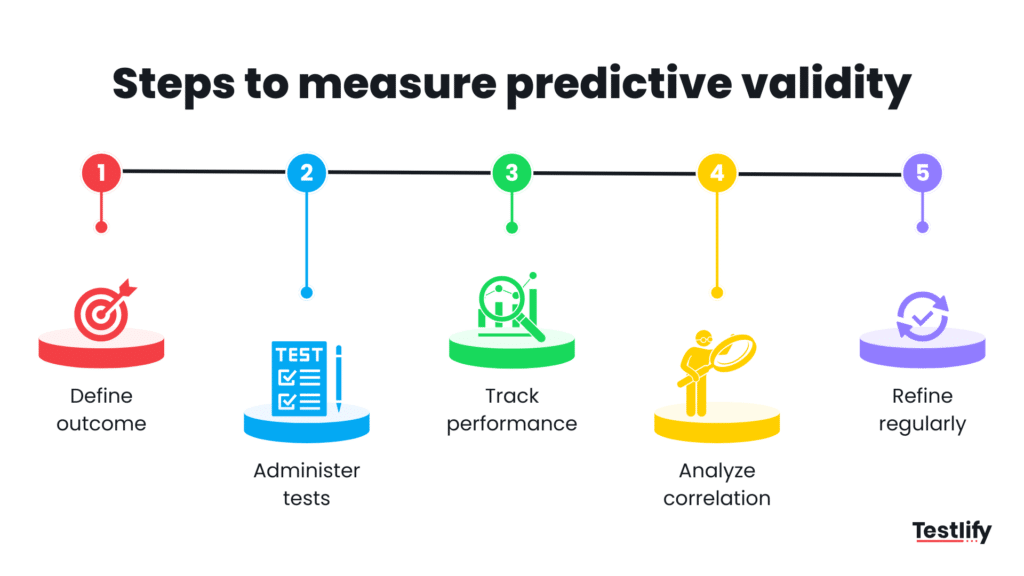
Next, the relationship between test scores and job performance is examined through a correlation coefficient. A high positive correlation, for example, 0.8, indicates strong predictive validity. In simple terms, the test is a reliable predictor of future success.
For example, a pre-employment test predicting project management success might show a strong correlation with timely project completion.
Predictive validity should be rechecked at regular intervals. Market conditions and job roles change over time, and tests need to adapt. Testlify validates their assessments continuously to ensure they are relevant and in line.
Predictive validity vs. Concurrent validity: Clearing the confusion
Two commonly used methods for validating tests in recruitment are predictive validity and concurrent validity. While they may seem similar, their focus and applications are distinct. Here’s a quick comparison to make it clear,
Aspect | Predictive Validity | Concurrent Validity |
|---|---|---|
Focus | Predicts a candidate’s future behavior or performance. | Measures the relationship between test results and current performance. |
Timing | Test scores are collected before hiring, and performance is evaluated later. | Test scores and performance data are collected simultaneously. |
Purpose | Helps in forecasting long-term job success, reducing hiring risks. | Validates whether a test aligns with existing performance benchmarks. |
Example | A sales aptitude test predicts how well a candidate will meet sales targets after joining the company. | A leadership test correlates the scores of current managers with their performance reviews. |
Best Use Case | Ideal for recruitment to build a future-ready workforce. | Useful for internal assessments like promotions or skill evaluations. |
Predictive validity is the better choice when hiring for future roles, as it aligns with long-term organizational goals. Concurrent validity works best for validating tests quickly. It provides immediate insights into whether a test aligns with current performance metrics.
Final thoughts
Predictive validity is more than a concept! It’s a proven approach you can use for smarter hiring. It ensures that assessments are reliable. This helps recruiters identify candidates who align with job requirements and have the potential to succeed.
Don’t leave hiring to guesswork. With platforms like Testlify, you can make data-backed decisions and minimize errors. Start today and see the difference!
Frequently asked questions (FAQs)

B2B SaaS Content Writer
Rishav Kumar is a B2B SaaS content writer with 4 years of experience. He loves crafting engaging content. Always exploring fresh ideas, he's passionate about helping businesses grow through impactful writing.
LinkedInRelated resources
View all
HR & recruitment
Employee autonomy: what it is and how to build it

HR & recruitment
What is skills intelligence: Components, benefits and tips

HR & recruitment
30 virtual team building activities for remote teams

HR & recruitment
What is a job requisition & position: A guide for hiring managers

HR & recruitment
Top HR programs every organization should have
HR & recruitment
Gamified assessments: types, examples and benefits
Get started.
Hire on proof, not resumes.
Run your first skills-based assessment free — no credit card required.