
Employee autonomy: what it is and how to build it
What employee autonomy really means, why it drives retention and performance, how to implement it across remote and hybrid teams, and where enterprise programmes fail.

TL;DR
- Employee autonomy is not the absence of oversight — it is the presence of trust, backed by clarity on goals and accountability for outcomes. Organisations that confuse the two build cultures that feel empowering but produce chaos.
- Employees with high autonomy are 2.3 times more likely to perform at their best and 2.3 times more likely to stay. (Gartner, 2023)
- The primary blocker to autonomy at enterprise scale is not employee readiness — it is manager capability. Managers who cannot delegate effectively cannot create autonomous teams regardless of policy.
- Autonomy needs to be calibrated by role, seniority, and skill level. A new hire with full autonomy is not empowered — they are unsupported. Skills-based assessment before autonomy expansion reduces failure rates significantly.
- Remote and hybrid teams need explicit autonomy frameworks — schedule autonomy, task autonomy, and decision autonomy each require different governance. Leaving it implicit produces inconsistency across managers.
- The highest-ROI implementation sequence: goals clarity first, then decision rights, then schedule flexibility. Most organisations do it in reverse and wonder why autonomy programmes stall.
- High-compliance industries (finance, healthcare, legal) can implement meaningful autonomy without sacrificing compliance — the constraint is on method choice within defined guardrails, not on outcomes or pace.
Your highest performers are leaving. Not for a competitor — for themselves. They are starting consultancies, freelancing, or joining early-stage companies that give them one thing their current role does not: the ability to decide how their work gets done. Employee autonomy is not a retention perk. It is the reason your best people stay or go.
This guide covers what employee autonomy actually means (and what it is not), why it drives measurable business outcomes, how to implement it by role and environment, and where enterprise HR teams consistently get it wrong.
 ChatGPT
 Gemini
 Claude
 Grok
Grok Perplexity
What is employee autonomy?
Employee autonomy is the degree of independence employees have to decide how, when, and where they do their work — without constant managerial oversight. It is not the same as flexibility (which is about schedule) or freedom (which implies no accountability). Autonomous employees own their outcomes; the method is theirs to choose within agreed guardrails.
Understanding the four dimensions of autonomy — and which ones you are actually granting — is what separates effective programmes from vague empowerment initiatives.

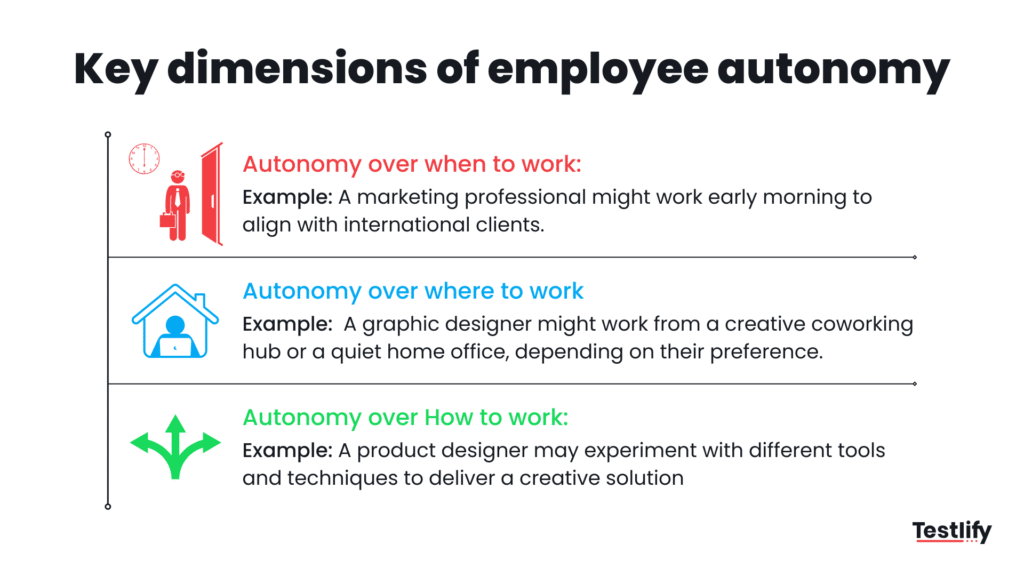
Key dimensions of employee autonomy
Most organisations grant one dimension of autonomy — usually schedule flexibility — and call it done. The employees who leave for more autonomous roles are rarely leaving because of when they work. They are leaving because of how much control they have over what they work on, how they approach it, and what decisions they can make without approval. Autonomy has four distinct dimensions, and each requires a different governance structure to work at scale.
Task autonomy
The employee chooses what to work on and in what order. Common in knowledge work roles — product managers, researchers, content teams — where the employee is better positioned than the manager to sequence work for impact.
Schedule autonomy
The employee decides when they work. Asynchronous-first remote teams operate almost entirely on schedule autonomy. It requires output-based performance management rather than hours-based.
Method autonomy
The employee chooses how to accomplish a defined goal. The outcome is set by the organisation; the approach is set by the employee. The most common and most practical starting point for enterprises moving from micromanagement.
Decision autonomy
The employee makes decisions within a defined scope without approval. Calibrating the scope of decision autonomy by seniority and role is what makes it scale in enterprise environments without creating governance gaps.
Autonomy vs flexibility: what’s the difference?
Flexibility describes when and where work happens — a 4-day week, remote work, adjusted hours. Autonomy describes control over the work itself — what gets done, how, and by whom. An employee can have schedule flexibility with zero task autonomy (a call centre agent who can work from home but must follow a script). The two are often conflated in HR communications, which is why autonomy programmes frequently under-deliver: flexibility is granted, autonomy is not.
Autonomy vs freedom: why the distinction matters
Freedom implies no constraints. Autonomy implies self-governance within a structure. The accountability framework is what makes autonomy sustainable in organisations — autonomous employees are responsible for outcomes, not just empowered to choose methods. Wells Fargo’s 2016 scandal is the canonical enterprise cautionary tale: outcome targets were set, methods were unconstrained, accountability was absent. The result was not autonomy — it was anarchy with a quota attached.
Knowing what autonomy is — and is not — makes the case for it much easier to build. The business data is what moves enterprise leadership.
Why employee autonomy matters
Autonomy is consistently ranked among the top three factors in employee engagement surveys — above compensation for high-performing knowledge workers. (Gallup, 2023) The reason is psychological: autonomy satisfies the human need for self-determination — the sense that your actions are self-chosen rather than externally imposed. That distinction drives commitment in a way that incentive structures cannot replicate.
What are the benefits of employee autonomy?
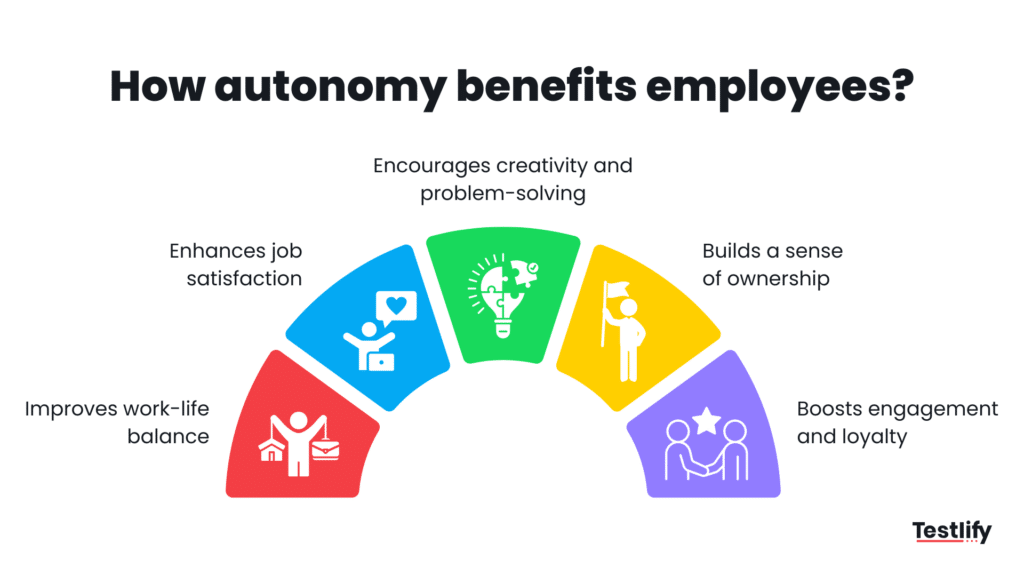
Employees with meaningful autonomy report higher job satisfaction, lower burnout rates, and stronger intrinsic motivation — the kind that does not require external incentives to sustain. (HBR, 2021) The mechanism is straightforward: when people control how they accomplish their work, they apply more cognitive effort and ownership to it. Micromanagement produces compliance; autonomy produces commitment.
Beyond individual wellbeing, 79% of organisations currently fail to adequately integrate employee wellbeing into work design — a gap that autonomy directly addresses by giving employees agency over the conditions in which they work. (Deloitte Human Capital Trends, 2020)
Why is employee autonomy important for retention?
Gartner’s research shows employees with high autonomy are 2.3 times more likely to stay in their organisation. (Gartner, 2023) The retention mechanism is not loyalty — it is the absence of the primary reason high performers leave: loss of control over their own work. When the choice is between staying at a company with meaningful autonomy or building that control by going independent, many choose the latter. Autonomy removes that calculus.
For enterprise HR, the financial case is straightforward: replacing a mid-level knowledge worker costs 50-200% of annual salary. A structured autonomy programme that improves retention by 10% in a 500-person engineering team produces a calculable ROI before any productivity uplift is counted.
The retention data is compelling — but it understates the full organisational case, which is why the business-impact section is where enterprise HR wins the budget conversation.
How employee autonomy drives business results
The individual benefits of autonomy — higher satisfaction, lower burnout, stronger retention — translate directly into organisational performance. Three datasets make the business case in terms that move budget conversations: profitability, innovation output, and decision speed. Each is measurable, each is linked to autonomy in primary research, and each compounds over time in ways that are difficult to achieve through other people-management levers.
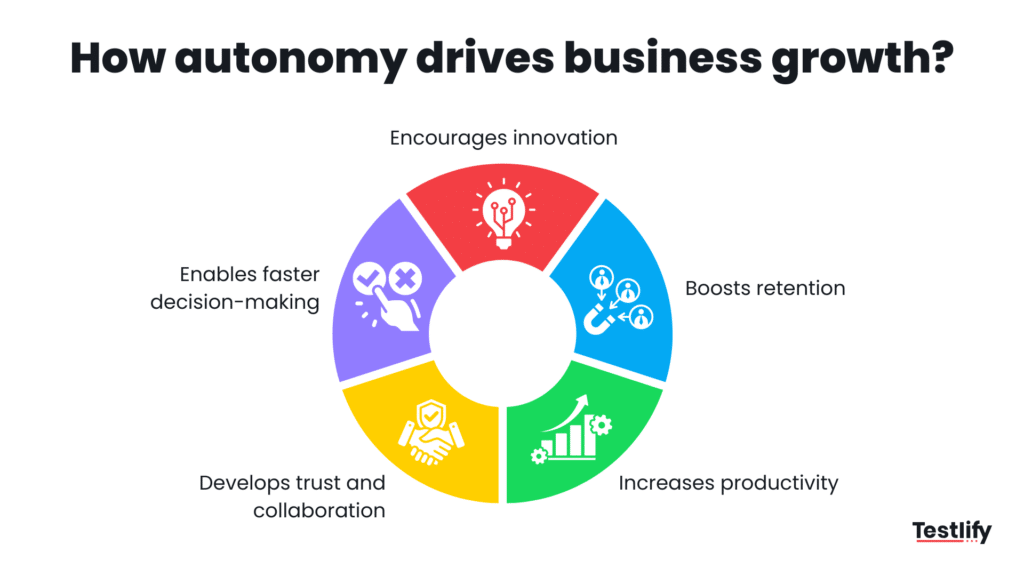
High employee engagement — which autonomy directly drives — produces a 21% increase in profitability. (Gallup, 2023) Companies that build innovation capability — which requires employee autonomy as a prerequisite — generate 2.4 times higher economic profits than peers. (McKinsey, 2023)
The mechanism behind both numbers is the same: autonomous employees make more decisions, make them faster, and make them closer to the actual work. Decision latency — the time between identifying an issue and resolving it — drops when employees have authority to act rather than escalating. At enterprise scale, that reduction compounds across thousands of daily decisions into measurable throughput and quality gains.
What is an example of employee autonomy at work?
Concrete examples by autonomy type:
Task autonomy
A product team sets quarterly objectives (OKRs); individual engineers choose which technical debt to address alongside feature work, without manager approval for each task.
Schedule autonomy
A content team operates asynchronously across three time zones. Deadlines are set; working hours are not. Output is measured on delivery quality, not hours logged.
Method autonomy
A sales team is given revenue targets and customer segment ownership. How they prospect, which channels they use, and how they sequence their outreach is their decision.
Decision autonomy
Customer support leads are authorised to issue refunds up to £500 without manager escalation. Above that threshold, approval is required. The scope is explicit; the autonomy within it is real.
Examples clarify what autonomy looks like in practice — but the implementation is where most organisations stall.
How to give employees more autonomy
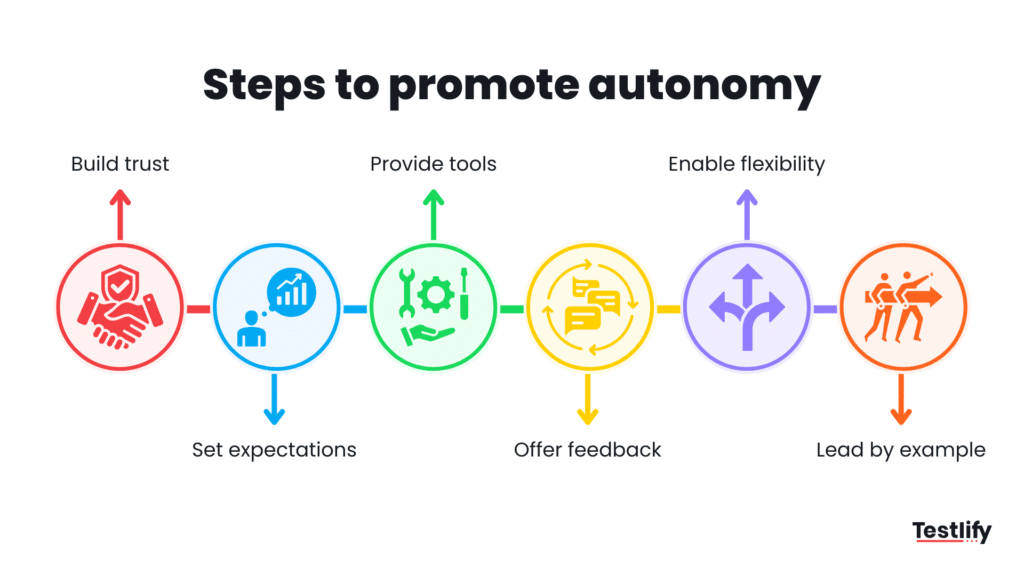
The sequence matters. Most autonomy programmes fail because they start with flexibility (the easiest to grant) rather than goals clarity (the hardest to get right). Without clear goals, autonomy produces effort without direction. The correct order:
Step 1: Define outcomes, not activities
Managers who describe roles in terms of tasks (“attend stand-up, write reports, escalate blockers”) create dependency. Managers who describe roles in terms of outcomes (“own the accuracy of the pipeline forecast”) create the conditions for autonomy. Rewrite job expectations in outcome terms before granting any other dimension of autonomy.
Step 2: Establish decision rights explicitly
Document which decisions an employee owns (no approval needed), which require consultation, and which require approval. Ambiguous decision rights are the primary cause of autonomy failing — employees default to escalating when they are unsure of their authority, and managers default to approving because it feels safer. Decision rights documentation removes the ambiguity.
Step 3: Assess skill readiness before expanding autonomy
An employee who lacks the skills for a task does not benefit from method autonomy — they are set up to fail independently rather than with support. Skills-based assessment before autonomy expansion identifies capability gaps early, so development can precede delegation. This is especially relevant for newly promoted managers and employees taking on expanded scopes.
Step 4: Calibrate by environment
Autonomy looks different across work modes:
Work mode | Highest-impact autonomy type | Key governance requirement |
|---|---|---|
Remote / fully distributed | Schedule + task autonomy | Async communication norms, output-based performance metrics |
Hybrid | Method + decision autonomy | Consistent standards across in-office and remote employees — autonomy must not correlate with proximity to manager |
In-office | Decision + task autonomy | Explicit delegation of decision scope; resist informal escalation culture where physical access to manager bypasses decision rights |
Step 5: Build feedback loops, not check-ins
Replace status update meetings (“what are you working on?”) with outcome reviews (“here is what the data shows, what do you see?”). The distinction signals trust and surfaces problems without creating surveillance. Feedback loops should be periodic and structured; informal interruptions should decrease as autonomy increases.
Pro Tip: Before expanding autonomy for a specific employee or team, ask one diagnostic question: can this person articulate what a good outcome looks like without you describing it? If the answer is no, the gap is goals clarity — not trust, not skills, not willingness. Fix the goals conversation first. Autonomy granted before goals are clear produces the exact frustration and rework that micromanagement was invented to prevent.
Knowing how to implement autonomy is only half the challenge — the other half is recognising where the boundary with micromanagement lies, and what to do when the balance tips wrong.
Autonomy vs micromanagement: finding the right balance
The most common reason autonomy programmes stall is not that employees cannot handle independence — it is that managers cannot let go of process control. Micromanagement is not always intentional. It is often a learned default, reinforced by performance systems that reward visible activity over measurable outcomes. Shifting from micromanagement to autonomy requires understanding where the line is, recognising when it has been crossed, and knowing what to do about it.
What is the difference between autonomy and micromanagement?
Micromanagement is approval-dependent work: the employee cannot act without the manager’s explicit sign-off at each step. Autonomy is outcome-dependent work: the employee acts, the manager reviews results. The practical distinction is in where attention goes — micromanagement focuses attention on process; autonomy focuses attention on outcomes.
The balance point is accountability calibration. Autonomy without accountability is the failure mode organisations fear (and why they default to micromanagement). Accountability without autonomy is the failure mode employees leave for (and why high performers disproportionately exit managed-by-process organisations). The working balance: employees own the method, both parties own the outcome.
Use these signals to diagnose which side of the line a team is on:
Micromanagement signal | Autonomy signal |
|---|---|
Employees ask for approval before starting routine tasks | Employees act on routine tasks and report outcomes |
Manager is the bottleneck on most decisions | Decisions are made at the level closest to the work |
Check-ins focus on “what are you working on?” | Check-ins focus on “what does the data show?” |
Employee output drops when manager is unavailable | Employee output is consistent regardless of manager presence |
High performers cite “lack of trust” in exit interviews | High performers cite “ownership” as a reason they stay |
In high-compliance environments — finance, healthcare, legal — this balance is often incorrectly framed as a trade-off between autonomy and compliance. It is not. Compliance constrains which outcomes are acceptable and which methods are prohibited. Within those constraints, method autonomy is fully available. A financial analyst must follow reporting standards; they do not need their manager to approve which analysis framework they use to get there. Compliance defines the guardrails; autonomy operates within them.
Getting the balance right between autonomy and accountability is one challenge — scaling it consistently across an enterprise is where most programmes break down.
Where enterprise autonomy programmes fail
Most autonomy initiatives fail not in design but in execution. Three failure modes account for the majority of rollbacks:
Manager capability gap
Autonomy requires managers to shift from directing to coaching — a fundamentally different skill set. Organisations that announce autonomy programmes without investing in manager development find that middle managers revert to micromanagement within weeks. The policy changes; the behaviour does not. Manager readiness assessment before programme rollout is not optional.
Inconsistent application across managers
In a 500-person organisation, some managers will grant genuine decision autonomy; others will grant nominal autonomy while requiring informal approval through back-channels. This produces unequal employee experience and, over time, drives the best employees toward the managers with real autonomy — creating talent clustering that HR has to undo. Standardised decision rights documentation prevents this.
Autonomy before readiness
Granting full method autonomy to an employee who lacks the skills for the task is not empowering — it is a setup for failure that damages both the employee’s confidence and the organisation’s willingness to try again. Quality of hire and role-readiness assessment before autonomy expansion produces measurably better outcomes than autonomy granted uniformly by seniority or tenure.
Key Takeaway: The single most predictive factor in whether an autonomy programme succeeds is not employee readiness — it is manager capability. Organisations that invest in manager development before autonomy rollout see 3-4x higher programme retention at 12 months than those that invest only in employee-facing communications. Train the managers first.
Frequently asked questions

B2B SaaS Content Writer
Rishav Kumar is a B2B SaaS content writer with 4 years of experience. He loves crafting engaging content. Always exploring fresh ideas, he's passionate about helping businesses grow through impactful writing.
LinkedInRelated resources
View all
HR & recruitment
What is skills intelligence: Components, benefits and tips

HR & recruitment
30 virtual team building activities for remote teams

HR & recruitment
What is a job requisition & position: A guide for hiring managers

HR & recruitment
Top HR programs every organization should have

HR & recruitment
Gamified assessments: types, examples and benefits

HR & recruitment
HR KPIs: What are they? Examples & formulas
Get started.
Hire on proof, not resumes.
Run your first skills-based assessment free — no credit card required.