
Gamified assessments: types, examples and benefits
Discover how gamified assessments revolutionize hiring by boosting engagement, fairness, and insights. Modernize recruitment with innovative tools like Testlify.
TL;DR
- Gamified assessments substantially reduce candidate drop-off compared to traditional formats — enterprise deployments consistently document completion rates of 98-99%, versus significantly lower rates for traditional questionnaire formats.
- They reduce social desirability bias: candidates cannot fake a simulation the way they can fake a personality questionnaire. Behavior in a game scenario reveals what self-report cannot.
- Predictive validity is comparable to structured interviews (correlation 0.3-0.5 with job performance) and better than resume screening at identifying high performers from underrepresented backgrounds.
- Enterprise adoption is established: Unilever, PwC, Deloitte, and HireVue all use game-based assessments at scale, primarily for early-funnel screening of high-volume roles.
- The critical distinction: gamified assessments add game elements to existing psychometric formats; game-based assessments are purpose-built simulations that generate behavioral data natively. Both are valid. They measure different things.
- For EEOC compliance, gamified assessments must be validated for job-relevance and adverse impact — the same standard as any selection tool.
Your assessment completion rates are probably lower than they should be. Candidates abandon traditional assessment processes at significant rates. Peter Cappelli’s HBR research on broken hiring processes identifies assessment friction as one of the primary reasons qualified candidates exit pipelines before evaluation is complete. Candidates do not find multiple-choice questionnaires engaging, and in a competitive hiring market, that friction costs you qualified applicants you never evaluate.
Gamified assessments address this by replacing administrative test formats with interactive simulations, puzzles, and scenario-based challenges. Completion rates go up. The behavioral data from gameplay — how a candidate approaches a problem, how they allocate resources under pressure, how quickly they adapt — is harder to fake and more predictive than a self-reported answer to “I remain calm under pressure: strongly agree / agree / disagree.”
This guide covers what gamified assessments are, how they compare to traditional testing, which enterprise organizations use them and why, and how to implement them in a process that is both effective and EEOC-defensible.
 ChatGPT
 Gemini
 Claude
 Grok
Grok Perplexity
What are gamified assessments?
Gamified assessments are pre-hire evaluation tools that incorporate game mechanics — scenarios, simulations, time pressure, and interactive challenges — into the assessment experience. The candidate’s behavior during gameplay generates the data recruiters and hiring managers use to evaluate competencies.
They are not trivia games. A well-designed gamified assessment measures the same cognitive and behavioral constructs as a validated psychometric test: cognitive ability, problem-solving, decision-making under pressure, attention to detail, risk tolerance, and personality factors like conscientiousness and openness. The difference is the delivery format — and the data richness that behavioral gameplay makes possible.
Gamified vs game-based assessments: the difference
Gamified assessments add game elements to existing psychometric formats. A cognitive ability test might include a progress bar, a timer, and a point system — the underlying structure remains traditional, but the experience is more engaging.
Game-based assessments are purpose-built simulations where the game itself is the assessment. The candidate manages a virtual business or resolves a crisis scenario. Assessment data comes from behavioral signals during gameplay — speed, decision patterns, resource allocation — not from explicit answers. Arctic Shores and HireVue’s game-based modules operate this way.
For enterprise procurement, the practical question is: which type maps to the competencies you need to measure and the roles you are filling?
Gamified vs traditional assessments
Traditional assessment | Gamified assessment | |
|---|---|---|
Format | Multiple choice, questionnaire | Simulation, scenario, interactive challenge |
Candidate experience | Low engagement, 20-30% drop-off | High engagement, substantially higher completion rates (98-99% documented in enterprise deployments) |
Social desirability bias | High — answers can be gamed | Low — simulation behavior is harder to fake |
Predictive validity | 0.3-0.5 | 0.3-0.5 (comparable) |
Adverse impact | Varies by format | Generally lower than resume screening |
ATS integration | Standard REST API | Standard REST API (Workday, Greenhouse, Lever) |
The comparison above covers format and mechanics — the next section covers why these differences matter operationally for enterprise TA teams.

Why enterprise HR teams are adopting gamified assessments
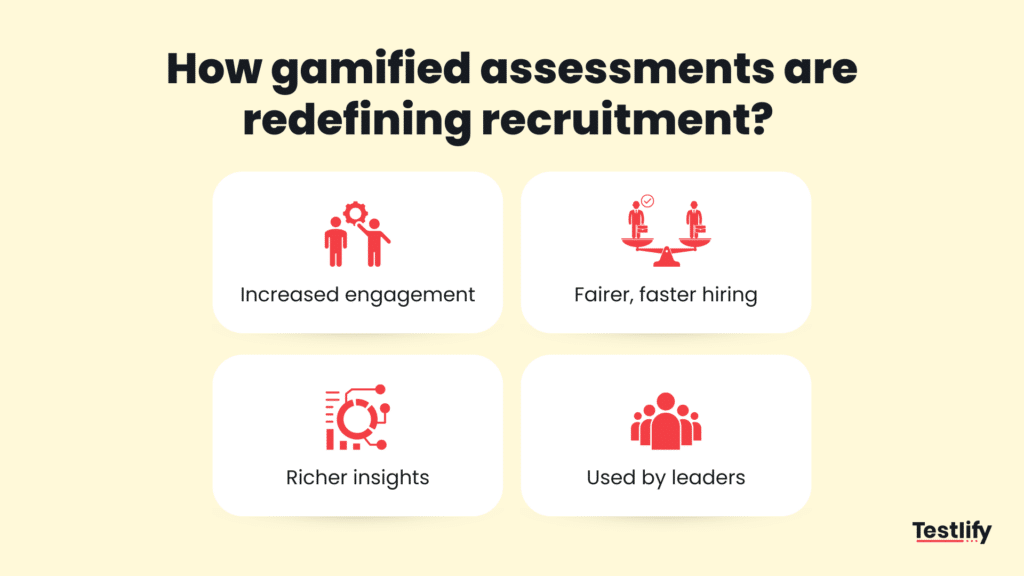
The shift toward gamified assessments in enterprise hiring is driven by three specific problems traditional formats do not solve well: high assessment abandonment, social desirability bias, and limited behavioral signal from self-report data.
Candidate completion rates
Assessment completion rate is a pipeline metric, not just a candidate experience metric. If 30% of candidates abandon your assessment before finishing, your effective pipeline is 30% smaller than your application numbers suggest. For roles where you screen thousands of applicants — graduate programs, call centre hiring, seasonal logistics — that attrition compounds at scale.
Research from the Talent Board Candidate Experience program shows that candidates who have a positive assessment experience are 38% more likely to accept an offer and more likely to refer others. Gamified formats consistently outperform traditional formats on experience ratings, particularly for Gen Z and millennial candidates who make up the majority of entry and mid-level hiring pools.
Reducing social desirability bias
Traditional personality questionnaires are vulnerable to faking. Candidates learn to answer “what a good employee would say” rather than revealing actual behavioral tendencies. Research in the Hu et al. (2021) meta-analysis in the International Journal of Selection and Assessment documents that high-stakes personality testing shows significant social desirability inflation — your results measure candidates’ ability to appear conscientious, not their actual conscientiousness.
Gamified assessments reduce this structurally. In a simulation, candidates respond to situations in real time, under time pressure, without a clear “right answer.” Their behavioral data reflects actual tendencies rather than considered self-presentation. The mechanism is similar to why structured interviews outperform unstructured ones: the standardized format removes the candidate’s ability to shape the evaluation through narrative.
Predictive validity evidence
Game-based assessments designed to measure established constructs achieve validity coefficients of 0.3-0.5 against job performance criteria — comparable to structured interviews and better than resume screening alone (0.1-0.2), per the Schmidt & Hunter (1998) meta-analysis of personnel selection methods. The caveat: construct validity depends on design quality. A poorly designed game that measures enjoyment of games rather than underlying cognitive constructs will have low predictive validity regardless of how engaging the experience is.
The enterprise standard is to require vendors to provide technical validation documentation — sample size, criterion-related validity coefficients, and adverse impact data — before deployment. Combining gamified formats with skills-based assessments gives you both candidate engagement and validated measurement. The next section covers which format to deploy for which role type.
Types of gamified assessments
Matching assessment type to the competency profile of the role is the critical implementation decision. Poor fit between format and competency requirements is the most common reason gamified programs fail to improve hire quality — not the technology itself.
Situational judgment simulations
Gamified situational judgment tests (SJTs) put work scenarios in an interactive environment — a virtual office, a customer service simulation, a crisis management scenario — where candidates make decisions as events unfold. Well-suited for roles requiring judgment under ambiguity, customer-facing positions, and management or leadership assessment where behavioral responses to realistic work situations are the relevant signal.
Cognitive ability games
Gamified cognitive assessments measure numerical reasoning, verbal reasoning, processing speed, and working memory through game mechanics rather than test items. Pymetrics measures 90 cognitive and emotional attributes in under 25 minutes across 12 game tasks — balloon risk tasks, attention tasks, and memory games that generate a behavioral profile mapped to role requirements. For enterprise high-volume screening, cognitive game assessments can replace or supplement traditional ability tests with equivalent predictive validity and significantly better candidate experience.
Personality and behavioral assessments
Behavioral simulation assessments measure personality constructs through behavioral choices in game scenarios rather than self-report items. The candidate navigates social situations or resolves interpersonal conflicts, and their behavioral patterns generate the personality profile. Particularly useful for customer success, sales, and management roles where personality drives performance variance alongside technical capability — and where traditional self-report questionnaires are most vulnerable to faking.
Skills-based challenges
For technical roles, gamified assessments include coding challenges, data analysis puzzles, and role-specific simulations. A financial analyst candidate might complete a gamified portfolio allocation task. A software engineer might debug a gamified code environment. Integrating skills challenges with psychometric testing gives you both behavioral and technical signals in a single candidate profile. Each of these formats delivers specific benefits at the enterprise scale covered next.
Benefits of gamified assessments for enterprise hiring
The benefits of gamified assessments operate at three levels: candidate experience, assessment quality, and operational efficiency. Which benefit matters most for your context determines which format to prioritize and where in your funnel to deploy it.
Higher completion rates
Every candidate who abandons your assessment is a missed data point. At scale, completion rate gaps between gamified and traditional formats translate directly into pipeline volume. Enterprise organizations that have migrated from traditional questionnaires report substantially higher completion rates — Harver (formerly Pymetrics) documents 98-99% completion rates for enterprise clients using gamified assessments. For graduate and early-career programs where candidate experience is a direct employer brand signal, this improvement also affects referral rates and application volumes in subsequent hiring cycles.
Reduced social desirability bias
Gamified assessments are structurally harder to game than self-report questionnaires. For diversity hiring, this has a specific implication: candidates from backgrounds with less exposure to corporate assessment preparation are less disadvantaged by gamified formats. Traditional questionnaires create score gaps unrelated to job performance when test-taking experience varies by demographic — gaps that gamified behavioral formats reduce significantly.
Better prediction of job performance
The combination of behavioral data richness and reduced social desirability inflation means gamified assessments can outperform traditional personality questionnaires on predictive validity for high-pressure roles. For positions where structured interview consistency is limited by interviewer bias or panel variability, a validated gamified assessment creates a standardized signal that is both harder to fake and more comparable across candidates.
Improved employer branding
Candidates consistently rate assessment experience as a direct signal of employer culture — Glassdoor employer brand research shows that hiring experience shapes candidate perception of the organization before day one. For high-demand roles in technology, data science, and strategic finance, a well-designed gamified assessment differentiates your process from the test-and-wait experience candidates encounter across multiple simultaneous applications. Candidate experience at assessment stage directly affects offer acceptance rates and talent brand perception.
Pro Tip: The most common implementation mistake is deploying a gamified assessment before defining the competency framework. Build the competency model for the role first — then select or configure the assessment to measure those specific constructs. A gamified assessment that measures enjoyment of games rather than job-relevant constructs has no predictive validity regardless of how engaging the experience is.
The benefits above are why enterprise organizations have adopted gamified assessments — the case studies below show how that adoption looks in practice.
Companies using gamified assessments
Enterprise adoption is concentrated in organizations with high-volume early-career hiring and technology-forward TA functions. These examples represent implementation patterns directly applicable to enterprise HR teams evaluating the approach.
Unilever
Unilever replaced CV screening and phone interviews with a three-part process: Pymetrics gamified assessments, a video interview, and a day-at-work simulation. The gamified stage screens for 60+ cognitive and emotional attributes without reviewing CVs first. Outcomes: a 16% increase in diversity of candidates progressing to interview and a reduction in time-to-hire from four months to four weeks for graduate recruitment, per Unilever. Removing the CV filter shifted shortlisting logic from educational pedigree to behavioral profile.
PwC
PwC deploys game-based assessments for graduate recruitment across multiple geographies before any human review of application materials. The games run on mobile, removing device access as a barrier. PwC reports improved candidate experience scores and increased diversity at the interview stage. For consulting and professional services roles, game-based assessment shifts shortlisting logic from academic credentials to behavioral profile — which has higher predictive validity for performance and retention in those roles.
Deloitte
Deloitte uses gamified assessments as part of its NextGen talent platform for early-career hiring. The platform integrates directly with its ATS, feeding assessment scores into recruiter dashboards without manual scoring. Direct ATS integration — assessment data flowing automatically into candidate records — is the enterprise deployment standard. Any gamified assessment that requires manual data transfer or a separate login to review results creates workflow friction that limits recruiter adoption at scale.
HireVue game-based modules
HireVue’s platform includes game-based modules embedded in the video interview flow. Candidates complete games measuring numerical reasoning, risk tolerance, and cognitive flexibility alongside or before video responses. For enterprise teams already using HireVue, adding game-based modules requires minimal integration work. The combined signal — cognitive game data plus structured video interview analysis — provides a multi-dimensional candidate profile within a single platform workflow. Implementation steps for deploying these approaches in your own process are covered next.
How to implement gamified assessments in your hiring process
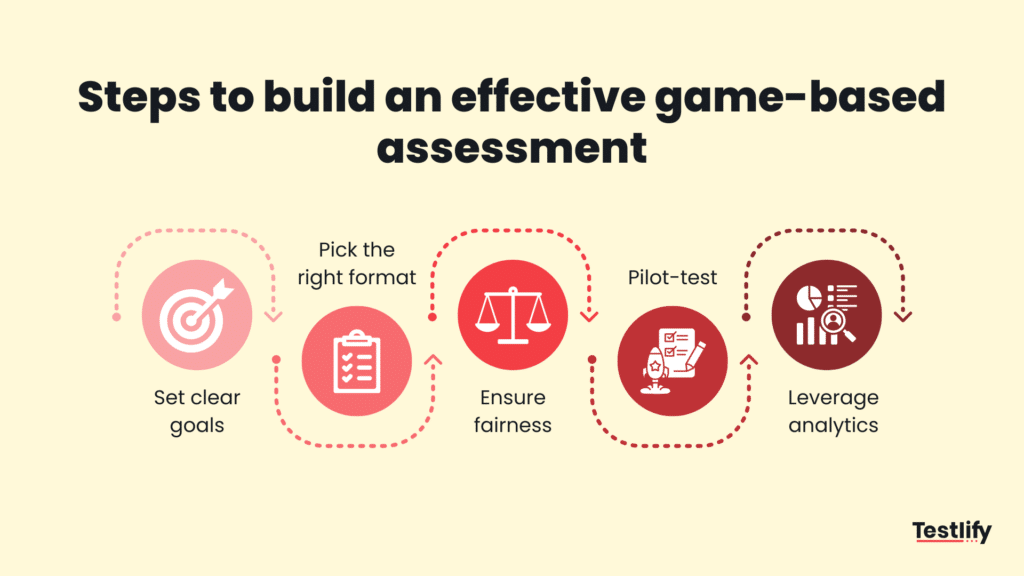
Implementation quality determines whether gamified assessments improve hire quality or just improve candidate experience. The two are related but distinct. These five steps reflect the enterprise standard for deploying gamified assessments as a validated, legally defensible selection tool.
Step 1: Define competencies before selecting the assessment
Map the competencies required for the role to the constructs the assessment actually measures. A gamified cognitive assessment does not measure conscientiousness. A behavioral simulation does not measure numerical reasoning. Competency-to-construct mapping is the validation foundation — without it, assessment selection is arbitrary and your validity evidence has no anchor.
Step 2: Choose assessment format by role profile
Role type | Recommended format |
|---|---|
High-volume early career (grad, customer service, logistics) | Cognitive ability games + behavioral simulation |
Technical specialist (engineering, data, finance) | Skills challenge + cognitive ability game |
Customer-facing (sales, account management, support) | SJT simulation + behavioral assessment |
Management and leadership | Business simulation + behavioral assessment |
Senior specialist or niche | Traditional validated assessment + optional gamified supplement |
Step 3: Require validation documentation from vendors
Require vendors to provide concurrent validity data (correlation with job performance in comparable populations), adverse impact analysis by race, gender, and age group, and reliability data (test-retest reliability coefficient). Vendors who cannot produce technical validation manuals should not be deployed in selection contexts — regardless of how engaging the game is. The SIOP Principles for Validation and Use of Personnel Selection Procedures provide the enterprise standard.
Step 4: Integrate with your ATS
Workday, Greenhouse, and Lever all support pre-hire assessment integration via API or native partner connections. Confirm which fields map to your ATS candidate profile, how scores appear in recruiter dashboards, and whether pass/fail thresholds can be configured in the integration. The path from assessment data to shortlisting decision should require zero manual steps — manual transfer is a workflow bottleneck that limits recruiter adoption at scale.
Step 5: Monitor adverse impact quarterly
Run adverse impact analysis quarterly for the first year of any new assessment deployment. Calculate selection rates for each demographic group at the assessment stage and apply the EEOC four-fifths rule. If any group’s selection rate falls below 80% of the highest-selected group’s rate, investigate whether the assessment is measuring job-relevant constructs or introducing construct-irrelevant variance. For objective hiring assessments that withstand EEOC scrutiny, ongoing monitoring is non-negotiable — not a one-time setup task.
Key Takeaway: Gamified assessments produce better outcomes as the front end of a structured process, not as a replacement for one. Deploy gamified assessment for initial screening, follow with structured interviews and skills verification, and use the full candidate profile — game data, interview scores, skills results — to make shortlisting decisions. Single-signal hiring underperforms multi-signal processes regardless of how good the tool is.
Implementation decisions and EEOC compliance are closely related — the next section covers what enterprise HR teams need to know to deploy gamified assessments legally and defensibly.
Gamified assessments and EEOC compliance
Gamified assessments are subject to the same federal legal standards as any other selection tool. The EEOC Uniform Guidelines on Employee Selection Procedures apply to any assessment used to make or influence hiring decisions, regardless of format. “It’s a game” is not a compliance defense.
Adverse impact requirements
The four-fifths rule applies. If your gamified assessment produces a selection rate for any protected group below 80% of the rate for the highest-selected group, you have a prima facie adverse impact case. This does not make the assessment illegal — it means you must demonstrate job-relatedness and business necessity.
For assessments with behavioral gameplay mechanics, the adverse impact analysis should go beyond pass/fail rates and examine whether specific game mechanics — reaction-time tasks, interface familiarity, device requirements — introduce construct-irrelevant variance that correlates with protected group membership. Assessments requiring specific device types or particular interface fluency may produce differential performance unrelated to job performance.
Validation requirements
Content validity, criterion-related validity, and construct validity are all relevant for gamified assessment deployment. The SIOP Principles define the validation standard for each. Enterprise HR teams evaluating vendors should request technical manuals covering validation methodology, sample sizes, and criterion-related validity coefficients. An engaging game without validation documentation is not a compliant selection tool.
The compliance infrastructure — validation records, adverse impact analysis, selection rate documentation by demographic group — is the same for gamified assessments as for any validated pre-hire tool. The format is new. The legal standard is not. Testlify’s pre-hire assessments are built to this standard, with adverse impact reporting available for every assessment administered.
Frequently asked questions

B2B SaaS Content Writer
Rishav Kumar is a B2B SaaS content writer with 4 years of experience. He loves crafting engaging content. Always exploring fresh ideas, he's passionate about helping businesses grow through impactful writing.
LinkedInRelated resources
View all
HR & recruitment
HR KPIs: What are they? Examples & formulas
HR & recruitment
A complete guide to human proctoring vs AI proctoring

HR & recruitment
14 HR industry trends to look at in 2026

HR & recruitment
What is high-performance culture and how to build one?
HR & recruitment
7 Proven strategies to combat workplace negativity today

HR & recruitment
What is a recruitment fair? (Tips for attending one)
Get started.
Hire on proof, not resumes.
Run your first skills-based assessment free — no credit card required.