
Phone interview questions: 30 to ask candidates and what good answers sound like
Thirty phone screen questions for hiring teams, with what to listen for in each answer, red flags, questions to avoid and a scorecard.

Phone interview questions are the short, standard questions a recruiter or hiring manager asks on a first call to decide whether a candidate should move to a full interview. A good phone screen confirms the must-haves, checks real interest, tests how clearly the person communicates and ends with a clear yes or no. Below are 30 phone interview questions grouped by what they screen for, each with what a strong answer sounds like and the red flag to listen for.
 ChatGPT
 Gemini
 Claude
 Grok
 Perplexity
TL;DR / Key Takeaways
- The best phone interview questions confirm deal-breakers first (work authorization, schedule, location, pay range, start date), then check motivation and the one or two skills that matter most.
- Keep the call to 15 to 30 minutes. A 20-minute plan works for most roles: 2 minutes to open, 4 on must-haves, 10 on interest and experience, 4 for candidate questions and next steps.
- Ask every candidate the same core questions in the same order and score them on the same 1 to 4 scale, so you compare people, not conversations.
- The strongest signals on a phone screen are specific examples, a clear reason for wanting this role and good questions at the end.
- Never ask about age, family plans, health, religion or national origin. Ask about the job requirement instead, such as "Can you work this shift?"
- A phone call cannot verify skills. Move skills checks to a short test or a scored AI interview, and keep the call for fit, logistics and questions.

What is a phone interview, and what should it decide?
A phone interview is a short first-round call, usually 15 to 30 minutes, that decides one thing: should this candidate get a full interview? Phone interview questions should confirm the must-haves, check interest and motivation, and give the candidate a clear picture of the role. Deep skills checks and culture debates belong in later rounds.
Teams also call it a phone screen or a screening interview. The goal is to narrow the pool fairly and fast. XY Planning Network, which hires through a short screen, runs its calls in about 10 minutes and uses them to cut the applicant pool by 60 to 70% before the next stage.
Speed matters because good candidates are still hard to find. SHRM's 2025 Talent Trends survey found that 69% of organizations still struggle to fill full-time roles, and AI use in HR tasks rose to 43% in 2025 from 26% a year earlier. A tight phone screen keeps strong candidates moving instead of waiting for a slot.
How should you structure a 20-minute phone interview?
A 20-minute phone interview works best in five blocks: a 2-minute opening, 4 minutes on must-haves, 10 minutes on interest and experience, 3 minutes for the candidate's questions and 1 minute on next steps. Putting deal-breakers early lets you end a mismatch politely within five minutes.
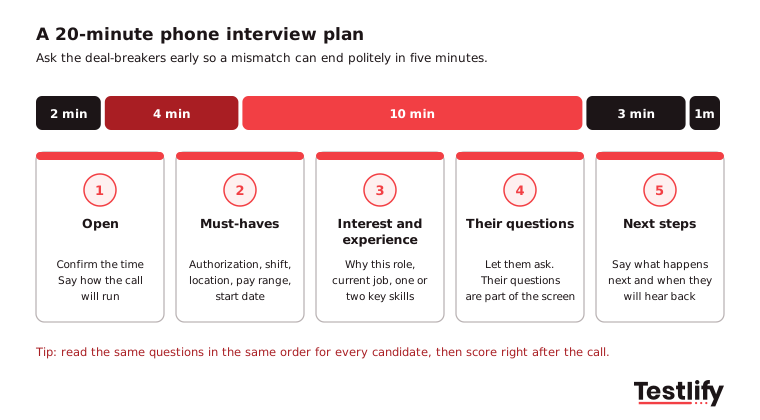
- Open (2 minutes): Confirm it is still a good time, say who you are, state the role and explain how the call will run.
- Must-haves (4 minutes): Ask the knockout questions: authorization, schedule, location, required licence, pay range, start date.
- Interest and experience (10 minutes): Ask why this role, walk through the current job and probe the one or two skills the role cannot do without.
- Candidate questions (3 minutes): Let them ask. The quality of their questions is part of the screen.
- Next steps (1 minute): Say what happens next and when they will hear back.
Northwestern University's HR team gives its managers a similar order in its phone screening guide: review the job and resume first, use the same format for every candidate, ask about one or two required competencies and close with the candidate's questions.
Pro tip: Write your questions down and read them the same way every time. A structured interview is fairer and easier to score, and it stops a friendly chat from replacing the screen.
What are the best phone interview questions to ask candidates?
The best phone interview questions to ask candidates are short, open questions tied to the job's must-haves and motivation. If you only have time for eight, use the quick picks below. The full list of 30 follows, grouped by what each set screens for.
Question | What it screens for | Strong answer | Red flag |
|---|---|---|---|
Can you walk me through your current role? | Relevant experience | Concrete duties, scope, results | Job title only, no detail |
Why are you looking for a new role now? | Motivation, retention risk | A clear pull toward something | Blaming every past employer |
What drew you to this role specifically? | Real interest | Names parts of the job ad | Could apply to any job |
Are you authorized to work in [country]? | Deal-breaker | Clear yes, or a sponsorship need stated up front | Vague or evasive |
What pay range are you targeting? | Budget fit | A range, open to the full package | Refuses any range late in the process |
Tell me about a time you used [key skill]. | Core skill | A specific example with an outcome | Talks in theory only |
When could you start if offered the job? | Timing | A clear notice period | Unclear or changing dates |
What questions do you have for me? | Preparation, interest | Questions about the work and team | No questions at all |
Which opening questions start a phone interview well?
Opening phone interview questions should be easy to answer and still useful. They warm the candidate up, confirm the resume and show how clearly the person explains their own work. Spend no more than two or three minutes here.
1. Is now still a good time to talk for about 20 minutes?
- Why ask it: A distracted candidate gives poor answers, and the question sets a time frame for both of you.
- Strong answer: A clear yes, or a quick request to move the call.
- Red flag: Taking the call while driving or in a loud place without saying so.
2. Can you walk me through your current role in two minutes?
- Why ask it: Tests whether the resume matches reality and whether the person can summarise.
- Strong answer: Team, scope, main duties and one result, in plain language.
- Red flag: A long story that never reaches the current job.
3. How did you hear about this position?
- Why ask it: Shows whether they found you on purpose and which sourcing channels work.
- Strong answer: A specific source and a reason they clicked.
- Red flag: Cannot recall the role or the company name.
4. What do you know about what our company does?
- Why ask it: A quick check on preparation that takes 30 seconds to answer.
- Strong answer: Product, customers or a recent update, in their own words.
- Red flag: Nothing beyond the company name.
Which phone screen questions confirm the must-haves?
Must-have phone screen questions are the knockout checks: work authorization, schedule, location, required licences, pay range and start date. Ask them early and ask every candidate the same way, so a mismatch ends the call fairly and the decision is easy to defend later.
5. Are you legally authorized to work in [country], and will you need visa sponsorship now or in the future?
- Why ask it: Sponsorship is a hard yes or no for many roles.
- Strong answer: A direct answer.
- Red flag: Avoiding the question. Ask this of every candidate, never only of some.
6. This role works [schedule, shift or on-site days]. Does that work for you?
- Why ask it: Schedule mismatches are a top reason offers fall through late.
- Strong answer: A clear yes, or a specific limit you can discuss.
- Red flag: "I'm sure we can figure it out" with no detail.
7. The role is based in [location]. How does the commute or relocation look for you?
- Why ask it: Confirms location fit before anyone invests more time.
- Strong answer: A plan, not a hope.
- Red flag: Has not thought about it.
8. Do you hold [required licence or certification], and is it current?
- Why ask it: Only for real job requirements, such as a driving licence or a nursing registration.
- Strong answer: Yes, with dates.
- Red flag: "I'm working on it" for a day-one requirement.
9. What pay range are you targeting for this role?
- Why ask it: Avoids a late mismatch. Share your range first if your state or city requires it.
- Strong answer: A range, with openness to the full package.
- Red flag: A number far outside your range with no flexibility. Many US states and cities ban questions about current or past pay, so ask about expectations, never salary history.
10. If we offered you the job, how soon could you start?
- Why ask it: Sets the timeline for the rest of the process.
- Strong answer: A notice period they intend to honour.
- Red flag: Offering to leave a current employer without notice.
Which questions show real interest and motivation?
Motivation questions show why a candidate wants this role, not just any role. Listen for specifics that tie back to the job: the work itself, the team, the product or the next step in their career. Vague answers are common, so one follow-up question usually separates real interest from a mass application.
11. Why are you looking for a new role right now?
- Strong answer: Something they are moving toward, such as more scope or a new skill.
- Red flag: Only complaints about the current employer.
12. What drew you to this role specifically?
- Strong answer: Mentions two or three things from the job description.
- Red flag: An answer that would fit any company.
13. What are you hoping is different in your next job compared with your current one?
- Strong answer: A specific change you can actually offer, or honestly cannot.
- Red flag: Wants something the role clearly does not have.
14. What kind of work do you enjoy most, and what drains you?
- Strong answer: Honest about both, with examples.
- Red flag: The draining part is the core of this job.
15. Where else are you in the interview process?
- Strong answer: A straight answer that helps you plan timing.
- Red flag: None on its own, but a near-final offer elsewhere means you need to move faster.
16. How does this role fit where you want to be in two or three years?
- Strong answer: A realistic link between the role and their goals.
- Red flag: Plans that point away from the job within months.
Which phone interview questions check experience and skills?
Experience questions on a phone call should confirm that the resume is accurate and that the candidate has used the one or two skills the role cannot do without. Keep them concrete and role-specific. A phone call can show familiarity with a skill, but it cannot measure how well someone performs it.
17. Which of your current responsibilities match this role most closely?
- Strong answer: Maps their duties to yours without being asked twice.
- Red flag: Cannot connect their experience to the role.
18. An important skill here is [skill]. How have you used it in your last two jobs?
- Strong answer: Names tools, scale and a result.
- Red flag: Repeats the job ad back to you.
19. Have you used [software or tool] at work, and for what?
- Strong answer: A specific task and how often.
- Red flag: "I can learn it" for a must-have tool.
20. What is the most useful skill you have built in the last six months?
- Strong answer: Something specific, and how they learned it.
- Red flag: Nothing new in a fast-changing role.
21. Can you explain the gap or short stint on your resume?
- Strong answer: A brief, plain explanation. Gaps for study, caregiving or layoffs are normal.
- Red flag: A story that changes as you ask follow-ups. Do not ask about the personal reasons behind a gap.
22. What would you focus on in your first 90 days in this role?
- Strong answer: Learning first, then one or two practical priorities.
- Red flag: Big changes before understanding the team.
Skills are where phone screens fall short. LinkedIn's Future of Recruiting 2025 report found that 93% of talent acquisition pros say accurately assessing skills is crucial to quality of hire. For role-specific question sets, browse the interview questions bank or a role page such as interview questions for a GIS specialist.
Which short behavioral questions work over the phone?
Short behavioral questions work on a phone screen when you ask for one recent example and keep the answer to about two minutes. Pick the one or two behaviors that matter most for the role, such as handling customers, deadlines or conflict. Save longer case questions for the full interview.
23. Tell me about a recent time you had several deadlines at once. How did you handle it?
- Strong answer: A real situation, how they chose priorities and the outcome.
- Red flag: "I just work harder."
24. Describe a disagreement with a colleague and how you resolved it.
- Strong answer: Takes some ownership and explains the fix.
- Red flag: The other person was entirely to blame.
25. Tell me about a goal you hit that you had to work hard for.
- Strong answer: A measurable result and their own part in it.
- Red flag: Only "we", never "I".
26. Tell me about a time you made a mistake at work. What did you do next?
- Strong answer: Owns it, fixes it and says what changed after.
- Red flag: Cannot name one.
27. How do you like to receive feedback from a manager?
- Strong answer: A clear preference and an example of feedback they used.
- Red flag: Sees all feedback as criticism.
Which closing questions should end every phone interview?
Closing phone interview questions give the candidate space to ask, catch anything you missed and set clear next steps. Candidates judge you here too, so end on time and tell them exactly when they will hear back.
28. What questions do you have for me about the role or the team?
- Strong answer: Questions about the work, success in the role or the team.
- Red flag: No questions, or only questions about time off.
29. Is there anything we did not cover that you think I should know?
- Strong answer: A relevant strength or context the questions missed.
- Red flag: None. This question mainly protects good candidates who interview quietly.
30. Are you still interested in moving forward after what you heard today?
- Strong answer: A clear yes, or an honest no that saves everyone time.
- Red flag: Hesitation they will not explain.
What red flags should you listen for on a phone screen?
Phone screen red flags are patterns, not single slips: vague answers with no examples, no knowledge of the role, blaming past employers, focusing only on pay and perks, and having no questions at the end. Nerves are not a red flag. Judge content and preparation, not polish.
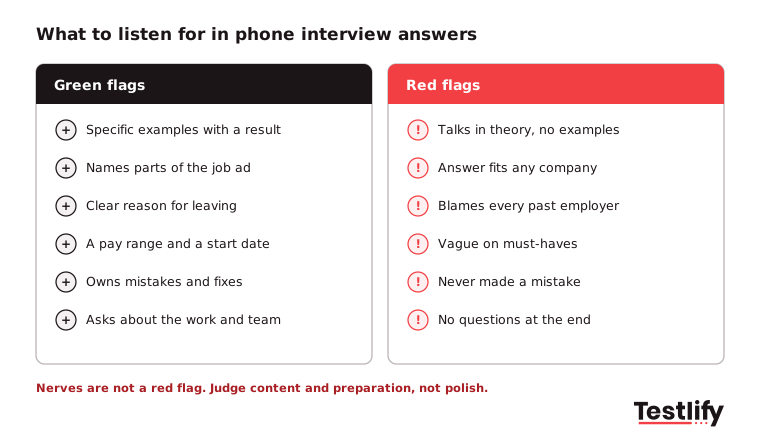
Context matters. A quiet voice on a call means little for a back-office role and more for a sales or support role, where the phone is the job. If an answer sounds polished but changes under follow-up questions, see how to spot candidate dishonesty.
Which phone interview questions should you never ask?
Phone interview questions should never reveal or touch on age, race, religion, national origin, disability, pregnancy, marital status or family plans. The EEOC's guidance on prohibited practices says employers may not ask about disability before an offer. Ask about the job requirement instead.
Do not ask | Ask instead |
|---|---|
How old are you? / When did you graduate? | Do you meet the minimum age for this role? (only if the law sets one) |
Do you have children or plan to? | This role works [shift]. Can you work that schedule? |
Where are you from originally? | Are you authorized to work in [country]? |
Do you have any health conditions? | Can you perform the essential duties of this role, with or without accommodation? (after an offer, in most cases) |
What is your current or past salary? | What pay range are you targeting? |
What religious holidays do you observe? | This role needs weekend cover once a month. Does that work for you? |
Rules on salary history and background checks vary by state and city, so check local law. Testlify's guide to inappropriate interview questions covers more examples.
How do you score a phone interview fairly?
A fair phone interview score comes from rating every candidate on the same four criteria, on the same 1 to 4 scale, right after the call. Use must-haves (pass or fail), motivation, relevant experience and communication. Write one line of evidence for each score so the next interviewer knows why the candidate advanced.
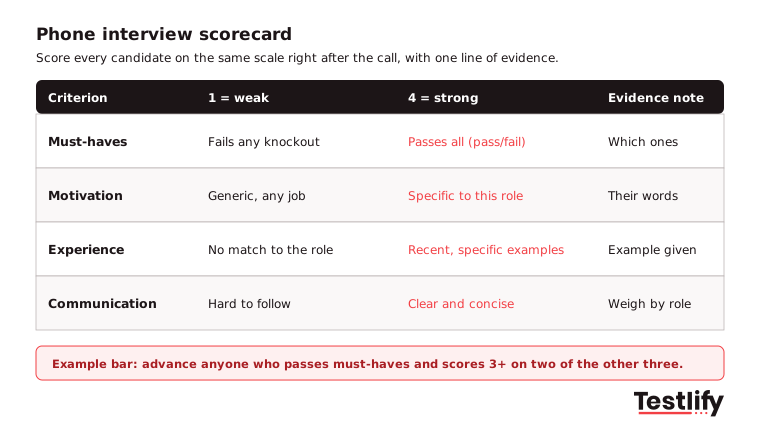
Set a bar before the first call, for example "advance anyone who passes must-haves and scores 3 or more on two of the three others". A shared interview scorecard keeps several recruiters scoring the same way.
Key takeaway: The phone screen is a filter, not a final verdict. Ask the same questions, score on the same scale, write down the evidence and pass the skills question to a proper test.
When should a skills test or AI interview replace the phone screen?
A skills test or AI interview should replace the phone screen when you have more applicants than recruiter hours, or when the role depends on a skill a call cannot measure. A short test or a scored first-round interview gives every candidate the same questions, any time of day, and leaves recruiters to call only the strongest.
Testlify supports that first round in a few ways:
- Skills tests before the call: Pick from 3,500+ tests in the Testlify test library, or build one from your job description, so the call only goes to people who can do the work.
- AI and one-way interviews: Video AI, Voice AI and Chat AI interviews, plus one-way video and audio questions, ask your phone screen questions in the same way for every candidate and score each answer. See the video interviewing tool.
- Fair at volume: 20+ proctoring checks, 25+ question types and assessments in 15+ languages help when you screen hundreds of applicants across regions.
For a deeper look at automating this step, read AI-powered phone screening and what AI interviews are and whether they work.
How can candidates prepare for phone interview questions?
Candidates prepare best for phone interview questions by practicing a two-minute summary of their current role, knowing their pay range and start date, and reading the job ad closely enough to name what draws them to it. Take the call somewhere quiet, keep the resume and job ad open, and bring two questions about the work.
- Answer the likely four: Your current role, why you are looking, why this job and your pay range.
- Use short examples: One situation, what you did, and the result, in under two minutes.
- Ask about the work: What success looks like in the first 90 days is a good question for any role.
Ready to make every phone screen count?
Give your recruiters fewer, better calls. Browse the Testlify test library to find a skills test for your next role, or start a 7-day free trial, no credit card required, and add a short assessment before the phone screen.
Frequently asked questions

Content Writer
Yashika Khandelwal is a Content Writer with 3+ years of experience creating research-backed content on hiring, talent assessment, and HR technology. She is a registered Organizational Psychologist and subject matter expert who combines behavioral science with practical recruitment insights to produce accurate, evidence-based content.
LinkedInRelated resources
View all
Interview questions
Nursing assistant interview questions: 35 to ask and what good answers sound like

Interview questions
40 delivery driver interview questions and what good answers sound like

Interview questions
Lab assistant interview questions: 30 to ask, with strong answers

Interview questions
30 scenario based interview questions to ask candidates

Interview questions
30 Selenium interview questions to ask and what strong answers sound like

Interview questions
Situational based interview questions: 30 examples for hiring teams
Get started.
Hire on proof, not resumes.
Run your first skills-based assessment free — no credit card required.