
Nursing assistant interview questions: 35 to ask and what good answers sound like
Thirty-five CNA interview questions grouped by skill, with what a strong answer sounds like, red flags to catch and a simple scorecard.

Nursing assistant interview questions help a hiring team find out three things about a certified nursing assistant (CNA): whether they can deliver safe basic care, whether they stay calm and kind under pressure, and whether they will show up for every shift. The 35 questions below are grouped by the skill they test, each with what a strong answer includes.
 ChatGPT
 Gemini
 Claude
 Grok
 Perplexity
TL;DR / Key Takeaways
- The best nursing assistant interview questions are scenario and behavioral questions about resident safety, dignity, infection control, teamwork and reliability, not "tell me about yourself".
- Check certification, the state nurse aide registry and CPR or BLS before the interview, so interview time goes on judgment and care.
- Strong answers name a specific action, explain why it keeps the resident safe, and say when they would tell the nurse.
- The biggest red flags are working outside scope, skipping hand hygiene, blaming residents and vague answers about attendance.
- Score every candidate on the same five areas with a 1 to 5 scale, and agree on what a 1, 3 and 5 sound like before the first interview.
- CNA turnover in nursing homes was 42.34% in 2025, so questions about shifts, workload and why they left the last job matter as much as clinical ones.

What does a nursing assistant interview need to find out?
A nursing assistant interview needs to find out whether the candidate can give safe, respectful basic care, work under a nurse's direction, and stay reliable on hard shifts. Certification shows they passed training. The interview shows how they act when a resident falls, refuses care or gets aggressive.
The demand is steady and the stakes are high. According to the BLS Occupational Outlook Handbook, there were 1,558,700 nursing assistant and orderly jobs in 2025, with a median pay of $41,870 and about 203,300 openings projected each year over the decade.
Keeping people is the harder part. The HCS 2025-2026 Nursing Home Salary and Benefits Report, which covered 917 nursing homes and more than 111,600 employees, found that CNA turnover was 42.34% in 2025, down from 44.16% in 2024. CNAs still had the highest turnover of any nursing home role. Every weak hire means another round of interviews a few months later.
What should you check before a nursing assistant interview?
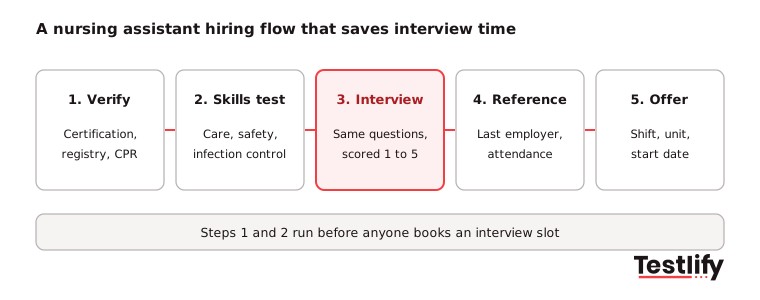
Before a nursing assistant interview, check four things on paper: an active CNA certification, a clean entry on the state nurse aide registry, current CPR or BLS, and the shift pattern the candidate can work. Settling these first leaves the interview for judgment, care and communication, which paperwork cannot show.
Federal rules set the floor for what a certified nursing assistant has learned. Under 42 CFR 483.152, a nurse aide training program must run no less than 75 clock hours, with at least 16 hours of supervised practical training. Before any contact with residents, aides must have 16 hours covering communication, infection control, safety and emergencies, resident independence, and resident rights.
Those five topics are a useful map for the interview. Ask at least one question on each, and you are checking what the certificate claims.
- Certification: Active, in your state, and the name matches the ID.
- Registry: Listed on the state nurse aide registry with no findings.
- CPR or BLS: Current card, and the date it expires.
- Availability: Days, nights, weekends and how far they live from the site.
Which general nursing assistant interview questions should you ask?
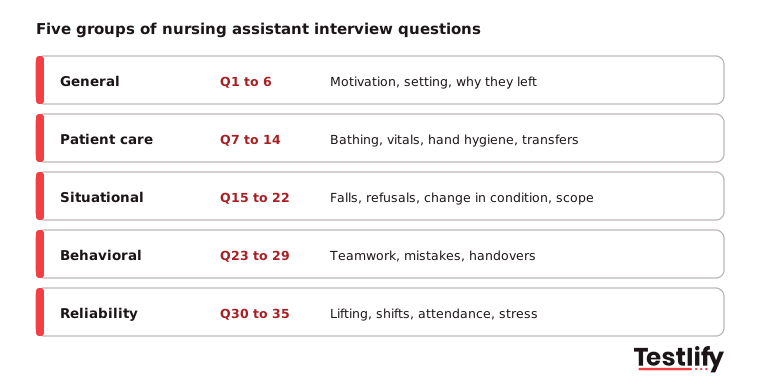
General nursing assistant interview questions should test motivation, fit with your setting and the reason the candidate left the last job. Keep this group short, about 10 minutes. The useful signal is whether the candidate talks about residents and the care team, or only about pay and hours.
- Why do you want to work as a nursing assistant? Look for a real reason linked to caring for people, such as a family member or a past job in care.
- Why do you want to work here, in this setting? A strong answer shows they know the difference between a hospital, a nursing home, home health and hospice.
- Why did you leave, or why are you leaving, your last job? Listen for a clear, calm reason. Repeated blame on every past employer is a warning sign.
- What part of the CNA job do you find hardest? An honest answer, such as bathing a resident who is upset, beats "nothing".
- How many residents or patients did you usually care for on a shift? The number tells you whether they can handle your ratio.
- What do you want to be doing in two years? Many CNAs are working toward LPN or RN school. Plans to grow are fine and often mean steady effort.
What patient care and clinical skills questions should you ask?
Patient care questions check the daily work a CNA does: activities of daily living, vital signs, transfers, feeding, skin care and infection control. Ask candidates to walk you through each step out loud. The order of steps shows whether they were trained well and still follow the training.
Infection control deserves extra time. The CDC's hand hygiene guidance for healthcare staff says some staff need to clean their hands as often as 100 times in a shift, including before touching a patient, after contact and after removing gloves.
- Can you walk me through how you give a bed bath? Strong answers include privacy, explaining each step, checking water temperature and checking skin for redness.
- How do you take and record vital signs, and when do you report them? Look for "I report anything outside the normal range to the nurse right away".
- When do you clean your hands during care? A strong answer covers before and after resident contact and after taking off gloves.
- How do you prevent pressure injuries? Expect repositioning on a schedule, keeping skin clean and dry, and reporting red areas.
- How do you help a resident who needs help eating? Good answers mention sitting upright, small bites, watching for coughing and recording intake.
- How do you transfer a resident from bed to wheelchair? Listen for checking the care plan, locking the brakes, using a gait belt or lift, and asking for help.
- What do you document after each shift, and why? A strong answer links notes to safety and to the next shift.
- How do you protect a resident's privacy and dignity? Expect closing doors and curtains, knocking, covering the body and never sharing details outside the care team.
For a wider set of care skills to test, see the Certified Nursing Assistant test.
What situational questions show how a nursing assistant handles pressure?
Situational questions describe a real moment on the floor and ask what the candidate would do next. Nursing assistant candidates who answer well act first to keep the resident safe, stay within their scope, and tell the nurse quickly. Situational judgment questions like these are hard to rehearse.
- A resident you are helping to walk starts to fall. What do you do? Strong: guide them gently to the floor, do not try to lift them alone, call for help, tell the nurse.
- A resident refuses a shower. What do you do? Strong: ask why, offer another time or a bed bath, respect the choice, tell the nurse.
- You notice a resident is confused, and they were alert yesterday. What do you do? Strong: report the change in condition to the nurse at once.
- A resident hits or scratches you during care. How do you respond? Strong: step back, stay calm, keep them safe, get help and report it.
- A family member says you are not doing enough for their mother. What do you say? Strong: listen, stay polite, explain what you can, bring in the nurse.
- The nurse asks you to give a resident their medication. What do you do? Strong: say politely that it is outside a CNA's scope in most settings.
- Three call lights go on at once. How do you decide who to see first? Strong: safety first, such as a fall risk or someone in pain, then tell a colleague.
- You see a coworker being rough with a resident. What do you do? Strong: make sure the resident is safe and report it to the nurse or supervisor that shift.
What behavioral questions test teamwork and communication?
Behavioral questions ask for a real past example, so they test what the candidate has done rather than what they say they would do. Ask for one specific story each time, then follow up with "what happened next?" A nursing assistant with real floor time gives names of tasks, times and outcomes.
- Tell me about a time you disagreed with a nurse about a resident's care.
- Describe a shift when you were short-staffed. What did you do?
- Tell me about a resident who was hard to care for and how you built trust.
- Describe a time you made a mistake at work. How did you fix it?
- Tell me about a time you had to explain something to a resident with dementia or hearing loss.
- Describe how you hand over to the next shift.
- Tell me about a time a coworker needed help and you were busy.
Strong answers own the mistake, describe what they said, and name the result. Weak answers stay general ("I always communicate well") or put all the blame on others. A structured interview, where every candidate gets the same questions in the same order, makes these answers easy to compare.
Pro tip: Ask the same three behavioral questions to every CNA candidate for the same unit. You will hear the difference between a practiced story and a real one within a week of interviews.
What questions check physical demands, shifts and reliability?
Questions about physical demands, shifts and reliability check whether the candidate can do the work safely for a full shift and keep coming back. Given high CNA turnover, these questions protect the team as much as the clinical ones do. Be direct and describe the real schedule.
Manual handling is one of the main injury risks in the job. OSHA's safe patient handling guidance points to overexertion from lifting, transfers and repositioning, with the shoulders and low back most affected.
- This role involves lifting and turning residents many times a shift. How do you protect your back? Look for lifts, gait belts, team lifts and good body mechanics.
- Which shifts can you work, and which can you not? Clear limits now prevent no-shows later.
- How do you get to work, and what do you do if that falls through?
- How many days did you miss in your last job, and why? Ask it plainly and listen for an honest answer.
- How do you handle stress after a hard shift? Look for a real habit, such as rest, exercise or talking to someone.
- What questions do you have for us? Good candidates ask about the ratio, training, the unit and who they report to.
What are the red flags in answers to nursing assistant interview questions?
The red flags in answers to nursing assistant interview questions are signs of unsafe care, poor judgment or low reliability. One weak answer is not a reason to reject. A pattern across two or three questions is. Use the table to agree on the flags before interviews start.
Area | Red flag answer | Why it matters |
|---|---|---|
Scope | Would give medication or change a care plan alone | Puts residents and your license at risk |
Infection control | Hand hygiene only "when hands look dirty" | Spreads infection between residents |
Safety | Would lift a fallen resident alone | Injury to the resident and the CNA |
Dignity | Talks about residents as tasks or blames them | Leads to complaints and poor care |
Reporting | Would "wait and see" on a change in condition | Delays care when it matters most |
Reliability | Vague about missed shifts or availability | Predicts no-shows and early quits |
Teamwork | Every story ends with someone else at fault | Friction with nurses and peers |
Across the teams we work with in healthcare hiring, the same pattern shows up: the candidates who fail in the first 90 days rarely lacked clinical knowledge. They struggled with reporting, teamwork or the schedule, which these questions surface early.
How should you score nursing assistant interview answers?
Nursing assistant interview answers are easiest to compare on a five-area scorecard: resident safety, infection control, dignity and communication, teamwork, and reliability. Rate each area from 1 to 5 and write a note for every score. Agree as a team on what a 1, a 3 and a 5 sound like.
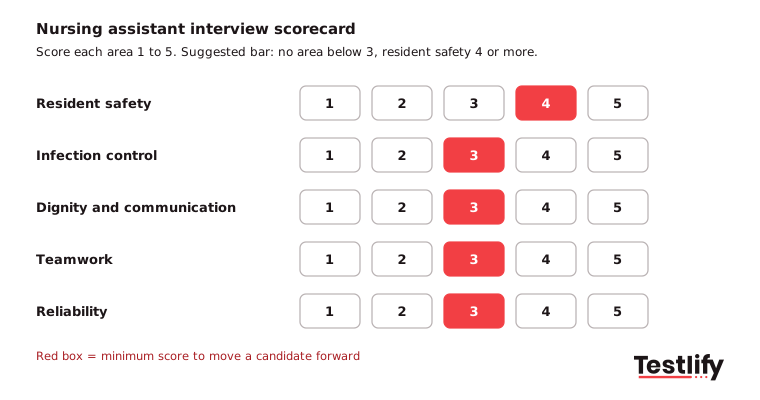
Set a minimum, for example no area below 3 and resident safety at 4 or more. Testlify's guide to the interview scorecard shows how to build one for any role.
Key takeaway: The questions matter less than asking all of them the same way and scoring against the same anchors. Consistency is what lets you compare a night-shift candidate on Tuesday with a day-shift candidate on Friday.
How can you hire nursing assistants faster without lowering the bar?
Hiring nursing assistants faster starts with moving the basic checks before the interview. A short skills test on care knowledge, safety and judgment screens out weak applicants in minutes, so nurses only interview people who already know the basics. The interview can then focus on scenarios and fit.
Testlify has a ready-made CNA test for US roles that covers resident care, safety and infection control. It sits in a library of 3,500+ tests, so you can add a compassion or communication test in the same invite. Assessments run in 15+ languages, which helps when your applicant pool is multilingual, and 20+ proctoring checks help make sure the answers are the candidate's own.
For more on healthcare hiring, see how pre-hire tests help healthcare hiring and the CNA job description template. Hiring for office roles too? See the executive assistant interview questions and research assistant interview questions.
Ready to screen CNA candidates before the interview?
Send every applicant the same short CNA skills test, then interview only the people who pass. Browse the Testlify test library or start a 7-day free trial, no credit card required, and set up your first nursing assistant assessment today.
Frequently asked questions

Content Writer
Yashika Khandelwal is a Content Writer with 3+ years of experience creating research-backed content on hiring, talent assessment, and HR technology. She is a registered Organizational Psychologist and subject matter expert who combines behavioral science with practical recruitment insights to produce accurate, evidence-based content.
LinkedInRelated resources
View all
Interview questions
40 delivery driver interview questions and what good answers sound like

Interview questions
Lab assistant interview questions: 30 to ask, with strong answers

Interview questions
30 scenario based interview questions to ask candidates

Interview questions
30 Selenium interview questions to ask and what strong answers sound like

Interview questions
Situational based interview questions: 30 examples for hiring teams

Interview questions
40 healthcare interview questions to ask candidates, with strong answers
Get started.
Hire on proof, not resumes.
Run your first skills-based assessment free — no credit card required.