
Lab assistant interview questions: 30 to ask, with strong answers
Thirty lab assistant interview questions on safety, specimens, equipment and records, with what strong answers sound like and how to score.

One mislabeled tube can send a whole batch of results in the wrong direction. Lab assistants handle that risk many times a day, so lab assistant interview questions must test habits, not just qualifications.
The 30 questions below cover safety, specimens, equipment, records and reliability. Each has a strong-answer cue and a red flag, followed by a scoring table and a practical task.
TL;DR:
- Ask lab assistant interview questions in five areas: safety and PPE, specimen handling, equipment, records and confidentiality, and behavior under routine pressure.
- Safety questions come first. A candidate who cannot explain what to do after a spill or a needlestick is not ready, whatever their degree.
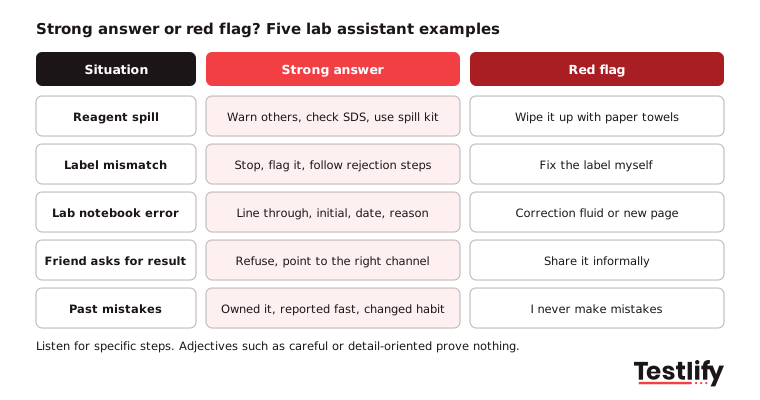
- Listen for specific steps, not adjectives. "I check the label against the requisition twice" beats "I am very detail-oriented".
- Score every answer on the same 1 to 5 scale, with written anchors, so two interviewers rate the same answer alike.
- Add a 20 minute practical task, such as labeling and logging five mock samples, to see accuracy instead of hearing about it.
- A short skills test before the interview filters out candidates without basic lab knowledge and keeps panel time for the strongest people.
 ChatGPT
 Gemini
 Claude
 Grok
 Perplexity
What does a lab assistant do, and what should the interview test?
A lab assistant supports scientists and technicians by preparing samples and solutions, labeling and logging specimens, cleaning and stocking equipment, and keeping records accurate. The interview should test whether the candidate does that work safely, accurately and the same way every time, because small errors in a lab travel far.
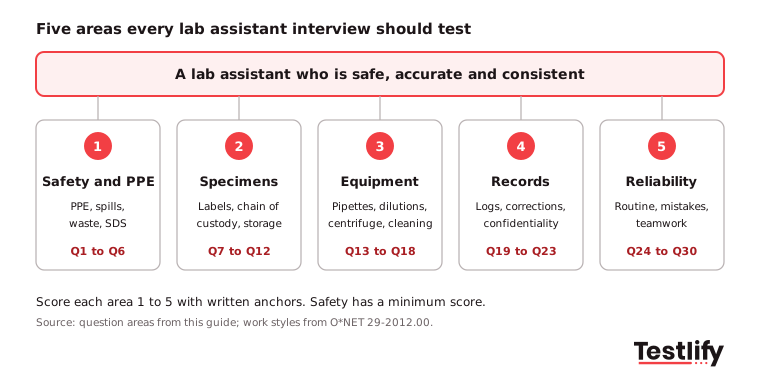
Use the five areas below as the spine of your interview plan. If you have not written the role yet, start from the lab assistant job description template and pick the duties your lab actually needs.

What lab assistant interview questions test safety and PPE?
Lab assistant interview questions on safety should ask for the exact steps the candidate takes, not general promises to "follow the rules". Strong candidates name the PPE for a task, explain where the safety data sheet lives, and describe what they do in the first minute after a spill or exposure.
OSHA says more than 500,000 people work in US laboratories, and the OSHA laboratory safety overview points to the Laboratory standard (29 CFR 1910.1450), which requires a written chemical hygiene plan for most non-production labs. Your questions should check that the candidate knows such a plan exists and how to use it.
- What PPE would you wear to prepare a dilute acid solution, and why? Strong answer: names lab coat, gloves suited to the chemical, eye protection, and working in a fume hood when needed. Red flag: "Gloves, I guess."
- A colleague knocks over a reagent bottle next to you. What do you do in the first two minutes? Strong answer: warns others, checks the safety data sheet, uses the spill kit for that chemical, reports it. Red flag: starts wiping it up with paper towels.
- Where would you find information on a chemical you have never handled before? Strong answer: the safety data sheet and the lab's chemical hygiene plan, then asks a supervisor.
- How do you dispose of sharps, biohazard waste and chemical waste? Strong answer: separates each into the right container and knows labeling rules. Red flag: one bin for everything.
- Tell me about a time you saw someone cut a safety corner. What did you do? Strong answer: raised it politely and promptly, and reported it if it continued.
- What does this hazard label tell you about handling the chemical? Strong answer: reads the pictograms and signal word, then states the handling step they imply.
What lab assistant interview questions test specimen handling and accuracy?
Lab assistant interview questions on specimen handling check whether the candidate protects sample identity from collection to result. The best answers mention matching labels to the request form, keeping chain of custody, storing samples at the right temperature and stopping work when something does not match.
In clinical labs, blood and body fluids add a second layer of risk. The OSHA bloodborne pathogens standard requires employers to have an exposure control plan, provide PPE and training, and offer hepatitis B vaccination.
A strong candidate already knows what "standard precautions" means in practice.
A tube arrives with a label that does not match the requisition. What do you do?
Strong answer: does not process it, flags it, follows the rejection or relabel procedure. Red flag: "I would fix the label."
How do you make sure you never mix up two samples?
Strong answer: one sample open at a time, two identifiers checked, barcode scanning where available.
Which samples need special storage, and how do you check it?
Strong answer: names cold chain or light-sensitive samples and checks fridge and freezer logs.
What does chain of custody mean, and when have you followed it?
Strong answer: a signed, timed record of every handover, with a real example.
What would you do after a needlestick injury?
Strong answer: wash the area, report immediately, follow the exposure plan for follow-up.
You are halfway through aliquoting and realize you used the wrong pipette tip size. What now?
Strong answer: stops, tells the supervisor, documents it, and repeats the work if the protocol says so.
What lab assistant interview questions test equipment and technique?
Lab assistant interview questions on equipment should ask candidates to describe how they use, check and clean common instruments, not just list them. Listen for calibration checks, simple troubleshooting and knowing when to stop and call a technician, because a lab assistant who guesses with equipment wastes samples and time.
How do you balance a centrifuge, and what happens if you do not?
Strong answer: matching tubes of equal weight placed opposite each other, otherwise vibration, damage or broken tubes.
How do you check that a pipette is accurate?
Strong answer: knows the calibration schedule, can describe a gravimetric check or the lab's own check, uses the right volume range.
How would you prepare 500 mL of a 1 in 10 dilution?
Strong answer: 50 mL of stock made up to 500 mL, in the right order and labeled.
Which instruments have you cleaned and maintained, and how often?
Strong answer: names the item, the schedule and where the log is kept.
An analyzer shows an error mid-run. What do you do first?
Strong answer: follows the error guide, protects the samples, informs the technician, does not force a restart.
How do you sterilize glassware or media, and how do you know it worked?
Strong answer: autoclave cycle, indicator tape or test strips, and records.
Pro tip: Ask candidates to describe the last time they did the task, step by step. People who have done it name small details and talk in sequence, while others stay general.
What lab assistant interview questions test records and confidentiality?
Lab assistant interview questions on records test whether the candidate writes things down at the time, corrects errors the right way and protects patient or study data. Strong candidates say they never erase or overwrite an entry, they line through and initial it, and they share results only through approved channels.
How do you correct a mistake in a lab notebook or log?
Strong answer: single line through, initial, date and reason. Red flag: correction fluid or tearing out a page.
Which lab software or information systems have you used?
Strong answer: names a laboratory information system or inventory tool and what they did in it.
A friend asks you for their test result before the doctor calls. What do you say?
Strong answer: politely refuses and points them to the right channel.
How do you keep stock and reagent inventory accurate?
Strong answer: logs use, checks expiry dates, flags low stock early, uses first in, first out.
What do you record when you receive a sample?
Strong answer: time, condition, identifiers, temperature, and who handed it over.
What behavioral and situational questions should you ask a lab assistant?
Behavioral and situational questions show how a lab assistant handles routine, pressure and teamwork, which matter as much as technique in a shared lab. Ask for real examples with a clear result, and listen for ownership of mistakes, calm prioritizing and respect for protocol even when it slows the work down.
Much of this job is repetitive. How do you stay accurate on the 200th sample of the day?
Strong answer: checklists, short breaks, the same routine every time.
Tell me about a mistake you made in a lab. What happened next?
Strong answer: owned it, reported it fast, changed a habit. Red flag: no mistakes ever.
Three people ask you for help at once, and one task is urgent. How do you decide?
Strong answer: clarifies urgency, handles time-critical samples first, tells the others when they will get help.
How would you explain a new procedure to a temporary worker?
Strong answer: shows, then watches them do it, then checks.
What would you do if a senior scientist asked you to skip a step to save time?
Strong answer: asks why, raises the risk, follows the protocol unless it is formally changed.
What part of lab work do you enjoy least, and how do you handle it?
Strong answer: an honest answer, such as cleaning or stock counts, with a plan to do it well.
Why do you want to work in this lab, and where do you see yourself in two years?
Strong answer: knows what the lab does and has a realistic goal, such as training toward a technician role.
For a research-heavy role, add questions on literature searches and data analysis from our research assistant interview questions.
How do you score lab assistant interview answers?
Lab assistant interview answers are best scored on a 1 to 5 scale for each of the five areas, with a written description of a 1, a 3 and a 5. Agree on those anchors before interviews start, have each interviewer score alone, then compare, so the hire rests on evidence instead of gut feel.
Area | 1: Not ready | 3: Ready with support | 5: Strong |
|---|---|---|---|
Safety and PPE | Vague, cannot name PPE or spill steps | Knows the basics, unsure on waste or SDS | Exact steps, reports issues, coaches others |
Specimen handling | Would relabel or guess | Checks labels, unsure on chain of custody | Two identifiers, stops on mismatch, documents |
Equipment | Lists tools only | Uses common tools, little maintenance | Calibrates, troubleshoots, knows when to escalate |
Records and confidentiality | Overwrites entries, shares results casually | Logs work, some gaps | Real-time records, correct corrections, protects data |
Reliability and teamwork | Blames others, no examples | Some examples, little reflection | Owns mistakes, prioritizes calmly, follows protocol |
A structured interview with the same questions for every candidate makes this table work. Put it into an interview scorecard so scores and notes sit in one place.
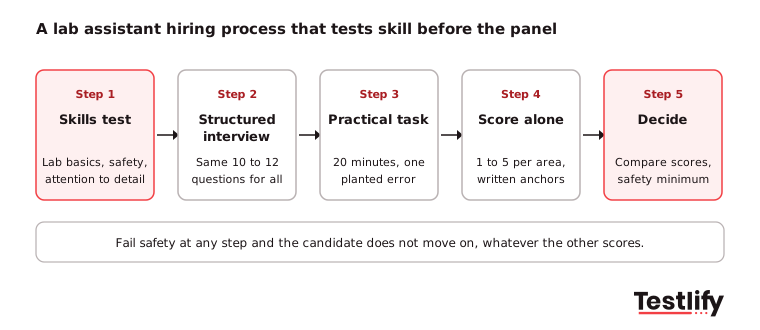
Key takeaway: Give safety a minimum score. A candidate who scores 5 on everything else but 1 on safety is not a hire for a lab.
What practical task should you add to a lab assistant interview?
A practical task for a lab assistant interview should take about 20 minutes and copy real daily work, such as labeling and logging five mock samples with one planted error, or preparing a simple dilution. Watching the task shows accuracy, speed and safety habits that no interview answer can prove.
Pick one of these, based on your lab:
- Sample intake: Hand over five mock tubes and requisition forms, with one mismatch. Score whether the candidate catches it and what they do next.
- Dilution and labeling: Ask for a simple dilution with water and food coloring, then a correct label with date, contents and initials.
- Equipment check: Ask the candidate to set up and balance a centrifuge with uneven tube volumes, without turning it on.
- Record correction: Give a log page with an error and ask them to correct it the right way.
Use the same task, the same planted errors and the same scoring for every candidate, or the comparison stops being fair.
Which lab assistant interview questions change for clinical, research and school labs?
Lab assistant interview questions change with the setting: clinical labs stress specimen identity, bloodborne pathogen safety and patient confidentiality; research labs stress technique, notebooks and following protocols; school and college labs stress preparation, safety with students and stock control. Keep the five areas and swap the examples.
Lab type | Add or stress | Example question |
|---|---|---|
Clinical or hospital lab | Specimen identity, standard precautions, patient privacy | What do you do when a specimen arrives unlabeled? |
Research lab | Notebook records, technique, protocol changes | How do you record a deviation from the protocol? |
School or college lab | Practical preparation, student safety, stock control | How do you prepare a class practical for 30 students safely? |
Industrial or QC lab | Standard operating procedures, batch records, audits | What do you do if a result falls outside the specification? |
For clinical roles, a short HIPAA knowledge test can confirm privacy basics before the interview.
How is a lab assistant interview different from a lab technician interview?
A lab assistant interview focuses on support work done under supervision: preparing, labeling, cleaning, stocking and recording. A lab technician interview goes further into running and reading tests, quality control and calibration, because technicians produce results.
Use deeper technical and analysis questions for technicians and keep assistant interviews practical.
The BLS Occupational Outlook Handbook puts clinical laboratory technologists and technicians at about 343,000 jobs in 2025, with about 20,800 openings a year through 2035, mostly to replace people who move on or retire.
Many of those technicians start as assistants, so asking about career goals (question 30) helps you spot people worth training. If you are hiring the next level up, the lab technician job description lists the extra duties to test.
How can a skills test shorten lab assistant hiring?
A skills test before the interview checks basic lab knowledge, safety awareness and attention to detail for every applicant in the same way, so interviewers only meet people who pass. That leaves interview time for the questions above and the practical task, where a hiring panel adds the most value.
Testlify's test library has 3,500+ tests, including a biotech laboratory technician test, a safety awareness test and an attention to detail test.
You can combine them in one assessment, add your own questions from 25+ question types, and run it with 20+ proctoring checks. For more on testing in clinical settings, see healthcare hiring with pre-hire tests.
Ready to hire your next lab assistant?
Build a lab assistant assessment from the Testlify test library, send it to applicants, and bring only the strongest into your structured interview. Start a 7-day free trial, no credit card required, or book a demo to see it with your own role.
Frequently asked questions (FAQs)

Human Resources Lead
Snehi Parmar leads People at Testlify, owning hiring, culture, performance, and retention for a 90-person team. She writes on practical HR strategy and building people processes that scale.
Related resources
View all
Interview questions
30 scenario based interview questions to ask candidates

Interview questions
30 Selenium interview questions to ask and what strong answers sound like

Interview questions
Situational based interview questions: 30 examples for hiring teams

Interview questions
40 healthcare interview questions to ask candidates, with strong answers

Interview questions
35 cultural fit interview questions to ask candidates

Interview questions
30 academic advisor interview questions to ask in 2026
Get started.
Hire on proof, not resumes.
Run your first skills-based assessment free — no credit card required.