
Organizational change management in 2026: why change stalls and what HR should do
Most workplace change still stalls. Here is what the latest data says about why, and the moves HR and hiring teams can make to fix it.
Organizational change management is the work of helping people adopt a change in how the business runs, from a new system or structure to a new strategy, so the change delivers what it promised. In 2026 the hard part is no longer the plan. It is people's capacity to absorb yet another change on top of their day job.
 ChatGPT
 Gemini
 Claude
 Grok
 Perplexity
TL;DR
- Organizational change management (OCM) helps employees adopt new systems, processes and strategies so changes deliver results.
- Change often fails because of limited employee capacity, not resistance. 62% Of workers say their managers did not reduce regular workloads to make room for change.
- AI adoption, continuous transformation and shifting skill requirements are making change management a bigger HR priority in 2026.
- HR needs to hire for adaptability and learning agility, reskill employees early and equip managers to lead teams through change.
- Measure success through employee adoption, workload, manager readiness and time to proficiency, not just launch dates or training completion.

What is organizational change management in 2026?
Organizational change management (OCM) is a structured way to move people from the current way of working to a new one, with a plan for communication, training, support and follow-through. It sits next to project management: the project delivers the new system or structure, and OCM makes sure people use it.
Most teams apply it at three levels:
- Individual: helping each person understand why the change matters and what it means for their role.
- Project: a change plan for one initiative, such as a new HRIS, a restructure or an AI rollout.
- Enterprise: building change into how leaders, managers and HR work, so the company can handle many changes at once.
If you want the basics first, start with the Testlify glossary entries for change management and organizational change. This post focuses on what the latest data says about why change stalls and what HR can do about it.
Why does so much organizational change still fail?
Organizational change still fails mostly because employees are asked to change without being given the time, voice or support to do it. The plans are usually fine. The rollout lands on people who are already at full capacity, led by managers who are stretched thin themselves.
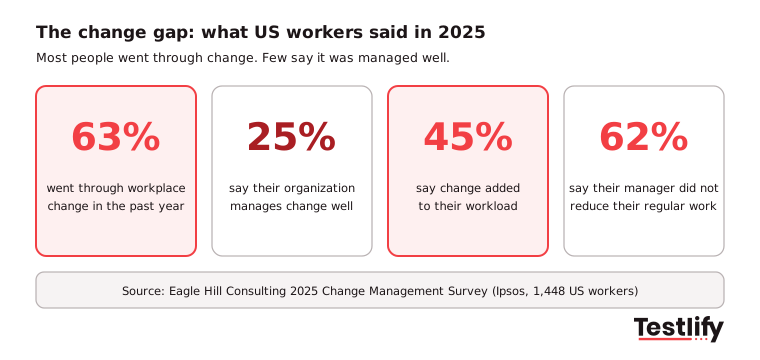
The numbers are blunt. Eagle Hill Consulting's 2025 Change Management Survey, fielded by Ipsos with 1,448 US workers in August 2025, found that:
- 63% went through workplace change in the past year.
- Only 25% say their organization manages change rollouts effectively, and only 24% say change is rolled out in a way that makes it easy to embrace.
- 34% say the changes were not worth the effort.
- 45% say change increased their workload and 43% say it raised their stress.
- 62% say their manager did not reduce their regular work so they could adjust.
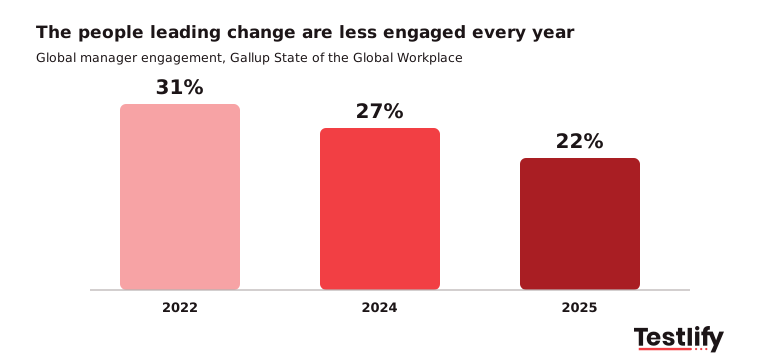
The people expected to lead change are struggling too. Gallup's State of the Global Workplace found global employee engagement fell to 20% in 2025, and manager engagement dropped to 22%, from 27% in 2024 and 31% in 2022. When the manager is disengaged, the change message reaches the team as one more task.
The point of view here is simple: most failed change is a capacity failure that gets labeled as resistance. People rarely reject a good idea. They reject a good idea that arrives with no time to learn it.
What are the biggest organizational change management trends for 2026?
The biggest organizational change management trends for 2026 are AI rollouts as the main change program, constant change instead of one big project, a squeezed middle-manager layer, shifting skills inside existing roles, and employees asking for a say in how change happens, not only what changes.
Trend | What the data shows | What it means for HR |
|---|---|---|
AI rollouts are the main change program | Deloitte: 59% of organizations take a tech-focused approach to AI and are 1.6x more likely to miss their AI return goals | Treat every AI rollout as a people change with its own plan |
Change never stops | Deloitte: 7 in 10 leaders say their main strategy is to be "fast and nimble" | Build lasting change capacity, not one-off programs |
Managers are squeezed | Gallup: manager engagement 22% in 2025 | Give team leads time, training and fewer priorities |
Skills are shifting inside roles | SHRM: 47% of organizations are updating existing roles with new skills | Reskill and hire for the new role, not the old job title |
Employees want a say in how | Eagle Hill: 57% feel heard on what to change, 40% on how, 33% on priorities | Involve teams in the rollout plan, not just the announcement |
Generations react differently | Eagle Hill: 70% of Gen X adjusted with no workload cut, vs 47% of Gen Z | Avoid one plan for everyone, let team leads adapt it |
The AI point deserves attention. Deloitte's 2026 Global Human Capital Trends found that organizations taking a tech-first approach to AI were 1.6 times more likely to fall short on AI returns than those that put people first. The tool is rarely the problem. Adoption is.
Why is change capacity a hiring and skills problem?
Change capacity is a hiring and skills problem because a company can only change as fast as its people can learn. If the workforce lacks the skills the new way of working needs, no amount of communication will close the gap. HR and talent acquisition teams decide much of that capacity, one hire and one promotion at a time.
The skills gap is already showing up in role design. SHRM's 2025 Talent Trends research found that 28% of organizations now require new skills for full-time roles and 47% are updating existing roles to include them, while 69% still struggle to fill positions. Every one of those updated roles is a small change program.
Three shifts follow for hiring teams:
- Hire for adaptability, not just today's tasks: For roles at the center of a change, test learning agility and adaptability along with role skills. A strong performer in the old process can still struggle in the new one.
- Reskill before the change lands: Map which roles change and train people early through upskilling and reskilling, instead of after go-live when everyone is already behind.
- Plan the workforce around the change: Fold big changes into workforce planning so hiring, mobility and training budgets match the new structure.
What does an organizational change management process look like now?
An organizational change management process that works in 2026 has six steps: check capacity, make room in the workload, involve people in how the change rolls out, equip team leads, close skills gaps, and measure adoption. The classic phases of prepare, implement and follow through still apply. What changes is where the effort goes.
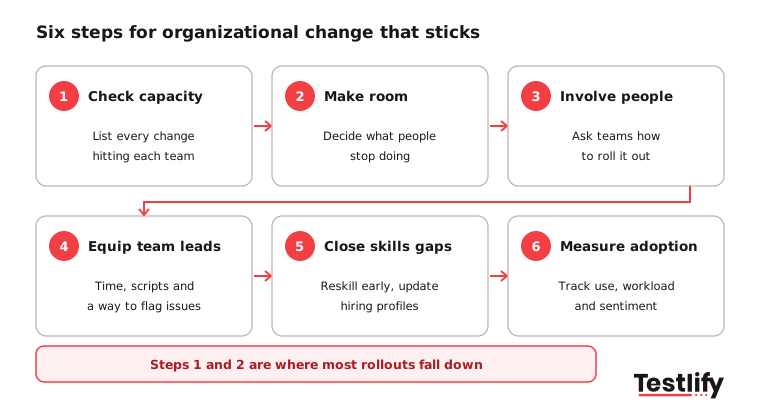
- Check capacity first: List every change already hitting the affected teams. If three projects land on the same people in one quarter, delay or merge one before you add another.
- Make room in the workload: Decide what people will stop doing while they learn the new way. Eagle Hill's data suggests this one step is where most rollouts fall down.
- Involve people in the how: Employees are usually told what is changing. Ask the teams affected how to roll it out, and change the plan based on what they say.
- Equip team leads: Eagle Hill found 47% of workers say their team lead has the most influence during change. Give leads talking points, time to coach and a way to raise problems early.
- Close skills gaps: Train for the new tasks before go-live, and adjust hiring profiles for roles the change reshapes.
- Measure adoption: Track whether people actually work the new way, then fix what blocks them.
Pro tip: Write a short "stop doing" list for every change. If nothing comes off people's plates, the change goes on top of a full plate, and the old way wins.
For the communication side of each step, see HR communication during organizational changes.
How should HR measure whether change is working?
HR should measure change by adoption, workload and sentiment, not by launch dates or training completion. A system that went live on time but that half the team works around is not a success. A few simple measures, tracked monthly, show whether the change is sticking.
- Adoption rate: the share of people using the new process or tool as intended, by team.
- Workload signal: overtime, open tickets or a quick pulse question on whether people had time to learn.
- Manager readiness: whether team leads can explain the change and answer basic questions about it.
- Sentiment and voice: a short pulse survey on whether people feel heard on how the change is rolling out.
- Retention in affected teams: exits in the six months after a change, compared with other teams.
- Time to proficiency: how long it takes people to reach normal output in the new way of working.
Retention deserves a closer look than most teams give it. The LinkedIn 2025 Workplace Learning Report found 88% of organizations are concerned about retention, and only 15% of employees say their manager helped them build a career plan in the past six months. Change that ignores careers tends to show up later as turnover.
What should HR leaders do in the next 90 days?
HR leaders should use the next 90 days to take stock of current change load, fix the manager layer and line up skills for the changes already planned. None of this needs a new program. It needs a clearer view of what people are being asked to absorb.
- Weeks 1 to 4: Build a single list of every change in flight across the business, with the teams each one touches. Flag teams with more than two at once.
- Weeks 5 to 8: Meet the managers of the most loaded teams. Agree on what can pause, and give them a simple script for the next change.
- Weeks 9 to 12: For each planned change, list the skills it needs. Update hiring profiles and start reskilling where the gap is widest.
Key takeaway: Organizational change management fails less from bad plans than from full calendars. Make room in the workload, give managers the tools to lead, and hire and train for the skills the change needs.
Want to build a team that handles change well?
Change goes faster when the people in key roles can learn quickly and adapt. Read more on skills-based organizations, or browse the Testlify change management test and adaptability test to see how candidates handle shifting priorities before you hire.
Frequently asked questions (FAQs)

Related resources
View all
Workplace culture
How to reduce employee absenteeism: 10 steps that work
Workplace culture
External recognition programs: what they are and how to run one

Workplace culture
Employee communication best practices for 2026

Workplace culture
What is an upskilling strategy? A practical guide for HR teams

Workplace culture
Employee engagement metrics: 12 to track and how to measure them
Workplace culture
How to identify flight risk employees: signs, steps and a risk matrix
Get started.
Hire on proof, not resumes.
Run your first skills-based assessment free — no credit card required.