
How to identify flight risk employees: signs, steps and a risk matrix
Spot employees who may quit before they resign, with the signs to watch, the HR data to check, a risk matrix and questions to ask them.

Your best people rarely announce they are leaving. By the time the resignation email arrives, the decision is usually made.
A flight risk employee is someone who is likely to leave your organization soon. Spotting one early gives you time to fix the problem before a competitor's offer does it for you.
To identify flight risk employees, combine three sources. Use structural risk factors such as pay below range, changes in behavior such as falling engagement, and direct talks such as stay interviews.
Look for patterns over several weeks, not a single bad day. Below you will find the signs, a six-step process, a risk matrix and stay interview questions.
TL;DR:
- Identify flight risk employees by checking structural risk first (pay, promotion gaps, a new manager, workload), then behavior changes, then asking them directly in a stay interview.
- Half of US employees are open to leaving: Gallup puts the share watching for or actively seeking a new job at 51% to 52% since 2024.
- Behavior signs show up late. Gallup found 77% of people who quit left within three months of starting to look, or never looked at all.
- 42% of people who quit say their manager or company could have kept them, yet 45% had no conversation about their job or future in the three months before leaving.
- Score each person on likelihood of leaving and impact of leaving, and act first on the high likelihood, high impact group.
- Never treat pregnancy, illness, age or other personal events as risk scores. Use them as prompts to offer support.
- Much flight risk starts at hiring: a clear role preview and skills-based selection reduce early exits.
 ChatGPT
 Gemini
 Claude
 Grok
 Perplexity
What is a flight risk employee?
A flight risk employee is a person who is likely to leave the organization in the near future, either because they are actively job hunting or because they would accept a good offer if one came along. Flight risk describes probability, not certainty, and it can apply to anyone from a new hire to a senior leader.
The pool of possible leavers is large. Gallup's turnover research found that 51% of US employees were watching for or actively seeking a new job in 2024.
Its retention indicator puts the figure at 52% in May 2026. That means flight risk is normal.
The job is to find the people closest to leaving whose exit would hurt most.
Flight risk is related to, but not the same as, quiet quitting. A quiet quitter does the minimum and stays.
A flight risk may keep performing well right up to the day they resign.

Why do employees become flight risks?
Employees become flight risks when something they value at work falls short and a better option looks possible. In Gallup's study of people who quit, the preventable causes were pay and benefits (30%), the relationship with their manager (21%), wider organizational issues (13%), career advancement (11%) and workload or staffing (9%).
- Pay below market or below peers: People compare their pay with job ads and with colleagues. A gap they can see is one of the clearest reasons to start looking.
- A poor relationship with their manager: Fewer positive conversations, little recognition and unclear expectations push people out faster than most policies do.
- No visible next step: When someone has been in the same role for years with no promotion or new scope, they look outside for growth. A clear career path helps here.
- Workload and burnout: Long stretches of overtime, understaffing and constant urgency wear people down. Watch for signs of burnout.
- Change they did not choose: A reorganization, a new manager, a return-to-office rule or a merger can reset how people feel about their job overnight.
- Poor role fit from the start: Some people were hired into a job that does not match their skills or expectations. These exits often happen in the first year.
Gallup's employee retention indicator adds that when exit reasons are grouped, engagement and culture (37%) and wellbeing and work-life balance (31%) account for 68% of exits, while pay alone is cited 16% of the time.
What are the signs that an employee is a flight risk?
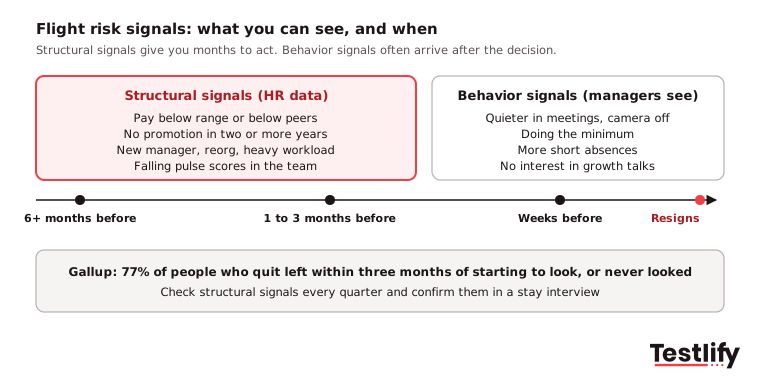
The signs of a flight risk employee fall into two groups: structural signals in HR data and behavior signals in daily work. Structural signals give you more time to act.
Behavior signals are easier to notice but often arrive late.
Signal | Type | Where to find it | How early it shows |
|---|---|---|---|
Pay below the range midpoint or below peers | Structural | Compensation data | Months before any change in behavior |
No promotion or role change in two or more years | Structural | HRIS job history | Months ahead |
New manager, reorg or team change | Structural | Org charts, HRIS | Weeks to months ahead |
Heavy overtime or a high workload for a long time | Structural | Time and project data | Weeks to months ahead |
Falling engagement or pulse survey scores in a team | Structural | Survey results by team | Weeks ahead |
Less input in meetings, camera off, quieter in chat | Behavior | Manager observation | Late |
Doing the minimum, avoiding new projects | Behavior | Manager observation | Late |
More short absences or unusual time off | Behavior | Leave records | Late |
No interest in training, mentoring or promotion talks | Behavior | L&D records, 1:1s | Late |
Updated LinkedIn profile, more personal calls | Behavior | Not recommended to track | Very late |
Behavior signs matter, but treat them as a reason to talk, not proof. A drop in output can come from illness, caring duties or a hard project.
Gallup also found that 77% of people who quit either left within three months of starting a search or did not search at all. By the time behavior changes, the decision may already be made.
Pro tip: Look at the structural signals every quarter even when nothing seems wrong. They are the only signals that give you months, not weeks, to act.
How to identify flight risk employees step by step
Identifying flight risk employees works best as a short, repeatable process: learn from past exits, check structural risk, listen to managers, talk to the people involved, score likelihood and impact, then act and review. Run it every quarter for critical roles and twice a year for everyone else.
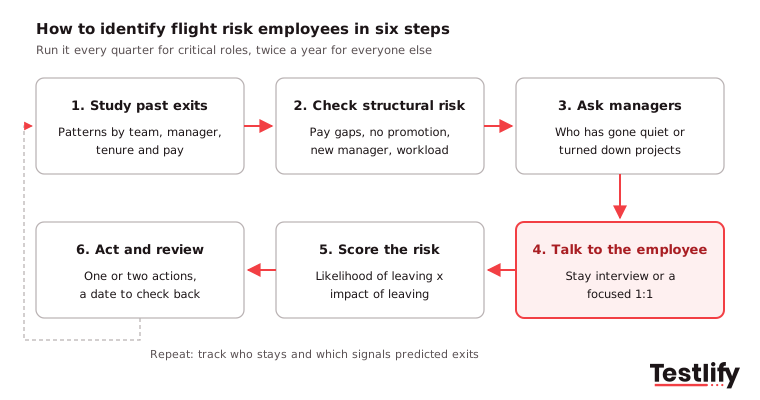
- Study past exits: Pull the last 12 to 24 months of voluntary leavers. Look for patterns by team, manager, tenure, pay position and time since last promotion. Your exit interview notes show the reasons in people's own words.
- Check structural risk: Apply those patterns to current employees. Flag people below their pay range, past the usual promotion window, under a new manager or carrying heavy workloads.
- Ask managers what they see: Managers know who has gone quiet, turned down projects or asked about other teams. Give them a short checklist so the input is consistent across teams.
- Talk to the employee: Hold a stay interview or a focused 1:1. This is the step most teams skip, and it is the one that tells you whether a flag is real.
- Score likelihood and impact: Rate each flagged person on how likely they are to leave and how much their exit would hurt. The matrix in the next section shows how.
- Act and review: Agree one or two actions per person, set a date to check back, and track whether those people stay. Over time this also shows which signals predict exits in your company.
Pulse data helps at step 2 and step 6. Short pulse surveys by team show where engagement is falling before people start to leave.
How do you score flight risk with a risk matrix?
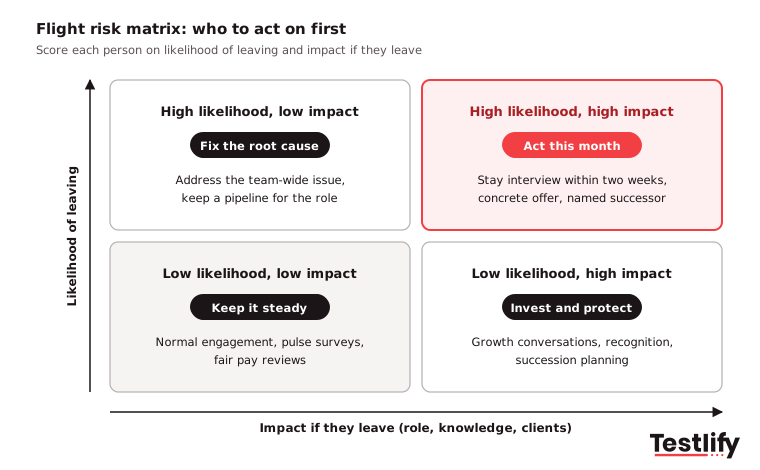
Scoring flight risk with a risk matrix means rating each person on two axes, likelihood of leaving and impact if they leave, and placing them in one of four boxes. The box decides the action: high likelihood and high impact gets attention this month, low likelihood and low impact gets your normal engagement work.
Quadrant | Who is in it | What to do |
|---|---|---|
High likelihood, high impact | Key people with clear risk signals | Stay interview within two weeks, a concrete offer on pay, scope or growth, and a named successor |
High likelihood, low impact | Replaceable roles with clear risk signals | Fix the root cause for the team, keep a pipeline ready for the role |
Low likelihood, high impact | Key people who seem settled | Regular growth conversations, recognition, succession planning |
Low likelihood, low impact | Settled people in replaceable roles | Normal engagement, pulse surveys, fair pay reviews |
Impact is about more than seniority. Consider how hard the role is to fill, how much knowledge would leave with the person, whether clients depend on them and whether others might follow.
Losing a high performer is what HR teams call regretted attrition, and it costs far more than the salary line suggests. Gallup estimates that replacing a leader or manager costs around 200% of their salary, a technical professional around 80% and a frontline employee around 40%.
Key takeaway: Keep the matrix private to HR and the direct manager, and review it with the employee's actual words from a stay interview. A score built only on data and guesswork labels people unfairly.
What questions should you ask in a stay interview?
A stay interview should ask what keeps the person in the job, what might make them leave and what would make the next year better. Keep it to 20 to 30 minutes, hold it with the direct manager, and focus on listening rather than defending decisions.
A stay interview is the most direct way to confirm or rule out a flight risk.
Gallup found that 45% of people who quit had no conversation with a manager or leader about their job satisfaction, performance or future in the three months before they left. A short, regular conversation closes that gap.
Use these questions:
- What do you look forward to most when you start work each week?
- What part of your job would you happily give away?
- When did you last think about leaving, and what prompted it?
- Do you feel your pay reflects your work and the market? Why or why not?
- What would you like to be doing in a year that you are not doing now?
- What support do you need from me that you are not getting?
- What would make you more likely to stay for the next two years?
- If a friend asked about working here, what would you tell them?
Write down the answers and agree one action before the meeting ends. A stay interview with no follow-up does more harm than no interview at all.
How do you identify flight risk fairly and legally?
Identifying flight risk fairly and legally means using job-related signals, telling people how their data is used and never treating protected characteristics or personal events as risk scores. Several popular guides list pregnancy, marriage, illness or a coming retirement as warning signs.
Using those to label someone a flight risk can lead to unfair decisions and legal claims.
- Keep personal events out of the score: Pregnancy, disability, age, religion and family status are protected in most countries. In the US, the EEOC explains that pregnancy discrimination covers decisions on pay, assignments and promotion. If someone goes through a big life change, offer support and flexibility, not a risk label.
- Do not monitor people covertly: Tracking job site visits, LinkedIn activity or personal messages damages trust and may break privacy law. The UK ICO's guidance on monitoring workers expects employers to be open about monitoring and to show that it is necessary and proportionate.
- Use team-level data where you can: Analyze engagement and turnover by team or manager first. Individual flags should come from conversations, not hidden scores.
- Protect the person you flag: A flight risk label should never block a promotion, a good project or a pay review. On Reddit and Workplace Stack Exchange, employees often say being seen as a flight risk stalled their careers, which then made them leave.
- Check your model for bias: If you use a predictive tool, check whether it flags some groups more than others and keep a person in the loop for every decision.
What should you do once you spot a flight risk employee?
Once you spot a flight risk employee, talk to them within two weeks, find the specific reason behind the risk and offer a change you can actually deliver. Match the response to the cause: a pay gap needs a pay review, a stalled career needs a growth plan, and a manager problem needs coaching or a move.
- Pay gap: Benchmark the role, explain how pay is set and fix gaps you can justify. Do not wait for the annual cycle if the person is at high risk.
- No growth: Agree a development plan with dates, a stretch project or a move to another team. Internal moves keep skills in the company; see this guide to internal mobility.
- Manager issues: Coach the manager, add a skip-level 1:1 or offer a transfer. If several people under one manager are at risk, the manager is the root cause.
- Burnout or workload: Remove work, add staff or change deadlines. Extra perks do not fix an impossible workload.
- Recognition: Thank people for specific work in public and in private. It costs nothing and is often missing.
- Plan for the exit anyway: For high-impact roles, document key knowledge and build a successor or a ready pipeline, even if the person stays.
The labor market shapes urgency. The BLS Job Openings and Labor Turnover Survey counted 3.1 million quits in August 2026, a quits rate of 1.9%.
Quits are lower than in 2022, but your best people still get offers. For more tactics, see these employee retention strategies.
Use the cost of employee turnover calculator to show leaders what an exit would cost.
How can hiring reduce flight risk from day one?
Hiring reduces flight risk from day one by matching people to roles they can do well and want to do, with honest expectations about the work. Many early exits are not about pay or managers at all.
They happen because the job turned out to be different from what the candidate expected, or the person lacked key skills and struggled.
- Give a realistic job preview: Show candidates the hard parts of the role, the schedule and the workload before they accept.
- Hire on skills, not resumes: Test the skills the job actually uses, so new hires can succeed early instead of struggling and leaving.
- Check motivation and work style: Ask structured questions about what the candidate wants from the next two years and compare it with what the role offers.
- Track early exits by source: If people from one channel or one interview panel leave in the first six months, fix that part of the process.
Testlify helps hiring teams with the skills part. Teams can choose from 3,500+ tests, including role-specific skills tests, situational judgment tests and personality and motivation tests such as the Big 5 personality test, and assessments run in 15+ languages.
Structured AI interviews ask every candidate the same role-based questions, so hiring decisions rest on evidence, not gut feeling.
Ready to book a demo?
Retention starts with the right hire. Book a demo to see how Testlify supports skills-based hiring for your next open role.
You can also browse the Testlify test library or start a 7-day free trial, no credit card required.
Frequently asked questions (FAQs)

Human Resources Lead
Snehi Parmar leads People at Testlify, owning hiring, culture, performance, and retention for a 90-person team. She writes on practical HR strategy and building people processes that scale.
Related resources
View all
Workplace culture
How to create an employee recognition program in 9 steps

Workplace culture
How to communicate with Gen Z workers: 9 tips for managers

Workplace culture
Participative Leadership: Meaning, Types, Pros and Cons

Workplace culture
12 Best Employee Engagement Strategies That Work in 2026

Workplace culture
Learning trends for 2026: what HR and L&D teams need to know

Workplace culture
50+ Core Values Examples for Companies, Teams and Hiring
Get started.
Hire on proof, not resumes.
Run your first skills-based assessment free — no credit card required.