
What is an upskilling strategy? A practical guide for HR teams
An upskilling strategy maps skill gaps to training and measures the result, so HR teams close gaps the business feels within a quarter.

An upskilling strategy is a plan that identifies the skill gaps closest to business goals, picks the training formats that close each gap fastest, and tracks whether employees apply the new skill on the job. It differs from a training calendar because every course on the plan ties back to a named gap and a metric, not a general wish to "build skills."
TL;DR /Key Takeaways
- An upskilling strategy ties each named skill gap to a training format, an owner and a business metric. Then it checks the skill on the job.
- The World Economic Forum expects 39% of workers' core skills to change by 2030.
- Pick 3 to 5 gaps ranked by business impact. A strategy that tries to close 15 gaps at once closes none well.
- Match the format to the skill: microlearning for fast-changing software, mentoring for judgment skills, stretch assignments for leadership.
- A first version takes 4 to 6 weeks to build. Pilot it with one team for 6 to 10 weeks before rolling out.
- Measure with a before-and-after skills assessment, not course completion. Completion shows training happened, not that the gap closed.
- Prioritize AI fluency, judgment and communication, and role-specific technical depth. McKinsey reports demand for AI fluency rose nearly sevenfold in two years.
 ChatGPT
 Gemini
 Claude
 Grok
 Perplexity
What is an upskilling strategy?
An upskilling strategy is a documented plan that connects a skill gap to a training format, an owner, and a success metric, so training spend maps to a business result instead of a general development goal. The word "upskilling" refers to teaching a current employee a new or deeper skill for their existing role or the next one up; "reskilling" covers a move to a different role entirely. A strategy ties the two together under one plan when a team needs both.
A strategy differs from a learning and development program in scope. L&D runs the full catalog of courses, compliance training, and career development across the company. An upskilling strategy is narrower: it names 3 to 5 skill gaps that matter this year, picks the fastest way to close each one, and reports back on whether the gap closed. For the broader program this sits inside, see learning and development activities.

Why do companies need an upskilling strategy in 2026?
Companies need an upskilling strategy in 2026 because the skills a role needs change faster than most hiring pipelines can replace people, and training current staff is usually cheaper and faster than hiring from outside. The World Economic Forum's Future of Jobs Report 2025 puts the figure at 39% of workers' core skills expected to change by 2030, down from 44% in the prior edition but still close to four in ten.
Three pressures make this urgent rather than optional:
- AI is changing job content, not just removing roles: Most roles keep their title but gain new tools, so the skill gap shows up inside a job, not in a layoff list.
- External hiring is slow and expensive for skills already inside the building: A six-month search for a skill a current employee could learn in ten weeks is a strategy failure, not a hiring one.
- Retention depends on growth: Employees who see no path to a new skill or role look elsewhere first. A named upskilling plan is one of the clearest signals a company gives that growth is real.
An upskilling strategy answers these pressures with a short list of gaps and a plan for each one, instead of a company-wide push to "build a learning culture" that never gets measured.
What are the main types of upskilling strategies?
The main types of upskilling strategies differ by how training reaches the employee and how closely it ties to a specific role. Most companies run two or three of these together rather than picking one.
Strategy type | How it works | Best for | Typical time to close a gap |
|---|---|---|---|
Role-based upskilling | Training mapped to the skills one job family needs next | A known gap in a large role group, such as support or sales | 6 to 12 weeks |
Flow-of-work microlearning | Short lessons delivered inside the tool the employee already uses | Fast-changing software or process skills | 2 to 6 weeks |
Mentoring and job shadowing | A more experienced employee transfers a skill one-on-one or in small groups | Judgment-heavy skills that are hard to teach from a course | 1 to 3 months |
Stretch assignments and job rotation | The employee learns by doing the work under supervision | Leadership and cross-functional skills | 3 to 6 months |
Certification-backed training | A structured course that ends in an external or internal credential | Technical and compliance-adjacent skills that need proof | 1 to 4 months |
Pick the type by matching it to the skill, not the other way around. A judgment-heavy skill such as giving feedback rarely transfers well through a self-paced course; a fast-changing software skill rarely needs a 3-month rotation.
How do you build an upskilling strategy in 6 steps?
Building an upskilling strategy starts with a skills audit and ends with a measurement loop, with four steps in between that turn the audit into training people actually finish. HBR's research on upskilling groups similar steps under a short list of core strategies rather than a long rollout plan, and that short list is the point: a strategy with 20 action items rarely survives the first budget review.
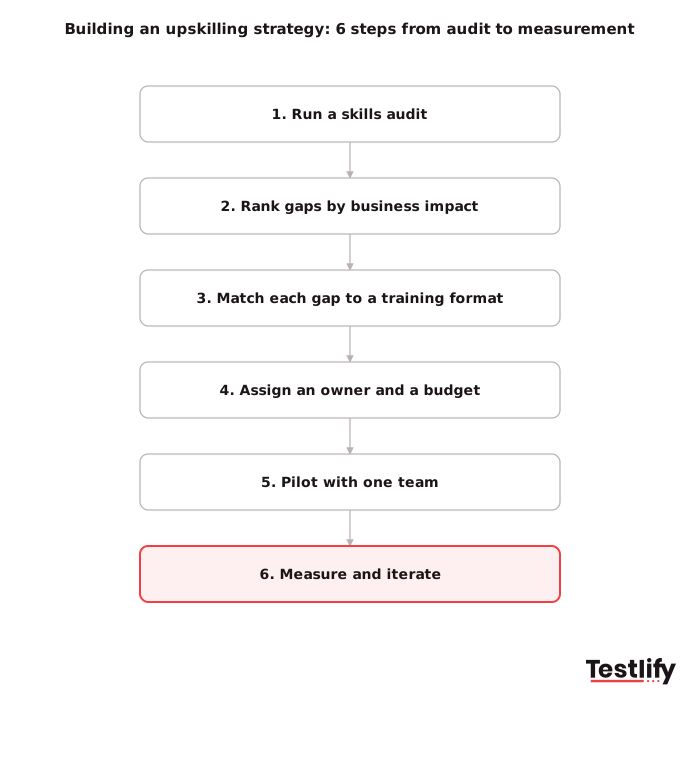
- Run a skills audit: Compare the skills each role needs now and in 18 months against what the team already has. A skills assessment or a structured self and manager rating works; a guess from the last performance review does not.
- Rank the gaps by business impact: Score each gap on how much revenue, risk, or speed it affects, and pick the top 3 to 5. A strategy that tries to close 15 gaps at once closes none of them well.
- Match each gap to a format: Use the table above: fast-changing skills get microlearning, judgment skills get mentoring, leadership skills get stretch assignments.
- Assign an owner and a budget per gap: Every gap needs one named owner, not a shared L&D inbox, and a budget line that survives the next planning cycle.
- Pilot with one team before rolling out company-wide: A 6- to 10-week pilot on one team surfaces format problems while the cost of fixing them is still low.
- Measure and iterate: Check whether the skill shows up on the job, not just whether the course was completed, then adjust the format or the gap list for the next quarter.
Pro tip: Write the business metric for each gap before you pick the training format. If you cannot name the number that should move, the gap is not specific enough yet to build a plan around.
Which skills should an upskilling strategy prioritize right now?
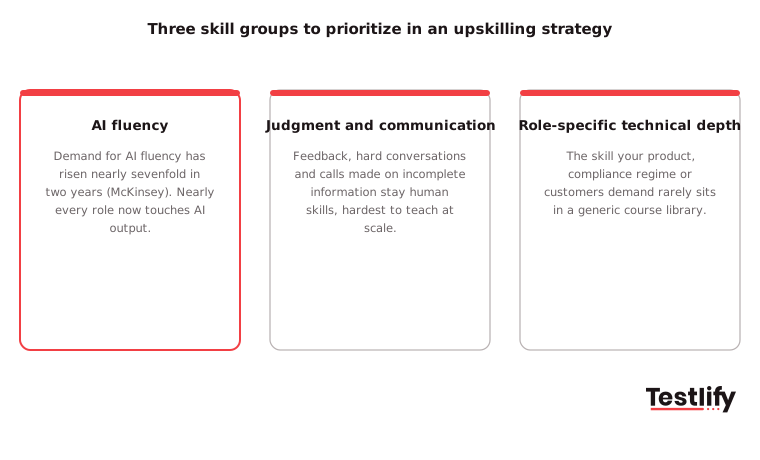
Skills worth prioritizing right now split into three groups: AI fluency for almost every role, judgment and communication skills that AI tools cannot replace, and the specific technical skills tied to your own product or industry. McKinsey's research on AI fluency reports that demand for AI fluency, knowing when and how to use AI and then checking and improving its output, has risen nearly sevenfold in two years.
- AI and data fluency: Not every employee needs to build models, but most roles now touch a tool that uses AI output, and employees who can read and question that output make fewer costly mistakes.
- Judgment and communication: Giving feedback, running a difficult conversation, and making a call with incomplete information stay human skills. They are also the hardest to teach at scale, which is why mentoring and stretch assignments matter more here than courses.
- Role-specific technical depth: The skill your own product, compliance regime, or customer base demands rarely shows up in a generic course library and usually needs an internal subject-matter expert to design it.
A 2025 LinkedIn Learning report found that employees are more likely to finish training tied to a named project or promotion path than training framed as general development, which is one more reason to rank gaps by business impact first.
How do you measure an upskilling strategy's success?
Measuring an upskilling strategy's success means tracking whether the skill shows up at work, not just whether a course was completed. Course completion tells you training happened; it does not tell you the gap closed.
Metric | What it tells you | How to track it |
|---|---|---|
Skill gap closed (pre/post assessment) | Whether the employee can now do the thing, not just attend the course | Before-and-after skills assessment on the same scale |
Time to apply the skill on the job | How fast training turns into real work | Manager check-in 30 and 90 days after training |
Internal mobility rate | Whether upskilled employees move into the roles the gap was meant to prepare them for | HRIS data on internal moves tied to a named skill |
Retention of upskilled employees | Whether growth investment reduces attrition in that group | Retention rate 12 months after training, compared with the rest of the team |
Business metric tied to the gap | The number you named in step 2 of the build process | Whatever the gap was ranked against: error rate, cycle time, revenue per rep |
SHRM's guidance on measuring training ROI recommends tying at least one learning metric to a business outcome leaders already track, rather than inventing a new learning-only scorecard nobody outside HR reads.
Key takeaway: A strategy with no pre/post skill measurement is a training calendar wearing a strategy's name. Add the before-and-after check before you scale past the pilot team.
What mistakes do upskilling strategies run into?
Upskilling strategies most often fail by trying to cover too many skills at once, skipping the pre/post measurement, and treating every skill with the same training format. Gallup's research on career advancement finds that one in four employees say they lack advancement opportunities, which raises the cost of a strategy that looks good in a slide deck but does not change what people can do.
- Too many gaps, no ranking: A list of 15 "priority skills" is not a priority list. Cut to 3 to 5 and say no to the rest for this cycle.
- No manager involvement: Across the teams we work with, the strategies that stick start with manager time, not a bigger course catalog; managers need to know what their team is learning and why, or the skill never gets a chance to show up on the job.
- One format for every skill: A judgment skill forced into a self-paced course and a fast-changing software skill forced into a 3-month rotation both waste the format's strength.
- No budget past the pilot: A strategy that runs out of funding after the first team's pilot was never a company strategy; it was a pilot with good intentions.
- Measuring attendance, not skill: Completion rates look good in a report and tell you nothing about whether the gap closed.
How does Testlify support an upskilling strategy?
Testlify supports an upskilling strategy at the step most companies skip: measuring the skill gap before training and checking it again after. The platform runs role-specific skills tests across 3,500+ validated tests and 25+ question types, so the audit in step 1 and the measurement in step 6 use the same scale.
- Skills audit at scale: Assess an entire team against the skills a role needs now, with results that roll up to a team-level gap view instead of 50 separate manager opinions. test library
- Pre/post comparison: Run the same assessment before and after training to see whether the gap actually closed, with a per-skill breakdown instead of a single pass/fail score.
- Built-in benchmarking: Compare a team's scores against a global benchmark to rank which gaps are furthest behind, which helps with step 2 of the build process above.
- Fits the audit into hiring too: The same skills data that flags an internal gap can inform a hiring decision when the gap is too large to close with training alone. AI-upskilling guide for HR teams
For a deeper look at reskilling the same workforce for a different role rather than a deeper one, see upskilling and reskilling and the glossary definition at upskilling.
Ready to build your upskilling strategy?
Start with the skills audit. Run a free trial of Testlify to assess your team against the skills your roles need now, no credit card required, and turn step 1 of your upskilling strategy into a real baseline this week.
Frequently asked questions

Content Writer
Yashika Khandelwal is a Content Writer with 3+ years of experience creating research-backed content on hiring, talent assessment, and HR technology. She is a registered Organizational Psychologist and subject matter expert who combines behavioral science with practical recruitment insights to produce accurate, evidence-based content.
LinkedInRelated resources
View all
Workplace culture
Employee engagement metrics: 12 to track and how to measure them

Workplace culture
How to identify flight risk employees: signs, steps and a risk matrix

Workplace culture
How to create an employee recognition program in 9 steps

Workplace culture
How to communicate with Gen Z workers: 9 tips for managers

Workplace culture
Participative Leadership: Meaning, Types, Pros and Cons

Workplace culture
12 Best Employee Engagement Strategies That Work in 2026
Get started.
Hire on proof, not resumes.
Run your first skills-based assessment free — no credit card required.