
External recognition programs: what they are and how to run one
An external recognition program celebrates employees publicly, outside the company. See the types, benefits, steps and mistakes to avoid.

A thank-you in a team meeting feels good, then fades by Friday. Praise that clients, peers and future employers can see lasts far longer.
Below, you will find the main types, the benefits and a five-step way to run one. You will also see the mistakes that make public praise backfire.
An external recognition program is a deliberate way to celebrate an employee's work in public, such as a LinkedIn post, a press mention, an industry award or a client thank-you. It sits alongside internal recognition and does not replace it.
TL;DR:
- An external recognition program celebrates an employee's work publicly, outside the company, through channels like social media, press, awards or customer-facing content.
- It differs from internal recognition because the audience includes people outside the organization, which raises the employee's visibility, not just their morale.
- Gallup found that employees who feel adequately recognized are far less likely to say they intend to leave their job within the next year.
- The four main types are public social recognition, media and press mentions, awards and certifications, and customer-facing recognition.
- Always get the employee's consent before naming them publicly; not everyone wants outside visibility.
- Tell the employee's manager and team before you post, so a public shout-out is never the first time they hear about the achievement.
- Track who gets external recognition and how often, so it does not cluster on a small group of visible roles.
 ChatGPT
 Gemini
 Claude
 Grok
 Perplexity
What is an external recognition program?
An external recognition program is a structured way of praising an employee's work so that people outside the company see it, not just managers and teammates. It sits next to internal recognition programs, which stay inside the organization through peer shout-outs, points systems or internal newsletters.
External recognition takes the same underlying achievement and gives it a wider stage: a social media post, a press mention, an award, or a line in a customer case study that names the person. Companies run these programs for two reasons at once.
The employee gets visibility that can help their career, their professional reputation and sometimes their pay negotiating position. The company gets a credible, third-party-adjacent story about its people, which helps with employer branding and makes job postings more convincing to candidates researching the company.

How is external recognition different from internal recognition?
External recognition is different from internal recognition mainly in audience and stakes, not in the underlying behavior being rewarded. Internal recognition (a Slack shout-out, a points-based rewards platform, a mention in an all-hands) stays inside the company and carries low risk: if the wording is slightly off, only coworkers see it.
External recognition puts the same achievement in front of clients, the public or an employee's professional network. That raises both the upside and the need for care.
Factor | Internal recognition | External recognition |
|---|---|---|
Audience | Coworkers and managers | Customers, the public, industry peers, an employee's own network |
Consent | Rarely asked explicitly | Should always be asked first |
Control | Easy to edit or retract | Hard to walk back once live (press, awards, public posts) |
Cost and effort | Close to free, same day | Often takes more time, sometimes a real budget |
What are the benefits of an external recognition program?
An external recognition program benefits the employee, their team and the company at the same time, which is part of why it works better than either internal recognition or marketing content alone.
- It keeps good people longer: Gallup's research on the global workplace found that employees who feel they get the right amount of recognition are far less likely to say they are looking for a new job. External recognition is a stronger form of that same signal, because it is visible outside the company too.
- It helps recruiting: A candidate researching the company sees real employees named in real contexts, which reads as more credible than a generic "great culture" claim on a careers page.
- It builds the employee's own reputation: A named press mention or an industry award becomes something the employee can point to in their own career, which many people value more than an internal badge.
- It gives the company a steady source of authentic content: Instead of inventing culture content from scratch, external recognition turns real work into posts, case studies and award entries that marketing and talent teams can both reuse.
- It reinforces the behavior you actually want more of: Naming the specific thing someone did, not just that they are "a great employee," makes it clear to the rest of the team what good work looks like.
Key takeaway: External recognition works because it combines two separate incentives in one act: the employee's own reputation and the company's employer brand. Programs that only serve one side rarely last past the first few posts.
What are the types of external recognition programs?
Most external recognition programs use some mix of four channels, matched to the kind of achievement being recognized.
- Public social recognition: A LinkedIn, X or company page post that names a specific person and describes what they did, written so it reads naturally to someone who has never met them.
- Media and press mentions: A press release, trade publication feature, podcast appearance or local news segment that credits an employee or a small team by name for a specific piece of work.
- Awards and certifications: Industry awards, professional certifications and conference speaking opportunities that the company helps an employee pursue, submit for, or get nominated into.
- Customer-facing recognition: A client thank-you, a named quote in a case study, or a review-site mention that credits the specific person or team the customer actually worked with.
How do you build an external recognition program?
Building an external recognition program works best as a short, repeatable process rather than a one-off campaign, so recognition keeps happening after the first few posts.
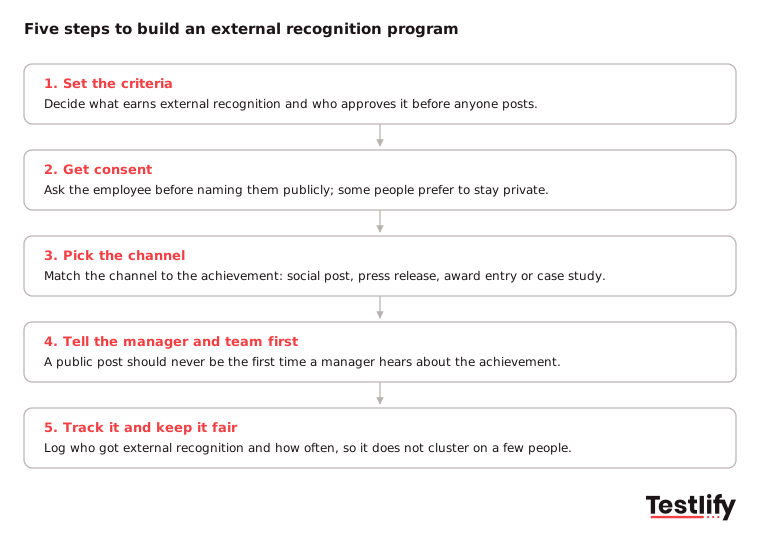
Step 1: Set the criteria
Decide in advance what kind of work earns external recognition (a client win, a major project, a conference talk) and who signs off before anything goes public. SHRM's toolkit on managing recognition programs recommends setting success metrics and writing the criteria down before launch, so recognition stays consistent as the team grows.
Step 2: Get consent
Always ask the employee before naming them publicly. Some people are glad for the visibility; others prefer recognition to stay internal, and both are valid.
Step 3: Pick the channel
Match the channel to the size of the achievement. A quick client win might be a same-day social post; a major project might deserve a press mention or an award submission that takes a few weeks to put together.
Step 4: Tell the manager and team first
A public post should never be the first time an employee's manager or team hears about the achievement. Give them at least 24 hours' notice so the recognition feels coordinated, not sprung on them.
Step 5: Track it and keep it fair
Keep a simple log of who has received external recognition and how often, and review it every 90 days. Without that review, visibility tends to cluster on the roles that are already client-facing or public by nature, while equally strong work elsewhere in the company goes unseen.
Pro tip: Build the approval step into whatever tool you already use for internal recognition, so external recognition is one extra click, not a separate process nobody remembers to run.
What mistakes should you avoid?
Most external recognition mistakes come from rushing, and public praise is hard to undo once it is live. Four patterns cause the most damage, and each one is easy to avoid with a little planning.
- Posting without asking first: Naming someone publicly without consent can embarrass an employee who would have preferred to stay out of the spotlight, even when the achievement is genuinely good news.
- Only recognizing client-facing roles: Sales, support and marketing naturally generate public moments. Engineering, operations and back-office work rarely do on their own, so a program that does not look for those stories will quietly favor one part of the company.
- Treating it as a one-time campaign: A single wave of posts around a launch or an anniversary reads as a marketing push, not recognition. The programs that build trust run continuously, in small, specific moments.
- Being vague about what someone did: "Shout-out to Priya for her amazing work" tells an outside audience nothing. Naming the actual project, client or result is what makes the recognition, and the message, land.
Build the team worth recognizing
An external recognition program only works if the hiring process puts the right people on the team in the first place. Testlify's skills assessments help hiring teams screen for the skills a role actually needs.
A structured employee recognition program gives you the internal foundation to build external recognition on top of. Book a demo to see how Testlify helps you hire the people worth celebrating.
Frequently asked questions (FAQs)

People and Talent Partner
Arushi Shah runs day-to-day talent acquisition and candidate experience at Testlify. She writes on interviewing, structured hiring, and giving candidates a fair, fast process.
LinkedInRelated resources
View all
Workplace culture
Employee communication best practices for 2026

Workplace culture
What is an upskilling strategy? A practical guide for HR teams

Workplace culture
Employee engagement metrics: 12 to track and how to measure them

Workplace culture
How to identify flight risk employees: signs, steps and a risk matrix

Workplace culture
How to create an employee recognition program in 9 steps

Workplace culture
How to communicate with Gen Z workers: 9 tips for managers
Get started.
Hire on proof, not resumes.
Run your first skills-based assessment free — no credit card required.