
How to reduce employee absenteeism: 10 steps that work
Most absence has a cause you can fix. Learn how to measure it, find the root cause, set a fair attendance policy and hire for reliability.

Every unplanned absence lands on someone else. A teammate stays late, a manager rewrites the rota, and a customer waits.
To reduce employee absenteeism, start by finding out why people miss work. Then measure it, fix the cause and hire people whose expectations match the job.
Most employers respond with stricter rules or attendance bonuses. Those rarely work, because most absence has a cause that the rules never touch.
TL;DR:
- Reduce employee absenteeism by fixing the cause, not the symptom: track absence, spot patterns, then act on burnout, illness, caregiving or poor job fit.
- US full-time workers had a 3.2% absence rate in 2025, according to the US Bureau of Labor Statistics. Personal care and service jobs ran highest at 4.3%.
- UK employers recorded 9.4 sickness days per employee in 2025, the highest in more than 15 years, with mental ill health the top cause of long-term absence.
- Gallup found the most engaged teams have 78% lower absenteeism than the least engaged, so manager quality matters more than attendance bonuses.
- Hold a short return-to-work conversation after every absence. It catches problems early and costs only time.
- Some absenteeism starts at hiring. Realistic job previews, reliability screening and structured onboarding cut early no-shows.
 ChatGPT
 Gemini
 Claude
 Grok
 Perplexity
What is employee absenteeism?
Employee absenteeism is a pattern of missing work that goes beyond agreed leave, such as repeated sick days, late call-outs or no-shows. Planned vacation, approved parental leave and public holidays do not count.
HR teams worry about unplanned absence, because the team only finds out on the day.
Absenteeism can be categorized into three kinds:
- Occasional absence: a day off for a cold or a sick child. Normal and expected.
- Patterned absence: Mondays, Fridays or the day after a holiday, again and again.
- Chronic absence: frequent or long absences linked to health, stress or disengagement.
Some absence is healthy. The BLS absence data for 2025 shows 3.2% of full-time US workers missed part of their usual week, 2.2 points of it for illness or injury.
A team running well above that rate has a problem worth fixing.

What causes employee absenteeism?
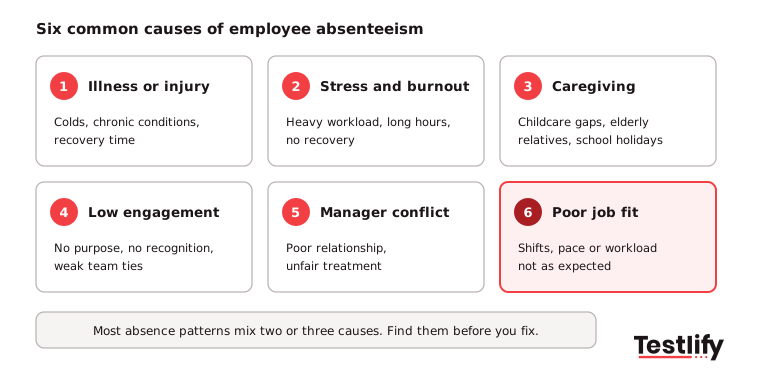
Employee absenteeism usually comes from six causes: illness and injury, stress and burnout, caregiving duties, low engagement, a poor relationship with the manager, and a job that does not match what the person expected. Most patterns mix two or three of these, so one fix rarely works alone.
Mental health now drives much of it. The CIPD Health and wellbeing at work 2025 report found mental ill health is the leading cause of long-term absence and the second cause of short-term absence, with stress a major factor in both.
Burnout shows up first as Monday call-outs and missed deadlines, long before anyone resigns.
Two causes get less attention than they deserve. Caregiving (childcare gaps, an elderly parent) causes many short, unplanned absences.
Poor job fit causes early absence in new hires who find the shifts, workload or pace are not what the job ad promised.
How much does absenteeism cost employers?
Absenteeism costs employers three ways: wages paid for time not worked, overtime or temps to cover the gap, and lost output from stretched teams. The UK Keep Britain Working review puts each sickness absence day at about GBP 120 in lost profit, with 150 million days lost a year.
The hidden cost is on the people who show up. Covering shifts again and again wears down the reliable members of a team, and that is how absence turns into turnover.
The Keep Britain Working final report also counts presenteeism, people working while unwell, as a large cost on its own.
To size it for your own business, multiply days lost by the average daily wage, then add the overtime and agency spend for the same period. Pair the result with Testlify's cost of employee turnover calculator if absence is already pushing people out.
How do you measure the absenteeism rate?
The absenteeism rate is the share of scheduled working days lost to unplanned absence in a period. Divide the days lost by the total days that should have been worked, then multiply by 100.
Track it monthly, by team and by shift, so patterns show up early.
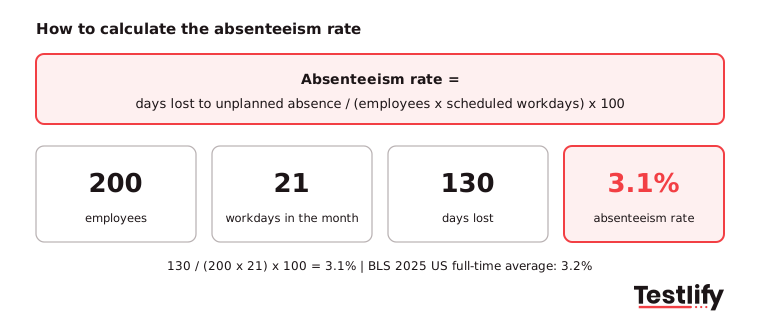
Absenteeism rate = days lost to unplanned absence / (employees x scheduled workdays) x 100
Example: 200 employees, 21 workdays in the month, 130 days lost. 130 / 4,200 x 100 = 3.1%.
What counts as acceptable depends on the work. BLS 2025 data shows management jobs at 2.5% and personal care and service jobs at 4.3%, so compare each team with similar roles, not with the company average.
Many UK employers also use the Bradford Factor, which weights frequent short absences more heavily than one long one.
How can you reduce employee absenteeism? 10 steps
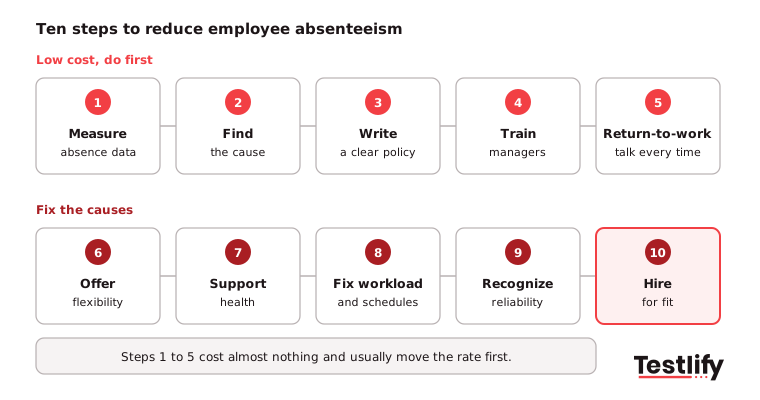
You can reduce employee absenteeism with ten steps in order: measure, find the cause, set a policy, train managers, check in after every absence, offer flexibility, support health, fix workload, recognize reliability and hire for fit. Steps 1 to 5 cost almost nothing and usually move the rate first.
1. Measure absence properly
Absence data needs one system and one format. Record every unplanned absence with the date, length and reason, so you can compare teams and months. Without data, every fix is a guess.
2. Find the cause behind each pattern
Absence patterns point to causes. Review absence by team, manager, shift and tenure. A spike under one manager needs a different fix than a spike among new hires.
3. Write a clear attendance policy
A clear policy tells people how to report an absence, by when and to whom. It also sets out what happens at each trigger point. The Testlify glossary entry on an absenteeism policy lists what to include.
4. Train managers to have the conversation
Managers often avoid the topic until it becomes a discipline case. Give them a short script and the policy, so early conversations feel routine.
5. Hold a return-to-work talk after every absence
A return-to-work talk takes five minutes. Welcome the person back, ask if they are fit to work and whether anything at work is making it harder. Burnout and caregiving problems often surface here first.
6. Offer flexibility where the role allows
Flexibility turns many full-day absences into a two-hour appointment. Where the role allows, offer shift swaps, flexible start times and hybrid days. See flexible work arrangements.
7. Support physical and mental health
Health support keeps small problems from becoming long absences. Make an employee assistance program easy to find. Offer paid sick days so people do not come in contagious.
8. Fix workload and scheduling
Chronic understaffing creates the burnout that causes absence. Publish shifts early and cap back-to-back overtime.
9. Recognize reliability, not perfect attendance
Perfect-attendance prizes push sick people into work. Thank the people who plan leave ahead and cover for colleagues instead.
10. Hire for fit and reliability
Hiring decisions shape absence in the first 90 days. Show the real job before the offer and screen for the traits the role needs. The hiring section below explains how.
Engagement sits underneath most of these steps. Gallup's engagement research found top-quartile teams have 78% lower absenteeism than bottom-quartile teams.
Pro tip: Run stay interviews with your most reliable people once a year. They will tell you what makes the job hard before the absence data does.
Which fix matches which cause of absenteeism?
Each cause of absenteeism needs its own fix. Use the table below after you have found the pattern in step 2.
Cause | Warning signs | First fix | Who owns it |
|---|---|---|---|
Illness or injury | Long single absences, doctor's notes | Paid sick days, phased return | HR and manager |
Stress or burnout | Mondays, rising short absences, missed deadlines | Workload review, EAP referral | Manager |
Caregiving | Short notice, school holidays | Flexible hours, shift swaps | Manager |
Low engagement | Absence spread across a team | Manager coaching, recognition | HR and leadership |
Manager conflict | Spike under one manager | Skip-level check-ins, manager training | HR |
Poor job fit | Absence in the first 90 days | Realistic job preview, better onboarding | Talent acquisition |
How do you handle excessive absenteeism fairly?
Excessive absenteeism is handled fairly when you follow your policy step by step: a private conversation, a written note of the agreed plan, support for any health or caregiving issue, and formal warnings only if nothing changes. Check protected leave rules before any discipline.
Start with a conversation, not a warning. Share the dates, ask what is going on, and agree on a plan with a review date.
For longer absences, the Keep Britain Working review recommends agreeing a return-to-work plan within two weeks and no later than six.
In the US, some absences are protected. The Family and Medical Leave Act gives eligible employees up to 12 workweeks of unpaid, job-protected leave a year for serious health conditions and family care, and the ADA may require adjustments for a disability.
Counting protected leave toward discipline is a common and costly mistake, so check with HR or legal first.
How does better hiring reduce employee absenteeism?
Better hiring reduces employee absenteeism because people who were surprised by the job are the ones who start calling out. Wrong expectations about shifts, pace or workload show up as absence within the first 90 days, long before they show up as turnover.
Talent acquisition teams can lower that risk in three ways:
- Show the real job: Put the schedule, shift pattern and toughest parts of the role in the job ad and the interview.
- Screen for reliability and fit: Use a work reliability test or a Big Five personality test next to skills tests and reference checks, never as the only signal.
- Onboard with structure: A clear first 30 days and a named buddy reduce early drop-off. See the employee onboarding guide.
This matters most in volume hiring for contact centers, retail, healthcare and logistics, where one missed shift leaves a queue or a ward short.
Key takeaway: Absence is a signal, not just a cost. Measure it, ask why, and fix the cause, including the hiring decisions that put the wrong person in the role.
Can Testlify help reduce absenteeism?
Testlify helps with the hiring side of absenteeism, not with tracking it. Testlify is a skills assessment and interviewing platform, so it does not record attendance.
It helps hiring teams check job fit and reliability before the offer, which is where some early absence starts.
- Role-specific tests: 3,500+ tests, including personality, situational judgment and work reliability tests, so you can test the traits a shift-based role needs.
- Same process for every candidate: Structured AI interviews and automated scoring keep every candidate on the same questions.
- Works where your teams hire: Assessments run in 15+ languages and sync with 100+ ATS and HRIS tools.
Ready to hire people who show up?
Browse the Testlify test library to find a reliability or personality test for your next role. Start a 7-day free trial, no credit card required.
Book a demo to see how Testlify fits your hiring process.
Frequently asked questions (FAQs)

Human Resources Lead
Snehi Parmar leads People at Testlify, owning hiring, culture, performance, and retention for a 90-person team. She writes on practical HR strategy and building people processes that scale.
Related resources
View all
Workplace culture
External recognition programs: what they are and how to run one

Workplace culture
Employee communication best practices for 2026

Workplace culture
What is an upskilling strategy? A practical guide for HR teams

Workplace culture
Employee engagement metrics: 12 to track and how to measure them

Workplace culture
How to identify flight risk employees: signs, steps and a risk matrix

Workplace culture
How to create an employee recognition program in 9 steps
Get started.
Hire on proof, not resumes.
Run your first skills-based assessment free — no credit card required.