
Bradford Factor
The Bradford Factor is a tool organization uses to measure the impact of absenteeism on the workplace. Organizations use the Bradford Factor to address absenteeism patterns among their employees.
 ChatGPT
 Gemini
 Claude
 Grok
Grok Perplexity
The Bradford Factor’s biggest risk in UK employment practice is its interaction with the Equality Act 2010.
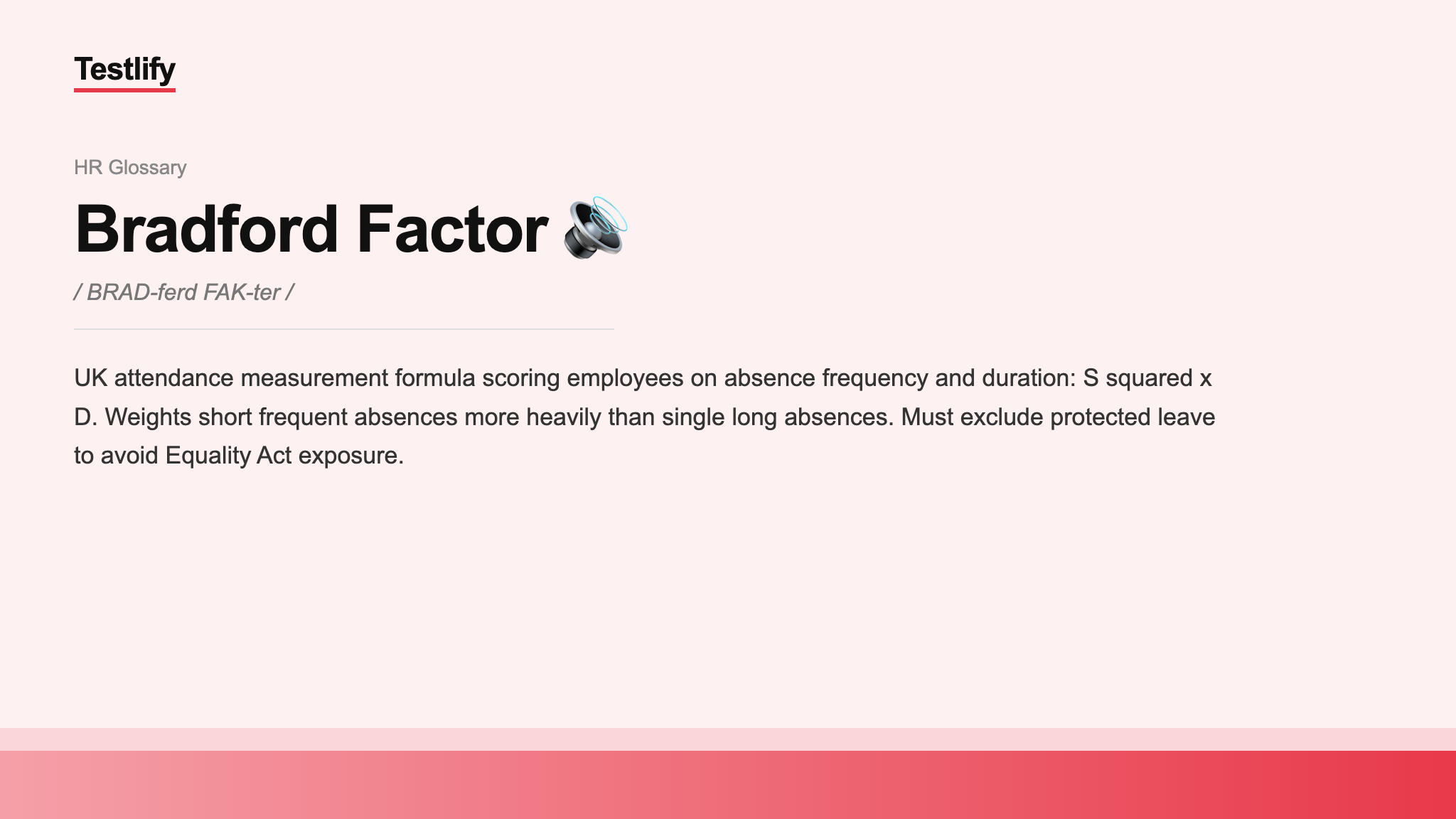
Bradford Factor is an attendance measurement formula used primarily in UK workplaces to quantify absence patterns by weighting frequency more heavily than duration. Formula: Bradford Factor = S² × D, where S is the number of separate absence spells and D is the total days absent. Also called: Bradford Index, Bradford Score.
The formula
Bradford Factor = S² x D
Where: – S = number of separate absence spells in the measurement period (typically rolling 52 weeks) – D = total number of days absent in the measurement period
The squaring of S is what gives the formula its distinctive property: frequency is weighted exponentially, not linearly. Two absences of 5 days each score very differently from one absence of 10 days:
This exponential weighting reflects the operational disruption logic: 10 separate one-day absences require 10 separate coverage arrangements, each unplanned; a single 10-day absence allows planning and substitution arrangements.
How UK employers typically use bradford factor thresholds
Most UK HR frameworks that use the Bradford Factor pair it with trigger thresholds at which specific management actions are initiated. Common thresholds (which vary by employer and sector):
These thresholds are not statutory – they are employer-defined policy benchmarks. ACAS guidance recommends that any threshold-triggered action be preceded by a return-to-work interview and individual assessment of circumstances.
Legal risks: the equality act 2010 problem
The Bradford Factor’s biggest risk in UK employment practice is its interaction with the Equality Act 2010. Protected characteristics under the Equality Act include disability, pregnancy and maternity, religion or belief, race, and sex – all of which can be the cause of legitimate absences that, if counted in the Bradford Score without exclusion, create indirect discrimination exposure.
Disability
Employees with disabilities or long-term health conditions may have a pattern of short-term absences precisely because their condition requires episodic medical treatment or periodic incapacity. Counting these absences in the Bradford Score can trigger automatic threshold consequences that indirectly discriminate against disabled employees. Under the Equality Act’s duty to make reasonable adjustments, employers are typically required to exclude disability-related absences from the Bradford Factor calculation, or to set higher individual thresholds for employees with declared disabilities affecting their absence pattern.
Pregnancy and maternity
Pregnancy-related illness absences must be excluded from any attendance assessment. Counting pregnancy-related absences as regular unprotected absences is pregnancy discrimination under the Equality Act and the Pregnant Workers Directive (for EU comparators).
Religion or belief
Absences for religious observance, where employees have a legitimate need for time off that is not accommodated, cannot be used against them in Bradford calculations without risk of indirect religious discrimination.
Practical exclusion approach
Most robust UK attendance policies that use the Bradford Factor explicitly exclude:
- Disability-related absences (where disclosed or where the employer knows of the disability)
- Pregnancy-related absences
- Maternity, paternity, adoption, and shared parental leave
- FMLA-equivalent or statutory leave (in non-UK contexts)
- Jury duty and other legally protected absences
The ACAS code of practice on disciplinary and grievance procedures further recommends that any attendance-triggered disciplinary action include an individual assessment of circumstances before proceeding, not mechanical threshold application.
The bradford factor in non-uk contexts
The Bradford Factor was developed for and is primarily used in UK employment practice, where it aligns with the UK’s points-based attendance policy tradition. In the United States, the equivalent framework is the points-based attendance policy – which functions similarly (assigning point values to absence episodes) but uses a linear rather than exponential scoring formula and has different legal exclusion requirements under FMLA, ADA, and state sick leave laws.
Australian, Canadian, and EU-based HR teams sometimes adopt Bradford Factor-inspired frameworks, but the legal exclusions must be adapted to the applicable jurisdiction’s protected leave and anti-discrimination frameworks.
Criticisms and limitations
- Not a diagnostic tool. The Bradford Factor measures patterns; it does not identify causes. A high score requires investigation, not automatic consequences. Employees with high scores may have chronic conditions, difficult working conditions, or legitimate recurring needs.
- Single-dimension view. The formula captures absence frequency and duration but not the reason, the quality of work during present days, or the broader contribution of the employee.
- Gaming incentive. Employees aware of the formula may choose to take one long absence instead of several short ones to keep their score low, which may not serve their health or the organization’s interests.
- Does not distinguish unplanned from planned. Pre-arranged annual leave taken in many short spells would score much higher than a single long holiday – a misleading signal.
- Legal exposure without careful management. As described above, mechanical application without exclusions creates Equality Act liability that exceeds the operational value of the tool.
Best practice: using bradford factor as a signal, not a sentence
The most defensible use of the Bradford Factor is as a diagnostic signal that triggers a conversation – not as an automated consequence engine:
1. Calculate scores regularly but treat them as a starting-point question, not a finding.
- Trigger return-to-work interviews at defined thresholds – conversations to understand the cause, not to issue warnings.
- Exclude all protected leave categories before calculating.
- Set individual benchmarks for employees with disclosed disabilities or health conditions, as a reasonable adjustment.
- Integrate with manager training so that managers understand the formula, its purpose, and its limitations – and can have productive attendance conversations rather than mechanical threshold enforcement.
- Audit periodically for disparate impact – check whether high Bradford scores correlate with protected characteristics in your workforce. Patterns that disproportionately affect employees with disabilities, pregnant employees, or employees of a particular religion or ethnicity are a legal warning sign.
See attendance policy for the US equivalent framework, and annual leave and annual leave entitlements for the leave entitlement context.
Frequently asked questions
The Bradford Factor is an attendance measurement formula used primarily in UK workplaces to quantify absence patterns by weighting frequency more heavily than duration. Formula: Bradford Factor = S² × D, where S is the number of separate absence spells and D is the total days absent in the measurement period (typically a rolling 52 weeks). Higher scores indicate more disruptive absence patterns.
Cite this page
Copy a ready-made citation for this page in your preferred style.
- APA
Testlify. (2023). Bradford Factor. https://testlify.com/hr-glossary/bradford-factor/
- MLA
"Bradford Factor." Testlify, 5 January 2023, https://testlify.com/hr-glossary/bradford-factor/.
- Chicago
Testlify. "Bradford Factor." Testlify. Last modified September 14, 2026. https://testlify.com/hr-glossary/bradford-factor/.
- HTML link
<a href="https://testlify.com/hr-glossary/bradford-factor/">Bradford Factor</a>, Testlify (2023)
Related terms
Brain Drain
Brain Drain is the emigration of highly skilled or talented individuals from one country to another, typically from developing countries to developed countries.
Branding
Branding refers to the marketing practice of creating a unique name, symbol, or design that identifies and differentiates a product or service from those of other producers.
Brinkmanship
Brinkmanship is the use of provocative or risky actions to push a situation to the brink of conflict, hoping that the other side will back down and make concessions.
Broadbanding
Broadbanding is a type of salary structure that groups jobs into a small number of salary ranges, rather than having a separate pay grade for each job.
Broker
A Broker is a person or firm that acts as an intermediary between buyers and sellers in a financial market or in the sale of goods or services.
Brown Bag Lunch
A Brown Bag Lunch is an informal gathering or meeting where attendees bring their own lunch to eat during the event.
Get started.
Hire on proof, not resumes.
Run your first skills-based assessment free — no credit card required.