
Healthcare hiring: a practical guide for 2026
How hospitals and clinics can hire clinical and non-clinical staff faster: the process, what to assess, required checks and key metrics.

Healthcare hiring is slow: an experienced RN takes about 78 days to recruit, according to the 2026 NSI National Health Care Retention and RN Staffing Report. Every one of those days is covered by overtime, agency staff or a closed bed.
Healthcare hiring is the process hospitals, clinics and care homes use to find, assess, verify and onboard the people who deliver and support patient care. It covers clinical roles such as nurses and physicians, and non-clinical roles such as billing, coding and health IT.
The fix is not to skip checks. Run assessment and verification early and in parallel, and you can hire faster without cutting corners on safety or compliance.
TL;DR:
- Healthcare hiring means finding, assessing, verifying and onboarding clinical and non-clinical staff, with license and background checks built into the process.
- Demand is not slowing: the US Bureau of Labor Statistics projects about 1.9 million healthcare openings every year on average.
- An experienced registered nurse takes about 78 days to recruit, and hospital RN turnover sits at 17.6%, according to the 2026 NSI report.
- A license proves the minimum standard. Test current skills, judgment and communication before the interview to see who can do the job well.
- Run credential checks in parallel with interviews, not after the offer, so verification does not add weeks to time to fill.
- Track time to fill, offer acceptance, first-year turnover and quality of hire for each role group, not one blended number.
 ChatGPT
 Gemini
 Claude
 Grok
 Perplexity
What is healthcare hiring?
Healthcare hiring is the full cycle of filling roles in a healthcare organization: planning headcount, sourcing candidates, screening and assessing them, verifying licenses and backgrounds, interviewing, making offers and onboarding. Healthcare recruitment is often used to mean the same thing, though some teams use "recruitment" for the sourcing half only.
Healthcare hiring differs from hiring in most other industries in three ways:
- Regulated roles: Many jobs legally require a current license or certification, and the employer must confirm it before the person treats patients.
- Patient safety: A weak hire affects patient outcomes, not only team output, so screening has to check judgment and communication as well as knowledge.
- Round-the-clock staffing: Shifts must be covered every day of the year. An open role turns into overtime, agency spend or closed beds.
The roles fall into four groups, and each one needs a slightly different process:
Role group | Example roles | What makes hiring hard |
|---|---|---|
Licensed clinical | Registered nurses, physicians, pharmacists, therapists | Scarce supply, license verification, competition on pay |
Allied and support | CNAs, medical assistants, patient care technicians, EVS | High volume, high turnover, shift work |
Administrative and revenue cycle | Patient access, medical billing, medical coding, front desk | Accuracy, system skills, customer service |
Health IT and data | EHR analysts, Epic specialists, data analysts | Competing with tech employers for the same people |

Why is healthcare hiring so hard right now?
Healthcare hiring is hard because demand keeps rising while the supply of qualified people grows slowly and burnout pushes experienced staff out. An aging population needs more care, training pipelines for nurses and physicians take years, and every departure restarts a long recruiting cycle.
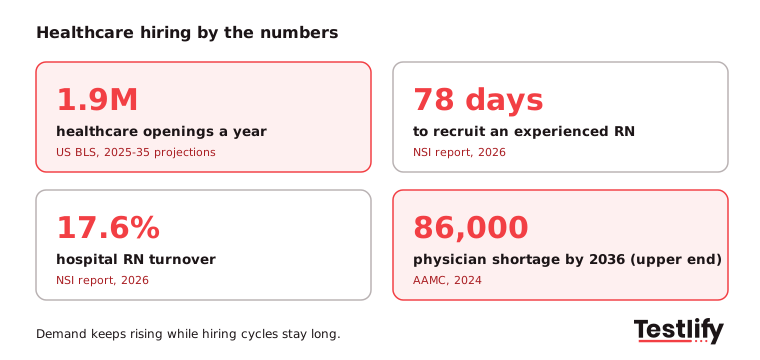
The numbers show the scale:
- Openings: The BLS Occupational Outlook Handbook projects about 1.9 million openings a year in healthcare occupations, growing much faster than the average for all jobs.
- Nurse vacancies: The 2026 NSI National Health Care Retention and RN Staffing Report found an RN vacancy rate of 8.6%, with a third of hospitals (33.1%) at 10% or higher.
- Time to recruit: The same NSI report says it takes 78 days to recruit an experienced RN, more than 2.5 months.
- Turnover: Hospital turnover is 18.5% and RN turnover is 17.6%. NSI puts the cost of losing one bedside RN at $60,090.
- Physicians: The Association of American Medical Colleges (AAMC) projected in March 2024 a shortage of up to 86,000 physicians by 2036.
- Burnout: The American Medical Association reported that 43.2% of physicians had at least one symptom of burnout in 2024. That is down from 53% in 2022, but still high.
Slow processes make the shortage worse. Strong candidates in healthcare often hold several offers, and a hiring process that takes weeks to schedule interviews and verify credentials loses them to a faster employer.
For a deeper look at the hardest roles, read recruiting for high-demand healthcare roles.
What are the steps in the healthcare hiring process?
The healthcare hiring process has eight steps: plan the role, write the job post, source candidates, screen and assess skills, interview, verify credentials and background, make the offer, and onboard. The biggest time savings come from running assessment and verification early and in parallel instead of one after another.
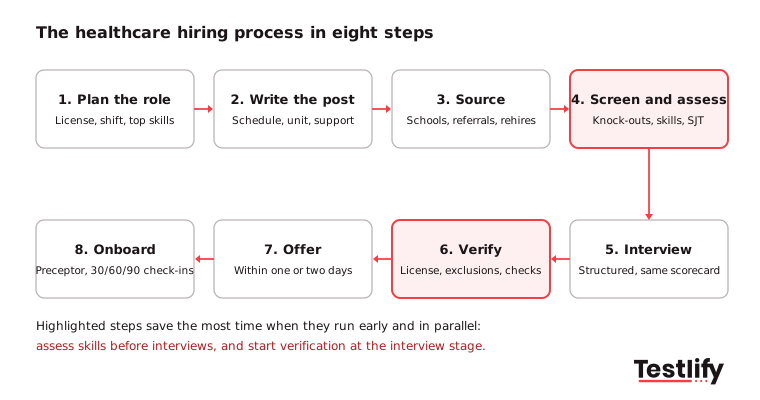
New staff need a preceptor or buddy, a clear orientation plan and check-ins at 30, 60 and 90 days. First-year turnover is where much of the cost sits.
Step 8: Onboard
Offers should go out within a day or two of the final interview. Delays at this step are where many healthcare candidates accept somewhere else.
Step 7: Make the offer
Confirm licenses with the issuing board, check exclusion lists and run the background check. Start this as soon as a candidate reaches the interview stage.
Step 6: Verify credentials and background
A structured interview uses the same questions and scoring guide for every candidate. Include the unit manager and, where possible, a peer.
Step 5: Interview
Start with a short knock-out questionnaire for license and availability. Then add a role-specific skills test and a situational judgment test. This replaces most resume reading.
Step 4: Screen and assess
Mix job boards, school partnerships, referrals, internal moves and former employees. Keep a warm pipeline for roles you hire every month.
Step 3: Source candidates
Lead with what candidates care about: schedule, unit, pay range where the law requires it, support for new staff and growth paths. Keep requirements to true must-haves.
Step 2: Write the job post
Agree on the unit, shift pattern, must-have license or certification, and the three to five skills that separate a good hire from an average one. Use turnover data to predict openings before they happen.
Step 1: Plan the role
Pro tip: Measure the gap between each step, not only total time to fill. Across the teams we work with, most lost days sit between steps (waiting for an interview slot, waiting for a reference) rather than inside them.
What should you assess for each healthcare role?
Healthcare hiring should assess current skills, judgment and communication on top of the license, because a license only proves the person met a minimum standard at some point. Two nurses with the same license can differ a lot in clinical judgment, documentation habits and how they speak to anxious patients.
Role group | Skills to test | Useful test types |
|---|---|---|
Licensed clinical | Clinical knowledge, medication math, prioritization, patient communication | Role knowledge test, situational judgment test, one-way video answer |
Allied and support | Basic care tasks, infection control, safety, reliability, compassion | Role test, scenario questions, short personality or values test |
Administrative and revenue cycle | Medical terminology, coding or billing accuracy, HIPAA basics, typing, customer service | Coding or billing test, HIPAA test, typing test, chat simulation |
Health IT and data | EHR system skills, data analysis, troubleshooting, security awareness | EHR or Epic test, data skills test, practical task |
A situational judgment test is especially useful in healthcare. It puts the candidate in a realistic scene, such as two call lights at once or an upset family member, and asks what they would do.
Their answer shows how they set priorities under pressure, which a resume cannot show.
Soft skills matter as much as clinical knowledge. We have seen hiring teams cut early turnover in patient-facing roles once they scored empathy and communication as seriously as technical knowledge.
For practical methods, read how to assess soft skills in healthcare hiring or try the healthcare compassion test for doctors and nurses.
Key takeaway: Use the license as a gate and the skills test as the ranking. The gate shows who is allowed to do the job, and the test shows who will do it well.
What checks are required before hiring healthcare workers?
Healthcare employers in the US usually need five checks before a new hire starts: license or certification verification, exclusion list screening, a background check, health requirements such as immunizations or a drug screen, and HIPAA training. Exact rules depend on the state, the role and the payer, so confirm the list with your compliance team.
- License and certification verification: Confirm the license directly with the issuing state board (primary source verification), not from a copy the candidate sends. Recheck before every renewal date.
- Exclusion list screening: Check the HHS Office of Inspector General exclusion list and any state Medicaid lists. Providers that bill federal health programs can face penalties for employing an excluded person.
- Background check: Follow the federal rules on consumer reports. The EEOC and FTC guidance on background checks says you need written notice and consent first, specific steps before rejecting someone based on the report, and the same standards for every candidate.
- Health requirements: Immunization records, TB screening and drug testing are common, set by state law and your own policy.
- HIPAA and privacy training: Train new staff on patient privacy during onboarding, before they access patient records.
For the basics of each check, see the background check glossary entry.
Which healthcare recruitment strategies work best?
The healthcare recruitment strategies that work best combine speed, a clear reason to join and a steady pipeline: hire fast, show real schedules and support, grow your own talent, and use referrals and former staff. Pay matters, but candidates also compare workload, flexibility and how new staff are treated.
- Speed up the first response: Reply to applicants within a day and offer self-scheduling for interviews. A fast first touch keeps candidates who are talking to several employers.
- Show the real job: Share the unit, the ratio, the shift pattern and the orientation plan in the post. Realistic job previews cut early quits.
- Offer flexibility: Self-scheduling, shorter shifts and internal float pools attract people who left full-time bedside roles.
- Grow your own: Partner with nursing and allied health schools for clinical placements, and fund certification for CNAs and medical assistants who want to move up. See the guide to internal mobility.
- Use referrals: Current staff know who is good and who would fit. A simple employee referral program with a fast thank-you works better than a large, slow bonus.
- Rehire former staff: Keep in touch with people who left on good terms. Boomerang hires need less training and settle in faster.
- Hire on skills, not only experience: For support and admin roles, a skills test can open the door to career changers who would fail a strict years-of-experience filter.
For more tactics, read 5 tips to succeed in healthcare recruiting.
How can technology speed up healthcare hiring without adding risk?
Technology speeds up healthcare hiring by removing the manual steps between application and interview: online skills tests replace resume reading, one-way video and AI interviews replace phone-screen scheduling, and ATS integrations remove copy-paste. The risk is low when a person still reviews every decision and the tools are checked for fairness.
- Online assessments: Candidates take a role test on their phone or laptop at any time, which suits people working shifts.
- One-way video and AI interviews: Candidates record answers when they are free, and hiring managers review them in minutes. This is often the fastest way to screen for communication.
- Automated workflows: Candidates who pass the bar move to the next step without waiting for a recruiter.
- ATS integration: Scores and reports sync back, so the hiring manager sees everything in one place.
Use automation with care. Some places regulate AI hiring tools: in New York City, Local Law 144 requires a yearly bias audit and candidate notice before an automated employment decision tool is used.
Keep a human in the loop for every reject decision.
Which metrics show your healthcare hiring is working?
The metrics that show healthcare hiring is working are time to fill, offer acceptance rate, first-year turnover, quality of hire and cost of vacancy, tracked separately for each role group. A blended number hides problems, since nurse hiring and front-desk hiring behave very differently.
Metric | What it tells you | Benchmark to compare against |
|---|---|---|
Time to fill | How long a role stays open | 78 days for an experienced RN (NSI 2026) |
RN vacancy rate | Share of RN positions that are open | 8.6% national average (NSI 2026) |
Offer acceptance rate | Whether your offer and speed compete | Your own trend by role and unit |
First-year turnover | Whether you hired the right people and onboarded them well | Hospital RN turnover is 17.6% (NSI 2026) |
Quality of hire | Performance and retention of new hires at 6 and 12 months | Manager rating plus retention, by source |
Cost of turnover | What each departure costs | $60,090 per bedside RN (NSI 2026) |
NSI also estimates that each one-point change in RN turnover costs or saves the average hospital about $295,000 a year. That figure is often the clearest way to get budget for better screening and onboarding.
Learn how to calculate turnover rate the same way every quarter.
How does Testlify support healthcare hiring?
Testlify supports healthcare hiring with ready-made skills tests for clinical and non-clinical roles, plus interviews and automated scoring, so hiring teams rank candidates on evidence before the first interview. Teams pick from 3,500+ tests, including role tests for registered nurses, certified nursing assistants and medical coding, plus HIPAA, Epic and healthcare compassion tests.
- Situational judgment and cognitive tests: Check judgment and problem solving alongside role knowledge.
- One-way video and AI interviews: Screen communication without scheduling calls.
- Multilingual testing: Run assessments in 15+ languages for diverse candidate pools.
- 20+ proctoring checks: Keep remote test results honest.
- 100+ ATS and HRIS integrations: Sync scores back to the system your team already uses.
CHG Healthcare used Testlify to standardize skills-based hiring for its staffing roles; read the CHG Healthcare story. To see the tests for your roles, visit the healthcare hiring page or start a 7-day free trial, no credit card needed.
Book a demo with the Testlify team to see skills tests, video and AI interviews, and automated scoring for your healthcare roles. Bring your hardest-to-fill role and we will show you how to assess it.
Frequently asked questions (FAQs)

People and Talent Partner
Arushi Shah runs day-to-day talent acquisition and candidate experience at Testlify. She writes on interviewing, structured hiring, and giving candidates a fair, fast process.
LinkedInRelated resources
View all
Talent Acquisition
Full cycle recruiting: what it is, the 6 stages and how to run it

Talent Acquisition
What is a hiring manager? Role and duties explained

Talent Acquisition
Contingent workforce management: a guide for hiring teams

Talent Acquisition
Public sector recruitment: a practical guide for hiring teams

Talent Acquisition
Hiring military veterans: a practical guide for employers in 2026

Talent Acquisition
Should job ads still list the years of experience qualified candidates need?
Get started.
Hire on proof, not resumes.
Run your first skills-based assessment free — no credit card required.