
AI hiring disclosure: what employers must tell candidates
What AI hiring disclosure means, which states require it, what the notice must say, and a sample policy for employers.

A candidate applies on Monday and is rejected by Monday night. No recruiter read the resume, and nobody told the candidate that software made the call. Several US states now treat that silence as a compliance problem.
AI hiring disclosure is the notice an employer gives candidates when an AI tool screens, scores or helps decide on their application. Illinois, New York City, Colorado and Connecticut already require some form of it.
This guide shows which rules apply to you, what your notice must say and how to write one. You will finish with a simple policy that covers every state you hire in.
TL;DR:
- AI hiring disclosure means telling candidates in writing when AI helps screen, score or decide on their application.
- Illinois amended its Human Rights Act, effective January 1, 2026, to require notice whenever AI is used to influence an employment decision.
- New York City's Local Law 144 requires at least 10 business days' notice before using an automated employment decision tool, plus a published bias audit.
- Colorado and Connecticut both require plain-language notice when AI influences a hiring, firing or promotion decision.
- No single federal AI hiring disclosure law exists yet, so the notice you owe a candidate depends on where they are applying from.
- Write one disclosure policy that meets the strictest state you hire in, then apply it everywhere, rather than tracking a different notice per state.
 ChatGPT
 Gemini
 Claude
 Grok
 Perplexity
What is AI hiring disclosure?
AI hiring disclosure is the practice of telling a candidate or employee, in writing, that an AI system is involved in screening, scoring or deciding on their job application, along with what the system measures and how they can ask for a human review. It covers resume screening tools, automated interview scoring, and any system that ranks or filters candidates before a person sees them.
Disclosure differs from consent. Most of the current state and city rules require notice, not candidate approval; a candidate cannot usually opt out of the process itself, but most rules give them a way to request an alternative process or a human review of the decision.

Which states and cities require AI hiring disclosure?
Illinois, New York City, Colorado and Connecticut each require some form of AI hiring disclosure as of 2026, though the wording and timing of the notice differs by jurisdiction. Check the current rule text before relying on a secondary summary, since several of these rules were still finalizing their implementing regulations in 2026.
Jurisdiction | What triggers disclosure | What the notice covers |
|---|---|---|
Illinois | AI used to influence or help make an employment decision | Annual notice to employees, plus notice when a new or updated AI system is adopted |
New York City | An automated employment decision tool screens candidates | At least 10 business days' notice, the qualifications assessed, and a published bias audit |
Colorado | AI influences hiring, firing or promotion decisions | Plain notice that AI is used in the decision |
Connecticut | Automated employment decision tools | Clear, plain-language notice plus a written description of the process |
According to SHRM's coverage of state AI hiring laws, more states are expected to introduce similar notice bills. A policy built only for today's four jurisdictions is likely to need updating soon.
What must an AI hiring disclosure notice say?
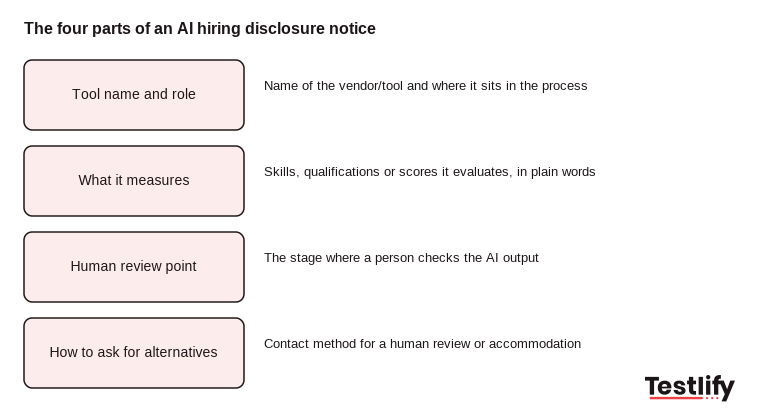
An AI hiring disclosure notice should say that AI is used in the process, name the tool or vendor, and describe in plain language what it measures or scores. It should also explain how a candidate can ask for an alternative process or a human review.
New York City's Local Law 144 is the most specific example on record. It requires notice at least 10 business days before the tool is used, plus a public link to the bias audit results, and the NYC automated employment decision tool page lays out the exact requirements.
Pro tip: Put the disclosure language in the job posting itself, not only in a separate email after someone applies. A posting-level notice reaches every candidate, including the ones an AI tool screens out before a recruiter ever sees them.
How do you write an AI hiring disclosure notice?
You write an AI hiring disclosure notice by naming the tool, stating what it measures, saying where in the process it is used, and giving candidates a plain way to ask for a human review or an accommodation. Keep the language short enough that an applicant reads the whole thing in under a minute.
Five short steps cover everything a candidate needs to know. Work through them in order, and the finished notice will be clear, specific and easy to keep up to date.
- Name the tool and its role: "We use [tool name] to screen resumes against the qualifications listed in this posting."
- State what it measures: List the skills, qualifications or scores the tool evaluates, in plain words, not technical jargon.
- Say when a human is involved: Note the stage where a person reviews the AI's output before any reject decision is final.
- Give a way to ask for alternatives: Provide an email or form for candidates who want a human review or an accommodation.
- Date and version the notice: Keep a record of which notice version was live when each candidate applied, since rules and tools both change.
What happens if an employer skips AI hiring disclosure?
An employer that skips required AI hiring disclosure risks a civil rights violation claim, a complaint to the state's human rights agency, or a fine, depending on the jurisdiction. Illinois treats a missing AI notice as a potential civil rights violation under its Human Rights Act.
NYC's Local Law 144 carries its own penalty structure for employers that skip the notice or the published audit. Treat disclosure as a compliance requirement with a paper trail, separate from the anti-discrimination rules the EEOC already enforces at the federal level.
How does Testlify support AI hiring disclosure?
Testlify supports AI hiring disclosure by keeping a human reviewer in the loop on every automated shortlist or reject decision. It also publishes a third-party NYC Local Law 144 bias audit of its matching model.
Recruiters also get an explainable, per-skill score they can hand to a candidate who asks for a review. That combination gives an employer the evidence a disclosure notice promises: what the tool measures, and how a candidate can ask for a second look.
A team building its own disclosure notice can point candidates to the NYC bias audit results and to the trust and security page for the data-handling detail most notices need to cover.
Key takeaway: A disclosure notice is only as good as the evidence behind it. Write the notice after you know what your AI vendor can actually show a candidate, not before.
Ready to put a disclosure-ready AI tool to work?
Book a demo to see how Testlify's bias audit and explainable scoring support your own AI hiring disclosure notice or start a 7-day free trial, no credit card needed.
Frequently asked questions (FAQs)

People and Talent Partner
Arushi Shah runs day-to-day talent acquisition and candidate experience at Testlify. She writes on interviewing, structured hiring, and giving candidates a fair, fast process.
LinkedInRelated resources
View all
AI in recruitment
Automated candidate screening at scale: a practical playbook

AI in recruitment
Responsible AI in hiring: the decisions your team still owns
AI in recruitment
Role simulations in hiring: how to design, run and score them

AI in recruitment
What tools offer AI-generated questions for custom assessments?

AI in recruitment
How does Testlify’s AI scoring handle open-ended answers and code quality?

AI in recruitment
How to use AI in recruiting using Testlify
Get started.
Hire on proof, not resumes.
Run your first skills-based assessment free — no credit card required.