
Employee poaching: Is it illegal, and how to prevent it
Employee poaching, or employee raiding, is enticing an employee to leave their job for another. Learn about its legality & prevention.

Employee poaching is the practice of recruiting a worker away from another company, usually a direct competitor, to win their skills, experience, and relationships. In the United States, it is legal.
What is not legal is two companies agreeing not to hire each other’s staff, or pushing someone to break a signed non-compete or walk out with trade secrets.
That gap, between a legal hiring tactic and an illegal agreement, is where most teams get confused. In 2024, the Federal Trade Commission tried to ban most non-competes for about 30 million U.S. workers, a court struck the rule down, and the agency walked it back in 2025.
So the rules you half-remember may already be out of date. This guide covers what poaching is, what the law actually allows in 2026, why companies do it, and the retention moves that keep your best people from picking up a recruiter’s call.
 ChatGPT
 Gemini
 Claude
 Grok
Grok Perplexity
TL;DR
- Poaching talent from a competitor is legal in the US. The illegal parts are no-poach pacts between employers, breaching a valid non-compete, and taking trade secrets.
- No-poach and wage-fixing agreements are criminal antitrust violations. Corporate fines run up to 100 million dollars, and individuals can face up to 1 million dollars and 10 years.
- Non-compete enforceability changed: the FTC’s 2024 ban was struck down, so state law decides, and it varies a lot.
- Poaching works because the best candidates are passive. About 3 million Americans quit voluntarily every month, and 77 percent of employers say skilled talent is hard to find.
- The durable defense is retention, not lawsuits: replacing a manager can cost up to twice their salary, so closing pay and growth gaps pays for itself.

What is employee poaching?
Employee poaching, also called talent poaching or employee raiding, is when an employer recruits a worker directly from a competitor or former employer to bring their skills in-house. These people usually are not job hunting. They are passive candidates, happy enough to stay, until a better offer changes the math.
It is most common where specific, hard-to-replace skills are in short supply: software engineering, data, sales, and senior leadership. The appeal is obvious. A poached hire already knows the industry, the tools, and often the customers, so they ramp faster than someone you train from scratch and help close a skills gap quickly.
Poaching sits close to two tactics people mix it up with. Headhunting targets a named individual for a specific role, whether or not they work for a rival. Lateral hiring brings in someone at a similar level from anywhere. Poaching is the narrower case: going after a competitor’s people on purpose.
Is employee poaching illegal?
No. Hiring talent away from a competitor is legal across the US. There is no law against approaching someone who works elsewhere and offering them a better job. The legal risk lives in the details: what the employee signed, what they bring with them, and whether two companies quietly agreed not to compete for staff.
With that said, here are the five things that turn a legal hire into a legal problem, giving companies a reasue to sue for poaching.
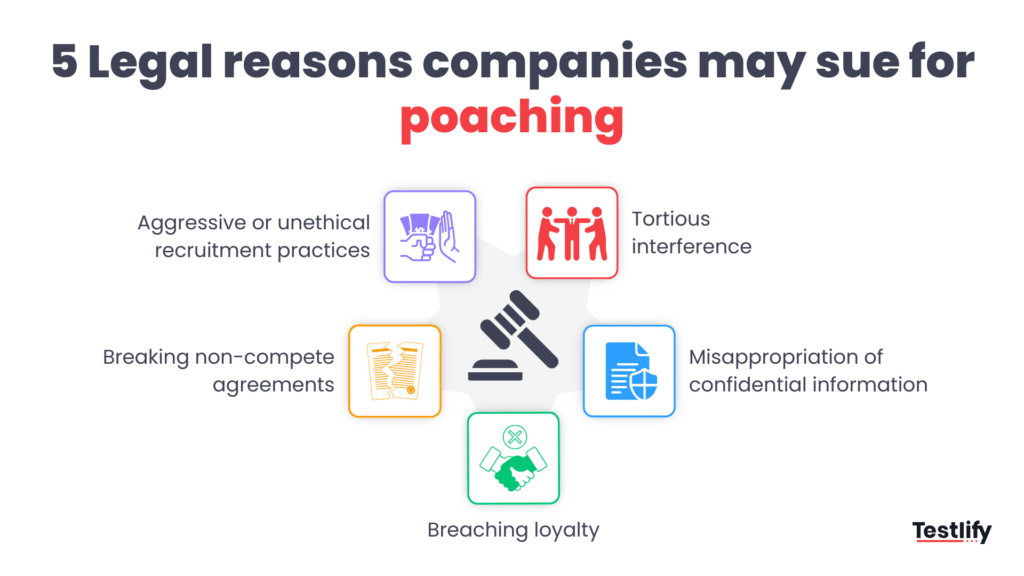
Unethical recruitment practices
Companies can face legal action if they use deceptive or unethical tactics such as encouraging candidates to break employment contracts, making false claims about a competitor, or pressuring employees to share confidential information during the hiring process.
Recruit ethically by focusing on the candidate’s skills and career goals rather than undermining their current employer.
No-poach agreements between employers
When competing companies agree not to recruit each other’s workers, that is a per se criminal violation of antitrust law, not a gray area. Under the Sherman Act, corporate fines reach up to 100 million dollars, and individuals can face up to 1 million dollars and 10 years in prison.
Federal enforcers have treated naked no-poach and wage-fixing deals as criminal since their guidance for HR on antitrust made the position explicit. They won a first jury conviction in a wage-fixing case in 2025.
Breaking non-compete agreements
A non-compete agreement bars an ex-employee from joining a rival for a set time. Enforceability is in flux.
The FTC’s 2024 rule to void most non-competes for roughly 30 million workers, about 1 in 5 of the workforce, was struck down by a federal court and formally abandoned in 2025. So state law governs again, and it ranges from California (rarely enforceable) to states that uphold a reasonable, narrow clause.
Trade secrets
Recruiting a person is fine. Recruiting them for the confidential data in their head, client lists, pricing, source code, is not. If a new hire shows up with a competitor’s proprietary information, the old employer can sue for misappropriation, and the hire and your company are both exposed.
Screen new hires for any documents or files carried over from a previous employer before they touch a live project.
Tortious interference
If you knowingly induce someone to break a valid non-compete or non-solicitation contract, the original employer can sue you for interfering with that contract, even though the hire itself was legal. This claim does not require proving you personally breached the contract, only that you knew about it and encouraged the breach anyway.
Why do companies poach employees?
Because skilled people are scarce and slow to grow. About 77 percent of employers report trouble finding the talent they need, near a record high, per the research on talent scarcity. When you cannot find a qualified candidate on the open market, the fastest route is to hire one who is already doing the job somewhere else.
The labor market keeps that door open. About 3 million US workers quit voluntarily every month, a quit rate near 2 percent, according to the Bureau of Labor Statistics job turnover data. People move. A well-timed offer to someone already weighing their options is not a hard sell, it is good timing.
The honest tradeoff: a poached hire costs more up front and can arrive with baggage, a non-compete, a counteroffer war, a bruised relationship with the company you took them from. The math works when the role is genuinely hard to fill and the person is genuinely proven. It backfires when you are paying a premium for a logo on a resume.
How does employee poaching work?
Done well, poaching is patient relationship-building, not a cold pitch. Here is the sequence most recruiters follow.
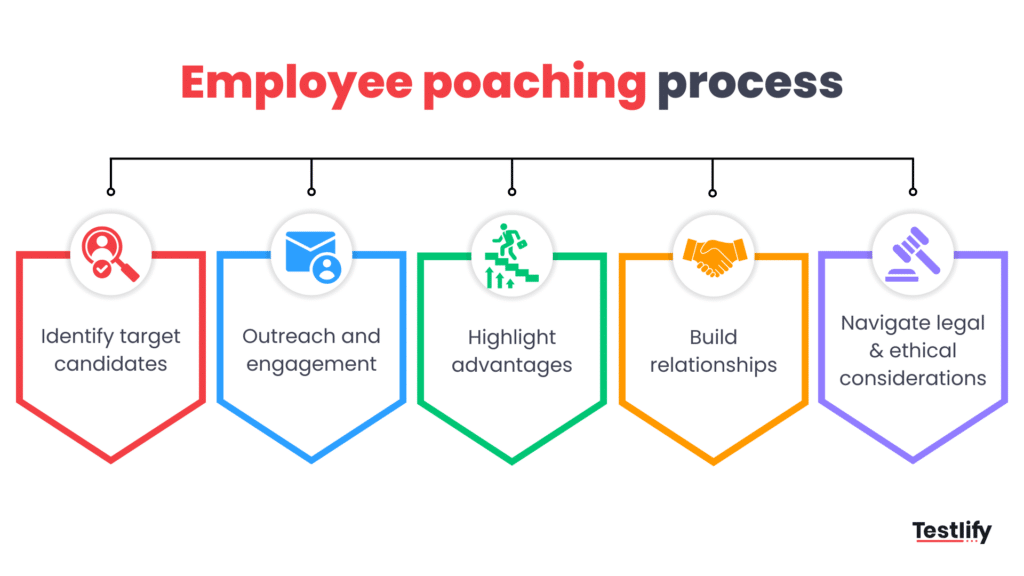
Identify the right people to approach
Map competitors and shortlist individuals whose skills match a real gap on your team. A small list of well-matched candidates will outperform a large list of loosely qualified prospects.
Reach out with a personal message
Generic LinkedIn messages rarely get a response. Reference a project they led, a problem they solved, or an achievement that caught your attention. Then explain why their experience makes them a strong fit for the role.
Lead with what they cannot get today
Compensation is important, but it is rarely the only reason passive candidates change jobs. Greater ownership, faster career growth, meaningful work, flexibility, or a stronger culture often have a bigger impact.
Before discussing salary, ask what they feel is missing in their current role. Their answer will tell you what to emphasize.
Build the relationship before the offer
Take time to understand the candidate’s career goals, motivations, and concerns. The strongest offers are tailored to those priorities and address potential objections before they become deal breakers.
Clear the legal checks first
Verify that there are no enforceable non-compete or non-solicitation clauses that could affect the move in your jurisdiction. Make it clear that you expect candidates to leave behind any confidential information or proprietary data from their current employer. This protects both your business and the candidate.
Which agreements actually limit poaching?
Three contract types get cited as poaching defenses, and they are not interchangeable. One of them is criminal. Here is how they compare.
Agreement | What it restricts | Who it binds | Legal status (US, 2026) |
|---|---|---|---|
Non-compete | Joining or starting a competing business for a set period | Employer and employee | Legal but state-dependent; federal ban struck down in 2024 to 2025 |
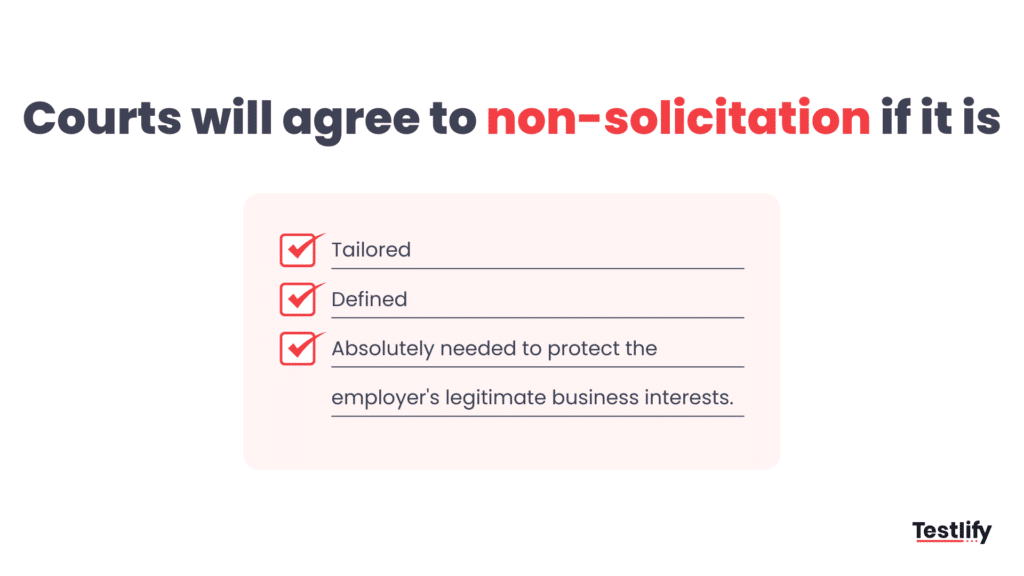
Non-solicitation | Taking clients or recruiting former colleagues away | Employer and employee | Generally legal if reasonable in scope and time |
No-poach | Two companies agreeing not to hire each other’s staff | Employer and employer | Per se criminal antitrust violation |
The takeaway is simple. Contracts between you and your own employee (non-compete, non-solicitation) can be valid when they are narrow and reasonable. A contract between you and a competitor about workers is illegal, full stop. Many companies that reach for a no-poach handshake actually want a non-solicitation clause, which is the lawful tool.
How do you prevent employee poaching?
You cannot wall your people in, and trying to is the fastest way to lose them. Prevention is retention. The goal is to make the recruiter’s call easy to decline, not to make leaving legally painful.
Start with the math. Replacing an employee costs between one-half and two times their annual salary once you count hiring, lost output, and ramp time, and for managers it runs near 200 percent, according to workplace research on turnover cost. Against that number, a raise or a growth path for a top performer is cheap insurance.
Use a no-poaching agreement
A lawful no-poaching agreement lives between you and your own employee, not between you and a competitor. Two employers agreeing not to hire each other’s staff is the criminal violation covered earlier in this guide, so use a narrow, reasonable non-compete or non-solicitation clause on senior and client-facing roles instead, where your state actually enforces one.
Measure employee engagement
Run a regular employee engagement survey and track a single trend line, such as an eNPS score, instead of one-off pulse checks that go nowhere. A dropping score on your most poachable teams is an early warning that shows up months before an actual resignation, and it gives you time to act.
Form an incentive plan
Build an incentive plan tied to tenure and performance, such as retention bonuses, equity that vests over time, or spot bonuses for hitting a hard project milestone. A plan your top performers can see and calculate themselves beats a vague promise of a raise someday.
Develop a strong company culture
A healthy workplace culture is the part a rival cannot copy from the outside, no matter how big their offer is. Invest in manager quality, recognition, and how decisions get made day to day, since that is what a recruiter’s pitch has nothing to compete against.
Offer above-market compensation
If a competitor’s offer is 25 percent higher, no culture deck fixes that, so review pay for your most poachable roles before someone else does. Paying at or above market on your hardest-to-fill roles is cheap compared with the cost of losing and replacing the person in that seat.
Foster career development
People leave when the next step is invisible, so make progression, new scope, and learning budgets visible and specific, not implied. Ambitious staff who can see where they are headed inside your company stop taking the recruiter’s call.
Pro Tip: Watch your competitors’ layoffs and funding news, not just your own attrition. The cleanest poaching happens when a rival stumbles. The cleanest defense happens when you spot a flight-risk top performer first and have the retention conversation before the offer lands, not after they resign.
What should you do when employees get poached?
Some loss is unavoidable, and treating it as a crisis makes it worse. Handle the exit well, and you protect the team that stays, plus the chance the leaver comes back.
Plan for succession early
Employee departures are inevitable. What matters is how prepared your team is when they happen. Cross-train employees to head important roles, document key processes, and develop internal successors so one resignation does not disrupt business continuity.
Offboard with grace
Treat departing employees with respect and professionalism. A positive offboarding experience protects your employer brand and increases the likelihood of boomerang hires who return with new skills and require minimal onboarding.
Run a real exit interview
Ask what would have kept them in a real exit interview. Patterns across exits tell you exactly which retention gap to close next.
Recruit beyond your rivals
The best hires do not always come from rival companies. Candidates from adjacent industries often bring transferable skills, fresh perspectives, and fewer legal complications. Widening your search also reduces reliance on a limited talent pool and strengthens long-term hiring resilience.
Watch for moonlighting only where it signals a deeper disengagement problem.
Should you poach talent?
Sometimes, with eyes open. Poaching is a sharp tool for a specific job: a genuinely scarce, high-impact role where a proven competitor’s hire pays back the premium quickly. For the rest of your hiring, it is expensive and risky compared with building a pipeline you can assess on merit.
On ethics, the line is conduct, not the act itself. Approaching a willing professional with a fair, honest offer is ordinary competition. Misleading them, pressuring them to break a contract, or strip-mining one partner’s team after a goodwill agreement, that is where reputations get damaged and trust between companies breaks. Poach when it is the right call, do it cleanly, and do not build your whole talent strategy on it.
Hire on proof
The best defense against employee poaching is building a workforce people want to join and stay with, while hiring based on proven ability rather than employer brand.
Testlify’s library of role-based skills assessments, cognitive and personality tests, and coding tests lets you find proven talent anywhere and benchmark the team you already have. Book a demo to see it on your roles.
Book a demo to see it on your roles.
Key takeaways
- Poaching is legal; the agreements around it are where the risk sits. Hiring from a competitor is fine, so spend your legal attention on contracts and trade secrets, not on the hire itself.
- No-poach deals are criminal, not just risky. Agreeing with a competitor not to hire each other’s staff can mean fines up to 100 million dollars for a company. If you want protection, use a lawful non-solicitation clause instead.
- The non-compete ground moved, so check current state law. The 2024 federal ban was struck down by 2025, which means enforceability now depends entirely on your state, and advice from two years ago may be wrong.
- Retention is cheaper than replacement. Losing a manager can cost up to twice their salary, so a timely raise or growth path for a top performer is the highest-return move you can make.
- Exit interviews are free intelligence. The reasons people leave are the exact gaps the next recruiter will exploit, so close them in order of frequency.
- Evidence widens the pool past your rivals. When you can measure skill directly, you stop needing a competitor’s brand as a quality signal and can hire strong people from anywhere.
Frequently asked questions (FAQs)

Related resources
View all
HR & recruitment
7 HR statutory compliance rules you must know

HR & recruitment
Employee Vetting: Steps, Checks, and Best Practices for 2026

HR & recruitment
Transferable Skills: Definition, Meaning & Examples

HR & recruitment
What is a returnship: Benefits and best practices

HR & recruitment
Graduate recruiting: Definition, process, and proven strategies

HR & recruitment
What is balanced scorecard (BSC)? A guide for 2026
Get started.
Hire on proof, not resumes.
Run your first skills-based assessment free — no credit card required.