
Headhunting in recruitment: Your ultimate 2026 guide
Master headhunting in recruitment with our ultimate 2025 guide! Discover strategies to find and attract top talent for your organization effectively.

Headhunting in recruitment is a focused strategy for hiring candidates for senior-level and executive positions. It is also called “executive search”. A SHRM study revealed that filling a position can take up to 42 days. Imagine how critical the timeline becomes when filling executive roles. Companies risk missing out on growth opportunities if it takes that long.
This is why headhunting in recruitment is crucial. Let’s learn everything about it in this blog.
 ChatGPT
 Gemini
 Claude
 Grok
Grok Perplexity
What is headhunting?
Headhunting is a recruitment process in which specialized recruiters, often called headhunters, search for and approach potential candidates for a job opening. Unlike traditional approaches involving advertisements and waiting for applicants, headhunters directly seek out tap talents, often passive candidates. These ‘passive candidates’ enable organizations to draw from a broader talent pool, ensuring they find the most qualified individuals for the position.
Headhunting in recruitment is commonly used to target high-level employees for roles that require niche skills or significant experience.

What is the difference between headhunting and recruiting?
Headhunting and recruitment are both different strategies with the same objectives.
Headhunting process is a proactive approach in which recruiters actively search for and contact specific candidates, often those who are passively looking for job opportunities. This process bypasses the traditional job application by seeking candidates who match the job description.
Headhunting is more expensive than the standard recruitment process, as headhunters have to take extra measures to target passive candidates, which might not be achieved through the normal recruitment process.
Headhunting fills highly competitive roles like senior, executive searches, or specialized roles. Recruitment identifies top candidates by engaging with individuals who are actively seeking new opportunities. Most candidates typically apply through job advertisements, which may be crafted internally or by external recruitment firms. This reactive approach is well-suited for roles that are easier to fill and can attract many applicants.
Recruitment is a more straightforward process of responding to applicants who have applied for a particular job posting.
Also read: What is employee poaching? Is it illegal and how to prevent
Types of headhunting in recruitment
There are three different types of headhunting in recruitment.
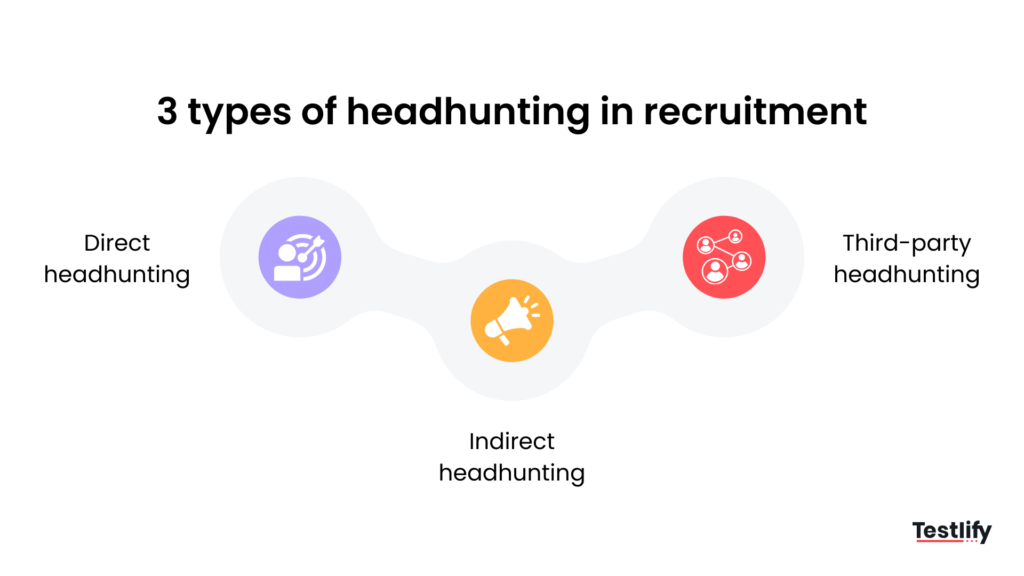
- Direct headhunting
This involves communicating with the ideal candidate one-on-one via call or in person.
- Indirect
This involves sending a message or email to prospective candidates, expressing the company’s interest in hiring them and providing relevant contact information. The candidates can then reach out if they are interested in the role.
- Third-party
This approach entails partnering with specialized recruitment firms seeking top talent for specific job titles. HR managers only contact candidates the agency has vetted and shortlisted. Many companies choose to work with third-party agencies for executive-level positions.
For instance, if you’re looking for a CFO, you would collaborate with executive recruitment agencies that focus on identifying the best candidates for that role.
Benefits of headhunting over traditional recruitment
There are numerous benefits for headhunting in recruitment, some of which include.
- Highly skilled talent access
Headhunting in recruitment involves contacting individuals who excel in their jobs. Recruiters gain access to a diverse range of high-caliber professionals. These individuals may not be actively seeking new roles; however, they possess excellent track records. This approach allows recruiters to reach top candidates who may not be visible through traditional methods.
- Targeted approach
Unlike traditional recruitment methods, headhunting solely focuses on individuals with power skills and expertise. This tailored approach enables headhunters to evaluate candidates based on their work culture, leading to a 360 recruitment angle.
- Confidentiality
Since headhunting often involves hiring for senior-level or sensitive positions, headhunters are discrete throughout the hiring process. This confidential approach shields the candidate’s current position and the company’s strategies.
- Niche expertise and time-saving
Headhunting in recruitment saves time when hiring, as the process is streamlined. Opting for candidates already experts in their field ensures a quicker integration into the team.
Challenges of headhunting in recruitment
- High-cost
Headhunting in recruitment is costlier than other recruiting methods. This is because headhunters are mostly from third-party agencies or outsourced, contributing to higher hiring costs.
- Restricted control
Outsourcing the recruitment process to external headhunters might restrict your control over the hiring process. Companies often lack influence over particular recruitment methods and the time period each process takes place. This reduces your control and challenges your recruitment strategy.
- Risk of mismatch
External headhunters might not completely understand the hiring organization’s culture. This can lead to candidates who do not fit the company’s values well.
How does headhunting work?
Headhunters work by following the below-streamlined processes.
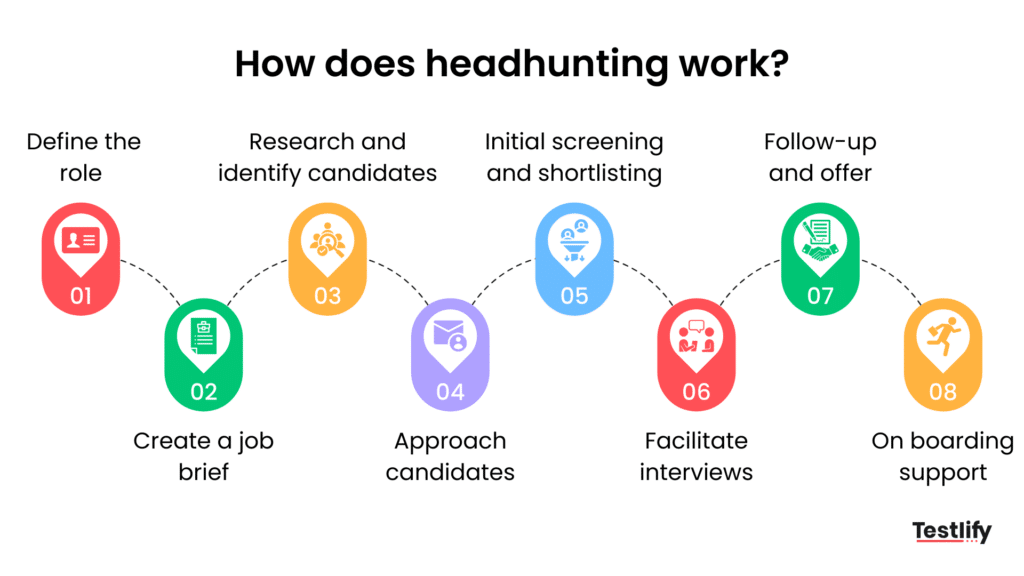
- Define the role
A company identifies the need for a new Chief Technology Officer (CTO) and defines the specific skills, experience, and qualifications required for the role. The whole process of headhunting is conducted with great discretion and confidentiality.
- Create a job brief
The headhunter collaborates with the company to develop a detailed job brief that outlines the responsibilities, desired background, and ideal candidate profile. This step also includes compiling a list of skills, expertise, background, etc, that candidates must possess to excel in the position.
- Research and identify candidates
The headhunter researches the industry to identify potential candidates currently in similar roles at other companies. They may compile a list using professional networks, LinkedIn, and industry contacts. Headhunters often use numerous talent-sourcing strategies to reach out to ideal candidates, intending to convince them to switch companies.
Headhunting in recruitment doesn’t restrict itself solely to passive candidates; it also considers active job seekers. An active method of recruitment is when candidates submit their resumes to apply for an advertised open position. After shortlisting and resume screening, headhunters compile a final list of potential candidates, including active and passive ones.
- Approach candidates
The headhunter contacts the identified candidates directly, often using personalized messages to engage them. They communicate the opportunity and the company’s interest in their expertise. Headhunters can use either of three methods (direct, indirect, and third-party) to communicate with candidates.
- Initial screening and shortlisting
Interested candidates are then screened through conversations or interviews to assess their qualifications, fit, and interest in open roles.
The headhunter presents the hiring manager with a shortlist of qualified candidates, providing insights about each candidate’s background and suitability for the role.
- Facilitate interviews
The headhunter coordinates interviews between the shortlisted candidates and the hiring team, ensuring a smooth process. Since hiring high-quality candidates is crucial, headhunting in recruitment is carried out with great care.
Sometimes, the entire process is repeated if the candidates are not fit enough for the position. To avoid such scenarios, recruiters and headhunters can assess and evaluate skills and competencies through pre-employment assessments.
- Follow-up and offer
After the interviews, the headhunter gathers feedback, assists with negotiations, and extends an offer to the selected candidate. This marks the final stage of the recruitment process. Candidates are briefed about the compensation, benefits, bonuses, if any.
This stage might extend for a few rounds of negotiations as well since senior-level candidates might have quite high expectations for a job switch.
Headhunters are usually not involved in negotiating as it is the company’s responsibility.
Ensure you listen patiently and communicate properly with the candidates to avoid disagreements or issues.
- Onboarding support
Once the candidate accepts the offer, recruiters may help with onboarding to facilitate a smooth transition into the company.
Final takeaway on headhunting in recruitment
Whether your company should engage in headhunting depends on several factors. If you struggle to find ideal candidates for senior positions as a recruiter, the answer is yes. However, you must remember that it is quite costly and may not be ideal for small businesses with restricted budgets.
That being said, headhunting in recruitment offers numerous advantages, such as a targeted hiring approach, reduced time to hire, and high-quality candidates. The best method to ensure you’re hiring the right candidates is to conduct pre-employment assessments, which provide a 360-degree insight into the candidates.
Frequently asked questions (FAQs)

Related resources
View all
HR & recruitment
Best Recruitment Methods in 2026: 12 Strategies That Fill Roles Faster

HR & recruitment
Hard skills vs Soft skills: Which one should you prioritize while hiring?

HR & recruitment
Job Description vs Job Specification: Key Differences (2026)

HR & recruitment
How to create a game-changing talent strategy?

HR & recruitment
Integrating AI into leadership development for a stronger talent pipeline

HR & recruitment
10 Proven strategies to attract top talent in 2026
Get started.
Hire on proof, not resumes.
Run your first skills-based assessment free — no credit card required.